I saw this list over at DirtSimple.org and had to make a pic for it.
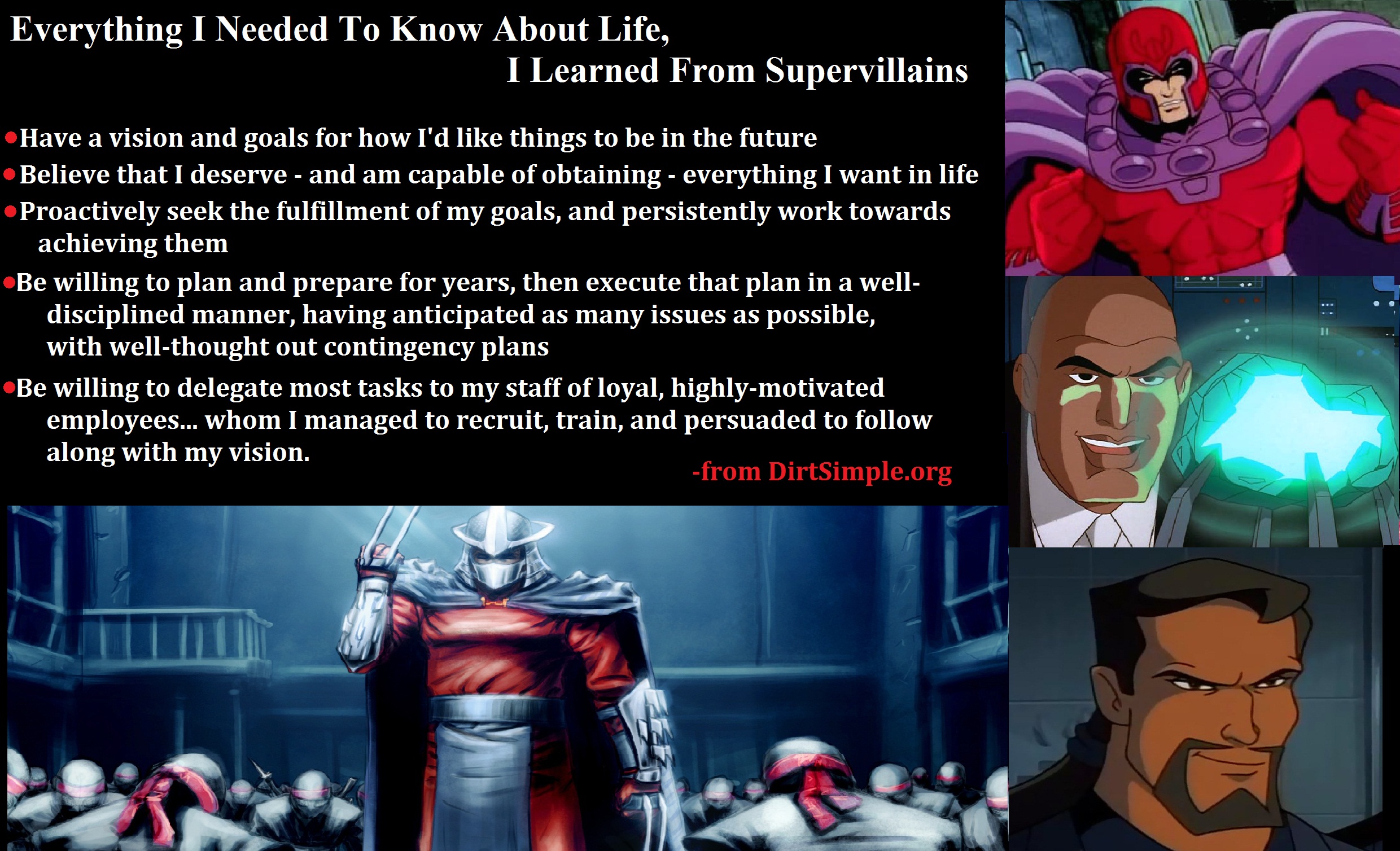
I saw this list over at DirtSimple.org and had to make a pic for it.
 This happened a few months ago, but I’m just now getting around to complaining about it. You’ll notice my Wonka’s Downfall video now has advertising on it. Not by any choice of mine! Mainly because it would be illegal, to be honest. But whatever, I made a thing and I’d rather have people see it than get money from it, it was not a profit-making project. A few weeks later I got a message from YouTube that Warner Brothers had filed some sort of claim to it, since they own the rights to Willy Wonka and the Chocolate Factory, and there was now advertising running on it and they would get the profits (joke’s on them, only 100 views! :P ).
This is intensely irritating to me. The visual part of this is just as important as the audio (probably moreso), but do any of the production companies responsible for Downfall get any share of the profits? I strongly suspect they do not. And why is that? Probably because none of them have the power to make legal threats like Time Warner does. But, I guess, that’s nothing new. >< Just needed to vent a bit.
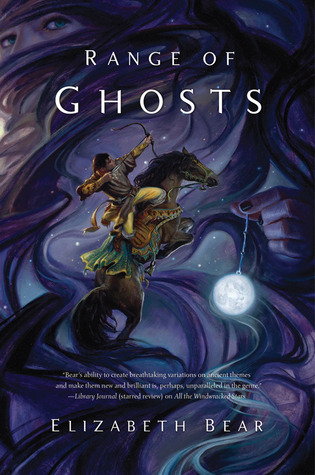 Range of Ghosts, by Elizabeth Bear
Brief Synopsis: A prince, having survived being on the losing side in a civil war, tries to avoid assassination. An unrelated princess joins an order of wizards to avoid assassination by her power-consolidating brother. They meet up, and are embroiled in a plan by an evil sorcerer to foment chaos and war in their lands so he can conqueror them easily after they’re exhausted.
Book Review: Not a bad book. It has some stunning imagery, really very well-worked scenes. And Elizabeth Bear is quite creative, introducing many fantastic concepts that are a pleasure to immerse yourself in. A cosmology that changes based on the beliefs of the peoples ruling an area? How cool is that? About 10,000 times cooler when it’s revealed that a city being conquered will change what happens in the sky above it, and people travelling to it can tell it’s changed hands by that! Unfortunately the writing is rather haphazard. We seem to dash from one plot point to another without much reason for going there, aside from “Well, this is where the next plot event happens”. There are a few plot holes which may be patched over in subsequent books (this is the first in a series), but they still irritate the mind. Worst for me – I just couldn’t relate to the characters. Their motivations seemed imposed on them by authorial fiat, rather than natural desires. So not a great book, but I can’t tell anyone to avoid it, because it really isn’t bad either. It’s right about the middle. However if I was asked to recommend a good fantasy novel written recently, this wouldn’t come to mind so… Not Recommended.
Book Club Review: That being said, this teetering on the edge of good actually makes for interesting discussion, because different people like and dislike different things about it. There were several people in our book club who thought this was a strong book most of the way through, and the disagreements between what was believable and what was strained made for some good talking. This branched into discussion over what makes believable characters, and what can be overlooked for the sake of moving a story forward. It isn’t emotional disagreement about politics or the meaning of life, but it is grist for the mill. I find myself in the position of saying that while I wouldn’t read this book on my own, it makes for a pretty good group-discussion book. Recommended.
 Like many people, I’ve long had problems falling asleep. Sleep has always felt like such a terrible waste of time, a third of my life lost. Imagine what I could have done living an extra ten years of life up to this point! But curtailing sleep was an unmitigated disaster, the loss of performance and quality of life was so bad that I might as well not have bothered at all. For those extra 2-3 hours I lost an entire day. So when I did go to bed, I wanted to lay down and get on with it.
That was always a ludicrous aspiration. Simply lying down does not shut off one’s mind. Now that I didn’t have other things to distract me, my brain could start going over every little thing that happened to me that day. Analyzing it, dissecting it, suggesting alternatives (too late) and estimating how it affected other’s opinions of me. And I would start contemplating what I would do the next day, sometimes elaborate plans. Or I’d start forming opinions of things I’d watched or read or witnessed. Then I’d realize what I was doing and get annoyed at myself for not falling asleep. And on and on like this for hours. The only way to avoid this was to first get so exhausted I’d just collapse into sleep when I went to bed, which required staying up way too late and suffering the next day. During my alcoholic phase I discovered that drinking a lot would also work, but that’s hardly an ideal solution.
This had been a blight upon my life since at least my early teens. Basically as far as I can remember I’ve been tortured by my inability to sleep. And I hear this is very common.
So when I discovered an easy and extremely reliable way to fall asleep in almost no time every single night, I was in awe for weeks. It was like I had developed a freakin’ super power. In fact, I’m still sorta in awe of it, although familiarity has dulled the shine a bit – I’m sure Superman isn’t constantly amazed that he can fly either. Seriously though, this is one of the most useful abilities I’ve ever developed in my life. It is such an amazing relief.
In the interest of spreading all superpowers to as many people as possible, I present:
1. Get some Melatonin and take 1-2mg just before you go to bed.
I generally don’t trust supplements, but this one came recommended by Gwern, who’s done a full write-up on it. It convinced me to try it, and it works. In short, Melatonin is a hormone your body makes to regulate your sleep cycle. Check out Gwern’s article for all sorts of details in an easy-to-read well-written format, which includes citations.
2. Lay down, close your eyes, and do some light meditation.
Meditation is also something I don’t trust, because it’s been associated with some much New-Age Woo that even hearing the word generally makes me roll my eyes. Which is too bad, because when you remove the mysticism it apparently actually helps to train you in various mental skills (such as focus and concentration). Anyway, the level of meditation required to fall asleep is absurdly light, you can almost just call it “relaxing”, but it is a focused and regimented relaxing that will GET YOU ASLEEP. Here’s the process (which I first lifted from Less Wrong) –
* focus entirely on your breath. Not on the process of breathing, just let that come naturally. Simply observe the air flowing into your nostrils, filling your lungs, and then leaving again. Nothing else, just that.
* this will work for about 3 seconds. Then your brain will randomly generate some thought. You won’t notice at first, but eventually you’ll realize “Oh hell, I’m thinking about what I want to do tomorrow instead of my breath!” Stop thinking about that and re-focus on your breath.
This is the tricky part, so there are many tricks on how to do this. My personal favorite is label the thought under a category – give it a tag like “plans” or “memory”. If there’s a song running your head tag it “music”, if you’re listening to a dripping sound, label it “sensory input”. If these very instructions on how to do it are running through your mind, label them “process.” If you’re annoyed that you’re thinking about thinking, label it “meta”. Then picture yourself throwing the label aside. I often make a mental wrist-flick as though tossing it in the trash. Don’t get upset, just refocus on your breath.
Early on this will happen constantly, you’ll be amazed how wasteful your brain processes are. As you get better you’ll be able to refocus more quickly, and be distracted less often.
You’ll fall asleep quickly once you’ve put your mind to bed. At first this can take 20+ minutes (still better than the hour+ it often took me to fall asleep). In 3-5 days (seriously, the learning curve is that quick) you’ll be able to do it in 5 minutes, maybe 10 on bad days.
That’s it. You can still lay in bed and contemplate projects or stories or whatever, when you want to. But now you can fall asleep when you want/need to as well. Congratulations on your new power, and you’re welcome. :)

“The Cool Stuff Theory of Literature is as follows: All literature consists of whatever the writer thinks is cool. The reader will like the book to the degree that he agrees with the writer about what’s cool. And that works all the way from the external trappings to the level of metaphor, subtext, and the way one uses words. In other words, I happen not to think that full-plate armor and great big honking greatswords are cool. I don’t like ‘em. I like cloaks and rapiers. So I write stories with a lot of cloaks and rapiers in ‘em, ’cause that’s cool. Guys who like military hardware, who think advanced military hardware is cool, are not gonna jump all over my books, because they have other ideas about what’s cool. The novel should be understood as a structure built to accommodate the greatest possible amount of cool stuff.” — Steven Brust
This is why a lot of critics and reviewers are useless – they don’t have the same taste as you. And that’s why we need so many, it’s hard to find someone who you share a significant amount of taste with. I realized that I do SF/F Reviews, but I haven’t really introduced my taste yet. I hope this is ameliorated somewhat because I try to rate books for book clubs by whether they give the readers things to talk about or not, but obviously my taste will still make a big difference, and I do comment on the general enjoyability of the book itself as well. So, in an effort to help potential review-readers gauge how much my reviews are relevant to them, I present my Top 5 Books and why I like them. May this help with your calibrations.
(this list is occasionally updated as my Top Five changes. When it does, previous Top Five entries are moved to Honorable Mentions)
In Vellum, something happened, but the enormity of the event can never be put into words. So instead the event is repeated and re-examined, over and over, from countless different angles. Every story is a separate story, not a continuing narrative, with separate characters. But every story is the same story, and the characters are always the same – in essence if not in flesh.
It isn’t written linearly, because its story isn’t a linear story. It is a mosaic which you can only see small pieces of at a time, and once you’ve read the whole thing you have all the pieces and you can hold them in your mind and mentally take several large steps backwards and finally see the actual picture.
Importantly, all the parts that make up the whole are themselves awesome. Like a mosaic, the various pieces may be different colors or shapes – there’s cyberpunk, there’s modern Lovecraftian horror (which is the best piece of modern Lovecraft I’ve read, but I am biased), there’s steampunk, there’s angels destroying each other in holy wars. But despite the differences, each piece is made of the same material as all the others, and the differences mainly serve to point this out.
And the overall picture, the theme that all the different pieces keep circling around and coming back to, is extremely relevant to me. It’s a simple theme, and if the sparking event of the novel could be put into words, it would be a simple two-word story: people die.
2. Worth The Candle, by Alexander Wales
Worth The Candle is a story about a storyteller trapped inside someone else’s story, who knows that this is what’s happening. Between all the killing of zombies and daring escapes through sewers and rescuing of princesses, there is also a continuous commentary on the nature of story telling. What it means to be inside a story, and how this can be used to your advantage if you are the main character. What the purpose of a story is, and how that is reflected in the monsters/challenges he is being faced with.
And of course hanging over all this is the knowledge that we ourselves are reading a novel, and all such commentary reflects on the text we are reading as well. It’s not just exhilarating and funny, it’s also intellectual and meta as hell. It prompted me to create a 100+ hour podcast analyzing it. Great stuff.
3. Harry Potter And The Methods of Rationality, by Eliezer Yudkowsky
A well-written fanfic that created the Rationalist Fiction genre. An alternate universe story, where Petunia married a scientist. Harry enters the wizarding world armed with Enlightenment ideals and the experimental spirit. This is a romp, and is perfection for a particular kind of nerd. I am this kind of nerd. I loved it so much I spent several years making it into an audiobook. If you were a bit of a child prodigy, and a nerd, without many friends, but with a love of living that made you obnoxious to others, you might just love this forever.
4. The Fifth Season, by N.K. Jemisin
I love angry characters. I love when their anger is justified, and I love seeing what it drives them to do. I love it even more when those who are abusing our characters actually have a damn good reason to do so! (“We don’t want you to explode the world, tyvm”) This book is an exploration of slavery, and systemic oppression, sure. But it’s not about that, per se. It is about what drives a person(s) to extremes, and it immerses you completely in that journey.
I know not everyone will have the same reaction I did, because this novel is for exactly the sort of person I am. Our protagonists are broken in the same way that I am broken. Do you know how good it feels to see that sort of broken portrayed? To see your rage, and hurt, and doubt, mirrored by an author you’ve never met, but who obviously feels all those things too? This story reached directly into my soul, grabbed hold, and squeezed.
Both for its conceptual density, and for its amazing characters. Rorschach is like many characters I love – the world is broken and he must fix it. He is unrelenting and uncompromising. I find the book particularly fascinating because Rorschach and Veidt are basically the same character, except Rorschach focuses on the trees and Vedit focuses on the forest. You can tell it’s a very well done book because I still can’t bring myself to say which one was in the right. They both have incredibly compelling arguments. Rorschach is certainly more inspirational, but it’s hard to argue with Veidt’s results. And neither one can exist in the same world with the other.
It’s also one of the first works I read that seriously explored the idea of what it would be like to be God, with Jon. Once you already know everything that will happen, you stop becoming a person and turn into nothing more than a force of nature. It’s a great examination, and emotionally compelling to boot.
Honorable Mentions:
Perdido Street Station, by China Mieville
The Wind-up Girl, by Paolo Bacigalupi
Best Served Cold, by Joe Abercrombie
Too Like The Lightning, by Ada Palmer
Permutation City
Altered Carbon, by Richard Morgan
 Like everyone else with a blog and a Hugo vote, I’m posting my Hugo noms. Final deadline for nominations is March 10th, don’t forget.
First, a confession – I don’t have much time to read anymore. I’ve never been a very fast reader, I simply had a lot of free time, which can be deceptively similar from the outside. But the past couple years I’ve taken on other projects and a serious relationship, both of which have cut into my time sharply, so I barely even have time to read the two-books-per-month for the local SF/F Book Club. Which means that the amount of novels I read is already low, and the number I read in the same year they’ve been published is astonishingly low. Therefore the majority of my nominations are more aspirational nominations than actual “I read this and I think it’s amazing and it was just published so it’s still eligible for the award I think it deserves!” nominations. They are books that I want to be good, and if enough people think they were then I’ll get a copy to read with the Hugo Packet (which we read in our Book Club every year) and I can actually make an informed decision then. :)
When it comes to short stories… I’ve never been an avid reader of them. Usually I find an author I like first, and then go read his backlog of stories afterwards. Fortunately that’s not as true this year! So let’s start with the short stories!
Short Stories
First and foremost:
Comes The Huntsman, by Rachel Acks
I know the author, which is how I came to actually read a short story (a rarity for me). However that’s not why I’m nominating it. This is truly an amazing, epic short story. People who know me IRL know that I often rave about Hal Duncan’s Vellum. It is, IMHO, the best book ever. It isn’t written linearly, because its story isn’t a linear story. It is a mosaic which you can only see small pieces of at a time, and once you’ve read the whole thing you have all the pieces and you can hold them in your mind and mentally take several large steps backwards and finally see the actual picture. As such, it’s hard to tell people what it’s about. It has to be experienced personally, and most people don’t like the experience.
Comes The Huntsman has the same structure. If you were to take Vellum and turn it into a short story, it would be Comes The Huntsman. Not in terms of story or characters or any of that, but in terms of emotion and structure. Which is my way of saying that I love this sort of story structure, it resonates with me like no other type of fiction can.
On top of that, Comes The Huntsman has an excellent story of its own, with real emotional pull. It is an excellent work, and everyone should read it. All the short stories I’m nominating are strong, I don’t mean to disparage any of them. But this one should win the 2012 Hugo, IMO.
Your Cities, by Anaea Lay
Again, I read it because I know the author. It is a fantastic story, in a world of upheaval that feels like it’s blossoming into something beautiful, and a character who’s personal storyline mirrors that narrative. That feeling of watching something amazing begin is infectiously exciting. It’s also available in audio form at Toasted Cake, and the reading is superb. I’ve subscribed to TC on the strength of that episode. They beat me to win the 2012 Parsec Podcast Awards, and very deservedly so!
The Three Feats of Agani, by Christie Yant
Brought to my attention by the formerly mentioned Anaea Lay. A great story of gods, which I imagine speaks strongly to any tranhumanists (which is why I personally loved it).
On to Books:
The Killing Moon, by NK Jemisin
I haven’t read it, but Anaea Lay has promised to “throw a spectacularly childish fit […] in order to solicit nominations for this book.” Thus I am nominating it. Plus I trust her taste.
Existence, by David Brin
Because he’s awesome and I’ve loved all his stuff to date.
Auraria, by Tim Westover
Again, I haven’t read it. But it’s recommended by Van Aaron Hughes, who doesn’t have exactly my taste but who’s opinion I trust. Moreover, it is a self-published book that is apparently awesome (coming in 2nd place in the Fantastic Reviews Battle of the Books), and I am ideologically committed to supporting people who bypass the established powers to strike out on their own and do a very good job of it.
The somewhat rare: Novelette!
(rare because I don’t read these, and few people includes them in their noms lists)
Wool, Omnibus Edition, by Hugh Howey
I haven’t read it yet, but I keep seeing it pop up over and over by various people I trust. I’m enthusiastic about it because it started out as simply a guy writing and posting his work online, and more and more people finding it and loving it and spreading it. It is essential a self-published work, which I think is awesome. A great story that also tells the publishing industry to go screw itself at the same time? Sign me up!
Dramatic Presentation
MLP:FiM: How Should A Pony Be?
Because Dr Who is overrated. I mean, it’s a’ight, but I don’t bother watching it unless it’s already on and I have nothing else to do. Which is why I’m only maybe halfway through season 2. My Little Pony, OTOH, is made of pure awesome, as I’ve written before. If it gets the nom, this will be my top vote.
HPMoR: 74a – Self Actualization, Part 9, Escalation of Conflicts
Because I’m not about to not nominate myself, even if I have no chance of even making an “also nominated” list. :) This episode was one of the most fun ones, I figured the more dramatic ones require too much background knowledge.
CAMPBELL AWARD FOR BEST NEW WRITER
Van Aaron Hughes – who I know personally from the Denver SF/F Book Club and who is a damn good writer! I’ll also be nominating him for Fan Writer for Fantastic Reviews, which runs the really freakin’ cool Battle of the Books every quarter which you really should read, it’s fun. :)
Anaea Lay – who I’ve met and who is awesome, and still eligible!
As you can see I’ve got free nomination room, so if there’s something you think is really deserving let me know.
 The Blue Sword, by Robin McKinley
Synopsis: An orphan is taken into a foreign land and discovers she has magical gifts. She must learn to use these gifts to prevent a dark sorcerer from invading her new home.
Brief Book Review: This is the stereotypical fantasy story template. It’s good for people who are new to the genre and haven’t been exposed to its tropes yet, but there isn’t anything new for those who’ve been reading SF/F for any amount of time. The characters are vibrant and the world feels rich, especially in the British areas. However the climax is abysmal. It turns out that 98% of the book didn’t even need to happen, and all the hero’s striving thus far has been filler. Seriously, it was bad enough that I just skimmed the rest of the book afterwards. It’s akin to Luke Skywalker training in the Force, making allies, saving the Princess, learning to wield a lightsaber, and as the final battle approaches and he’s climbing into his X-Wing he sees a button that says “Press here to win”, and upon pressing it the Death Star blows up and the Empire is overthrown. Why did we even bother? Not recommended.
Club Review: This will be short, because there’s little substance to the book. It can be fun identifying all the tropes we’ve come to know and love, finding the similarities to Star Wars or Harry Potter or other classics. And perhaps the white-washing of British Colonialism could spark some discussion. But it’s such a light book that there’s not much to chew over. Not recommended.
 I’m sometimes confronted with “How can you think no one should be killed? Aren’t some people so vile that they deserve death?”
So let’s take a Boogie Man – someone who has committed great evil while rejoicing in it, and who will never be held accountable. While the details are certainly debatable, I’ll be using Dick Cheney as my Boogie Man. After 9/11 the American people were united and motivated as never before. The entire world community was behind us, “We Are All Americans” was a common refrain. Cheney squandered this unity and goodwill to throw us into an unnecessary war with an uninvolved third party, resulting in the needless loss of trillions of dollars of wealth and hundreds of thousands of lives. The evil he has done is hard for me to imagine. I realize there are worse people alive right now, but they don’t draw my bile like he does, because they weren’t acting in my name.
He will never be punished, but even if he was, it wouldn’t be enough. Even if he was captured and executed, he would believe that he was being killed by the enemies of patriotism and freedom, and he would feel he was going to a righteous death. Even if he was tortured over many days, he would bear it in the knowledge that it was being done by evil people who despise him for being a true monument of The Good. He would think himself a great martyr.
There is only one acceptable punishment for someone like this. They must be taught what they truly did, in a way that is not currently possible. He must become a good person, and then come to realize the horror he has committed. He has to be so disgusted with the loathsome being he was that he spends tormented centuries trying to do penance, trying to find some way to make up for his actions, knowing that it may never be enough in the face of what he’s done. That is the level of suffering that would be appropriate punishment, not something cheap and tawdry like a hero’s death.
I hope this doesn’t turn out to be literally worse than death (and if it is, I wouldn’t support it). I do not wish hell upon anyone. In time maybe he could find some way to earn redemption, some way to make peace with the monster he was. This punishment would be better all around – the world has lost an evil man and gained a good man, and perhaps he will do a lot of good in the centuries he works for absolution. The only possible downside is that other potential murderers would not be as deterred by this punishment, but that is pure speculation – for all we know they could be deterred quite a bit more.
Sadly, this is not currently possible. But our laws should encapsulate our ideals, not our basest instincts. So no – there should be no death penalty. And anyone who dies in state custody should be cryonically frozen so hopefully in due time they can be revived, corrected, and redeemed.
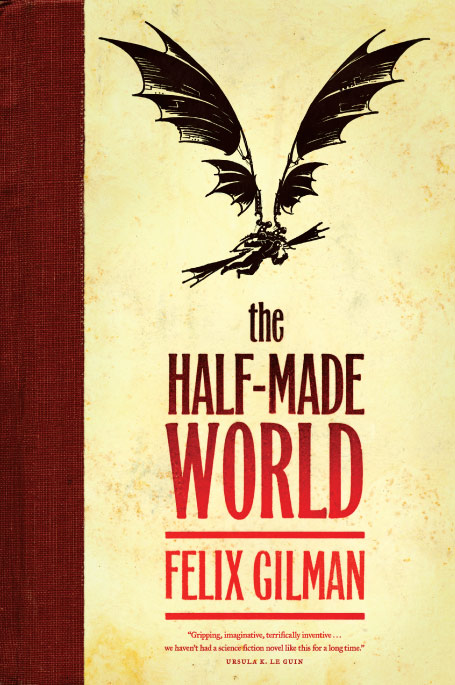 The Half-Made World, by Felix Gilman
Synopsis: Two factions war for control of a Steampunk Old West. A young psychologist (Liv) must find and cure an insane old man who’s mind may hold the key to ending the war permanently.
Brief Book Review: An interesting read, but not a compelling one. The super-human powers that rule the two factions are fascinating, and could have been a great examination of how non-human intellects interact with humans, and how intelligences without the ability to directly manipulate the world can still have huge effects by offering humans things they want in exchange… but it was never explored in much detail. The world itself is beautifully rendered, with great locations and extremely cool chaotic environs in the non-Made section of the world, where reality is still somewhat fluid and objects can change when you aren’t looking – and which doesn’t seem to make much difference to anything, aside from making a great backdrop. Liv is slowly stripped down to her constituent parts over the course of her journey, which is a neat concept but doesn’t have as much impact as it should. She doesn’t actually do a single thing of any importance until literally the very last scene of the book. The book feels unsatisfying because the protagonists are passive, rarely initiating anything themselves – merely reacting to this neat world. While it works well as a mood piece, those sorts of works are usually written as short stories for good reason. It doesn’t quite work at novel length. Not Recommended, unless this is exactly your type of book (and you know it if it is).
Club Review: Unfortunately there isn’t a great amount to chew over in a discussion setting. The villains are painted too strongly as villainous to provoke empathy, and the heroes don’t do much to cheer about. The sets are pretty, but there’s only so much to say about that. It has a very similar problem to Permanence – a lot of cool ideas that are great in concept, but without the execution to make them compelling. Merely thinking up a cool idea isn’t enough, you need to do something with it. Even if this is your type of book, it’s more of a solitary pleasure rather than a group discussion piece. Not Recommended.
 My life’s gotten pretty darn good lately. I am more healthy, fulfilled, and happy than I have been in any point of my life that I can remember. This worries me. The odds that I would be this happy are very remote. I am a white male in the richest country in the world during a time of relative peace. None of this was under my control. When I look back on all the things that could have gone wrong to prevent me from ending up here, I’m left speechless. And while I’ve overcome a number of hardships to get here, none of them were unrecoverable disasters. The universe did not hit me with small pox before there was a treatment. The fact that I did face obstacles and did overcome them adds to my feelings of happiness with my life, so I can’t even say they were, on balance, terrible.
At LessWrong HonoreDB wrote:
Geese will instinctively gorge themselves when winter is coming on. Eat a goose right after it’s fattened itself up for the winter, and you get a delicious treat that died happy. The problem is that geese will only do this if they believe food may become scarce during the winter (or their instinct to gorge only kicks in when the environment is such that that would be a reasonable inference; it’s not clear whether it’s the goose or evolution doing the analysis). If they realize that food will remain available during the winter, they eat normally. And there are quite a few possible clues–farmers trying to replicate Sousa’s setup have discovered that cheating on any part leads to unfatted livers.
- Even as chicks, geese cannot be handled by a human, or encounter other geese who have been.
- There can be no visible fences.
- Geese cannot be “fed,” rather a variety of food must be distributed randomly throughout a large space, with the placement constantly changing, so that the geese happen to come across it.
This seems to mirror my life up to now. Things are great, I’m happy, and it feels like this is due to a combination of luck and skill, and not any outside manipulation. This makes me suspicious. Life is too good, especially for an impartial uncaring universe. I am increasing my probability estimate that I exist in a simulation, and the creators of this simulation are Friendly enough to human intelligences that they ensure we have decent lives. Which would also require that people who’s lives are terrible – the Dalit slumdog in India – don’t actually exist, they’re only weakly emulated to make our lives seem better by comparison. If we’re going that far, it’s possible that almost no one else actually exists, just as that geese’s environment was almost entirely fabricated.
I don’t take this solipsism very seriously. It seems like a good way to slip into complacency, to allow your fellow man to suffer because he isn’t real, and to slack off in the fight against Death because it won’t actually happen. But it still worries at the back of my mind sometimes, a persistent niggling feeling that this is literally too good to be true and nothing is real.
(to any benevolent AI’s monitoring my life for happiness – I’m not actually complaining. This shit is pretty awesome, don’t throw me any tragedies just to try to convince me this is real, thanks. :) )


