Jun 032015
 

In addition to coordinating the Lit Track, I moderated three panels at Denver Comic Con last weekend. This is the audio of the second one. It was a little rough at first, but once I got into the groove things went very well. I think I did OK for my second time ever moderating a panel. :)

It’s a panel on Super-Villains. Panelists are: Alexi Vandenberg, Rob Weiner, Rob Peaslee, Amalie Howard, and Stephen Graham Jones. Moderator Eneasz Brodski. This was recorded onsite at Denver Comic Con 2015.
Includes:
The most admirable trait of villains?
Do you prefer your villains to be relatable, or hateable?
What’s the difference between a true villain and just a bad person?
Is the only difference between a villain and a hero the POV of the story?
and more
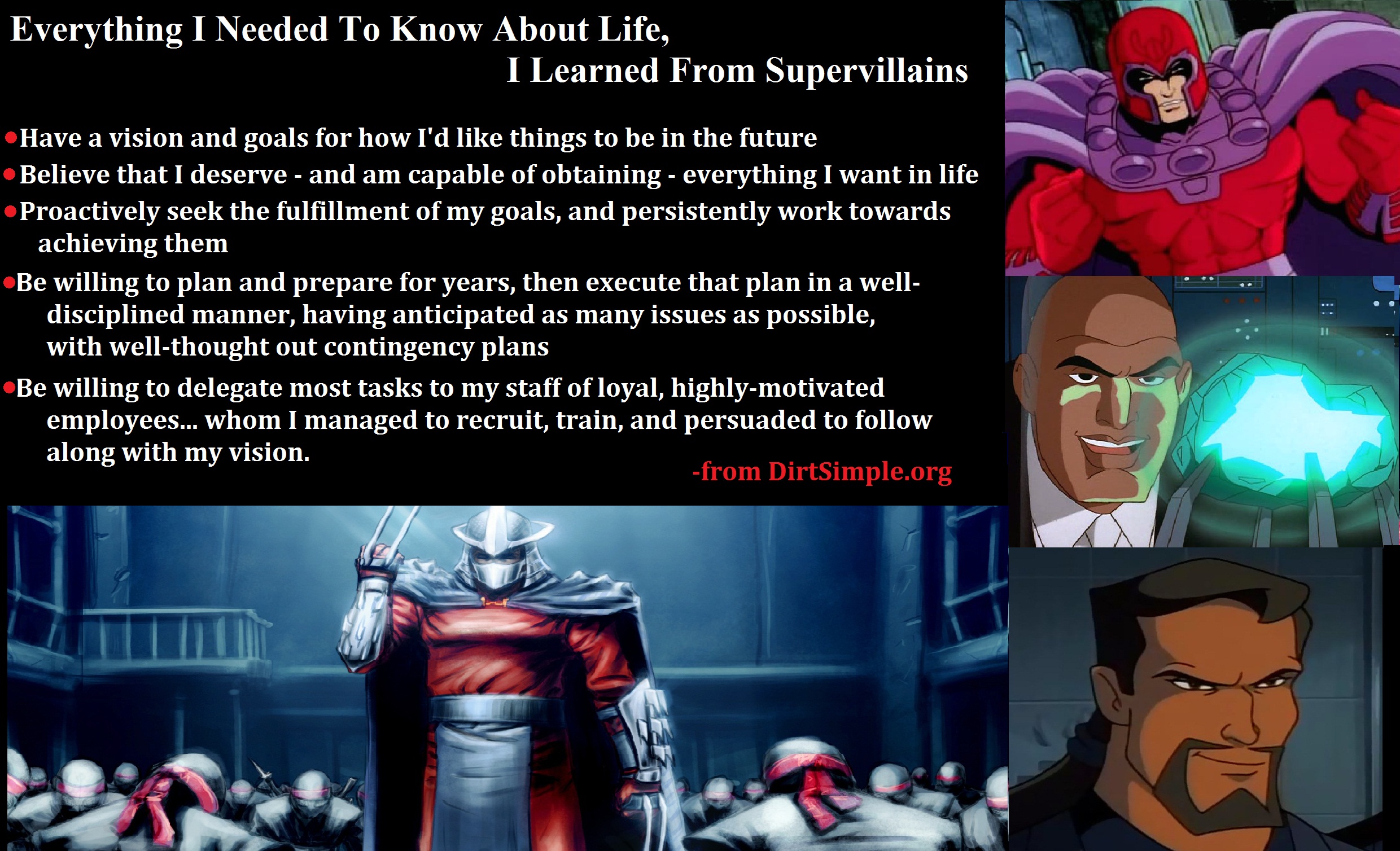
It was inspired by this pic from two years back:

Learned From SuperVillians

Jun 012015
 

In addition to coordinating the Lit Track, I moderated three panels at Denver Comic Con last weekend. This is the audio of the first one.

It’s a panel on YA lit, and writing YA, by YA Authors. Panelists are: Dan Wells, Amanda Strong, Angie Hodapp, Gail Wagner, and Michelle Kellogg. Moderator Eneasz Brodski. This was recorded onsite at Denver Comic Con 2015.
Includes:
How much sex & violence can you use?
Who are you writing for?
Who counts as a “Young Adult”?
Is the YA field censored by gate-keepers? And is this doing a disservice to YA readers?
and more

May 282015
 

51kxQMvzMeL._SY344_BO1,204,203,200_The Three-Body Problem, by Cixin Liu (translation by Ken Liu)

Synopsis: A secret SETI-equivalent Chinese program makes radio contact with an alien species.

Book Review: The Three-Body Problem starts out with a bang, dropping us right into the middle of China’s Cultural Revolution in the late 60s, from the perspective of a persecuted intellectual. The emotional impact is high, the politics are gripping, and the gradual revelation of a mysterious government program reels you in. Unfortunately, Cixin Liu isn’t able to keep the emotion going once we flash ahead to the modern day. He switches gears to focus on the alien-contact conspiracy and the exploration of a scientific problem, and only halfway pulls it off.

One of the great things about SF, that sets it apart from other genres, is the wonder of discovery. The intellectual excitement of running into a puzzle and working through it via experimentation and deduction. Or the exploration of how a culture would have evolved to handle vastly different circumstances. When Liu sticks to these he does a damn good job! Aside from the Cultural Revolution, the most exciting parts of the book are when we’re being shown the alien’s world. Unfortunately, this is only one aspect of storytelling, and everything else that goes into making a good SF story seems to be ignored.

For a start, the characters are almost undifferentiatable. The only one who sticks out is the hard-boiled cop. Everyone else is a young, single engineer. It’s worth pointing out that the protagonist is actually a married man with at least one child, and yet he’s written exactly like someone with no family at all. If someone else hadn’t reminded me of the brief scene where his wife and child are introduced I would still be under the impression that he was a single young man. And even the hard-boiled cop is basically just a hard-boiled, sarcastic version of the same character template.

There is no discernable emotion after the Cultural Revolution section. An author isn’t just supposed to show us cool gadgets and interesting puzzles, s/he is supposed to make us feel something. Or at least convince us that someone in the novel is feeling something. The Martian was non-stop puzzle-solving challenges, but the entire time there was a joy to it, or excitement, or some sort of relatable emotion. Three-Body Problem is flat in affect throughout.

The dialog can be taken as an example of this problem. It never feels like the sorts of things real people would actually say to each other (with the occasional exception of the cop, Da Shi). Rather, in almost every case it is little more than a way to give us exposition or tell the plot. It feels like people are being forced into verbalizing info dumps rather than actually interacting with each other, and it’s wooden and awkward.

Finally, there is prodigious amounts of telling-rather-than-showing. As a single example, here’s how the after effects of severe radiation dosing is handled:

“However, like everyone else who remained in the cafeteria after the explosion, [character] suffered severe radiation contamination.”

The entire book is like this. Contrast this to the handling in Leviathan Wakes, where the two characters are shown nearly panicking when their radiation counters go red, grimly joking about it afterwards, and later on we see them taking a cocktail of anti-cancer drugs which they’re informed they’ll have to take regularly for the rest of their lives. It took a few extra paragraphs to show that, and make us feel both the panic of the exposure and the consequences of it. It involved us emotionally with the characters. Liu’s line was little more than an acknowledgment that he knows radiation exists, and added nothing.

I will say that this may be intentional. Perhaps the Chinese style of writing is far more sedate than the American style, and to have characters who feel things is considered crass and readers hate it. This could be considered a fantastic book by Chinese critics, for all I know. But at the risk of being culturally insensitive… I consider this poor fiction. This sort of flat, bad writing – wrapped around an intriguing idea with a great puzzle and fun discovery at its center – is what I think gave SF it’s bad rep waaaaaay back in the day. It is entirely possible to write SF that’s based around a mind-blowing idea with a fantastic puzzle, full of all the wonder of discovery and exploration, while also having a story arc, compelling characters, realistic dialog, strong writing, and emotional resonance with the reader. Sure, it’s a lot harder. But if it was easy everyone would be doing it. Not Recommended.

Book Club Review: The lack of engagement and emotion really hurt this as a Book Club book. Once the puzzle is solved and the mystery is revealed, what is there for readers to discuss? The characters, the emotion, the themes. What we think the author was trying to say. In a story that doesn’t have any of those things, the discussion was a bit forced, and didn’t last very long. Not Recommended.

Puppy Note: This book was not on the Puppy Slate. When I thought to myself “How did this book make it onto the Hugo Ballot?” my first thought was the same uncharitable thought that the Puppies normally have. I thought “This is cultural inclusiveness being taken too far. The liberal thought-leaders want to show they are racially/culturally diverse, and they know that this book is CRAZY popular in China! For it to be so popular among so many readers, it must be fantastic! So let’s make sure it gets a nomination regardless of its merits.” Thus a type of affirmative action – signaling your awesome cultural acceptance and diversity at the cost of nominating a book that would have been much more deserving of the Hugo on its merits.

Except that the Puppy Leaders have come forward to say that they love this book, and would have put it on their slate if they’d known about it!! And I’m like… WHAT THE HELL is going on?? OK, we all already suspect that the Puppies don’t have great taste in SF lit, but if they think this book deserves a nomination on its merits, than perhaps *I* am being a giant, insensitive dick by assuming that only someone with a hidden liberal agenda would nominate this. Obviously people must actually like it. And if I am lumping in the Sad/Rabid Puppies with their hated “SJW” nemesis for picking crap for political reasons, maybe that’s a big flashing sign that says “There is no such thing as the political-reasons voter, and the Puppies were even more wrong that I thought from the very beginning.” Seriously, if I can’t tell you apart from your political rivals based on book selection, I think you’re grasping at straws.

Second, apparently Puppy-approved books can be nominated without the Puppy’s help. In fact, despite their efforts in this case. If the liberal conspiracy you claim is keeping good works down keeps nominating things you like (much like they nominated Correia and Torgerson in the past…) then it might not actually exist.

Third, why the hell hadn’t the Puppy Leadership heard of this book!? I am not very in-touch with the SF community. I have very rarely heard of more than 1 or 2 books that are nominated each year. Yet even I had heard of The Three-Body Problem. If the Hugo Popes deciding what books should be put on the Puppy Slate are so poor at reading the field that they can’t identify and nominate The Three-Body Problem, and have to admit afterwards “Man, I’m glad that made it in, because we love it!” then perhaps they are doing a shit-ass job of being the Hugo Popes and should relegate that job to the SF-reading hive mind again. FFS.
May 272015
 

Chrysalis and MeFor the past couple weeks I was working pretty intensely on setting up the Denver Comic Con Literary Track (getting authors on panels, scheduling, etc). This all came to a crescendo this weekend, during which time I was in the 200s Hall all three days (mostly room 205) meeting authors, making sure everything was running smoothly, and keeping panels running on time. It was an amazing experience!

When I first attended Comic Con I felt lost. I had no idea what to do. What exactly is the attraction here? It was too free-form and chaotic. Everyone else was cool and excited, I was just awkward and nervous. Eventually I left. I didn’t feel like I fit in.

The next year I volunteered, at a friend’s request (she said they really needed the help). I was a low-level gopher working Crowd Control, but I finally had a reason to be there. I had a job! An excuse to be where I was! And instant “friends” in my coworkers and supervisors. That structure and support made all the difference, and I came back a second day despite having not signed up for it initially.

I am now aware, several years later, that the way to go to a con is to get a group of friends who all want to go and go as a group. It’s a fun social experience for all of you, hanging out and going to see occasional attractions you’re all excited about, and generally treating it like a mobile party. I kinda wish someone had told me that in the past. But OTOH I’m glad I didn’t know, because it led to this volunteering thing which, over the course of a few years, led me to my Literary Coordinator position.

And I gotta say – wow. There were SOOO MANY awesome people I got to meet because of this! It was a ton of work getting everyone sorted (hours every week for several months, in addition to the three 10-hour days at DCC itself), but it was ridiculously worth it. Honestly it was actually too much – some people I barely got to see. But I did manage to have a fair bit of interaction with a handful of people who were absolutely fantastic to hang with! I am sad that many of them don’t live in Colorado, I hope to see them again soon.

It was also really inspiring. I got to moderate three panels. The first time you stand up on a podium in front of 100-200 people and have to entertain them for 50 minutes – DAMN is that terrifying! But so freakin’ exhilarating, and SO MUCH WIN when you pull it off! All three of my panels went very well, and I am extremely proud. I’ll be posting audio of them later this week/early next week (and eventually video, once that becomes available). But I digress – the inspiration part! So far I’m barely published. I want to be like the people on my panels. Even like the few who were just breaking into writing and introduced themselves with “And here is my first book!” I’ve been dithering about, not starting my first novel for several months now, because it’s a long and scary process and I dunno if I can do it. No more! Time to get this project underway!

I learned a lot of things over the course of the weekend, about panel coordination and running a con. I won’t bore y’all with them, since that’s probably not why you’re here. But more than anything else I found out that coordination is hard, and coordination on they fly is EXTREMELY hard. The best thing to do (whenever possible) is to have plans made before hand, drill them repeatedly, make sure everyone knows about them (good lord, I was surprised how much communication failures are a huge problem!) and then stick to the plan as much as possible. There’ll be plenty of crises that come up naturally, there’s no call to go creating more of our own. :)

May 182015
 

mad-max-fury-road-entertainment-weekly-image-2I saw Fury Road over the weekend. It’s a fantastic action flick. If that’s feminist propaganda, 98% of actions movies would be greatly improved by being feminist propaganda.

May 142015
 

skingame_lgSkin Game, by Jim Butcher

Synopsis: An urban-fantasy supernatural bank heist

Book Review: This is a frustrating book, because it has some very cool parts, but some very big failures as well, and you can see the unrealized potential within it. It reads very much like a novelization of the Buffy TV Series if it had been done by someone without Joss Whedon’s talent for self-awareness and meta-analysis.

Skin Game has that snappy, modern, referential humor that we so love. It is often funny, and in parts laugh-out-loud hilarious. The big parasite twist absolutely made my evening. :) The writing is never bad, and in parts it is outstanding! “Her heels clicking with metronomic inevitability” or “with all the sympathy of a bullet in flight” are evocative and high-impact lines. And the characters are generally strong and distinct, making them easy to identify and accept.

Unfortunately the awesomeness-to-word-count ratio is not favorable. The story seems to need to take a break every so often to have a fight scene, like a Fox executive is standing over Jim’s shoulder saying “No one’s been staked in 20 minutes? Throw some vampires at them!” Now, some of these fight scenes are vital, well-built, and fantastic. The one just outside Carpenter’s house was a tour-de-force, with a fantastic build-up, high stakes, the possibility of something bad actually happening, and major plot-altering outcomes as a result. I loved it. But several other fight scenes were dull, and could have been removed entirely without changing the story one bit. Any time a scene can be removed without altering a story at all, it should be.

It wasn’t just the fight scenes though. There’s a lot of really unfortunate dialog that basically consists of the characters telling the reader how s/he should be feeling right now. Most of it while trying to sound profound or moving. That is bad writing. You never tell a reader how he should feel (even if it’s dressed up as friends psycho-analyzing the protagonist to make him feel better). You make a reader feel things by showing them action that evokes those feelings. No matter how many times someone says “They took away everything that was familiar. They hurt you.” that doesn’t make us feel that pain. Repeating it doesn’t make it more impactful. There was not a single emotional point in the book that was left un-belabored.

As a result, a lot of the book was simply boring. Which is one of the worst things a book can be. Any time I have to resort to skimming a book it loses esteem in my eyes, and I had to do that quite a bit. With the exception of the fight outside Carpenter’s house, I never felt reluctant to put it down, or excited to pick it up again.

I suspect that part of the problem is that this is the 15th book in a (planned) 20 book series. Call me cynical, but I have a very hard time believing this story arc had to be spread out over 20 books and couldn’t have been done in (say) five. Very little of consequence happened in this book, and all those extra pages I was forced to skim through were just padding. For comparison, Catherine Valente wrote Deathless, which in the course of a single book takes its protagonist from age 10 to age 60+, covers two world wars, and has an amazing character arc, intense plot, and vast changes in the world. It’s an epic story. A few years ago I read the first Dresden novel (Storm Front). Harry Dresden seems virtually unchanged since that novel. Same with the world he’s in. Valente accomplished more in a single book than Butcher’s done in fifteen. I kinda resent that. My time is being wasted so a series can be padded out. Bleh.

Ultimately, I want something that will stick with me when I read (or watch) a story. Buffy was campy and fun, but it was also good–it still reverberates in my life. Skin Game, once you skip the boring bits, was certainly fun. But there’s nothing there that’ll stick with me. As one friend said: “A workman-like example of entertainment product.” It’s probably good beach reading with a drink. But that’s not what I’m interested in. Not Recommended.

Book Club Review: There isn’t much to say here. I won’t say there’s nothing for a book club to talk about. It is interesting to compare what different people find enjoyable – what jokes worked for some but not others, what bored one person vs what excited another, etc. There were a couple people in our group who were legitimately entertained and said the rest of us were being too finicky. But that only gets you so far. There wasn’t anything thought-provoking or innovative to push discussion. While it may be a good book for individual reading for some, as a book club book I would Not Recommend.

Puppy Note: This book really isn’t terrible, it’s just not great. Which means it’s already better than at least one nominee I’ve read every year. Every year since I started participating in the Hugos there’s been at least one book that I thought was simply awful, and in one case I was surprised the book had even made it to print! This book is easily better than any of those. And from what I’ve heard, some of the other books in this series have been quite a bit better. Which, first of all, makes me more convinced there should be a separate Hugo category for Series. But which also makes me ask “Why did Brad pick this book, this year?” It’s obviously not a good example of what Butcher can do when he really tries (or at least I hope that’s the case). Picking this particular mediocre book smacks very much of the exact sort of “basing Hugo decisions based on insider knowledge and politics,” rather than “just judging a work on its merits” that the Puppies campaign was supposedly against. Oh how quickly things turn.

May 132015
 

If your protagonist is literally Satan, and the most interesting thing you can think to do with that is put him in a glorified Police Procedural, you need to fire your ENTIRE CREATIVE STAFF >:(

May 062015
 

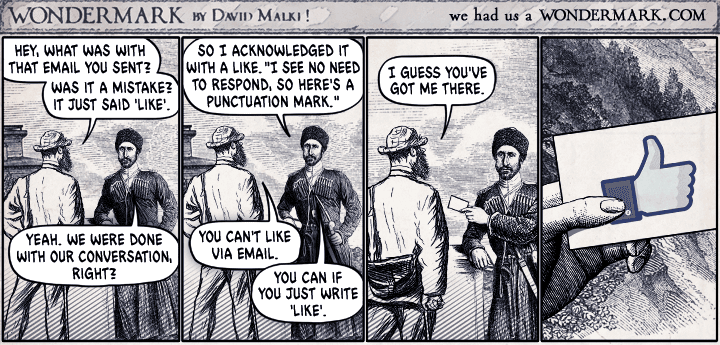
via wondermark.com
Like


Oh shit! My SO, much more concerned about animal rights than I am, may well be a better utilitarian than me. Ozy: We have seen the Utility Monster, and it is us.

An examination of the politics of the Harry Potter books.
“the whole Wizarding World in general, has been living under a continuous state of emergency for over three hundred years … Muggles are bound to find out in the end, unless the authorities and the population in general are allowed to react quickly and effectively without regard to constitutional niceties. … Since their society can’t have a proper rule of law (as we understand it) without risking its own existence, wizards have found another way of ensuring their safety and protection.
… the way power seems to work in the Wizarding World is the patron-client system, such as existed in Ancient Rome … Basically, the system works by otherwise unprotected wizards attaching themselves to a powerful “patron” and becoming his “clients.” The patron will smooth over any problems his client might have with the Ministry of Magic, and use his money and connections to help him out of his difficulties, and keep him out of Azkaban – as Dumbledore did with Mundungus Fletcher. In return, the client himself becomes a part of the patron’s entourage and connections. The patron ends up with a large body of wizards dependent on him whom he can rely on (a private army, in other words) which effectively puts him above the law ”

Killing the leaders of terrorist groups may make them more likely to attack civilian rather than military targets:
“Subsequent statistical studies have found that terrorism is not simply correlated with political failure; the attacks on civilians actually lower the odds of government concessions. This is because terrorism tends to shift electorates to the political right, strengthening hardliners most opposed to appeasement.
…It turns out that certain kinds of groups are significantly more likely to attack civilians than others – those suffering from leadership deficits in which lower level members are calling the shots. Leadership deficits promote terrorism by empowering lower level members of the organization, who have stronger incentives to harm civilians.
…In accordance with this new theory for terrorism, our study reveals that decapitation strikes with drones make militant groups more likely to attack civilians by weakening the leadership.”

First I thought this was an Onion article. Then I thought it was April 1st. Texas Governor Deploys State Guard To Stave Off Obama Takeover. What. The. Fuck.

Trolling for good. :) Satanic Temple: 72-Hour Abortion Waiting Period is Against Our Religion “Turns out a core religious tenet of The Satanic Temple is control over one’s own body.”

The U.S. imprisons a much higher percentage of its citizens than any similar country and frequently fails to protect those prisoners from being raped or assaulted, even when they are kids. The FBI helped send multiple people to death row based partly on junk science that was also used to convict people for lesser crimes for two decades. DNA exonerations of longtime prisoners are legion. Asset forfeiture laws have police seizing the property of Americans who’ve never been convicted of anything. The War on Drugs has eroded the Fourth Amendment and undermined the sanctity of the home to an oppressive degree, such that it is no longer surprising to hear about no-knock raids where family pets are shot, flash bang grenades burn innocents, and people are killed. Black and Hispanic men are stopped and frisked dozens of times by police without having done anything wrong.
Many conservatives show no evidence of caring.
… If public school teachers or community organizers behaved as badly, the outrage on AM radio and Fox News would be constant. Yet police abuses as numerous and egregious as what the Baltimore Sun documented in this stellar investigation garnered orders of magnitude less coverage and outrage from conservatives than James O’Keefe stinging ACORN.

New ACLU Cellphone App Automatically Preserves Video of Police Encounters

Why is America celebrating the beating of a black child?
“these beatings are the acts of a people so desperate and helpless, so terrorized and enraged, that heaping pain upon their children actually seems like a sane and viable act of parental protection.

The intensity of this fear is integral to the history of black Americans. Just as black parents have “the talk” with their children, listing survival tips for when they are confronted by white authority, black corporal punishment has been encouraged as the only way to make black children acceptable to society.”

A CEO explains why CEOs make so much money. Interesting perspective. In short: unintended consequence of regulation and public disclosure. No board wants to admit to having a cruddy CEO by paying him less than average, so below-average pay is increased to match the market rate, which brings the entire average up, rinse and repeat. We need to make this work for accountants! www.glassdoor.com here I come!

So much yes. Smashing police cars is a legitimate political strategy.
“Non-violence is a type of political performance designed to raise awareness and win over sympathy of those with privilege. When those on the outside of struggle—the white, the wealthy, the straight, the able-bodied, the masculine—have demonstrated repeatedly that they do not care, are not invested, are not going to step in the line of fire to defend the oppressed, this is a futile political strategy.”

“Militance is about direct action which defends our communities from violence. […] it is how virtually all of our oppressed movements were sparked, and has arguably gained us the only real political victories we’ve had under the rule of empire.”

“Telling someone to be peaceful and shaming their militance not only lacks a nuanced and historical political understanding, it is literally a deadly and irresponsible demand.”

(relinking You Are Not The Target Audience again as well – “[peaceful] protest, even at its most acrimonious, still takes the form of an appeal to power–it assumes certain institutions can be reasoned with. As such it risks effectively bolstering the perceived legitimacy of those institutions.
In contrast, physical resistance challenges not only the state’s appearance of control but also the legitimacy of their monopoly on force. “)

Video – Obama brings in his Anger Translator during the White House Correspondents dinner. :) That’s gotta be a life-goal for any comedian!

More fun comedy, 5 min video –Julia Louis-Dreyfus’s Last Fuckable Day

Obamacare’s projected cost falls due to lower premiums under health care law, CBO says
“Apparently, only 8% of the people are aware of this fact.
Obamacare is currently coming in at 11% below budget – mostly because:
(a) Health care premiums are rising less than expected. They are still rising – but much more slowly than they used to. Accusations that companies across the country are raising costs dramatically are simply not true (though there may be a few local exceptions).
(b) Fewer companies than expected are dropping health insurance coverage for employees. Again, the charge that companies across the country will be dropping health insurance coverage have turned out to be false. Some have done so, but not as many as the CBO had predicted.” (quoting Alonzo Fyfe)

On Utilitarian Ethics (or why Utilitarians aren’t as insufferable as more traditional liberals):
“Many people have remarked on the paradox of an academia made mostly of upper-class ethnic-majority Westerners trying so very hard to find reasons why lots of things are the fault of upper-class ethnic-majority Westerners …
what if people are really, fundamentally, good? … Deontology very clearly says that if you cause a problem, it’s your job to help fix it … Utilitarianism tells us that we are perfectly justified in seeing the relief of suffering as a pressing need. We don’t need to justify it by positing facts that may later be proven untrue…
This theory implies that utilitarian liberals will have all the features of liberalism except the interest in blaming their own group for major problems. The utilitarians I know are very interested in helping the poor and in various other liberal ideas, but are more likely than other liberals to roll their eyes at talk about colonialism and stereotype threat.”

FBI admits it fudged forensic hair matches in nearly all criminal trials for decades

Hope everyone had a great Cake & Cunnilingus day on April 14th! (NSFW)

Thank all the gods! EFF Busts Podcasting Patent, Invalidating Key Claims at Patent Office

A quick primer on the Christus Victor idea. Christus Victor was the dominant view of the atonement for the first thousand years of the church. This was a fun read. I want more SF utilizing these themes.

Scott Alexander has some strong doubts about Growth Mindset.
“telling kids that they’re failing because they just don’t have the right work ethic is a crappy thing to do.
… Imagine a boot stamping on a human face forever, saying “YOUR PROBLEM IS THAT YOU’RE JUST NOT TRYING NOT TO BE STAMPED ON HARD ENOUGH”.”

This is even more fun than the original song. :)

For a break from the current drama: ‘Bees are good,’ Obama says as children scream.
“now THAT is how you write a headline” – Blake