embrodski

Sep 202012
 

Among Others, by Jo Walton

Synopsis: Set in ’79 and ’80, the diary of a teenage girl (Mor) who lost her twin and was herself crippled in a car accident. She deals with the loss by joining an SF book club. In the meantime, fairies help her defend herself from her evil witch mother.

Brief Book Review: A well written book with a few minor holes. An intimate portrayal of an isolated teen dealing with loss. Some readers may be put off by the lack of a plot, or that Mor seems far too wise for her age, but I didn’t mind the first and actively enjoyed the latter. Be prepared for more of an Oprah Book Club book rather than a SF book, but with all the positive aspects rather than the negative ones. Recommended.

Club Review: This book can be read in two very different ways, and once a reader latches on to one it is extremely hard to switch to the other. Different people will have very different reading experiences depending on which way they chose to interpret the story. This itself makes it a very strong book club book, as there will be a lot of comparing of notes on how the experience differed. There are a number of implied or veiled aspects to the story that can be disputed. The large number of references to 70s SF/F will get the older members of a group reminiscing about books of the past. The combination of powerlessness and frankness that characterize Mor make for some memorable lines. And the existence of a book club within the book makes for some fun comparison.

Summary: A strong book with some flaws that will give a book club a lot to chew over. The vagueness of it provides for a lot of reader interpretation, which makes for good discussion with others. Strongly recommended.
Sep 182012
 

This article from Alone is extremely good. I’d recommend reading the whole thing, but in summary it states that people expect a higher power (god, government, society, dad, etc) to provide an environment where the most terrible things are not allowed, and this allows us to accept less responsibility for ourselves. It is a reminder that the world is beyond the reach of god. It is a continuation of the idea of Heroic Responsibility.

He points out that humans create institutions to make their environment safer, and then offload their own responsibilities onto these institutions. He accuses us all of shirking our Heroic Responsibility. I’m not sure this is fair. An individual human can only do so much. I’ve avoided vulnerability to a somewhat silly degree in the past (avoiding caring for others or owning much more than I can carry at a dead run… caring for too much makes you vulnerable). Turns out too much independence can be far more harmful than not enough, because individual humans are weak and small, and we can do things of Power only by combining our efforts. To do something noteworthy, we much focus on our specialty and trust others to do focus on theirs. To create a strong meta-individual, we cannot all be completely responsible for everything – we need some specialists in responsibility as well. Not every cell in the human body can fight off hostile invaders, most of them have other vital tasks.

On the other hand, cells are cheap. They are destroyed and discarded and replaced constantly. A single person/cell can’t expect their survival to be prioritized over the meta-being (or even over that of the comfort of a large number of other persons/cells, hence Torture vs Dust Specks). We are powerful in groups, but what is the point of that power if we trade away our existence to achieve it? It is, perhaps, important that we are working and trusting others sufficiently like ourselves, lest we find ourselves re-purposed for the interests of hostile beings.

Sep 172012
 

A recent episode of Planet Money described the process of “creative destruction”.

“By 1991 Walmart has taken over Woolworth’s place on the Dow Jones, by 1997 Woolworth’s has closed down all of its stores […] Why isn’t Woolworth’s prepared to make that change, they should be better prepared than anyone. They could’ve been Wal-Mart, why didn’t they go out to the rural areas and build giant stores? […] When you have an incremental innovation, where it’s just about trying to do what you already do a little bit better, the established firms are really good at that, they’ve got all the resources and all the expertise. But whenever there’s a disruptive innovation that comes along, a totally different way of doing something, that causes a problem for the established firms.”

10% of companies go bankrupt every year. If a major cause of death for powerful, established companies is failure to adapt, it is important that anyone who plans to live for thousands of years be willing and able to adapt to changing conditions. This includes being willing to change your values. Maybe not drastically, and maybe not the most fundamental values. But inflexibility is a death sentence, and it is far better to keep yourself mentally limber than to default to brittle conservatism. If you resist all minor changes for long enough you can become so entrenched in your old positions that once change is finally inevitable you may be unable to adapt in time, and go the way of Woolworth’s.

Sep 132012
 

On August 27, 2012, the American Academy of Pediatrics issued a revised circumcision policy statement saying:

 Although health benefits are not great enough to recommend routine circumcision for all male newborns, the benefits of circumcision are sufficient to justify access to this procedure for families choosing it … Parents ultimately should decide whether circumcision is in the best interests of their male child.

As summarized at Science Based Medicine, the medical support for circumcision has always been shakey. There appear to be some minor benefits*, and some minor costs and risks, and the two are close enough in the balance scales that pediatric organizations around the world teeter around the “no recommendation” point – some recommending slightly against, some recommending slightly for, many neutral.

Surprisingly (at least to me) it seems that sexual pleasure is not affected one way or another by circumcision. It’s nice to see that’s actually being considered in these studies. But what’s not considered (at least not that I’ve been able to find) is masturbation. It’s easier when you’re uncircumcised. Most circumcised men need to use a lubricant to masturbate, the uncircumcised don’t. Masturbation is great, and simply ignoring this aspect of human life seems to be a major oversight.

Anecdotally, my gf likes that she can grab at me at any time. It’d be a pain in the ass if she always had to get some lube first, and a bit messy. I’d be upset if I ever had to give that up.


* to summarize: nearly all the health benefits can be achieved with simple hygiene. And you should be washing your dick anyway if you want other people to play with it. It appears to reduce how frequently you will catch STDs when having unprotected sex, but you’re gonna catch something if you’re having unprotected sex anyway, wtf is wrong with you?

Sep 112012
 

Deadline, by Mira Grant


Synopsis: After his sister was murdered, Shaun now hallucinates her speaking to him constantly. He drives around a post-zombie-apocalypse US with his friends, making “witty banter” and trying to uncover a big government conspiracy to keep the populace timid and afraid.

Brief Book Review: Not much to like here. A longer review/FAQ here.

Club Review: It’s actually not terrible for a book club book. It’s rather long, but as mentioned in the FAQ, it’s very easy to skim. It’s much like a popcorn movie, you don’t have to put in much effort. It may make for a decent break between more demanding books. There are several really good scenes, but like most good scenes they don’t really provoke much discussion. There is a LOT to complain about, and if you like going MST3K on a book, this can provide for a fair bit of fun. The problem is that there isn’t much variety to the fun, as the same annoying items keep coming up over and over and you can’t really mock them more than once or twice. It is not nearly the beautiful MST3K-feast that something truly awful would be. It’s uniformly middlin’ bad, with some good bits here and there which don’t quite make up for it. It’s too bad this book isn’t worse, or better, or shorter (seriously, an editor would have made this a much better novel). If it was any of those it’d be easy to give it a mild recommendation, but it’s hard to slog through 600 pages of mediocre writing and repetitive snarky quips just for some exasperated venting.

I will note that several people actually gave it fairly decent ratings, despite it’s flaws. They felt it was light and fun enough that it wasn’t a loss.

Summary: Not worth it. It ends on a cliff hanger and I don’t care. I wouldn’t recommend it for book clubs, but not terrible.

Sep 102012
 

If you have both a dog and an SO you live with, you’ve probably thought to yourself “That dog must think our entire species has RAGING Tourettes.”  There he is, quiet almost all day long, just enjoying being his doggy self. And here we are, making noise non-stop for no conceivable reason. It’s rare for us to be in the same room for even a half hour without some sort of verbal exchange. What the poor doggy doesn’t understand is that we’re constructing a very basic form of hive mind, and that this process has been so critical in our species’ survival that we feel uncomfortable if we aren’t doing that whenever we’re around others.

It has been observed that when the corpus callosum of the brain is severed (separating the left and right sides of the brain) two different mental agents appear within one body, sometimes with different personalities. It seems that individuation happens when the bandwidth between thought processors is too low. The bandwidth of human speech is far too low to form any sort of single conscious entity*, but it can be rich enough to form the beginnings of a proto-agent when a group of people get together and begin to think alike and act in concert.

Most people seem to need to be part of a group. Isolation is intensely painful for humans, it is used as punishment for criminals already in jail, and long periods of it will often drive people past sanity. Infants who grow up in isolated environments die at an astounding rate, are physically sicker, and are often unable to function in society when they mature.  Neuro-typical humans seek out others to be around, creating surrogate families if the ones they were born into don’t fit them. I’m not implying that we have evolved for the purpose of being sub-agents of larger meta-individuals. This desire is seen in many social species and is probably simply a side-effect of kin selection. However this desire, combined with our ability to mingle our mental processes through language, has made us uniquely suitable to form super-individual agents.

These meta-agents we form are macrocosms of our own minds. As postulated by Minsky, our various mental sub-agents often do not agree, and sometimes are at odds with each other. Some agents are strongly involved in some processes and not at all in others, and which agents compromise what we consider “ourselves” changes from moment to moment.

Much like individuals, meta-agents often propagate their own survival. They can issue statements that are supposed to represent the group as a whole. The biggest difference between our society of mind and the society of a meta-mind is that our society of mind is physically trapped within a single skull, whereas a meta-mind is distributed.


*A great exploration of a species that can do this is found in Vernor Vinge’s Fire Upon The Deep, wherein individual “Tines” are quite feral and dumb, but their high-bandwidth vocalization allows them to form conscious minds when in close proximity.

Sep 062012
 

I come from a family of arguers. We love to sit around and dispute almost any old thing. So Facebook has become my favorite place to hang out, as people are always itchin’ for a fight there. I’ll never reach the level of the late, great Hitchens (who is a hero of mine), but you can still enjoy a pick-up game even if you’re not Michael Jordan.

I don’t get to do it as much as I’d like, because I do my best not to be friends with dickbags. But some of my friends don’t have those same qualms, so I can get into arguments with THEIR friends on THEIR threads. Much fun ensues! Here’s the latest such exchange.

Originating Post:

That we have tasked our government with the responsibility of humane treatment of animals, protecting the purity of our food and water, guaranteeing safe working conditions, protecting the environment, and guaranteeing a safety net for the poor, the sick, and the elderly, is not an infringement on your rights — it is a measure of how compassionate a society we choose to be. If you benefit from living in this country, you should not begrudge the responsibilities that come with it.

Him: Given that over 90% of the taxes are paid by less than 50% of the population, no, all of the above is NOT “a measure of how compassionate a society we choose to be”, it is a measure of willing a majority are to force OTHERS to do the heavy work of their compassion for them. Forcing others to expend their resources on objects of benevolence is *not* compassion, no matter how pretty the words are. 

This is the perfect elaboration of the dictum that Democracy is “two wolves and a lamb, voting on what to have for dinner.”


Me: Hi ——. That is a dirty lie, and you should know it. I’m about to gift you the truth, so you have the benefit of the doubt today.That number counts only the Federal Income Tax, which is a minority of the taxes that almost any random taxpayer pays. Unless you are rich, payroll taxes are a greater percentage of your tax burden. From the Center on Budget and Policy Priorities: ” Tax Policy Center data show that only about 17 percent of households did not pay any federal income tax or payroll tax in 2009, despite the high unemployment and temporary tax cuts that marked that year.[5] In 2007, a more typical year, the figure was 14 percent.”

“Most of the people who pay neither federal income tax nor payroll taxes are low-income people who are elderly, unable to work due to a serious disability, or students, most of whom subsequently become taxpayers.”
“even these figures greatly understate low-income households’ total tax burden because these households also pay substantial state and local taxes. Data from the Institute on Taxation and Economic Policy show that the poorest fifth of households paid a stunning 12.3 percent of their incomes in state and local taxes in 2011″Repeating the 90%/50% figure in the future will mark you a liar, as you now know the facts.You are also slandering the working poor. How much “heavy work” does Mitt Romney or Warren Buffet do? Whereas “61 percent of those that owed no federal income tax in a given year are working households”. Families that often work 2-3 jobs at a time just to pay the bills.Even disregarding this – the Top 1% own 34% of all the nation’s wealth. The bottom 50% own 1.1% of all the nation’s wealth. Given that over 98% of all the wealth is owned by less than 50% of the population, perhaps the taxes they are paying are fairly proportional. And, again, that’s only if you completely ignore the highly regressive payroll taxes, and all state and local taxes.

Him: Eneasz: Screw you. You could provide the correction without the invective. Yes, I was referring to federal taxes, and that is a worthwhile correction.I always, btw, find “payroll taxes” an amusing euphemism, since in other contexts, Lefties like you will hasten to make the point that since people are paying into Social Security what they get out of it, SS is therefore NOT the largest Ponzi scheme in history.

“How much ‘heavy work’ does Mitt Romney or Warren Buffett do?” I honestly have no idea – and neither do you; you simply assume the default class warrior nonsense about the idle rich. The fact is, though, that ROmney earned every penny he has. Again, government largesse is NOT COMPASSION, since it is by and large paid for by other people; you don’t get to feel all compassionate and kind by holding a gun to my head and forcing me to give to the poor; that is far more dshonest than you are accusing ME of being.

Piss off.

Me: Regardless of how the government does its accounting, if you count Social Security as part of what you’re being “forced” to pay for than you have to count how it’s actually paid for. You don’t get to say “look at all these programs we’re being taxed to provide!” and then completely ignore the major mechanism used to fund them.

“you simply assume the default class warrior nonsense about the idle rich” – O’RLY? *I* am the one who introduced the default warrior class narrative? *I* am the one who made claims about the poor who “force OTHERS to do the heavy work […] for them”? Excuse me Mr Kettle, but it seems like you were quite happy to beat up on the defenseless as long as no one was swinging back. As soon as someone points out you’re full of shit it’s all “Oh wah, wah, I can’t take any push-back, you culture warriors are so mean and aggressive!””

The fact is, though, that ROmney earned every penny he has ” – LOL!

“you don’t get to feel all compassionate and kind by holding a gun to my head and forcing me to give to the poor” You have an immensely inflated sense of importance. You can whine about being forced into slavery all day, and people will laugh at you. Or you can put on your big-boy pants and join a conversation about the problems we face as a society, and how to best address those problems with the tools we have. I haven’t complained about people holding a gun to my head and forcing me to kill babies in Iraq since I was in Middle School. You know why? Because I’m not a retard.

Sep 052012
 

I’m a big fan of architecture. Here are a couple pics from Chicago.
(The Tower in Fog from the first WorldCon post is from Chicago as well)

Gorgeous building, very stately, love the flying buttresses.


Unique design. Parking on the first dozen floors, living quarters above them. Practical? Maybe. But ugly. Uniquely ugly. That’ll be an eyesore for decades. Centuries?


The fire department has an awesome park/garden on the roof! Massive win!


There’s a sweet underground mole-city/shopping center running below the hotel I was in. Unstoppably cool. Although the city is fairly hilly, so there are places where it comes out at ground level, and places where it’s actually a full story above the ground. But when I first stumbled across it I was a floor below ground level, so to me it’ll always be the mole-city.

Aside from the main fancy stip downtown, Chicago is old and run-down and ugly looking. It isn’t even cool industrial blight, it’s just decayed. I hope I don’t have to go back much.

Sep 032012
 

I met a number of cool people at the con, and I regret not having gotten pics of more of them. In particular – Kevin Riggle, who hung out with me a fair bit of Friday, and Anaea Lay (author of Your Cities) who was my “con girlfriend” in that we hung out much of Sunday and went to the awards together. She has just posted the first post-Hugo-win interview with Author Ken Liu (of Paper Menagerie, which deserved the Hugo so much! It was beautiful. Much better than that Movement thing I wrote about)

This is Anaea Lay (far left), I went up to her after a panel because 1) she was cute, and 2) I figured I could actually start a conversation with the whole similarity-of-names thing (originally my first name was pronounced exactly like hers except with an “sh” sound added to the end). Turns out they do both have origins in greek antiquity. :)


Learned a bit more about myself too. Figured I had most of that stuff ironed out already, but it turns out that growing as a person doesn’t mean you’re done growing, it just means you’re done making all the noob mistakes and can start working on slightly more complex mistakes now. :) My actual girlfriend (as opposed to Con girlfriend) recommended that I not mention that I have a girlfriend at the con. We’re monogomish, and she’s got a bit of experience with that, but this was my first time without her by my side. It’s easier when you present as a couple, how do you slip that in when the SO isn’t there? I tried that and I hated it. Several times I was about to mention her and I had to stop myself. It made me feel skeevy and dishonest, and I didn’t much like myself. A lot of people in SF/F fandom identify as poly (I still dislike the term… I’m not poly, I’m just monogomish) so I shoulda just been direct about it. Bleh. Lesson learned.

On to further coolness!

I went to the live recording of The SF Squeecast. I went for two reasons – 1) Cat Valente was there, and I’d seen her on a previous panel. She’s smokin’ hot, and she’s got an intense charismatic prescence about her. It makes you want to be near her more. (she’s second from the left) 2) I needed something light and fun to lift the spirits, and podcasts are usually that sort of entertainment. Especially, one would assume, podcasts with the word squee in them. It did not dissappoint! It may have been even better than the Disaster Response in SF panel in terms of pure fun (hard to say). Seanan McGuire (aka Mira Grant, far left) stole the show, she is an absolute RIOT. If the hyper chibi anime girl jumped into the real world, she’d be Seanan. If fact, she might actually BE an escaped anime charecter, she looked distinctly dissapointed a couple times that she couldn’t pratfall on command. I’ll post a link to the episode once it’s available, it was a blast.


I now understand the Newflesh trilogy a little better. It’s just Seanan romping around having a blast in a B zombie movie. Hell, Shaun is basically Seanan. I can see why she gets Hugo nominations from her fans. It’s impossible not to like her, and you want to have a good time along with her. Deadline is still a bad book (as highlighted in the FAQ), but now I understand.

The Awards themselves were a blast. Scalzi was very entertaining (as always), the pomp was great, the whole thing was awesome. And I got a pic of me with Zach Weiner!!!!! WOOOOO!!!

Sep 012012
 

WorldCon is awesome. Although I dropped my phone in a toilet. That part was lame, but entirely not the fault of WorldCon.

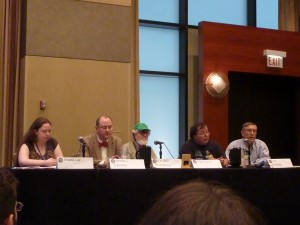
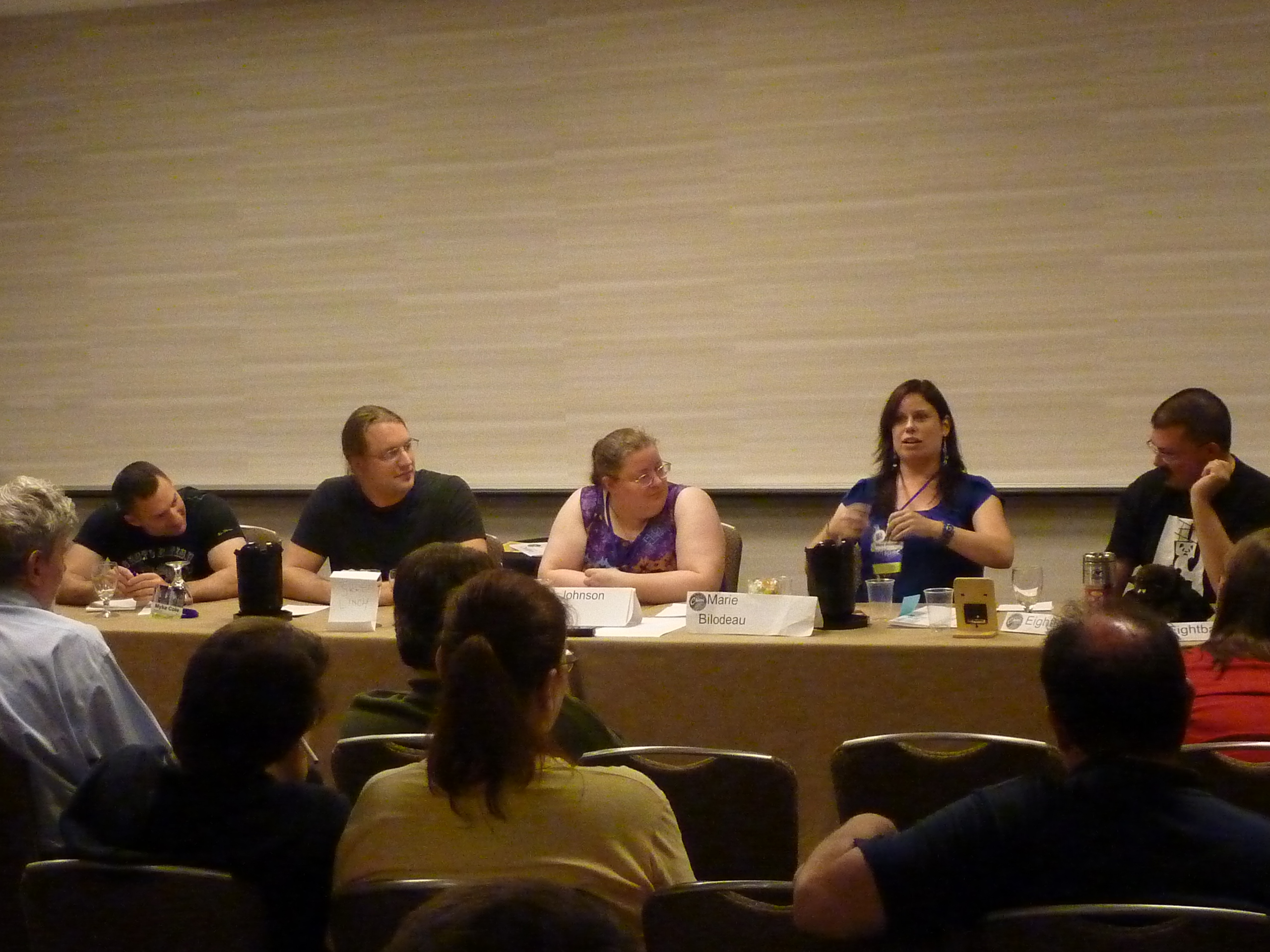
I’ve learned that the subject of panels is generally less important than who is on them. Note good panelists and go to thier panels. Myke Cole (far left below) from the Disaster Response in SF panel was great, that was the most fun panel of the past two days, and almost no one got to experience it. Although the intimacy probably helped. The chemistry among the panellists, and between the panel and the audience, was awesome.

Note poor ones and avoid those panels. Lynda Williams will not stop talking about her books, regardless of what the panel topic is about. STOP PEDDLING YOUR CRAP! We’ll take a look if it sounds interesting, but hearing you go on and on about it like a Firefly fan on a bender makes it unappealing.

I got to see David Brin!!! Pimpin’ as always.


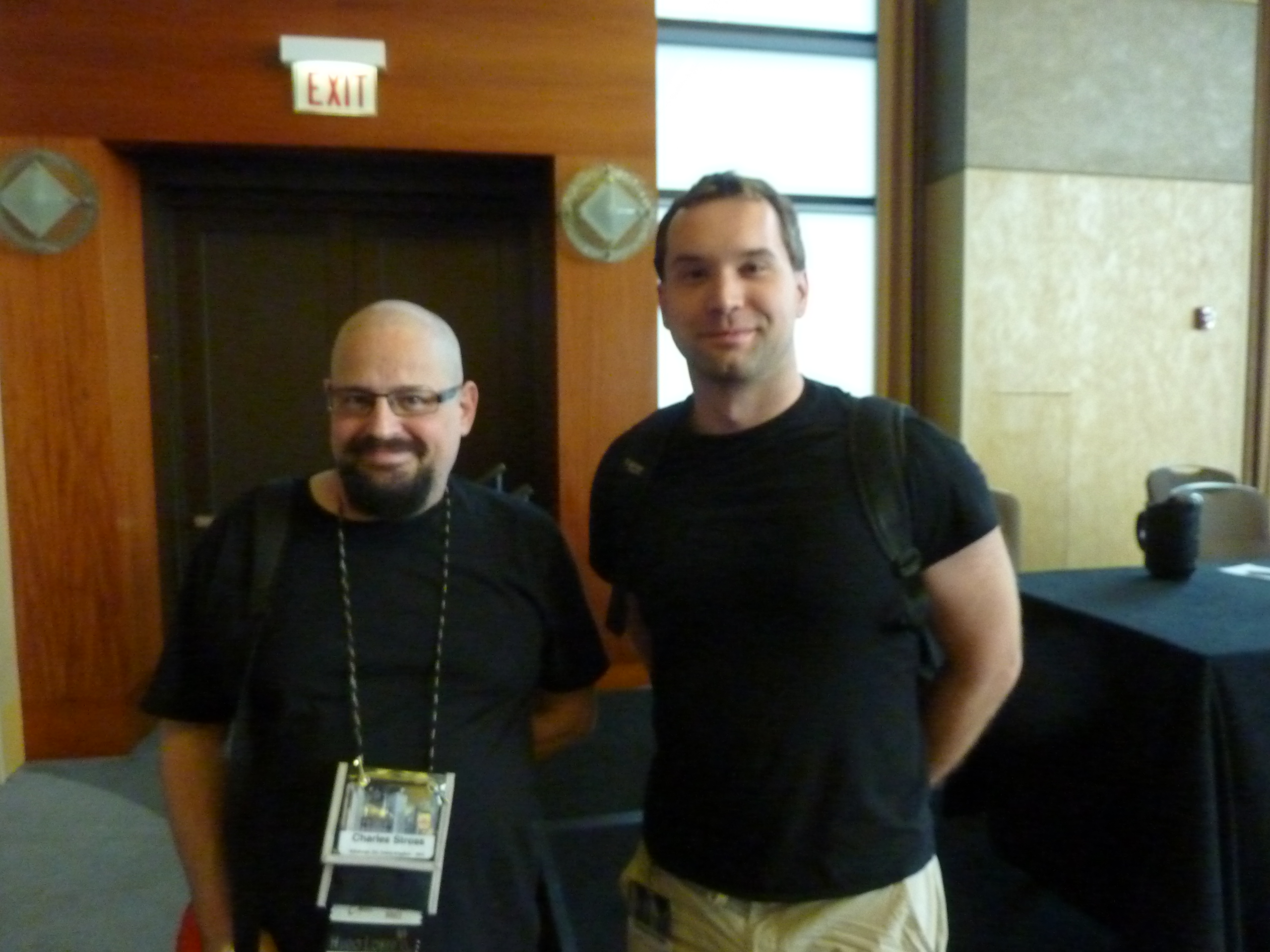
And Charlie Stross!


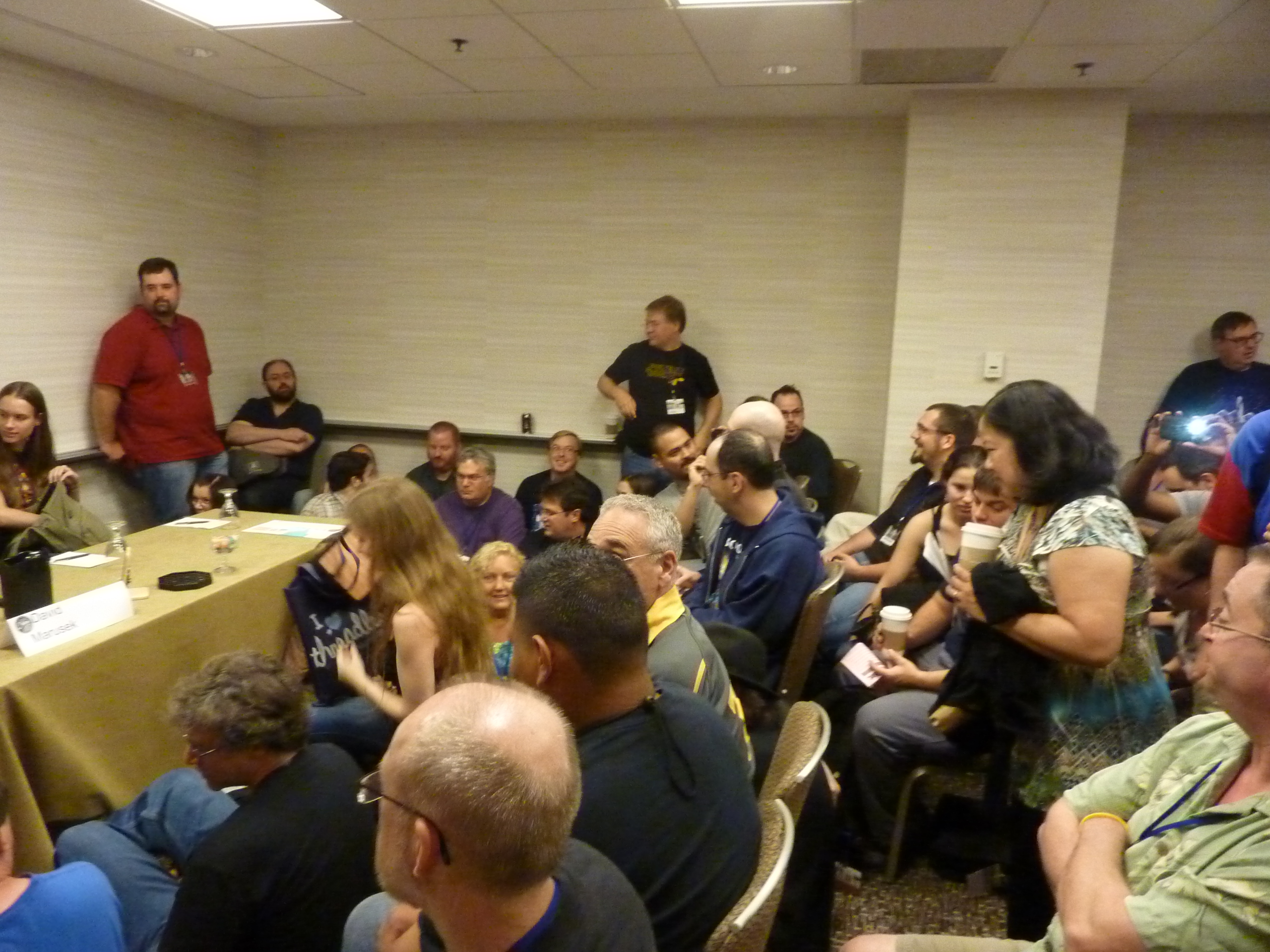
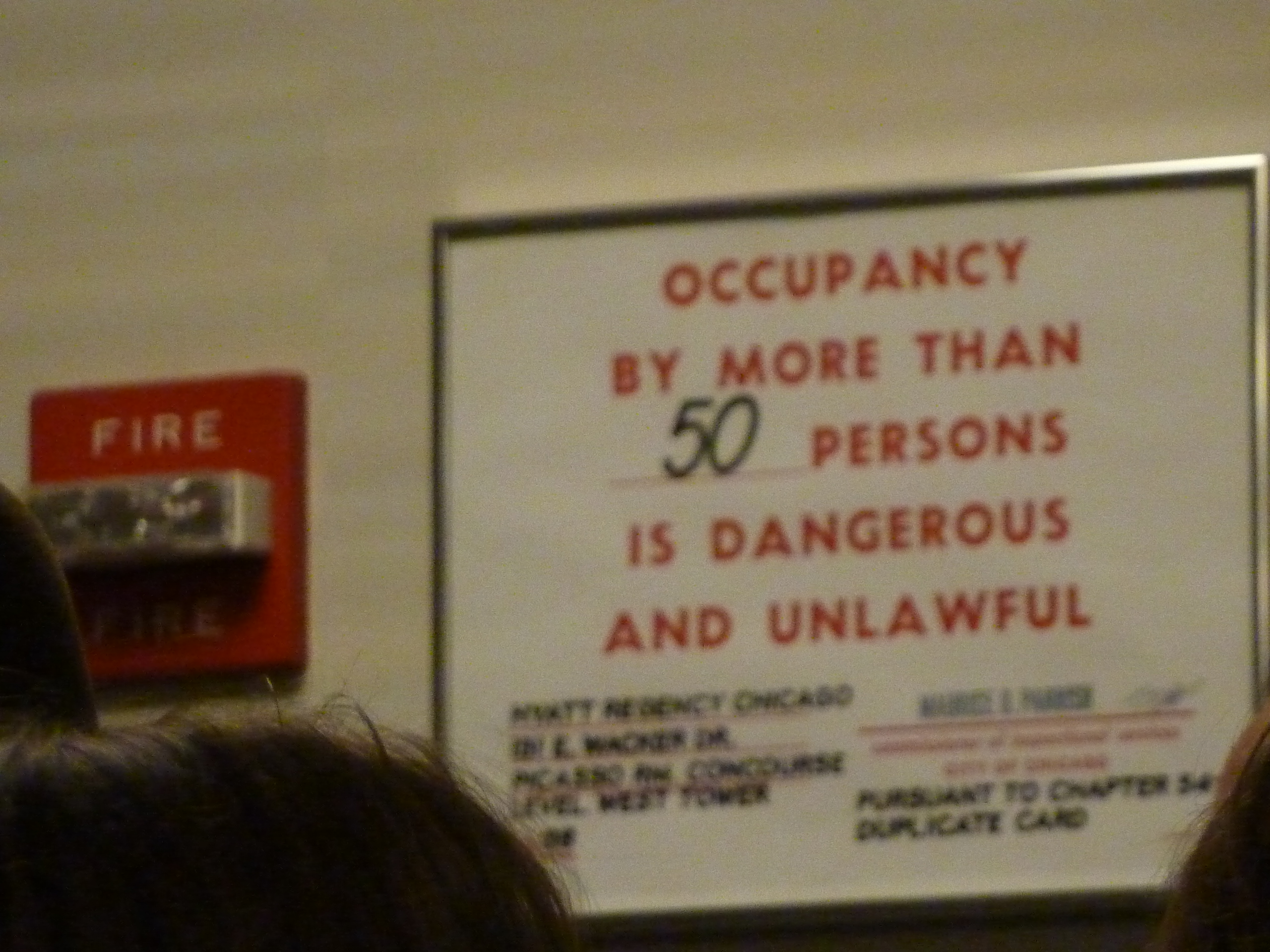
One of the most memorable moments was the Patrick Rothfuss reading. (Yeah – he’s just as awesome as you’ve heard.) He is apparently not a big name in SF if you’re old and out-of-touch*. So he was assigned one of the small rooms for unknown authors. It overflowed so badly that they had to move him two floors down to a larger room on the fly. It was still too small. I managed to catch some of the crowding below, but I don’t have a wide-angle lens so it doesn’t really capture the packedness. I may have lost a bit of measure in that room today, a fire or similar panic would have killed us all, and left the world without an end to the Kingkiller Chronicles. He was great, his banter was witty, he read The Gerbil Story and two poems.


* – I realize that’s very easy to say in retrospect. He’s been a bit of a break-out phenomenon, I dunno if I coulda done any better. Still, it’s freaking Patrick Rothfuss!!