embrodski

Oct 102012
 

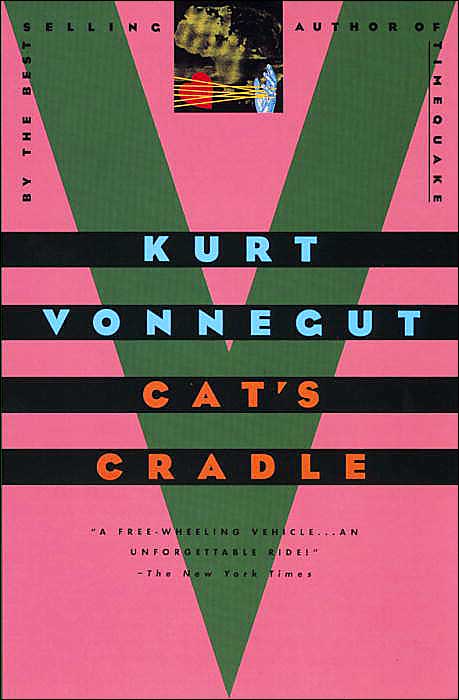
Cat’s Cradle, by Kurt Vonnegut

Synopsis: A nihilist travels to the poorest nation on earth and joins the world’s most nihilistic religion just days before the entire world is destroyed.

Brief Book Review: Like all of Vonnegut’s books it’s very well written. It pulls you in and holds you. And like all of his books, it also makes you hate being alive. Unless you’re in a similar emotional position as the author the characters will come off as extremely unlikable and the relentless despair leaves a bad taste in the mouth. Strongly recommended for those in pain, not recommended for anyone else.

Club Review: Everyone has gone through episodes of intense emotional pain in their lives, some for very long periods of time. There’s a very good chance that someone in your book club is in that position right now. The differing viewpoints of the people who dislike the nihilism of this book and those who love its acceptance of the absurdity of existence will provide for a lot of good discussion. There are many themes running through this book that will likewise also produce strong dissenting opinions – the vilification of science, the rejection of redemption, the futility of striving. Some people may like certain aspects of the book, and dislike others. It provides a lot of great subject matter and presents it in a very emotionally compelling manner.

Summary: Not a pleasurable read, but an ideal book for a book club. Strongly recommended.

Oct 082012
 

Why is this guy angry?


He pretends it’s because the nerdy girls he meets aren’t nerdy enough*. They’re infringing on his identity and trying to pretend to be in his cultural group, but they really aren’t. They’re impostors and phoneys!

It’s actually because he feels entitled to fuck them, and is frustrated that they don’t feel the same way.

He has nothing to offer anyone. “Why don’t girls like me?” Well, what reason have you given them to like you? “They should like me for who I am! I’m a special and beautiful snowflake.” Sure you are. “If I just found someone who really knew me, who saw who I really am, they would be all over me.”

Because, as Alone has repeatedly pointed out, “who I really am” doesn’t mean what you do, to this sort of person. It doesn’t mean what he’s accomplished, or the joy he can bring to those around him, or the strength of his relationships with friends and family. It is whatever he thinks he really is, deep inside, the fantasy he’s constructed, and external evidence be damned.

Part of this fantasy, of the identity he’s trying to put on and present to the world, is that he’s a “gamer”. And so anyone else who also claims to be a gamer should have a secret insight into his soul, and should be able to see how awesome he really is. Any attractive girl who has this insight would find him irresistible, because who could resist someone as awesome and caring as him?

But the gamer girl disagrees. She sees a bitter wanker who can’t understand why the world doesn’t care about his l33t skillz. She ignores his advances and moves on.

And that is the root of the butt-hurt. He was entitled to that lay. She obviously couldn’t see the “real” him, and that must be because she’s not a “real” gamer girl. She’s just an attention whore, a scheming manipulative girl who pretends to like games so that all these highly-desirable(!) fine manly specimens(!!) will give her the time of day! She’s a cock-tease that pretends to know their deepest souls, but then won’t fuck them like they deserve! He goes to the point of threatening his unwilling lay with “everyone at the con is going to sexually objectify you” unless they “prove their cred even harder”.

He then gives women this wonderful advice – shut up and calm the fuck down; you asked for it.

This guy would be right at home in the “men’s rights” movement.


*He also complains that advertisers have figured out that sex sells, which is just a bizarre complaint.

Oct 052012
 

I grew up inside my own head. I read a lot, and thought a lot, and didn’t care for physical play. I was scrawny as a kid, chubby as a young adult. I disliked being constrained to a body. It was something that tied my mind down. I would have preferred to be transferred into a robot body, or even eschew the physical altogether and live entirely within a computer.

Now that I am fit, I revel in my body. I love having a physical form and using it to do things. Simply being alive in a physical vessel is a constant pleasure.* I stretch, I flex, I feel air across my skin. I wish I had started working out years ago, this is a whole new facet to life. It feels like I was living in two dimensions before, and a whole third dimension has opened up to me, an entire new axis of experience. It is amazing. I don’t even know how I could explain it to my younger self, there’s no words that can convey the feeling. Or rather, there must be words, but I am not skilled enough to deploy them. I refuse to believe that someone of sufficient skill couldn’t explain how this feels. Even so, my younger self would not believe them. I see young people who are out of shape and obviously just don’t care and I want to say something to them, to wake them up, but I know it won’t make any difference. Most likely they’ll think I’m an asshole. So I hold my peace and hope they’ll discover this for themselves some day.

Unfortunately, as is always the case, caring about something also means it can hurt you. When I was younger, I could have been crippled and not cared too much. Old age didn’t seem all that terrible, as long as my mind was sharp. Now, I fear what will happen as I age. Already my body is starting to show signs of wear. Eventually it’ll start to fail on me. Moving quickly will hurt my joints. My muscles will atrophy and my insides will pain me every day. Many common illnesses will have the potential to be fatal. I almost wish I hadn’t found this aspect of life, knowing how it’ll be ripped away from me later.

It is worth the existential terror, though. My life would have been much emptier without this glorious physical aspect I’ve found, I think I’ll have been happier having experienced this and lost it, than had I lived never experiencing this physical joy.**

Seriously though, let’s solve this aging shit already.


*Although I admit, I’m still wary of the whole “eating” concept. That’s kinda gross.)

**Yes, perhaps this is a delusion born of the fact that I can’t go back. I can’t double-guess myself ad infinitum.

Oct 032012
 

The Wise Man’s Fear, by Patrick Rothfuss

Synopsis: The second book in the Kingkiller Trilogy. Kvothe continues his education at the University while searching for information about his family’s killers (the Chandrian) and trying to woo his first love (Denna). Along the way he learns magic, is taught the martial arts of the far east, spends time in the faire realm, and gets wrapped up in political intrigue. It sounds cliché when summarized like this, but it is extremely well done.

Brief Book Review: This book is amazing. The writing draws you in, the characters are realistic, and the plot keeps you reading long after you should’ve gone to bed/work/whatever. The only downside is that at nearly 1100 pages (!!!) it is a monster. But it is worth every single page. Strongly recommended.

Club Review: This is a bit more mixed, unfortunately. The fact that it’s 1100 pages is actually quite a deterrent for book clubbing, as many members won’t be able to finish it. If you do choose this book, it may be best to divide it over two meetings, discussing the first half at the first one and the second half at the second one. However this runs into the second problem – the book is very good, so there is very little to disagree on (very little “grist” as I would call it). There’s only so long that a group can relate great sections of the book and all agree how cool they were. There might be some minor irritations to discuss, but very little that is truly substantial. The book club meeting is likely to end a bit early.

There is a partial solution to this. This book (combined with the first one) is very much a puzzle, and pieces to fit it all together are littered everywhere. A fair bit of productive discussion can center around trying to decipher who is pulling what strings, how everything fits together, and predicting what will happen in the last book. Two bits of advice to aid in this: Patrick Rothfuss is very fond of Checkov’s Guns. What you thought was simply a cool bit of world-building almost always turns out to be a piece of puzzle that fills in some future gap. Everything is woven extremely tight. And in this vein, he is also fond of word play. Many things can be inferred simply based on the choice of words he uses. He has planted extremely fertile ground for extrapolation.

Finally, there’s the fact that if the third book delivers on the promise these first two have made, this will likely become the biggest fantasy trilogy of our generation. It’ll be known as much as the worlds of George RR Martin and Robert Jordan, maybe even JK Rowling. Wouldn’t you like to be in on it from the beginning, and not have to play catch-up later when it gets big? :)
Summary: A great book who’s length and lack of major problems actually work against it for book-club purposes. Recommended.

Oct 012012
 

All my life I had believed Isaac Newton created Calculus. I’d heard repeatedly that he was an unparalleled genius. Possibly one of the smartest men ever to have existed (if a bit of a dick).

Last week I learned that Calculus was created at the same time and independently by Gottfried Leibniz as well.

Which is not to detract from Newton’s genius, or Leibniz’s. Obviously they were fantastically brilliant. But it strikes home again how much depends on the environment. Once the groundwork is lain, an idea can come to fruition, and not before. But once the land is ripe and the soil is ready, the idea will spring up with force and push its way into existence. The history of invention (and much of science*) is littered with these simultaneous, independent discoveries of seemingly unique concepts.

This is both good news and bad news.

The bad news is that it seems we can’t rush advances we need NOW. Tons of background work has to be done first, the overall level of knowledge in the human race must reach a critical threshold first. No matter how much you need that wheat, you can’t plant it on Mars until you’ve done massive amounts of terraforming.

The good news is, you don’t have to be Albert Einstein or Isaac Newton to contribute to the advancement of the human race. The tree provides the fruit, but the soil bacteria are critical to the process. I can contribute to the general pool of knowledge in small ways to make the environment richer and more hospitable to the genius-level advancements that I don’t have the ability to produce personally. If you have the mental ability, pursue a career in the sciences. Become a researcher. You can work as a lab technician with little more than a high school degree and some training. Speak and vote for greater scientific exploration and funding whenever the topic comes up. Help spread a love of advancement and a knowledge of rationality. Help make this a world where scientists are rock-stars.


*Also art, but I’m not sure how applicable that is, since art is entirely about what people are ready for and doesn’t rest on knowledge.

Sep 252012
 

If you look up, there’s a new tab up there next to Videos. I don’t really write, but it is something I’d like to start doing more often, so I figured I’d start putting my stuff up. Right now all that’s there is some submissions to flash-fiction contests. There’s a half-dozen stories of varying quality, each one readable in under 4 minutes.

Sep 242012
 

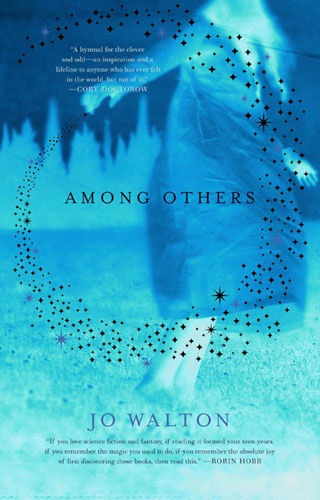
While I’m going on about Among Others, I have a thought about morality that can be pulled from it.

“I went into Woolworths where I pinched a bottle of talc and a Twix […] I wouldn’t take a book though, or rather, I would from Woolworths, if they had any, but I wouldn’t from a bookshop, not unless I was desperate.”

There’s a lot of dystopic settings in SF/F that show how morality goes out the window in extreme situations. I could have taken any of them as an example. But I think this hits much closer to home, and it shows degrees both in when we’re willing to steal and who we’re willing to steal from. It’s very easy to be moral when you have a decent steady income. I buy every book I read*, because I can and I know others can’t. If I was unable to buy the books I would still read them somehow, and hope that someone in a better position than me could buy them to make up the difference. A lot of us are good simply because we can afford to be.

The solution to this is fairly obvious – to create better people, create more wealth. Scientific and economic progress doesn’t just make us better off, it makes us better people. In the aggregate, the researchers at Bell Labs have done more to make the world a better place than any prophet.


* When possible. Some aren’t available


Sep 212012
 

Speaking of Among Others, I had an interesting conversation with Anaea Lay about the ending when we were at WorldCon.

Warning, here there be spoilers.

One of the things that you notice as you’re leaving religion is that almost nobody acts like they believe in an afterlife. With few exceptions, no one acts like it’s going on to the next stage of life – like going through puberty, or moving to a different city. Everyone treats it like it is the annihilation of a human soul. It’s one of the clues that tips off observant children that this whole religion thing is probably bullshit.

As I mentioned in my book-club review, there’s two ways to read Among Others. One way is as a fantasy, that actually contains fairies and ghosts and magic. The other way is as the story of a girl struggling with mental illness. Specifically, she’s written as someone who is succumbing to schizophrenia, in a family with a history of schizophrenia. I’ve been told that Jo Walton based many of the things that happened in the book on events in her life, as she did grow up with a mother suffering from schizophrenia. As such, there’s two ways to read the ending.

The naturalist reading is a triumph. Mor overcomes her mental problems and doesn’t commit suicide. She goes on to live a happy, prosperous life as a Sci-Fi author.

The supernaturalist reading is a horror story. Mor casts her sister half-mauled into some unknown afterlife, having robbed her of the chance to be eternal and happy as a fairie, with the knowledge of magic running in their veins. She chooses instead to go be with her new boyfriend.

As was pointed out by Anaea, it is akin to having a choice between moving to a different country with your sister, or delaying moving to that country for a few decades so you can hang out with your new crush and knowing that this will cause you sister’s legs to be crippled and her left arm amputated. Sure, it sucks that you’re forced to make that choice. In an ideal world you wouldn’t have to choose between your new romance and your sister’s limbs. But once you’re in that position, there is NO WAY that not saving your sister is the correct moral choice.

This did not occur to me, because I was committed to the naturalist reading. But this also did not occur to Jo Walton or almost anyone else who read this with the supernaturalist view, even though it should have. Because just like all the religious people out there who profess to believe in an afterlife but still treat it as annihilation, the characters in the story act like there is no afterlife. In a world with no afterlife Mor’s choice was correct, and most readers in this world cannot suspend that feeling even when we’re presented with a world in which there IS an afterlife. We still react as if there isn’t one.

(It’s similar to how many readers of Movement couldn’t get past the fact that autistic children require compassion and acceptance in OUR world to realize that not treating them in a fictional world where a treatment is available is immoral, as I argued).

I consider this another good reason to stick with the naturalist reading of the book. I prefer to have a heroine that is strong and relatable, rather than an amoral beast.