Jan 252017
 

The primary thing I personally want to say is that there is almost no such thing as malicious evil. All evil is done by people who think they are doing good. Even the Nazi thinks that he is safe-guarding his society from exploitative forces that wish to drain it and abandon the hollowed-out ruin. The fact that doing evil ALWAYS FEELS LIKE DOING GOOD is exactly why we can’t count on arguments of “it’s for the good in this case” special-exceptions. We spent a lot of time and social capital on arriving at “Extra-judicial violence is never acceptable.” The fact that it feels so right and good to break an established rule against violence should give us pause. Twice.

Here’s some other things said on Facebook, which means it’ll disappear in just a few days, and that I wish to preserve for posterity.


L: One of the reasons we support liberal civilization is because it keeps us safer than an authoritarian regime would, even one that we thought was “on our side”.

The prohibition against private political violence is the absolute cornerstone of civilization. It is prior to free speech. It is prior to democracy. It is prior to egalitarianism. It is the very first step towards freedom and liberalism. It is the Schelling fence that must be defended above all others.

What’s terrifying isn’t that an idiot nazi blogger got punched. An occupational hazard of being an asshole is that people are more likely to punch you. What’s terrifying is that I’m arguing with people who think they are liberals on Facebook about whether or not to condone it.

I’m upset that so many people claiming to be liberals endorse punching people for the explicit purpose of political intimidation. That’s a big deal. That scares the shit out of me.

Jan 232017
 

I’m a big fan of Malcolm X. In fact, I used to think I supported violence-as-a-solution more than most people, and stayed quiet about those beliefs out of shame. Richard Spencer being punched has proven me wrong.

Race riots were acceptable & necessary because the law was on the side of racial oppression. That was an armed struggle against state-sponsored terrorism. The law supported and protected extra-judicial violence against black people.

The law is not on the side of the Nazis. In fact, the only law that IS on Richard Spencer’s side is the law guaranteeing freedom of speech. If our side is the one resorting to extra-judicial violence because we take issue with a law guaranteeing *freedom of speech*, we might need to take a serious look at ourselves.

Some people I know are saying that the law now IS on the side of the Nazis. I don’t see any evidence of this yet. Simply asserting “Trump loves Nazis” absolutely does not do it for me, because anyone can assert anything. I am, of course, worried that this will become the case. I was horrified when Trump called for a “2nd Amendment” solution to a Clinton win. But just as I would expect any decent person in the Republican party to say “Guys, that’s not OK,” I’m also willing to say that, until we see this happening, we shouldn’t be the first to resort to vigilante violence.

Yes, Spencer is a racist who advocates awful things. He organizes like-minded people and tries to rally them to political action. The Westboro Baptists so the same. So does the KKK. I think there’s better ways of handling this than anonymous beatings in the streets.

Spencer was literally on a public street, answering questions that an interested reporter was putting to him. Are we OK setting a precedent of walking up to two people engaged in a conversation and punching the one we dislike?

Germany has straight-up made Nazi rhetoric illegal. I think they’ve decided on a good tactic. I would be more than willing to at least seriously propose a similar law here in the US. Any system that protects ideologies that calls for its destruction is lacking a certain self-preservation instinct. It would have to be a careful law. But it is, at least, a good idea in the abstract. I would much rather live in a system where the law clearly carves out certain speech as unacceptable and Nazis face legal consequences, rather than having to live in a world of anarchy where I have to hope that I’m not on the wrong side of mob sentiment lest I be beaten and everyone decides to look the other way.

There will always be crazy fuckers with awful ideas. You discredit them, and you rely on the laws to protect us from their violence. The law is what holds them back. It’s when the law fails to do so that things are dangerous (see: the South, up until just a few decades ago). That’s why I become worried when people gleefully cheer at the failure of the law to protect people from violence. If you think beating someone in the street will effectively discredit them and keep public opinion on your side, well, I think that’s a bad way to influence public opinion.


Follow-up note: I’ve had one note of disagreement cleared up when it turned out me and a friend view a punch to the face as very different levels of violence. To me, it’s the first step to a beating, and the horrors that come with that. To them, it was merely the outside-level of a slap. I would not be nearly as horrified by a slap, or something symbolic like a thrown shoe. I see a lot more violence in a closed fist.

Jan 222017
 

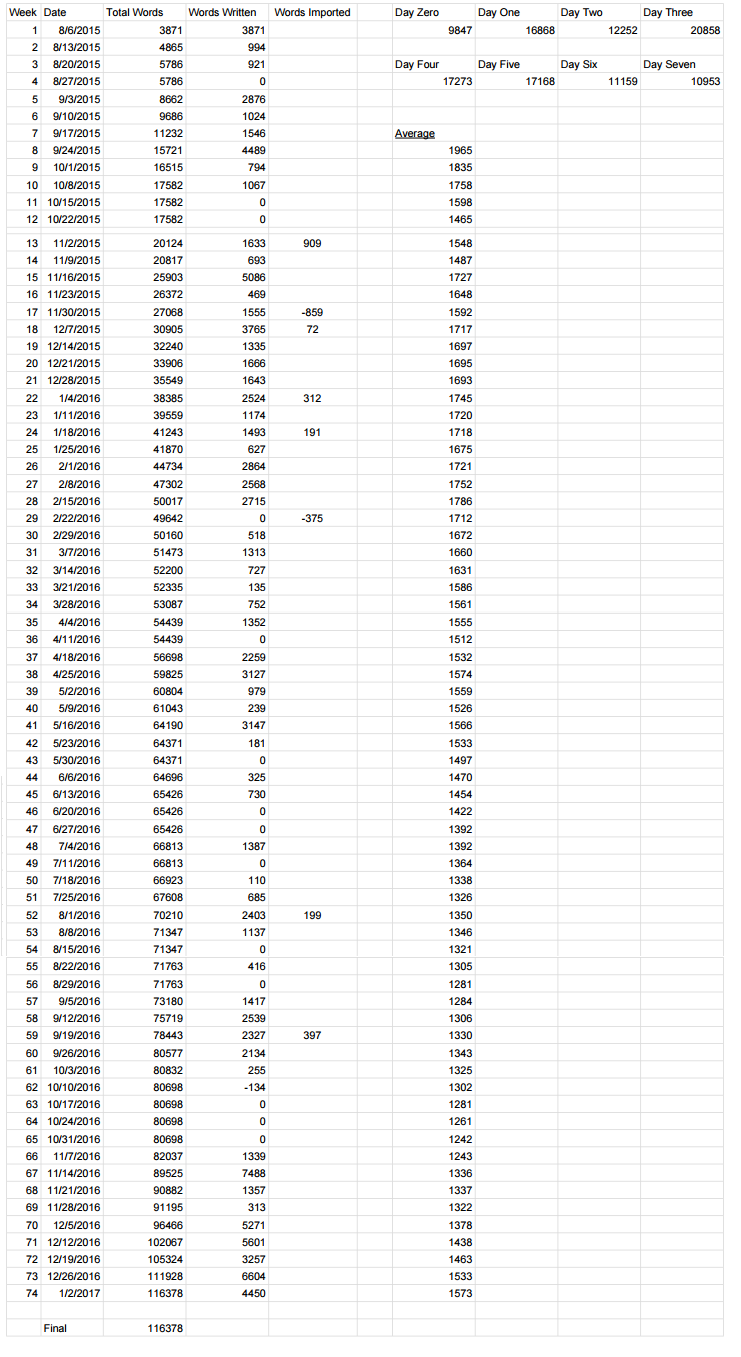
In mid-November I was laid off from my accounting job, and decided to finish my novel by year’s end. Despite a huge shock to my personal life right about that time (of which there are still all sorts of aftershocks), I managed to do so. :) I wrote the final line on Dec 30th, 2016.

I’m in my revision pass now, which looks like it’ll take a couple months in itself. But a couple things I’ve learned so far:

1. Working for yourself is far more intense than working for The Man.

I thought working for myself would be relaxing. A nice change of pace from the demands of corporate life, since I could work when and where I liked, and no uniform is required. Oh how wrong I was.

I should perhaps put “working” in quotes, because there’s no guarantee I’ll ever see any money for this. But that being said – when I’m working The Man and I’m at the office, I get paid for every hour that I’m there, period. I don’t have to be at the top of my game. If I show up Monday after a big party weekend, and I’m hungover and working at half-efficiency? No big deal. If I surf Facebook or chat with my coworkers for an hour? Still getting paid.

My posts to this blog have dropped off quite a bit over the last few months. I’m behind with most of the blogs I read, as well as not following the news as much, and I’ve abandoned several podcasts I used to listen to religiously. Because I just don’t have the time anymore. Every single minute I’m NOT working is time that I’m not getting paid, so to speak. Every hour of my life is now divided into “productive” (meaning may support my continuing to be alive) or “non-productive” (which feels like it’s wasted entirely). It’s intense. There is no such thing as “time off” or “down time” or even “slack” when you work for yourself. There’s only Doing The Thing, or Not. And getting sick is a double-whammy. It makes me more jealous of my time, and I was already fairly jealous of it.

I used to work on the Methods of Rationality podcast at the office, during my lunch hour. It was a lot like getting paid to work on my podcast. Now I have to chisel out 6-8 hours of my life every two weeks, taking time away from my writing, or my friends/family, or just rest, to do so. I used to always be a full episode ahead, now I rarely get it finished more than 3 days before it goes live. I still love it, but before it was something I used to fill my “free” time, and now it is a more dearly-felt cost.

I can honestly say I have worked far harder during my last few months of unemployment than I ever worked when I was grinding away in the last decade at the 9-5 (with the exception of some very hairy Quarter-End months.)

2. Starbucks is awesome, cuz work environment matters.

I discovered pretty quickly that working at home just wasn’t working for me. It was too easy to get distracted. There was always something to read, or to do. More than anything else, my bed was right there, and the nap times called me.

“How can I write well when I’m this tired? I can’t. I must rest my brain, and I’ll write afterwards. Whoops, it’s two days later.”

It just felt like such a hollow pursuit. I was floating in a strange limbo and nothing I did mattered. So I went to Starbucks.

At Starbucks, there are other humans. Those humans are always looking at me and judging me. If I am typing away, being productive, they smile, and judge me worthy. If I am surfing the internet or chatting on Facebook, they see how I am wasting my life, and scowl.

I know this isn’t actually true. No one gives a shit what I’m doing, they don’t look at me or my screen. But now I’m no longer in some weird dreamtime, I’m among humans. I’m grounded in the real world. And I’m reminded why I write. It’s for these people around me. To some day be seen and validated and maybe maybe even admired. So I sit, and I write, and I feel good about it. I know this isn’t psychologically healthy, but fuck it – do what works. Cuz in the end that’s all that matters.

Also, no bed nearby, so naps are not an option. :)


Anyway, I still need to do a full revision pass, and find an agent, and find a publisher, so I’m only like halfway through the process. And I’ll have to get a day job pretty soon to pay the bills too. But I’m happy to have discovered that if I ever get the chance to do this sort of thing for a living for real, I have the self-discipline to actually sit down and write a novel, rather than sliding into sloth and hedonism. :)

Jan 182017
 

Oh how I hate the media. Are they TRYING to help Trump?

This article leads with DeVos’s Gun vs Bears comment. (“I will refer back to Sen. [Mike] Enzi and the school he was talking about in Wyoming. I think probably there, I would imagine that there is probably a gun in the schools to protect from potential grizzlies.”) It’s also the highlight line under the picture when you share on Facebook: “She wouldn’t say guns don’t belong in schools–and cited a school’s need to protect itself from “potential grizzlies.” Bears, that is.”

That just means she’s really shitty at social posturing. We all know the correct PR answer is “Guns never belong in schools!” and then to demure and say “of course some exceptions can be made in extreme situations, such as to protect our children from rampaging bears.” The fact that she was honest and led with “Well sometimes guns are necessary” shouldn’t be a strike against her. I prefer honesty over political double-talk.

In fact, this makes me sympathize with her very much, because I hate bullshit. So when the rest of the article goes on to point out how absolutely clueless and incompetent she is, I’m now asking myself “How much of this is true, and how much is it the source doing it’s best to smear her?”

But I guess having a snappy “omg she’s scared of bears and loves guns everywhere cuz of it” line will get more people to click through. At least that must be the media’s expectation. It SURE got me talking about it, and linking it! It’s Moloch, in the flesh. I wish there was some way to discourage/punish this sort of behavior.

Jan 132017
 

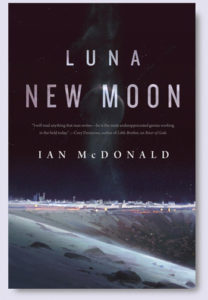
Luna: New Moon, by Ian McDonald

Synopsis:  The Godfather, on the moon

Book Review: I don’t have much to say about this, as I was neither wowed or disappointed. It is basically The Godfather, on the moon.

The physics is hard, as one would expect.

The society is extreme libertarian, to the point of there not being any police or law besides “contract law.” It’s an interesting portrait because normally these sorts of things are written as Libertarian Utopias by hardcore libertarians. This is written very much like a world of feuding crime families, with no law for the masses to appeal to, which feels far more realistic. But since the POV is from the crime family’s perspective, you only get the barest glimpse of how much this sucks for almost everyone else, and instead follow the rich and powerful as they brawl for resources.

This sounds like a good plot, and to be honest, the plotting is good. But you’ve already seen this plot as one of the most-revered movies in cinema history. The characters, meanwhile, are kinda flat and interchangeable. There’s just too damn many of them. And there is very little introspection or thinking, just action after action. This is great for some people, but I like my fiction to be more “thinky.”

In the end, not bad, but certainly not McDonald’s best, and not something I’ll remember in a few weeks. Not Recommended.

Book Club Review: Kinda the same as the book review. Reaction was mixed, but no one was disappointed. There were some fun things to talk about, and we had a nice evening. But I wouldn’t say this is one to seek out and really recommend to your group over other options so… Not Recommended.

Jan 082017
 

I despise what the Republican Congress is doing. These motherfuckers bring out hatred in me. For example – Republicans Confirm Planned Parenthood Will Lose Federal Funding As Soon As Next Month.

I.

Aaaaaaand then a friend of mine states that all Republicans are horrible people, and there are no decent people who are registered (R). I’m horrified that many of my friends are turning into the sort of sweeping-generalizations mob that I used to see from the Right. How is this any different from “All Muslims are horrible?”

II.

I’m told repeatedly that hating someone for taking away your rights and humanity is acceptable. And yeah, I also hate the Republican Establishment. Everyone has every right to feel as pissed off and angry at this bullshit that’s coming down the pike as they want. We’re going to NEED a lot of anger to fight it.

But there are good Republicans, just like there are good [any group you care to name]. The more the message “ALL X ARE EVIL” is repeated, the more it makes it acceptable for people to lash out in violence against anyone who is, or is perceived to be, X. It’s the constant repeating of the rhetoric that creates an environment that leads to violence. We were complaining about the Trump rallies doing this, but we’ve seen it happen many times before. Hundreds of times in history. Have we learned nothing?

There are a lot of people who hate Trump, and want diversity and coexistence, and who identify as Republican. It is immoral to say they’re all evil.

III.

So I’m told I’m an example of the Banality of Evil.  A poster-boy for “The only thing necessary for the triumph of evil is for good men to do nothing.”

But that’s kinda the opposite of what’s happening, isn’t it? I’m standing up for my few republican friends precisely because I refuse to sit down and do nothing. It sucks being called evil by my own community, simply because I won’t throw a couple people I know under the bus.

IV.

They ask: What makes a Republican a “good one?” What steps are they taking to protect the weakest among us? Where are all these “good people”? What are they doing?

I provide links to the Republicans Who Have Renounced Trump, and the Log Cabin Republicans, but my reply is that this is the exact same question as “Where are are the Muslims decrying the terrorist violence? Why aren’t they policing their community? Why aren’t they telling us about the attacks the extremists are planning?” Are these fair questions to ask of the Muslim community? If not, do you know why not?

The Republican Party has some vile shit in its platform. The Koran has some vile shit in it as well. If you think the Republican Platform is bad, look at the founding documents of any of the three Abrahamic religions. And yet we all accept that people who claim that these are the most important books in their lives, and that their highest ideal is to live by them, can still be good people. If we can do that for Jews, Christians, and Muslims, but we can’t do it for Republicans, why is that?

V.

I’m told plenty of religious people are great: they negotiate with their religion and try to live by it but also seek a separate peace from the nasty stuff that has no business being a part of a modern mindset. People phrase things all sorts of ways, and “Living by” means different things to different people. What would it mean to “live by” the ideals of the Republican Party at this point?

Which is exactly my point. This does mean different things to different people, and for someone from the outside to say “THIS is what it means to “live by” your ideals!” to a different group isn’t any different than someone saying socialists want to starve 50 million people to death. Or pick your choice of slander.

In practice altering an entire ideology is slow and difficult work. In the real world everyone has to worry about procedure, convincing the majority of their constituents, power grabs by people who are more conservative than you are, etc. The Democratic Party’s change on gay marriage, for example, was no quick whim. It took decades of struggle. DADT and DOMA (for non-US readers, these are anti-gay legislation from the 90s) were both signed in by a smiling Clinton. Just a few years before Obama “evolved” on the issue he was speaking about how marriage should be between a man and a woman, while Dick-freaking-Cheney, one of the most evil men in the US, was defending gay rights. I know, right?? The world is a weird place.

So what do people do? They stay with the ideology they were raised with, that of the community around them, that broadly looks more like it represents them than the alternatives, or at least enough to the point that it isn’t worth the loss of your community for switching, and just cherry-pick their beliefs! It’s damned infuriating. But it doesn’t make them bad, it just makes them human.

And by cherry-picking, and standing up for their gay/women/whatever friends, they are making a change. (incidentally, that’s why I’m standing up for my R friends. I want to see our group be less myopic and viscous.) Some of them even join groups that attempt to make direct change! Calling those progressive voices that are trying to bring it back to moderation horrible/despicable people hurts the reform movement.

Both political parties are evolving. Let’s not evolve away from what made us the right side in the first place.

Jan 022017
 

(text of pic: You and some other guy are glued to the tracks. Any of you can pull the lever, releasing the trolley and killing the other guy. You told the other guy that you’ll pulll the level if he does, hoping he won’t kill you. After a long time, he finally pulls the lever. Do you keep your promise and lead to 2 deaths instead of 1?)

This is prob common knowledge, but hey, here’s my answers
1 – Yes. If someone’s killing me, sure as hell I’m gonna do everything in my power to kill him back. Screw that guy.
2 – Yes. If you don’t follow through on precommitments, it leaves you open to exploitation by defectors. Slightly less important for you personally if there’s only one of you but…
..2a – could still be very important if someone has access to your source code, OR if you’re actually a simulation being simulated by a predictor to see what the real-you would do in this situation so they know if it’s safe to defect or not, and
..2b – even if this is the real world rather than a simulation, your actions will reflect on those who are similar to you, which likely includes many of your friends and loved ones. If you don’t pull the lever, this is weak-to-moderate evidence that your loved ones also wouldn’t pull the lever if put in the same situation, and that leaves them open to exploitation.
3 – This would be much harder to apply in the case of actual nuclear weapons. But fortunately these are trolleys, so I don’t have to think that hard :)

The more interesting question is… if you’re glued to the tracks and have nothing else to do for your entire life (and you can’t talk to the other guy)… should you pull the lever just for the excitement of seeing what he’ll do?

Dec 312016
 

I recently posted a negative review of a book that is, IMHO, bad. The author is well-known, especially for an earlier work that is very well regarded, and a commenter was wondering if they should bump it further back on their “to read” list based on the weakness of this latest work.

My short answer is No.

The longer answer is that for artistic (I) and business (II) reasons, (as well as some fears of my own (III)) it’s very hard to estimate how good one piece of art will be simply based on the fact that it was made by the same creator as a different piece of art.

I.

The artistic reason is because no one really knows what makes something resonate with people at the object level. There are a lot of hints and guidelines (“bleed onto the page”), but there is no way to evaluate a work and say “This will be known as a work of genius” short of releasing it into the wild and watching the results.

This is infuriating to artists (especially to those of us who equate love of our work with self-worth. It sucks to have your value as a human fluctuate based on criteria that are unknowable and spooky and seemingly random!) There is a famous story about Harlan Ellison that really demonstrates this. (I don’t have a cite, so consider it apocryphal until confirmed) He poured his soul into a story. It drew on everything that made him tick, so it’s hard to say how long he spent “writing” it, but in terms of working with ink and paper he spent weeks creating, revising, and polishing it, until it was perfect. It would be his masterwork, and he sent it to his publisher in the knowledge that soon his name would be cemented in SF history. That same night, he jotted off a quick story on a lark, to take a break from the serious writing, and sent that off the next day to a different market. The first story never gained any acclaim, no one remembers it, I don’t even know what it was called. The second story is “I Have No Mouth And I Must Scream,” which is one of the best-known and most-reprinted SF short stories in the genre’s history.

And this sort of thing happens all the time. Every single writer in my Top 5 post has put out work that I considered sub-par, and in some cases just plain shitty. Even Vellum, which I can say probably makes up a portion of my soul, was followed-up by a sequel that was…. well, I basically just ignore that it exists. The same director that gave us Blade Runner (one of the best films to grace the screen) also gave us Prometheus (which I can’t bring myself to link).

Artists have an extremely difficult time seeing what works and what doesn’t when it comes to their own work. The fear is that this can result in great things being lost. My current go-to example is “The Fifth Season“, which is fucking amazing, and one of the best things I’ve read in at least two years. OMG it’s so good. The author, NK Jemisin, said in an interview (which I read myself, so True Fact) that she nearly threw out the entire manuscript because it was such a foaming pile of shit in her eyes that she couldn’t face putting her name on it. Her friends convinced her otherwise, and it made my year, and (perhaps more importantly) won the 2016 Best Novel Hugo. For this reason artists are told not to “self-reject.” The tragedy of a Fifth Season being lost is much worse than if a CrossTalk makes it into publication. Artists to encouraged to simply keep putting things out and let the public judge.


II.

The business reason is pretty straightforward. Once an artist does produce something truly amazing, they gain a fan base. Before this time, an artist is a financial risk. Editors and publishers look critically at all work from unknowns, and in theory only things of a certain minimum quality get through. There is a check on the worst stuff. Upcoming artists know this as well, and they often put a ton of effort and angst into making their work as good as it can possibly be. The Jinni And The Golem took the author seven years to write, which is a ridiculously long time. But it paid off.

Once a writer is an award-winning, best-selling author, these checks basically disappear. A publisher knows that the author’s next work will sell, period. An editor may still try their best to force improvements and changes, but the editor is employed by the publisher, and the publisher wants the next book without too much hassle, so they can make a profit. They certainly won’t accept a flat rejection from the editor. And the editor is under psychological pressure as well… they’re altering the work of an award-winning, best-selling artist. That likely causes them to overlook things simply because “maybe this is the new zeitgeist the author is tapping into,” or similar. Of course everyone involved wants the book to be GOOD! They have brands and reputations to maintain, and a good work sells better than a poor one. But the knowledge that this isn’t a major financial risk anymore, combined with the fact that no one really knows what’s good or not (as per Section I), means more mediocre stuff will get through.


III.

I also have a couple personal fears about causes behind this.

The first fear is that no one has more than one truly genius work inside of them. This is the terror that keeps me up at night. That everything that makes someone who they are can be best expressed in one ground-shaking work. Most people will never make their ground-shaking work. But some of them are lucky enough to make their Neuromancer or their Catcher In The Rye. And everything after that is simply chasing the dragon. It is riding on the glory of that first success. For some people this artistic climax doesn’t come until midway through their career, or maybe at the very end of it. For others it comes right at the start. I don’t know which is worse. If it comes near the start, then you can live off your art for the rest of your life, as your fans continue to buy the rest of your works. On the other hand, you will forever be striving to match that first incredible piece, and you will always fall short, for as long as you live. Oh god. :(

This is basically a “regression to the mean” effect, and one shouldn’t miss out on an artist’s fantastic outlier at their peak simply because later/earlier works have regressed to the mean.

The other fear is that art comes from pain. Once an artist puts out that big hit, they get acceptance, and love, and money, all of which make life suck less. Also they can often use that money to get therapy and become more complete and less-broken humans. Which also means they can’t put out work as good as they did when they were in pain. So, horrifyingly, the choice is between a good life or good art. :( Naturally, most people choose a good life.


IV.

So in summary, no, don’t bump something down a list just because other works by the same artist are kinda crappy. There isn’t much relation. You can certainly judge some things based on author… I’ve read a few things by Mira Grant, and despite her popularity, I really hate all of them. I will never read something she’s written again, unless I get a LOT of assurance from sources I really trust that this work is a break from the past, and actually is in-freaking-credible. And likewise, I’ll probably read everything Yudkowsky and Chiang ever put out.

But if you’ve heard a work is genuinely great, like The Doomsday Book is said to be, and it’s well-regarded by the community and/or people you trust, and it’s won awards… well, then it is very likely good, and don’t let future works affect your ordering.


Dec 162016
 

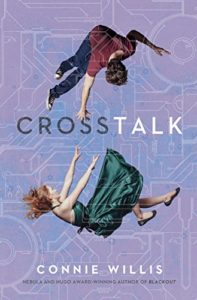
CrossTalk, by Connie Willis

Synopsis:  A rom-com wherein the Irish have telepathy, but no one knows about it, and the Irish have not taken over the world.

Book Review: I like some rom-coms. There is something to be said for a well executed love story with great comedic elements. My personal favorite is Moonstruck, which is just the best. But many rom-coms are absolute garbage, because to work at all they rely on humans acting in the most unbelievable ways. Their protagonists have to be intentionally obtuse, failing utterly at even the most basic communication skills. They make decisions that are so mindbogglingly stupid that they can only be justified if the people involved know that they are characters in a bad movie and they must make these choices in service to the plot, so this turd can finally reach it’s end and they can be put out of their misery.

CrossTalk is the SF novelization of that sort of movie. It is aggressively ANTI-rationalist. The book would come to an immediate end if the protagonists ever had a brief, honest conversation, rather than lying through their teeth and hiding EVERYTHING for NO REASON.

Seriously, for no reason at all. Let’s say you just got brain surgery to become telepathic with one specific person–your fiance. But when you wake up, something has gone wrong! You are telepathic with the wrong person! Would you not immediately say to the brain surgeon “Hey, I think something went wrong with the surgery?” Or would you instead lie about this and hide the fact from all medical professionals, and your fiance, and everyone in your life? Do you LIKE botched brain surgery? What is wrong with you??

Also, the person you now have the telepathic connection to is the creepy stalker guy who’s got a crush on you, and who has been trying to tell you for days to not go forward with this surgery that would link you to your fiance. He is the immediate #1 suspect for what went wrong, right? I mean, this is way too convenient to be a coincidence, it’s obvious this was sabotage on his part! Yet for some reason you blindly accept that these facts are unrelated?

AND! Despite the fact that you specifically had a telepathy chip installed in your brain, and a million lines of evidence point directly to “I now have telepathy”, you will doggedly insist for quite a while that your creepy stalker has installed bugs and cameras everywhere, and is speaking to you through some OTHER secret means, rather than via the telepathy chip you now carry! What are you even thinking??

All this happens within the first few chapters, and it just keeps going like this for the entire damn book. Oh my god.

That’s just the PERSONAL ridiculousness that makes individual people obviously brain-damaged caricatures. The entire world has structural problems as well, because we later discover that telepathy is a natural ability that people of Irish descent possess. Yet no one else in the world knows they have this power! In fact, most Irish people don’t even know until it manifests in them and then their relatives have to have “the talk” with them. They’ve certainly never used this ability to take over the world, or to make a killing in business, or for any sort of intelligence advantage at all. It is used STRICTLY for gossip. This is a failure of imagination so egregious that I would only expect it of a Lit Fic author.

The supposed theme is an utter failure as well. The author was trying to make a point about how terrible having telepathy would be, and trying to make some sort of connection to social media, to scold all the young people. But she is sabotaged by her own subconscious belief that telepathy is awesome. Because every character who gets telepathy in this book LOVES it. It is an amazing tool! It’s like having another sense, or a super-power. Yes, at first it’s very confusing and scary… but with a minimal level of training, all these problems are easily overcome. Seriously, it only takes a few days for the idiot-level protagonist to learn how to block out other voices and concentrate just on who she wants to talk to. (And she gets the ability to secretly read minds in the process!!) In the novel even a 9-year-old masters the ability in a week or two! Look, it takes humans significantly longer than that to learn HOW TO WALK. But we put in the effort anyway, because it’s a fucking amazing ability. Ain’t no one writing screeds about how awful walking is because there was this painful learning process. And, true to form, when characters lose their telepathy, they are horrified. It hurts, and they want the ability back, because it really is awesome. Losing it is like losing a limb. But this is a book against telepathy?

Most infuriating of all are the “villains” of the story. I’m a transhumanist, so I want all humans to be the best humans they can. More health, more life, more intellect, more abilities, etc. These are good things! The antagonists of CrossTalk are people who want to take the demonstrably-awesome ability of telepathy and give it to all humanity. Instead of just the Irish having it, now we can all be telepathic. Our protagonists spend most the book fighting against them. Our protagonists are the evil elitist cabal who wishes to retain this power only for themselves, and leave the rest of humanity crippled. They are the equivalent of sighted people with a cure for blindness, living in a planet of the blind, who refuse to let this cure get out to anyone outside of their ethnic group. Why am I supposed to be cheering for the evil people of this story?

The one good part of all this is the 9-year-old, who is a spunky and whip-smart girl that uses almost no slang from the 50s. I would have enjoyed a book following her. She was likable, and the only character in this mess that didn’t have her head firmly up her own ass. Unfortunately, that was not this book. Not Recommended.

Book Club Review: No.

It’s kinda surprising this book is so bad. Connie Willis has written amazing things in the past. “To Say Nothing Of The Dog” and “Doomsday Book” are extremely well regarding in SF circles. She’s won multiple Hugo and Nebula awards! This reinforces my “once an author gets big enough, people will buy anything they publish, and so there is no longer a filter that restricts them to only publishing their genius stuff” theory. C’est la vie.

Not Recommended.

Dec 132016
 

This is a tale of two blog posts. The first is a Tumblr post that made me FEEL STUFF, and did so fantastically.

There are a lot of arguments about why the FDA is bad. Scott Alexander has posted about it several times on his site, and he’s far from the only one. A person can read these articles and say “Why yes, this is a travesty! The FDA must be reigned in before it destroys us all!”

And then someone posts something like this (specifically the part by KungFuNurse) and the imagine of a snake-oil salesman killing innocent people with Patent Tonics and then skipping town with their money is simply so emotionally compelling and super-available that it’s hard to not be swayed by it. It requires a real effort to remain committed to what I can see is the case via calculating costs vs. benefits, rather than the image of my poor mom being swindled and killed. :(

So I am eternally grateful when someone comes forward and puts it in no-nonsense SUPER EMOTIVE terms why the FDA is fucking them and ruining their lives. Especially because these regulations are ones that I know happen to people I KNOW PERSONALLY, rather than the snake-oil song-and-dance that touches almost no one. Because I know click-through is awful, here’s the full text from the link:

your regulation is #problematic, statecucks

So, the shitlib FDA apologists etc. just love to peddle the bollocks that regulation protects the vulnerable, the marginalized, the badbrains, the executively dysfunctional, the people every PC cuck loves to pretend to give a shit about while actually cucking us over every single chance they get.

And it’s bullshit. Here’s what the nanny state actually looks like to its victims:

> you have a medication you’re going to be using every single fucking day for the rest of your goddamn life or at least until you get an artifical gland installed to produce it endogenously
> you cannot do the sane thing of simply placing a regular order for it online and having it delivered to your home,
> you need to walk how fucking many* kilometres (or take the goddamn bus) to one of the few pharmacies in town (because the state regulates their numbers) to buy your permitted refill (because it’s either completely illegal to buy more than 3 months supply at a time, or the pharmacies just never sell more because the public medical insurance limits its coverage to 3 months at a time)
> you need to keep renewing the prescription all the fucking time

> you have a very useful medication which requires a special permit
> and of fucking course you need to keep renewing the fucking prescription
> only a few doctors in the entire fucking county even know how to apply for the special permits
> your doctor, naturally, is not one of them
> you need to get the papers the previous doctor wrote about it from the county public healthcare shitstem office something department of fuck you
> you cannot go ask them in meatspace because there is no fucking person who could do it
> you cannot ask them on the phone because “””security implications”””, even if you ask for them to be delivered via mail to the exact home address the motherfuckers have on file so the only way for them to not end up to the only person who should have access to them is for some creep to intercept the mail, after lying in wait for something like a couple of weeks because they can’t be expected to deliver shit on time, so basically zero chance, but nonetheless ~*~in theory~*~ it might not work that way so fuck you
> you need to write a fucking letter to some fucking bureaucrats to pretty please ask them to give you your medical files uwu
> there is no ready-made template because fuck you
> you’ve been trying to do it for six months but unable to get it done because you have no fucking idea how to write a fucking information request for some fucking intentionally obtuse statecuck bureaucracy

> drug A basically cures your ADHD-related anxiety
> of course it has no sales permit so you cannot get it even though it has been used elsewhere for decades and has no demonstrated risks or addictive potential
> because fuck you

> drugs B and C seem promising for treating your ADHD-related anxiety and they have no abuse potential either
> they even have sales permits
> but not for ADHD-related anxiety so the doctor will not prescribe it because fuck you

> what you can get is legendary-sized massive overprescriptions of Valium and other benzodiazepines with a respectable street price because those are approved for sale
> because the State wants to protect people from potentially addictive and/or risky drugs, duh
> because fuck you

To every goddamn socdem shitlib FDA apologist statecuck:

#problematic, #problematic, #problematic!

NONE OF YOU ARE FREE FROM #PROBLEMATIC

(as an aside, I guess “cuck” is now basically a synomyn for “fuck?” That happened fast…)

I will keep this forever, because it drives home the frustration and real harm that is actually caused. I love this post!

OTOH, this isn’t really something that you can use to change minds. Is it? It’s not like it’s something that anyone would propose a counter-argument to, because it just plain isn’t amenable to that sort of engagement. And if something can’t be counter-argued, it shouldn’t be allowed to be an argument either. So this is purely to align emotional-motivation with intellectual-motivation. I’m already on record as saying this is a wonderful thing, so props for that! But it’s basically for the choir, right?

And then the OP went and translated the whole thing into Respectable-Speak, which can be counter-argued if one wanted to:

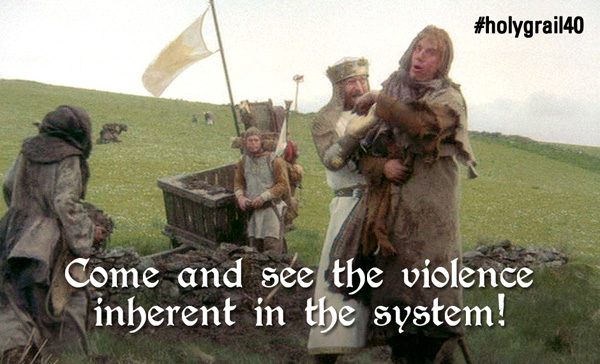
The Violence Inherent in the System of Rationing Access to Drugs

In popular imagination, especially in left-leaning memeplexes, it’s common to think of barriers like FDA approvals and prescription requirements as helping people by protecting them from being harmed by the medication they use. However, I would like to argue that this has great harms to many vulnerable populations, especially (but not limited to) people with insufficient material resources, executive functioning issues, many kinds of disabilities, etc.

One common failure mode is where people will be on a steady dose of the same drug for the rest of their foreseeable life. In that case it would definitely seem reasonable that people would be able to keep using that drug without any unnecessary hassles, as the typical objections of “can we know it works for them”, “do they know how to use it” etc. are utterly moot.

This is not usually the case. The exact details vary (it’s definitely different in the US than in Finland), but around here prescription-only drugs will require constant renewals and refills under “professional supervision”. I cannot simply go to the website of a pharmacy and order my estradiol like it’s vitamins from Amazon; I have to waste the time of us both by getting the purchase rubber-stamped by a real person, either physically in the pharmacy, on the phone, or in an online chat service.

While this may seem relatively convenient (and admittedly it has been made as easy as the rules allow), it doesn’t change the fact that one cannot observe any solid reason for such barriers to access, and it doesn’t take much to render that convenience substantially less consequential if one has eg. movement difficulties, social phobia, or any of the other weird brain things reality in its persistent insistence to be inconvenient tends to heap upon the unfortunate and underprivileged.

When ones needs move outside the ordinary, things get even worse. I’m a modafinil user lucky enough to have an actual prescription for it, or more accurately, I would be if I was able to deal with the bureaucracy around the special permits required. My current doctor doesn’t know how to apply for the special permit, so I need to get the permit application the previous doctor wrote.

I cannot get the documents by showing up physically at desk whatever of building N of the county healthcare department of something.

I cannot request the documents via phone because of alleged patient confidentiality issues; not even with the limitation that I would request them to the address the healthcare department has in their patient records, which would effectively eliminate any potential privacy issues as the mail could not be redirected without physically intercepting it, and any adversary capable of consistently intercepting my mail already has full access to my confidential info anyway. Common sense and realistic threat analysis don’t matter to bureaucracy.

There obviously is no convenient web interface where I could use my online banking credentials to order them mailed to me, let alone view them right there (Finland has a system where people can use their bank logins as official ID for many government functions; this has exactly the uncomfortable implications around privacy and government-corporate collusion one would expect, yet it fails at actually solving some of the problems it would naively seem inherently suitable for).

The only available way to request those documents is to write a physical paper letter to the county healthcare archive whatever offices. There naturally is no ready-made template for it, so I would have to whip up an Official Request in the language I’m less comfortable doing written communication in (long story) which happens to be even worse than phoning strangers without explicit invitation. Unsurprisingly I’m now over six months without modafinil because of this.

The harms created by regulating access to medication obviously get even worse when one moves outside the category of drugs that have actually managed to gain official approval for treating your issues; a distinction which uncomfortably often tends to be outright orthogonal to whether they do work for treating your issues.

Semax is an OTC drug in Russia, and has been in use there for decades. It also effectively cures my ADHD-related anxiety. It is not even manufactured and sold in the West except for some obscure companies which produce/procure it for not human consumption, and I have personal communications from the customs office that importing it would be considered a repeat offense. The fact that it has no demonstrated abuse potential nor has there been any evidence of significant harmful side effects doesn’t matter, as the law treats anything which could be used for treating illnesses, ailments etc. a regulated drug, unless it has been exempted as homeopathic or certain categories of herbal.

(It shouldn’t take much astuteness from the reader to notice that the law, while judging intent and purpose instead of eg. risks or abuse potential, specifically carves out an exception for homeopathy. This obviously undermines the common argument that regulations are keeping homeopaths and other quacks in check; in this case the regulation explicitly favors the homeopaths.)

Clonidine and guanfacine are approved as blood-pressure medications in Finland, and in the US they also have approval for treating ADHD-related issues. I haven’t tested them so I can’t conclusively say that they would help significantly (unlike semax which definitely does), but the fact that they are approved for sale doesn’t help as they are not approved for this particular purpose in this particular country. Despite once again lacking in addictiveness, abuse potential etc.

The US famously not approving thalidomide is often quoted by proponents of the notoriously strict FDA regulations (note how in this case the situation in Finland is even worse than under the yoke of the FDA), but empirical evidence shows that there is no meaningful difference between rich western countries in how often drugs get recalled for safety reasons: the number is consistently around 3-4%. This implies that a very unambitious and safe reform would be to categorically permit the use of any drug for any purpose (even if not officially approve) as long as it’s approved in one such country.

Now one would expect that at least such a strict system would do a reasonable job of protecting me from harm and addiction risk.

However, such reasonableness is nowhere to be found. In the past I have been prescribed the notoriously harmful atypical antipsychotic quetiapine for mere sleep issues, as that combination is approved. Currently my anxiety issues are kept in check by intermittent benzodiazepines (diazepam aka. Valium, and oxazepam) which not only do have substantial abuse potential as evident from their respectable street price, but they also are the substance I know I would get addicted to if I ever do (or specifically, the combination of benzodiazepines with stimulants; in perfectly prescription-conforming dosages even), and the prescriptions are (due to a quirk of the system how refill sizes are calculated; my “worst case dose” is multiplied under the assumption that I would take such amounts every day) sufficiently large to make not getting addicted a matter of individual choice as the rationing of amounts is incapable of having such an effect.

TL;DR: local bureaucracy valiantly protects trans person from harmless but unusual treatments, prescribes drugs that can cause severe long-term brain damage or actual abuse and addiction instead.

Now, while this is far more respectable, and something that’s more likely to get linked on my Facebook, it has no emotional resonance. I basically fell asleep reading it. It honestly felt like a long, exaggerated excuse that some FDA-hater came up with to propose all the most outlandish worst-case-scenario things that never actually happen to anyone. And even if by some coincidence they DID happen to someone, the otherside is grandma being killed by Dr Terminus, so I’m just gonna step back and figure the government’s got this one handled, K?

And so I’m greatly torn between things that have emotional relevance, and things that put forth reasoned arguments. I guess this is why we need both. We determine what is the best course by using dispassionate, reasoned thinking. Then we find a way to motivate ourselves to actually care by seeking out the emotive pleas that drive it.

I’d like to end this post by dropping IMMENSE gratitude on Scott Alexander, and Eliezer Yudkowsky. These are two writers who have consistently (and for long periods of time over many subjects) done the nearly-impossible. They’ve put forth reasoned arguments that have all the substance and grounding of the sober 2nd post, and infused them with much of the emotive persuasion and visceral appeal of the 1st post. They literally explained important and sobering things to me with tons of support, while making me care on a personal level, and being entertaining to boot. It’s an incredibly rare skill, and I am deeply grateful there are humans who can pull it off, and are willing to use their powers for Good.

<3