 AAAAHHHHH!!!!! I WILL BE PUBLISHED A SECOND TIME!!! My short story “Of All Possible Worlds” will be in “Swords v Cthulhu”, coming out early next year!
I will have written at least two things worth a damn before I die!!!!! :D :D :D
Jul 012015
AAAAHHHHH!!!!! I WILL BE PUBLISHED A SECOND TIME!!! My short story “Of All Possible Worlds” will be in “Swords v Cthulhu”, coming out early next year!
I will have written at least two things worth a damn before I die!!!!! :D :D :D
 Based on yesterday’s post, already two people asked why not just wirehead with a large and complex set of emotions.
I’m old enough to have played the original Doom when it came out (sooo old!). It had a cheat-code that made you invincible, commonly called god-mode. The first thing you notice is that it’s super cool to be invincible and just mow down all those monsters with impunity! The next thing you notice is that after a while (maybe ten minutes?) it loses all appeal. It becomes boring. There is no game anymore, once you no longer have to worry about taking damage. It becomes a task. You start enabling other cheats to get through it faster. Full-ammo cheats, to just use the biggest, fastest gun nonstop and get those monsters out of your way. Then walk-through-wall cheats, so you can just go straight to the level exit without wandering around looking for keys. Over, and over, and over again, level after level. It becomes a Kafka-esque grotesquery. Why am I doing this? Why am I here? Is my purpose just to keep walking endlessly from Spawn Point to Exit, the world passing around me in a blur, green and blue explosions obscuring all vision? When will this end?
It was a relief to be finished with the game.
That was my generation’s first brush with the difference between goal-oriented objectives, and process-oriented objectives. We learned that the point of a game isn’t to get to the end, the point is to play the game. It used to be that if you wanted to be an awesome guitarist, you had to go through the process of playing guitar a LOT. There was no shortcut. So one could be excused for confusing “I want to be a rock star” with “I want to be playing awesome music.” Before cheat codes, getting to the end of the game was fun, so we thought that was our objective. After cheat-codes we could go straight to the end any time we wanted, and now we had to choose – is your objective really just to get to the end? Or is it to go through the process of playing the game?
Some things are goal-oriented, of course. Very few people clean their toilets because they enjoy the process of cleaning their toilet. They want their toilet to be clean. If they could push a button and have a clean toilet without having to do the cleaning, they would.
Process-oriented objectives still have a goal. You want to beat the game. But you do not want first-order control over the bit “Game Won? Y/N”. You want first-order control over the actions that can get you there – strafing, shooting, jumping – resulting in second-order control over if the bit finally gets flipped or not.
First-order control is god mode. Your goal is completed with full efficiency. Second-order control is indirect. You can take actions, and those actions will, if executed well, get you closer to your goal. They are fuzzier, you can be wrong about their effects, their effects can be inconsistent over time, and you can get better at using them. You can tell if you’d prefer god-mode for a task by considering if you’d like to have it completed without going through the steps.
Do you want to:
Have Not Played The Game, And Have It Completed? or Be Playing The Game?
Have A Clean Toilet, Without Cleaning It Yourself? or Be Cleaning The Toilet?
Be At The End of a Movie? or Be Watching The Movie?
Have A #1 Single? or Be Creating Amazing Music?
If the answer is in the first column, you want first-order control. If it is in the second column, you want second-order control.
Wireheading, even variable multi-emotional wireheading, assumes that emotions are a goal-oriented objective, and thus takes first-order control of one’s emotional state. I contest that emotions are a process-oriented objective. The purpose is to evoke those emotions by using second-order control – taking actions that will lead to those emotions being felt. To eliminate that step and go straight to the credits is to lose the whole point of being human.
 I don’t mean that humans are machines that happen to feel emotions. I mean that humans are designed to be machines whose output is the feeling of emotions—“emotion-feeling” is the thing of value that we produce.
Humanity has wondered what the purpose of life is for so long that it’s one of history’s oldest running jokes. And while everyone is fairly concerned with the question, transhumanist singularitarian are particularly worried about it because an incorrect answer could lead to a universe forever devoid of value, when a superhuman AI tries to make things better by maximizing that (less than perfect) answer. I’m not here to do anything as lofty as proposing a definition of the purpose of life that would be safe to give to a superhuman AI. I expect any such attempt by me would end in tears, and screaming, and oh god there’s so much blood, why is there so much blood? But up until very recently I couldn’t even figure out why I should be alive.
“To be happy” is obviously right out, because then wireheading is the ultimate good, rather than the go-to utopia-horror example. Everything else one can do seems like no more than a means to an end. Producing things, propagating life, even thinking. They all seem like endeavors that are useful, but a life of maximizing those things would suck. And the implication is that if we can create a machine that can do those things better than we can, it would be good to replace ourselves with that machine and set it to reproduce itself infinitely. Imagining such a future, I disagree.
I recently saw a statement to the effect of “Art exists to produce feelings in us that we want, but do not get enough of in the course of normal life.” That’s what makes art valuable – supplementing emotional malnutrition. Such a thing exists because “to feel emotions” is the core function of humanity, and not fulfilling that function hurts like not eating does.
The point is not to feel one stupid emotion intensely, forever. It is to feel a large variety of emotions, changing over time, in a wide variety of intensities. This is why wireheading is bad. This is why (for many people) the optimal level of psychosis is non-zero. This is why intelligence is important – a greater level of intelligence allows a species to experience far more complex and nuanced emotional states. And the ability to experience more varieties of emotions is why it’s better to become more complex rather than simply dialing up happiness. It’s why disorders that prevent us from experiencing certain emotions are so awful (with the worst obviously being the ones that prevent us from feeling the “best” desires)
It’s why we like funny things, and tragic things, and scary things. Who wants to feel the way they feel after watching all of Evangelion?? Turns out – everyone, at some point, for at least a little bit of time!
It is why all human life has value. You do not matter based on what you can produce, or how smart you are, or how useful you are to others. You matter because you are a human who feels things.
My utility function is to feel a certain elastic web of emotions, and it varies from other utility functions by which emotions are desired in which amounts. My personality determines what actions produce what emotions.
And a machine that could feel things even better than humans can could be a wonderful thing. Greg Egan’s Diaspora features an entire society of uploaded humans, living rich, complex lives of substance. Loving, striving, crying, etc. The society can support far more humans than is physically possible in meat-bodies, running far faster than is possible in realspace. Since all these humans are running on computer chips, one could argue that one way of looking at this thing is not “A society of uploaded humans” but “A machine that feels human emotions better than meat-humans do.” And it’s a glorious thing. I would be happy to live in such a society.
 If you haven’t heard yet, Taylor Swift wouldn’t allow Apple Music to stream her latest album. For the first three month free trial period every user gets, artists would get no royalties, and Swift took issue with being told to work for free. Apple capitulated in record time.
In our last book club session, when we’d run out of Goblin Emperor things to talk about, a friend mentioned that he thought Harlan Ellison was a bit of a dick. From what I’ve heard this is not an unusual sentiment, but he brought it up because on one of the commentary tracks in the Babylon 5 DVDs (Ellison is an SF writer and contributed quite a bit to the Babylon 5 TV Series) Ellison said that originally when the producers were putting together the DVD release they asked him to record a commentary track for free. He then went on a bit of a rant about how insulting it was to be asked to work for free. Ellison and Swift are both basically are saying “Fuck you, pay me,” although Ellison was (apparently) a bit less polite about it than Swift. My friend takes exception to this, because these are both jobs that most people would LOVE to have. Many would (and do) literally do them for free. And as such, these people should be grateful they’re so damn successful and not be such jerks about being freakin’ rock stars.
 I’d made a similar point before, comparing profession writers to male porn stars, but I couldn’t quite agree with him. Obviously anyone in a profession that people would love to do for free is going to have their wages seriously depressed. It would be stupid to expect to be paid simply due to effort, and I find claims of “I am an artist, and art is important, so I deserve a living wage!” to be just as infuriatingly self-important at the next guy. OMG those idiots make everyone who actually tries to make art look bad, and I hope they lose the ability to talk until they’ve learned what douche-waffles they are.
On the other hand, that’s not what we’re talking about here. This is an outside party saying to someone who produces art “Hey, you should give me your work for free, which I will profit from.” And while my friend protested that “They aren’t being compelled to work. They can just say “No” and walk away without making a huge deal about it and being such dicks” I am inclined to disagree. It’s one thing for me to put out my work for free, or volunteer my labor for free. But for someone else to come to me and make that request is insulting. It doesn’t imply that my work is worthless, as they intend to make a profit. Rather, it implies that my work may be valuable, but I am of so little worth as a human being that I don’t deserve to accrue any of the profit from that work, and I should be happy to let someone else take it. That isn’t just offensive, it’s downright degrading, and I feel anyone is absolutely justified in getting angry and making a big deal over it. That someone is such an asshole as to be willing to say that to me (or anyone else) is a good reason for me to stand up and say “Hey everyone! Look at what an asshole this guy is!! Don’t be like him!”
I understand fan or student projects that do not intend to make a profit asking for volunteer help. I do that with my podcast. Hobbies aren’t commercial ventures. But if I was working on something that I intended to sell for cash, you can bet your ass I wouldn’t be approaching professionals without some sort of offer in return.
And seeing how most people have no ability to negotiate with Apple or major producers, it’s a damn good thing that there are people with some amount of clout like Ellison and Swift willing to stand up and say “Hey everyone, these guys are being exploitative assholes. They will take your labor, make a profit, and give you nothing. Screw them.”
In addition to coordinating the Lit Track, I moderated three panels at Denver Comic Con last weekend. This is the audio of the third one. It was near the end of the third day and everyone was exhausted. I missed a few things, and fell into the trap of repeating myself at one point. But overall I think it went really well!
It’s a panel on Religion in SF/F. Panelists are: Amanda Strong, Andrea Stanton, Warren Hammond, Moderator Eneasz Brodski. This was recorded onsite at Denver Comic Con 2015.
Includes:
Best portrayal of religion in SF/F?
Are SF worlds too secular? What happened to all the religion?
How do you write characters or societies that feel authentically religious without being preachy?
and more
In addition to coordinating the Lit Track, I moderated three panels at Denver Comic Con last weekend. This is the audio of the second one. It was a little rough at first, but once I got into the groove things went very well. I think I did OK for my second time ever moderating a panel. :)
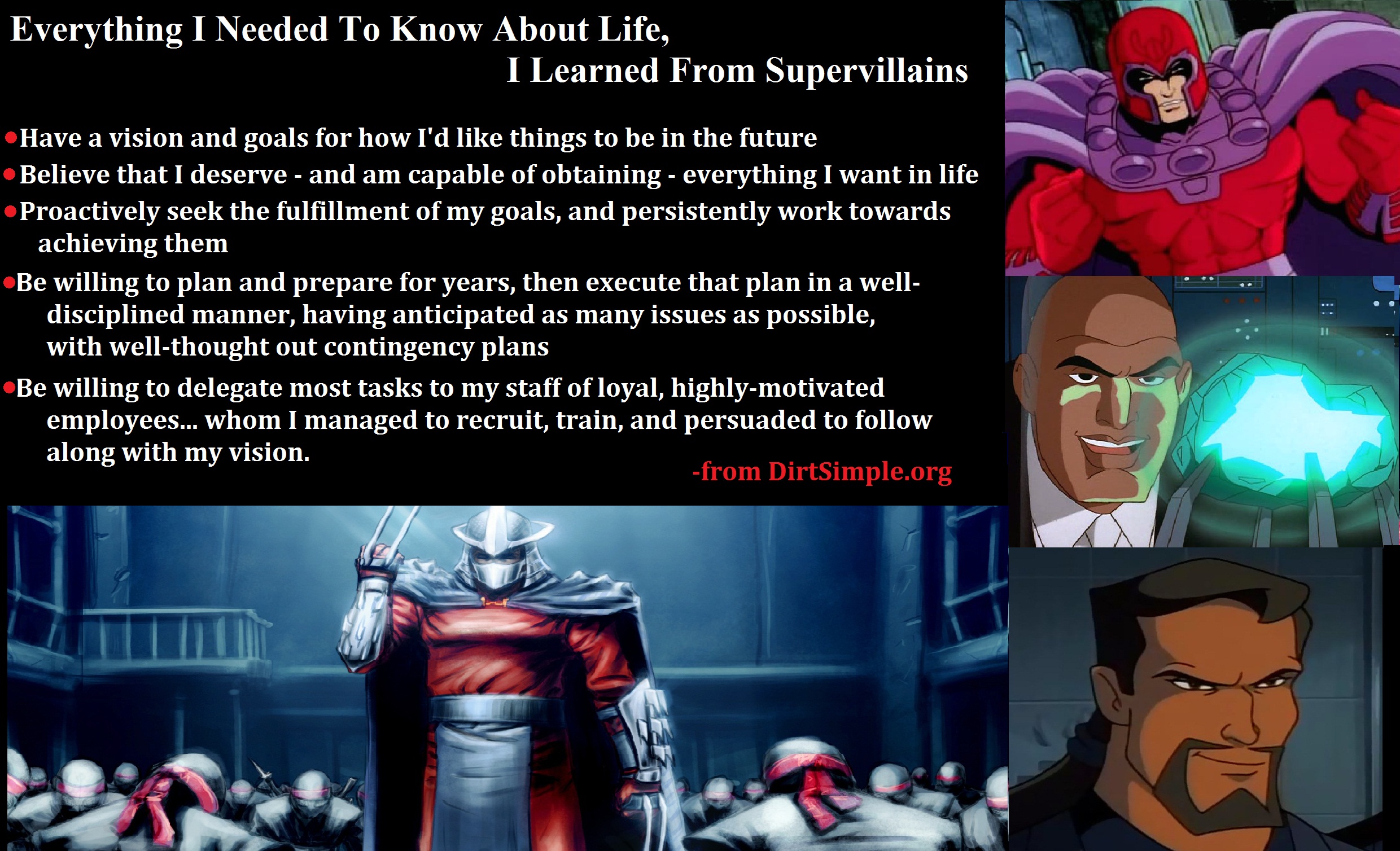
It’s a panel on Super-Villains. Panelists are: Alexi Vandenberg, Rob Weiner, Rob Peaslee, Amalie Howard, and Stephen Graham Jones. Moderator Eneasz Brodski. This was recorded onsite at Denver Comic Con 2015.
Includes:
The most admirable trait of villains?
Do you prefer your villains to be relatable, or hateable?
What’s the difference between a true villain and just a bad person?
Is the only difference between a villain and a hero the POV of the story?
and more
It was inspired by this pic from two years back:
In addition to coordinating the Lit Track, I moderated three panels at Denver Comic Con last weekend. This is the audio of the first one.
It’s a panel on YA lit, and writing YA, by YA Authors. Panelists are: Dan Wells, Amanda Strong, Angie Hodapp, Gail Wagner, and Michelle Kellogg. Moderator Eneasz Brodski. This was recorded onsite at Denver Comic Con 2015.
Includes:
How much sex & violence can you use?
Who are you writing for?
Who counts as a “Young Adult”?
Is the YA field censored by gate-keepers? And is this doing a disservice to YA readers?
and more
Hey, I’m in a music video! It’s a fandom vid, done by the great people at Geekiarchy, parodying Cher Lloyd’s “Want U Back.” I show up for a few seconds as a FOX executive. :)
It was crazy fun to shoot, if exhausting! Nathan Fillion retweeted it, which is pretty damn awesome. :D Enjoy!
 For the past couple weeks I was working pretty intensely on setting up the Denver Comic Con Literary Track (getting authors on panels, scheduling, etc). This all came to a crescendo this weekend, during which time I was in the 200s Hall all three days (mostly room 205) meeting authors, making sure everything was running smoothly, and keeping panels running on time. It was an amazing experience!
When I first attended Comic Con I felt lost. I had no idea what to do. What exactly is the attraction here? It was too free-form and chaotic. Everyone else was cool and excited, I was just awkward and nervous. Eventually I left. I didn’t feel like I fit in.
The next year I volunteered, at a friend’s request (she said they really needed the help). I was a low-level gopher working Crowd Control, but I finally had a reason to be there. I had a job! An excuse to be where I was! And instant “friends” in my coworkers and supervisors. That structure and support made all the difference, and I came back a second day despite having not signed up for it initially.
I am now aware, several years later, that the way to go to a con is to get a group of friends who all want to go and go as a group. It’s a fun social experience for all of you, hanging out and going to see occasional attractions you’re all excited about, and generally treating it like a mobile party. I kinda wish someone had told me that in the past. But OTOH I’m glad I didn’t know, because it led to this volunteering thing which, over the course of a few years, led me to my Literary Coordinator position.
And I gotta say – wow. There were SOOO MANY awesome people I got to meet because of this! It was a ton of work getting everyone sorted (hours every week for several months, in addition to the three 10-hour days at DCC itself), but it was ridiculously worth it. Honestly it was actually too much – some people I barely got to see. But I did manage to have a fair bit of interaction with a handful of people who were absolutely fantastic to hang with! I am sad that many of them don’t live in Colorado, I hope to see them again soon.
It was also really inspiring. I got to moderate three panels. The first time you stand up on a podium in front of 100-200 people and have to entertain them for 50 minutes – DAMN is that terrifying! But so freakin’ exhilarating, and SO MUCH WIN when you pull it off! All three of my panels went very well, and I am extremely proud. I’ll be posting audio of them later this week/early next week (and eventually video, once that becomes available). But I digress – the inspiration part! So far I’m barely published. I want to be like the people on my panels. Even like the few who were just breaking into writing and introduced themselves with “And here is my first book!” I’ve been dithering about, not starting my first novel for several months now, because it’s a long and scary process and I dunno if I can do it. No more! Time to get this project underway!
I learned a lot of things over the course of the weekend, about panel coordination and running a con. I won’t bore y’all with them, since that’s probably not why you’re here. But more than anything else I found out that coordination is hard, and coordination on they fly is EXTREMELY hard. The best thing to do (whenever possible) is to have plans made before hand, drill them repeatedly, make sure everyone knows about them (good lord, I was surprised how much communication failures are a huge problem!) and then stick to the plan as much as possible. There’ll be plenty of crises that come up naturally, there’s no call to go creating more of our own. :)
This is my 5th ToastMasters speech, titled “Happily Ever After.” It basically just retreads a lot of stuff I’ve posted here before, but now in audio format.