Mar 142013
 

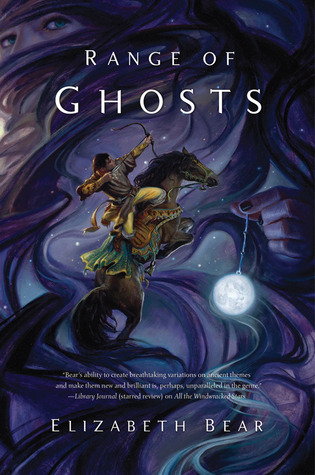
range of ghostsRange of Ghosts, by Elizabeth Bear

Brief Synopsis: A prince, having survived being on the losing side in a civil war, tries to avoid assassination. An unrelated princess joins an order of wizards to avoid assassination by her power-consolidating brother. They meet up, and are embroiled in a plan by an evil sorcerer to foment chaos and war in their lands so he can conqueror them easily after they’re exhausted.

Book Review: Not a bad book. It has some stunning imagery, really very well-worked scenes. And Elizabeth Bear is quite creative, introducing many fantastic concepts that are a pleasure to immerse yourself in. A cosmology that changes based on the beliefs of the peoples ruling an area? How cool is that? About 10,000 times cooler when it’s revealed that a city being conquered will change what happens in the sky above it, and people travelling to it can tell it’s changed hands by that! Unfortunately the writing is rather haphazard. We seem to dash from one plot point to another without much reason for going there, aside from “Well, this is where the next plot event happens”. There are a few plot holes which may be patched over in subsequent books (this is the first in a series), but they still irritate the mind. Worst for me – I just couldn’t relate to the characters. Their motivations seemed imposed on them by authorial fiat, rather than natural desires. So not a great book, but I can’t tell anyone to avoid it, because it really isn’t bad either. It’s right about the middle. However if I was asked to recommend a good fantasy novel written recently, this wouldn’t come to mind so… Not Recommended.

Book Club Review: That being said, this teetering on the edge of good actually makes for interesting discussion, because different people like and dislike different things about it. There were several people in our book club who thought this was a strong book most of the way through, and the disagreements between what was believable and what was strained made for some good talking. This branched into discussion over what makes believable characters, and what can be overlooked for the sake of moving a story forward. It isn’t emotional disagreement about politics or the meaning of life, but it is grist for the mill. I find myself in the position of saying that while I wouldn’t read this book on my own, it makes for a pretty good group-discussion book. Recommended.

Mar 082013
 

star-wars-rock-band

“The Cool Stuff Theory of Literature is as follows: All literature consists of whatever the writer thinks is cool. The reader will like the book to the degree that he agrees with the writer about what’s cool. And that works all the way from the external trappings to the level of metaphor, subtext, and the way one uses words. In other words, I happen not to think that full-plate armor and great big honking greatswords are cool. I don’t like ‘em. I like cloaks and rapiers. So I write stories with a lot of cloaks and rapiers in ‘em, ’cause that’s cool. Guys who like military hardware, who think advanced military hardware is cool, are not gonna jump all over my books, because they have other ideas about what’s cool. The novel should be understood as a structure built to accommodate the greatest possible amount of cool stuff.” — Steven Brust

This is why a lot of critics and reviewers are useless – they don’t have the same taste as you. And that’s why we need so many, it’s hard to find someone who you share a significant amount of taste with. I realized that I do SF/F Reviews, but I haven’t really introduced my taste yet. I hope this is ameliorated somewhat because I try to rate books for book clubs by whether they give the readers things to talk about or not, but obviously my taste will still make a big difference, and I do comment on the general enjoyability of the book itself as well. So, in an effort to help potential review-readers gauge how much my reviews are relevant to them, I present my Top 5 Books and why I like them. May this help with your calibrations.

(this list is occasionally updated as my Top Five changes. When it does, previous Top Five entries are moved to Honorable Mentions)

1. Vellum, by Hal Duncan

In Vellum, something happened, but the enormity of the event can never be put into words. So instead the event is repeated and re-examined, over and over, from countless different angles. Every story is a separate story, not a continuing narrative, with separate characters. But every story is the same story, and the characters are always the same – in essence if not in flesh.

It isn’t written linearly, because its story isn’t a linear story. It is a mosaic which you can only see small pieces of at a time, and once you’ve read the whole thing you have all the pieces and you can hold them in your mind and mentally take several large steps backwards and finally see the actual picture.

Importantly, all the parts that make up the whole are themselves awesome. Like a mosaic, the various pieces may be different colors or shapes – there’s cyberpunk, there’s modern Lovecraftian horror (which is the best piece of modern Lovecraft I’ve read, but I am biased), there’s steampunk, there’s angels destroying each other in holy wars. But despite the differences, each piece is made of the same material as all the others, and the differences mainly serve to point this out.

And the overall picture, the theme that all the different pieces keep circling around and coming back to, is extremely relevant to me. It’s a simple theme, and if the sparking event of the novel could be put into words, it would be a simple two-word story: people die.

2. Worth The Candle, by Alexander Wales

Worth The Candle is a story about a storyteller trapped inside someone else’s story, who knows that this is what’s happening. Between all the killing of zombies and daring escapes through sewers and rescuing of princesses, there is also a continuous commentary on the nature of story telling. What it means to be inside a story, and how this can be used to your advantage if you are the main character. What the purpose of a story is, and how that is reflected in the monsters/challenges he is being faced with.

And of course hanging over all this is the knowledge that we ourselves are reading a novel, and all such commentary reflects on the text we are reading as well. It’s not just exhilarating and funny, it’s also intellectual and meta as hell. It prompted me to create a 100+ hour podcast analyzing it. Great stuff.

3. Harry Potter And The Methods of Rationality, by Eliezer Yudkowsky

A well-written fanfic that created the Rationalist Fiction genre. An alternate universe story, where Petunia married a scientist. Harry enters the wizarding world armed with Enlightenment ideals and the experimental spirit. This is a romp, and is perfection for a particular kind of nerd. I am this kind of nerd. I loved it so much I spent several years making it into an audiobook. If you were a bit of a child prodigy, and a nerd, without many friends, but with a love of living that made you obnoxious to others, you might just love this forever.

4. The Fifth Season, by N.K. Jemisin

I love angry characters. I love when their anger is justified, and I love seeing what it drives them to do. I love it even more when those who are abusing our characters actually have a damn good reason to do so! (“We don’t want you to explode the world, tyvm”) This book is an exploration of slavery, and systemic oppression, sure. But it’s not about that, per se. It is about what drives a person(s) to extremes, and it immerses you completely in that journey.

I know not everyone will have the same reaction I did, because this novel is for exactly the sort of person I am. Our protagonists are broken in the same way that I am broken. Do you know how good it feels to see that sort of broken portrayed? To see your rage, and hurt, and doubt, mirrored by an author you’ve never met, but who obviously feels all those things too? This story reached directly into my soul, grabbed hold, and squeezed.

5. Watchmen, by Alan Moore

Both for its conceptual density, and for its amazing characters. Rorschach is like many characters I love – the world is broken and he must fix it. He is unrelenting and uncompromising. I find the book particularly fascinating because Rorschach and Veidt are basically the same character, except Rorschach focuses on the trees and Vedit focuses on the forest. You can tell it’s a very well done book because I still can’t bring myself to say which one was in the right. They both have incredibly compelling arguments. Rorschach is certainly more inspirational, but it’s hard to argue with Veidt’s results. And neither one can exist in the same world with the other.

It’s also one of the first works I read that seriously explored the idea of what it would be like to be God, with Jon. Once you already know everything that will happen, you stop becoming a person and turn into nothing more than a force of nature. It’s a great examination, and emotionally compelling to boot.


Honorable Mentions:

Perdido Street Station, by China Mieville
The Wind-up Girl, by Paolo Bacigalupi
Best Served Cold, by Joe Abercrombie
Too Like The Lightning, by Ada Palmer
Permutation City/Diaspora, by Greg Egan
Altered Carbon, by Richard Morgan


Mar 062013
 

hugo-awardsLike everyone else with a blog and a Hugo vote, I’m posting my Hugo noms. Final deadline for nominations is March 10th, don’t forget.

First, a confession – I don’t have much time to read anymore. I’ve never been a very fast reader, I simply had a lot of free time, which can be deceptively similar from the outside. But the past couple years I’ve taken on other projects and a serious relationship, both of which have cut into my time sharply, so I barely even have time to read the two-books-per-month for the local SF/F Book Club. Which means that the amount of novels I read is already low, and the number I read in the same year they’ve been published is astonishingly low. Therefore the majority of my nominations are more aspirational nominations than actual “I read this and I think it’s amazing and it was just published so it’s still eligible for the award I think it deserves!” nominations. They are books that I want to be good, and if enough people think they were then I’ll get a copy to read with the Hugo Packet (which we read in our Book Club every year) and I can actually make an informed decision then. :)

When it comes to short stories… I’ve never been an avid reader of them. Usually I find an author I like first, and then go read his backlog of stories afterwards. Fortunately that’s not as true this year! So let’s start with the short stories!

Short Stories

First and foremost:

Comes The Huntsman, by Rachel Acks

I know the author, which is how I came to actually read a short story (a rarity for me). However that’s not why I’m nominating it. This is truly an amazing, epic short story. People who know me IRL know that I often rave about Hal Duncan’s Vellum. It is, IMHO, the best book ever. It isn’t written linearly, because its story isn’t a linear story. It is a mosaic which you can only see small pieces of at a time, and once you’ve read the whole thing you have all the pieces and you can hold them in your mind and mentally take several large steps backwards and finally see the actual picture. As such, it’s hard to tell people what it’s about. It has to be experienced personally, and most people don’t like the experience.

Comes The Huntsman has the same structure. If you were to take Vellum and turn it into a short story, it would be Comes The Huntsman. Not in terms of story or characters or any of that, but in terms of emotion and structure. Which is my way of saying that I love this sort of story structure, it resonates with me like no other type of fiction can.

On top of that, Comes The Huntsman has an excellent story of its own, with real emotional pull. It is an excellent work, and everyone should read it. All the short stories I’m nominating are strong, I don’t mean to disparage any of them. But this one should win the 2012 Hugo, IMO.


Your Cities, by Anaea Lay

Again, I read it because I know the author. It is a fantastic story, in a world of upheaval that feels like it’s blossoming into something beautiful, and a character who’s personal storyline mirrors that narrative. That feeling of watching something amazing begin is infectiously exciting. It’s also available in audio form at Toasted Cake, and the reading is superb. I’ve subscribed to TC on the strength of that episode. They beat me to win the 2012 Parsec Podcast Awards, and very deservedly so!


The Three Feats of Agani, by Christie Yant

Brought to my attention by the formerly mentioned Anaea Lay. A great story of gods, which I imagine speaks strongly to any tranhumanists (which is why I personally loved it).


On to Books:

The Killing Moon, by NK Jemisin

I haven’t read it, but Anaea Lay has promised to “throw a spectacularly childish fit […] in order to solicit nominations for this book.” Thus I am nominating it. Plus I trust her taste.


Existence, by David Brin

Because he’s awesome and I’ve loved all his stuff to date.


Auraria, by Tim Westover

Again, I haven’t read it. But it’s recommended by Van Aaron Hughes, who doesn’t have exactly my taste but who’s opinion I trust. Moreover, it is a self-published book that is apparently awesome (coming in 2nd place in the Fantastic Reviews Battle of the Books), and I am ideologically committed to supporting people who bypass the established powers to strike out on their own and do a very good job of it.


The somewhat rare: Novelette!

(rare because I don’t read these, and few people includes them in their noms lists)

Wool, Omnibus Edition, by Hugh Howey

I haven’t read it yet, but I keep seeing it pop up over and over by various people I trust. I’m enthusiastic about it because it started out as simply a guy writing and posting his work online, and more and more people finding it and loving it and spreading it. It is essential a self-published work, which I think is awesome. A great story that also tells the publishing industry to go screw itself at the same time? Sign me up!


Dramatic Presentation

MLP:FiM: How Should A Pony Be?

Because Dr Who is overrated. I mean, it’s a’ight, but I don’t bother watching it unless it’s already on and I have nothing else to do. Which is why I’m only maybe halfway through season 2. My Little Pony, OTOH, is made of pure awesome, as I’ve written before. If it gets the nom, this will be my top vote.


HPMoR: 74a – Self Actualization, Part 9, Escalation of Conflicts

Because I’m not about to not nominate myself, even if I have no chance of even making an “also nominated” list. :) This episode was one of the most fun ones, I figured the more dramatic ones require too much background knowledge.


CAMPBELL AWARD FOR BEST NEW WRITER

Van Aaron Hughes – who I know personally from the Denver SF/F Book Club and who is a damn good writer! I’ll also be nominating him for Fan Writer for Fantastic Reviews, which runs the really freakin’ cool Battle of the Books every quarter which you really should read, it’s fun. :)

Anaea Lay – who I’ve met and who is awesome, and still eligible!


As you can see I’ve got free nomination room, so if there’s something you think is really deserving let me know.
Mar 052013
 

blue-sword-robin-mckinleyThe Blue Sword, by Robin McKinley

Synopsis: An orphan is taken into a foreign land and discovers she has magical gifts. She must learn to use these gifts to prevent a dark sorcerer from invading her new home.

Brief Book Review: This is the stereotypical fantasy story template. It’s good for people who are new to the genre and haven’t been exposed to its tropes yet, but there isn’t anything new for those who’ve been reading SF/F for any amount of time. The characters are vibrant and the world feels rich, especially in the British areas. However the climax is abysmal. It turns out that 98% of the book didn’t even need to happen, and all the hero’s striving thus far has been filler. Seriously, it was bad enough that I just skimmed the rest of the book afterwards. It’s akin to Luke Skywalker training in the Force, making allies, saving the Princess, learning to wield a lightsaber, and as the final battle approaches and he’s climbing into his X-Wing he sees a button that says “Press here to win”, and upon pressing it the Death Star blows up and the Empire is overthrown. Why did we even bother? Not recommended.

Club Review: This will be short, because there’s little substance to the book. It can be fun identifying all the tropes we’ve come to know and love, finding the similarities to Star Wars or Harry Potter or other classics. And perhaps the white-washing of British Colonialism could spark some discussion. But it’s such a light book that there’s not much to chew over. Not recommended.

Feb 262013
 

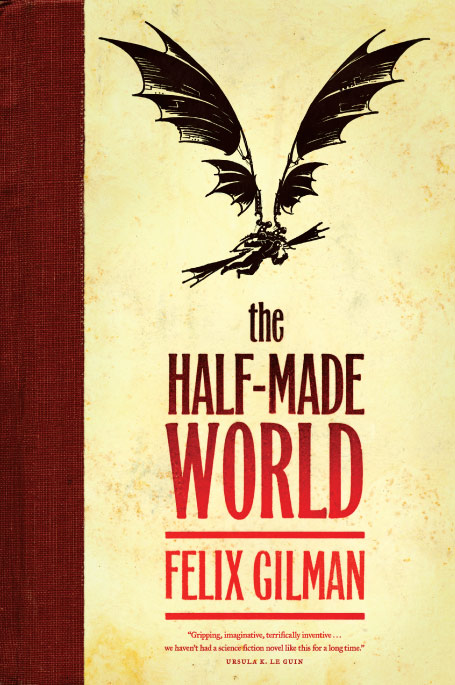
HalfMadeWorld_frontThe Half-Made World, by Felix Gilman

Synopsis: Two factions war for control of a Steampunk Old West. A young psychologist (Liv) must find and cure an insane old man who’s mind may hold the key to ending the war permanently.

Brief Book Review: An interesting read, but not a compelling one. The super-human powers that rule the two factions are fascinating, and could have been a great examination of how non-human intellects interact with humans, and how intelligences without the ability to directly manipulate the world can still have huge effects by offering humans things they want in exchange… but it was never explored in much detail. The world itself is beautifully rendered, with great locations and extremely cool chaotic environs in the non-Made section of the world, where reality is still somewhat fluid and objects can change when you aren’t looking – and which doesn’t seem to make much difference to anything, aside from making a great backdrop. Liv is slowly stripped down to her constituent parts over the course of her journey, which is a neat concept but doesn’t have as much impact as it should. She doesn’t actually do a single thing of any importance until literally the very last scene of the book. The book feels unsatisfying because the protagonists are passive, rarely initiating anything themselves – merely reacting to this neat world. While it works well as a mood piece, those sorts of works are usually written as short stories for good reason. It doesn’t quite work at novel length. Not Recommended, unless this is exactly your type of book (and you know it if it is).

Club Review: Unfortunately there isn’t a great amount to chew over in a discussion setting. The villains are painted too strongly as villainous to provoke empathy, and the heroes don’t do much to cheer about. The sets are pretty, but there’s only so much to say about that. It has a very similar problem to Permanence – a lot of cool ideas that are great in concept, but without the execution to make them compelling. Merely thinking up a cool idea isn’t enough, you need to do something with it. Even if this is your type of book, it’s more of a solitary pleasure rather than a group discussion piece. Not Recommended.

Jan 102013
 

200px-TheWayOfKingsThe Way of Kings, by Brandon Sanderson

Synopsis: An ancient evil draws close to consume the world in war. A prince attempts to unite his divided kingdom to resist it, a scholar seeks lost legends for clues to its nature, and a slave rises to become a savior.

Brief Book Review: Pure awesome. Nevermind the great fight scenes, the creepy-as-hell Outsiders intruding into the world, the rich but lost history of gods on earth, and the constant growing sense of doom. All that is great, but what really sets this book apart is its idealization of the human spirit. This is a book of Capital Letter Ideals. Honor. Loyalty. Duty. Empathy. These characters are archetypes of the things we most aspire to be. Unless you have a frigid heart of stone, this story will stir things in you. Strongly recommended.

Club Review: Unfortunately the size is a problem, over 1000 pages. It’s too long for an average book club and we had to read it over several sessions. But once you start it goes much faster than you’d expect, it’s very hard to stop reading when you get into it. While much of the talk will likely be praise, there are actually several things to argue about that make this more than a simple gushing event – choices the characters make that the readers may disagree over. It’s not as interesting a discussion as more ambivalent books may spark, but it’s such a good read that people likely won’t mind. Recommended.

Dec 042012
 

Flow My Tears, the Policeman Said, by Phillip K Dick

Synopsis: Living in a police state, a famous and genetically superior man is suddenly stripped of his identity and erased from everyone’s memory. As far as he can tell, he never existed. He struggles to regain his past and avoid the attention of the corrupt authorities.

Brief Book Review: It’s hard to evaluate this book, because it isn’t really a novel. There isn’t a plot really… there’s just a thing that happened. A lot of words are used on introspection and silent despair without a lot happening. When things do happen, they often don’t make much sense. The writing itself is clumsy, and none of the characters are very likable. That being said, all this seems to work together to make this book a compelling and fascinating exploration of helplessness. It may very well be worth it for that alone. Some books try to make you feel a certain way, this one tricks you into it while you aren’t looking, and does so well. However overall – Not Recommended.

Club Review: And yet, for book club purposes, this book is ideal. While none of the characters are likable, they’re all memorable, and their actions can spark quite a lot of discussion. Criticism, empathy, dissection – all are likely to be applied to any single character, sometimes all three from a single reader. It is a disjointed and confusing narrative, and as such it leaves a lot of room for interpretation. It is this sort of fertile soil that nowadays leads to fan theories and fanfiction, and it makes for great discussion. Many of the things that make it a poor novel actually make it quite a good Book Club book. It’s likely that most readers will be ambivalent about the book and unsure what to make of it, but there will be plenty to talk about. Recommended.

Nov 082012
 

Permanence, by Karl Schroeder

Synopsis: An orphaned girl living on an orbital habitat discovers a seemingly abandoned alien craft – an inter-solar trading vessel. She gathers interested parties to investigate it while attempting to keep her legal claim in the face of competing national interests.

Brief Book Review: A lot of very big ideas in this book, each of which could’ve been explored in an entire novel of its own. Unfortunately packing so many high-concept ideas in a single novel means none of them are explored very far, and the brief touch-and-go ends up being disappointing. The book is also seriously hindered by the author’s inability to write compelling realistic characters. I liked a lot of this book, but ultimately its flaws overwhelmed the story. Not recommended.

Club Review: For club reading, this book is probably worse than as a solitary read. If I had simply read this on my own I might have recommended it, but trying to discuss it in a group really brought out the problems. Every time you try to comment on a brilliant and compelling idea in the story you realize that there’s not much to say, because it was never really explored. It was mentioned, and then abandoned. Intelligent but non-sentient aliens make a brief appearance. To contrast, Blindsight uses its entire length to explore how non-sentient intelligence could arise. Now obviously no novel can rigorously explore every single cool idea from SF that it incorporates, but Permanence seemed to keep getting distracted and didn’t even say much about its pet central theme (which, I assume, is that value-drift is bad, but can be avoided by trade?). Many plot lines and secondary characters seemed to get the same treatment – a cool premise which is never delivered on. In the end there just wasn’t that much there to talk about. Not recommended.

Oct 252012
 

City of Bones, by Martha Wells

Synopsis: A post-apocalyptic fantasy. After out-of-control magic reduced most of the world to a desert wasteland, the survivors do their best to survive while trying to find magical artifacts and piece together what went wrong.

Brief Book Review: A lackluster effort. There is never any build-up of tension, the world building suffers from multiple holes, and the book commits the cardinal sin of fiction: it is boring. Not recommended.

Club Review: As a club review, it’s not as bad as a solitary read. The book club will likely find itself comparing this to other post-apocalyptic or dystopian works they actually enjoyed, and may get into some fun conversations about the contrasts, and how people react in truly desperate situations. Those with a historical background might draw comparisons to Rome. And everyone will have some fun talking about the various inconsistencies and snafus. It’s not awful, and it’s an early book – I’ve heard the author has gone on to write much better things. But that’s not enough to recommend people spend their limited time reading or skimming it. Not Recommended.

Oct 102012
 

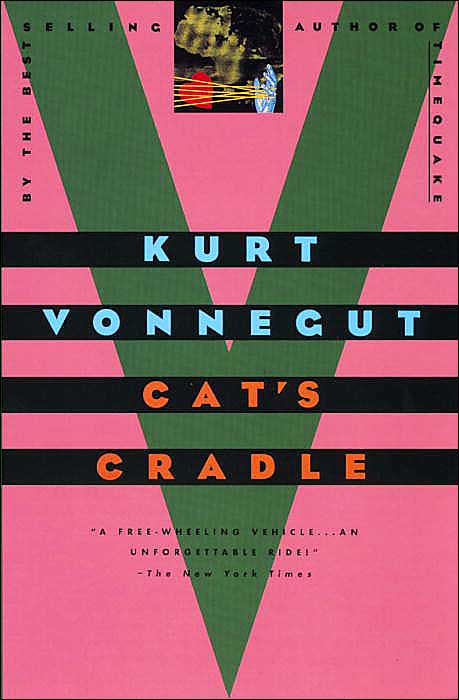
Cat’s Cradle, by Kurt Vonnegut

Synopsis: A nihilist travels to the poorest nation on earth and joins the world’s most nihilistic religion just days before the entire world is destroyed.

Brief Book Review: Like all of Vonnegut’s books it’s very well written. It pulls you in and holds you. And like all of his books, it also makes you hate being alive. Unless you’re in a similar emotional position as the author the characters will come off as extremely unlikable and the relentless despair leaves a bad taste in the mouth. Strongly recommended for those in pain, not recommended for anyone else.

Club Review: Everyone has gone through episodes of intense emotional pain in their lives, some for very long periods of time. There’s a very good chance that someone in your book club is in that position right now. The differing viewpoints of the people who dislike the nihilism of this book and those who love its acceptance of the absurdity of existence will provide for a lot of good discussion. There are many themes running through this book that will likewise also produce strong dissenting opinions – the vilification of science, the rejection of redemption, the futility of striving. Some people may like certain aspects of the book, and dislike others. It provides a lot of great subject matter and presents it in a very emotionally compelling manner.

Summary: Not a pleasurable read, but an ideal book for a book club. Strongly recommended.