Aug 142013
 

20110305_ASP501Recently Lavabit, which lets people send secure private emails via encryption, was shut down by the government. Why?

“we offered secure storage, where incoming emails were stored in such a way that they could only be accessed with the user’s password so that even myself couldn’t retrieve those emails. And that’s what we meant by encrypted email.  That’s a term that’s sort of been thrown around because there’s so many different standards for encryption.  But in our case it was encrypted and secure storage because as a third party I didn’t want to be put in a situation where I had to turn over private information, I just didn’t have it, I didn’t have access to it.  And that was sort of, may have been the situation that I was facing.”

Because it makes blanket spying on everyone very hard. Feels like a pre-emptive strike by the totalitarians, no?

I’m pro-Radical Transparency. I’m up for opening all my communication – but only if it goes both ways. A one-way window is not transparency, and I’ll open my communications if the government opens theirs. Which begins with a full pardon for Manning and Snowden and the prosecution of the people who tried to hide what those two revealed. What sort of government punishes our heroes and protects the villains?

There’s a link to the Lavabit legal defense fund from their homepage, here: http://lavabit.com/ We can’t fight The Powers if we don’t combine our efforts. Individual humans are weak, united we are strong.

Aug 132013
 

28349I was taken to the previously-mentioned clothing-optional club for the first time by my now-fiancee. She later confessed it was partly a test, as she couldn’t be long-term with someone who wasn’t comfortable with that sort of thing (spoiler alert: I passed). There’s a fair bit of nudity (more female than male), a bit of sex, and a lesser amount of public sex. It is also one of the most women-friendly places you’ll find.

As my fiancée said, these sorts of places only exist if the women feel comfortable and secure. If they don’t then they leave, and don’t come back, and the whole scene dies. It’s an empowering environment and I dare say it’s far more feminist than most places in the day-to-day world. Women can express their sexuality exactly however they want without judgment or shaming. There’s lots of exhibitionism and everyone’s enjoying it.

When I first saw the Blurred Lines video it reminded me of this. Partly because this is my experience with topless ladies running around, and partly because the first time I heard this song I was actually at the club. So I’ve associated this song with liberation and sexuality and all those good things. When I first heard someone say the video was sexist it was like getting slapped. “Wait, what? The song I associate with one of the most anti-sexist places I know of is sexist? How can this be possible??”

It seems most people don’t draw this same association. Most people have never been in a safe sex-play area. For most people, their experiences of nearly-naked women interacting with clothed men consist of strip clubs. I’ve only ever been in a strip-club once, and that was a very limited engagement which probably wasn’t typical. From what I’ve heard of them, many strip clubs can be degrading and are filled with douchebags. I don’t want to cast stones at something I don’t have experience with, but they have a reputation as being frequented by sexist assholes.

So, sadly, the average viewer will not see this and associate it with “awesome liberated sexy-time fun!” but rather “dark dingy sexist titty bar”.  Thus the video’s bad reputation. I think it’s a test that our society has failed utterly, that this is the association people make. Once happy swinger clubs are the norm and shitty strip bars are almost impossible to find, videos like this will be associated with play rather than exploitation. How is it that the opposite of that is what ended up happening? The world is mad.

Aug 122013
 

A little over a week ago I heard Robin Thicke’s “Blurred Lines” for the first time, and I immediately loved it. The music was catchy and light, the vocals were fun, and the song was vaguely sexual. A good summer song. A friend who was with me at the time was surprised I hadn’t heard it before, and promised to email me with the artist & song name so I could listen to it again. The next day he sent me a link to the Unrated Video, and I immediately loved it even more. Several very hot ladies romping around nearly naked? What was not to like? :) And it fits the mood of the song very well.

Warning – extremely NSFW.

Since then I learned the video is sexist. This kinda surprised me. Me & my fiancée periodically attend a clothing-optional club and so I’m quite used to seeing naked people running around and having a good time. It’s never been sexist then, what’s different now?

It can’t be because the ladies are there on display – that’s always been half the point. Speaking both from personal experience and from talking to others (lest one think I’m presenting only the male opinion here) – people who go to those sorts of clubs are going with the intention of displaying themselves. It’s a lot of work to keep up (often a lot of money as well), people are proud of how they look, and they are showing off so people will look at them. I don’t feel comfortable accepting that people who are comfortable naked and enjoy displaying themselves are being sexist against themselves. That feels only a couple steps removed from demanding people wear burkas and saying it’s a pro-feminist thing to do so.

Yes, it’s objectification, but it’s a song about sex. A lot of sex is objectification. We are all sex objects for each other from time to time. It can be sexy as hell to be treated as a toy by someone else, or for them to let you treat them like one. It’s great fun when it’s consensual and well done – power imbalances are hot. It certainly isn’t sexist for us to be having sex the way we both want to be having it. Obviously this is confined to the bedroom/play-area… but the whole point of civil rights is that everyone is respected as a person, and that includes respecting our decision to bring objectification into our sex play when we want it. If the video had been taking place in an office, or out on the street, or really just about anywhere in day-to-day life it would be incredibly offensive. But it looks very much like it’s taking place in a safe sex-play area (soft pink walls, gentle lighting, semi-private). It’s a place where people go for this sort of fun, in a song about sex. I contrast this to Benny Benassi’s “Satisfaction” video  (also NSFW), which does strike me as sexist. There’s never nudity in that video, but the women are using all sorts of construction tools – something you’d see at work, or walking around town. That is NOT when someone is putting themselves out for objectification! Wrong message!!

As far as I can tell, Robin Thicke is just sharing the more private parts of sex-positive culture, and people are pattern-matching to sexist warning signs without actually taking the time to think if it’s actually sexist. But I’m very cautious that I might just have a blind spot for this video, so I’m leaving myself very open on this topic. I do already have one reservation about the video, and one about the song. And so much opinion is against me that I realize it’s most likely me that is wrong. But really… what am I missing? Does what I said above not apply in this case?

Aug 092013
 

bioshock infiniteFor over a year I had almost no time to play video games. A few months ago I managed to find some free time again, so I finally played through Mass Effect 3, and now I’m working through Bioshock Infinite. I’m enjoying it while it lasts, because I may well soon lose extra gaming time again. :)

I’m not that far into the game yet, seems like less than halfway. For all its good points, one thing still bothers me – I’m playing a bit of a psychopathic murderer. I’m not referring to the whole “must atone for his violent past and poor life choices” plot line. He was a Pinkerton thug, and before that he “fought” at the massacre at Wounded Knee, and the story arc looks like it’s going to be one of redemption. That’s totally legit, and pretty good storytelling. What I’m referring to is the way the First-Person-Shooter motivation is handled.

Like most video games, the majority of the game play comes from killing tons of dudes. The motivation for this doesn’t have to be complicated – the other side is evil aliens, or mobsters, or Nazis, or even just soldiers from the other side. You’ve got an easy audience here – we signed up for a game were we run around killing tons of dudes, the simplest excuse will work.

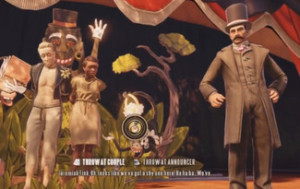
Bioshock Infitine sets the stage for you before throwing the enemies at you. You get to walk around the city and meet its inhabitants, and get a feeling for them as people. They have hopes and worries, they gossip and complain. Their two biggest sins are that they are religious zealots, and they’re very racist. First, my parents are religious zealots, and I don’t think that makes them worthy of extermination. Second, this game takes place in 1912, where even people who weren’t bad were a bit racist. To overcome this, the game makes the racist to the point of absurdity. A conversation I overheard could be summed up in this exchange:


A: “Wow, I am so racist!”

B: “Not a racist as me! I’m more racist!”

A: “It sure is great being racist!”

B: “I love being a racist in a city of super-racists!”

A: “You know the best thing about being racist? All the racism!”

B: “God bless racism!”


It goes a bit far at times. Anyway, the infiltration part of the game ends when I have to choose to join in the stoning of an interracial couple or throwing the baseball at an authority figure ordering the stoning. There doesn’t look to be enough baseballs to kill the couple, this is one of those public-flogging types of events that will leave them beaten and bloody, and possibly permanently damaged. Obviously I’m not gonna join in so I chuck the ball at the evil authority figure. Naturally a nearby policeman tries to stop me, and I reply by… bashing his face in with a metal implement until he dies from it, then doing the same to his partner.

After that I take their guns and go on a murderous rampage while the cops try to stop my reign of terror. Call me crazy, but that seems like a bit of an overreaction.

The main objective of the game is to rescue a girl and take her out of the city. If I had her in tow and guys started shooting at me to try to stop me, I’d be ok with gunning them down. Yeah, maybe they think they’re stopping a kidnapper or something, but like I said – I’m an easy audience. I’m here to run around shooting guys, and the excuse of “they’re the security detail that’s stopping me from rescuing the girl” is good enough. That the writers added the “I’m here to kill all the racists” thing at the beginning really makes me uneasy. It has shattered my comfortable veneer of justification by trying to give me too much justification and failing to take into account that maybe I think racism is bad, but not death-penalty-worthy. It’s detracting from my enjoyment of the game. Something keeps bothering me, saying “Dude, wtf?”

But hey, I’m not that far into the game, maybe this was intentional and it’ll pay off.

Aug 062013
 

200px-Chasm_City_cover_(Amazon)A comment to my previous Ender’s Game post said it “leaves the impression that you missed the part where O.S.Card throws a heavy critique at this “ultimate solution” — at the end of “Ender’s Game” and throughout “Xenocide”. Do you make a point that he criticizes it only on moral grounds, not on rational grounds?”

No, my complaint is that I don’t believe him when he throws in that critique at the end. The entire novel is a set-up to make sure Ender can commit genocide and still be innocent of doing so. It’s been a long time since I read it, but IIRC in the end no one is held to account, there is no war-crimes tribunal, and everyone goes on their merry way.

When I read Reynolds’ “Chasm City”, I got the distinct impression that Haussman did a terrible thing. Identifying with a mass-murderer felt creepy as hell, and there were all sorts of consequences. Not once was there a heavy critique of mass murder thrown in, because it wasn’t needed. The feeling that it was awful came from the story itself, not from an excuse added on by the author. When I read “Ender’s Game” I felt a lot like Luke Skywalker after blowing up the Death Star – victorious and righteous, with maybe some sadness that this much life had to be lost.

A fiction author doesn’t make his points through explicit argumentation, he does so via an emotional narrative. If the narrative leaves you feeling like genocide was kinda cool, it’s not actually a heavy critique, regardless of what he says at the end. I didn’t read Xenocide or Speaker For The Dead, so I can’t comment on them, maybe they served as a retraction (from what I’ve heard they’re mainly more apologia, but my sources are probably biased). But Ender’s Game clearly conveys a “crush anything that threatens you” mindset.

Aug 052013
 

67880_10151248319907726_181291897_n

In a previous post I recanted from my position of “I don’t care if the government knows who I call”. I had held that because it was a step closer to my ideal of Radical Transparency – under that ideal everyone who be able to see who you called, but in return you’d also be able to see who’s looking, and see everyone that the looker has called. It was pointed out to me that advancing one half of that equation (the watchers can watch everyone) without advancing the other half (everyone can watch right back) leads away from what I want, as the watchers gain more power and have less reason to return transparency. The only winning move is to hold on tightly to secrecy and only trade it in fair exchange. Simply giving it away may look like its closer to Radical Transparency on the surface, while actually moving to Totalitarianism (the polar opposite of Transparency) in reality.

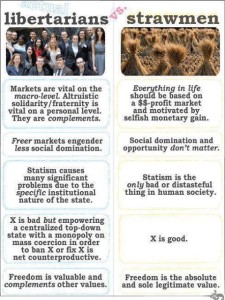
While I support many Libertarian ideals (not all… some I think are downright dangerous), it seems to me that Libertarians are doing the same thing all the time. They want to end government welfare, which currently supports both the ultra-rich in the form of corporate welfare and the poor in the form of plain old regular welfare. They will often vote with parties and interests who strip welfare from the low income population to move towards this ideal. But those parties and interests never move to strip welfare from the rich, and in effect the libertarians end up supporting a system which strengthens an unproductive ruling class that siphons off wealth. Deregulation often follows a similar track, wherein the only regulations that are repealed are those that protect the weak at the expense of the powerful, and never the other way around.

I know enough libertarians to know this is not what they want. The goal is an equal playing field, which the government may referee but never give preferential support to any one entity over another. They are being promised their ideal, with the politicians they vote for promising to level the whole field, starting at this side and moving across over time. One has to start somewhere, after all. But by “leveling” only one half of the field they are giving even MORE preferential support to the side who isn’t being focused on. It’s not a coincidence that the side left unmolested is the rich and powerful, the oligarchs and mega-corps. Allowing them to accrue all this excess power during the leveling process will make it much harder to reign them in when the time comes. And, call me cynical, but I doubt that there was ever any intention to level the other side anyway. I think the libertarians are being manipulated just as much as I was being manipulated.

The only way to advance without being exploited into strengthening your enemies is to demand both fronts are pushed at the same time. For everyone increase in our transparency to the government, we must demand an equal increase in government transparency to us. For every reduction in populace welfare, there must be a proportionate reduction in corporate welfare. Anything else is a losing move.

Aug 012013
 

enders-gameThere’s been a lot of talk about the merits of separating the Art from the Artist due to the Ender’s Game movie coming out this year. It’s one of the classics of SF, but Orson Scott Card is a raging homophobe. I’ve always been fond of the Death of the Author, and I don’t want an author’s opinions and personal life affecting my judgment of their art, so I generally try to know as little about an author as possible. After all, the separation might be an ideal, but ideals are notoriously tough in practice.

On the other hand, it is fair to judge an author by his book, and interpret other statements of his in light of that judgment. When I read Ender’s Game I loved it. Bear in mind that I also loved Atlas Shrugged when I first read it – I’m a sucker for good revenge narratives. When I read Ender’s Game I was its perfect target audience – a nerdy teenage boy who felt like an outcast. I wanted vengeance on those who had wronged me, I wanted the power to crush all those before me, I wanted to express this power with extreme violence, and I wanted to be held as a righteous and blameless paragon of virtue for doing all this. Ender’s Game delivered that in spades, with a protagonist who was exactly like me (I felt) in very similar situations. There is nothing about this book I didn’t love.

Much like what happened with Atlas Shrugged, as I grew older and started thinking about it more, I grew more and more troubled by what was being supported by the narrative. In the case of Ender’s Game, it is the claim that the only way to be safe is to completely exterminate anything you feel threatened by. Up to and including genocide over what was clearly a mistake. The perpetrator of such extreme reactive violence is absolutely innocent and righteous in his actions because he felt under threat. This is a philosophy of fear, clung to by the terrified… and they will never feel safe no matter how many people they kill.

It is also absolutely unworkable in any sort of society. Pre-emptive or retaliatory violence must be moderated with the understanding that afterwards we all still have to live together. Extremely disproportionate response leads to scenarios like we saw in the recent Zimmerman-Martin exchange, that allowed a man to walk free after killing a kid because he was losing a fistfight. If this is enshrined as a legitimate reaction it leads to the conclusion that Card eventually brought us to – genocide is the only final solution to any perceived threat. Ender’s Game should be a chilling warning of that, rather than a ringing endorsement of it.

(I’m not unique in this insight of course. There’s been many great articles written about this theme in Ender’s Game, one of my favorite ones being Creating The Innocent Killer)

This portrait of Card’s mentality given his work is worrisome on its face. But even further than that, he’s a strong supporter of an organization that considers homosexuals to be a threat to America and Everything Decent In The World. If I was part of a minority (or cared for someone in a minority) that was being attacked by a group that considers themselves unimpeachably pure-of-heart, considers that minority a threat, and a well-known figure in that group has publicly shown that he considers genocide against those he sees as threatening to be acceptable if he himself is “good”… well shit, I think I’d be making a hell of a big deal about this too.


(As an aside, I fortunately don’t feel torn on the issue of this movie, because I never had any intention of watching it in the first place. I’m just not interested in seeing Hollywood screw up another SF novel. I find it interesting that everyone I know who’s said they are boycotting the movie has already read the book. The Quirrell part of me wants to say it’s not that much of a sacrifice if the book’s already been read…)

Jul 302013
 

HUGOtrophyI’ve just submitted my Hugo Ballot. Here’s my votes, and why. I’ve omitted categories I didn’t vote in. For those unfamiliar – it’s a preference ballot, meaning you rank your choices and if your first pick doesn’t win your vote goes to your second pick instead, and so forth.


Best Novel

1. Redshirts – Well written, exciting plot, believable characters, and contains quite a bit of depth as well! It champions the 2013 ethos of awesomeness and is a good book in its own right. This would have deserved a Hugo nomination even in a General Election, rather than this more-focused No Angst year. The best choice for Hugo this year.

2. Blackout – Poor plotting, but the writing itself isn’t bad, and it exemplifies the ethos of awesomeness more than any other book in the list. I don’t think it’d be worthy of an award in normal circumstances, but it gets huge bonus points for doing this year’s theme so well, and that earns it an acceptable second place.

3. 2013 – Good writing, and the main character certainly pursues awesomeness in all its forms, but it’s a very low-energy book that failed to catch my attention. I’ve already forgotten too much of it to make me care if it wins anything.

4. Captain Vorpatril’s Alliance – Strong writing, and certainly sticks to the “life is great, stop whining” theme, but nothing of note happened in the whole book, and the central section should have been excised. Too much wit, not enough substance.

No Award – Throne of the Crescent Moon – This book is a giant turd, it shouldn’t ever win any award, except maybe the Award for The Biggest Pile of Turd That Isn’t Save the Pearls.


Best Novellete

1. Fade to White

2. The Boy Who Cast No Shadow

3. In Sea-Salt Tears

See here for reasons

I’m voting No Award over The Girl-Thing Who Went Out For Sushi and Rat-Catcher. Neither of these are bad! I found them both ok, if not stellar. However they were not available online. I know that isn’t the author’s fault, but it makes me grumpy enough that I won’t vote for them. If either one was amazing I would’ve said “Screw this, I’m voting for it anyway, it was bad-ass!” But mediocrity isn’t enough to overcome my annoyance at the inaccessibility.


Best Short Story

1. Immersion

2. Mono no Aware

3. Mantis Wives

See here for reasons


Best Dramatic Presentation, Short Form

1. Game of Thrones, “Blackwater” – Because GoT is great, and I’ve never really seen the appeal of Dr Who.


Best Pro Artist

1. Chris McGrath – because look at those backgrounds! Too many artists neglect the background. In his art it’s as important and intricate as the subjects in the foreground. Really cool!

Jul 292013
 

OSnc8 (1)The 2013 Hugo-nominated novels are a bit of a mystery, in that most of them are not very good. I’ve been trying to figure out why this is, as we’ve been reading through them. There are less-than-charitable views on why the Hugo’s suck, but I have more optimistic view of the matter.

As anyone who’s tried to read EarthFic knows, it is relentlessly depressing. And I don’t mean in a cool Grim Dark The Crow kind of way, but rather in the life-sapping soul-draining This American Life kind of way. Where individuals are weak and ineffectual and we just have to take comfort in our shared humanity and accept our powerlessness in the face of the unfairness of life. It’s hard to explain the level of crushing pessimism most TAL episodes convey. Secretly everyone is just a flawed person who ruins everything due to human weakness and we have to shrug and make the best of it because in the end it doesn’t matter, we don’t have any effect on anything anyway. It is emotional solipsism and it grinds you down.
Genre fiction has long been a bulwark against such bullshit. The stakes matter in a wider context and people have the ability to change things. Usually. But it’s not always that way. Some books are darker than others, and some go so far as to give up on humanity entirely. Lots of Phillip K Dick’s stuff and almost all of Vonnegut’s stuff was like this. The less enjoyable a novel becomes the more it’s praised by the traditional literary critics, and things can start to slide in that direction. Soon everything you’re reading becomes sullen.

As Eliezer Yudkowsky recent said –

“It’s getting shockingly hard to find enjoyable reading material anywhere, including in mainstream science fiction and fantasy. I think that reading fanfiction has trained me to expect a certain amount of funny and awesome in my stories, and mainstream SF&F, whatever its other virtues, is not delivering the quantity of hedons per second I have come to expect. I mean, yes, have your characters suffer and character-develop, but also have them strap a solid-fuel rocket to a broomstick, ya know? I try to read the mainstream stuff now and nobody in the novels is having any fun even when I’m a third of the way through the book. It’s like they don’t even realize their readers might want sympathetic hedons along with the suffering and character development.”

I think the 2013 Hugo nominations are a reaction against that. Every single book seems to be a way to try to bring back awesomeness. Let’s have a balls-to-the-wall good time without angsting and moaning about how tortured we are and how much everything sucks. It’s harder for readers to relate when life in this century is objectively so darn good.

I think it’s unfortunate that the books that captured this zeitgeist and got Hugo noms are so very *very* lacking. I’ve honestly read fanfic better than most of them. And I’m not just talking about Harry Potter and the Methods of Rationality, although obviously that’s the big one. It IS possible to write Awesome stories that are also good! There must be some way to also make them legally publishable. The first person who figures out how to do that is going to make massive amounts of money. 50 Shades of Grey-style money. Until then, at least we have the big Hugo carrot to keep tempting new authors forward with more.

Jul 262013
 

Capt VorpatrilCaptain Vorpatril’s Alliance, by Lois McMaster Bujold

Synopsis: A romantic comedy and a heist adventure set in an Imperial Britain-style future.

Brief Book Review: Bujold can write witty dialog like no one else. Her writing style is a pleasure to read, you can tell she’s having fun and she infects you with that same sense of joy. There are no surprises in this book, it follows all the tropes from the first-chapter Meet Cute onward, but even though you know how it’ll end it’s still fun to watch it going there. Or it would be, if this was a novella, which it really should have been. Because between the charming bits at the beginning and the end there is an slog of absolute drudgery in the middle. You know what’s extremely boring in real life? Reading about the archaic and intricate ways that seating guests around a dinner table in formal events signifies their status and importance in the noble bureaucracy, and how a faux pas in the utensil setting reveals either a person’s ignorance of custom or their deliberate snubbing of someone else’s station. You know what’s even MORE boring? All that same crap about a society that doesn’t even exist! If that wasn’t bad enough, Bujold takes pains to give us superfluous and absolutely irrelevant information constantly. Allow me to demonstrate a typical over-worded sentence.

“I’d have loved to go with him, but I’m running a diplomatic luncheon”X

See that big red X? That would be the PERFECT place for a period! We have all the info we need. But there was no period. Instead we got:

“I’d have loved to go with him, but I’m running a diplomatic luncheon at the Residence today for Laisa, as she had to go down to that Vorbarra District economics conference in Nizhne-Whitekirk.”

That part in italics? It meant nothing. There was never anything that happened at any “the Residence”, Laisa never showed up in the book, the Vorbarra District is some random place we never see with no impact on anything, the economics conference is never touched on in any way again, and what the fuck is Nizhne-Whitekirk??? No one else in the book cares, so why should I? I got the (uncharitable) impression that a novella was being padded out to novel length because novels earn money and novellas don’t, and the victim of this fraud was hours of my life.

The members of our book club who follow her work assured me that this book is less tedious if you’ve read all her other works. It’s like a jaunt down memory lane, visiting all the old friends, with shout-outs and nods to the fans. I guess that sort of nostalgia can be fun, but there’s nothing here for people who don’t follow the series. I had flashbacks of being forced to read biblical genealogies. Even then, 200 pages of nothing happening for the sake of nostalgia is too much. Not Recommended.

Book Club Review: This book did provide us discussion of style vs substance. There’s no denying that Bujold has great style, her prose is like a great pop song. Like most pop songs however, it also doesn’t have much to say. There’s nothing here that’ll stick with me. When the story was moving the writing really was enjoyable. Some of our members were appreciative of the style on its own merits, sometimes it’s fun to listen to pop music and you don’t need anything deeper there. But that sort of conversation can be had about any book with great style and no meat, there’s nothing that makes this one special in that regard. Plus it could have done without the 200 pages in the middle. Not Recommended.