May 042015
 

business-cat-is-seriousI just re-read “Is this art?” Great post, and short, take five minutes to go read it if you can. Most relevant part is:

> If Person A uses the word “art” to mean “something beautiful that required skill to create” and Person B uses the word “art” to mean “something intentionally created to make a statement,” then it seems like their debate over whether the urinal is “art” should be resolved as soon as they clarify what they meant by the word.

> As far as I can tell, the disguised query in this case is usually “does this deserve to be taken seriously?” which can be translated in practice into, “Is this the sort of thing that deserves to be exhibited in a gallery?”


If the Larry and Brad can be taken at their word, they seem think that the answer to the question “Does this work represent the best of SF?” should be answered with “If the casual reader picked up a book for entertainment reading, would the Hugo winner be the best SF book of the year for that?”

This does make some sense — most people read fiction purely for entertainment. Their primary criteria for judging a work of fiction is “Was it fun to read? Did I have a good time?” So Larry and Brad have a point when they say that the Hugos do not represent the “large majority” of the reading public. The majority of the reading public is picking up a good yarn. And there is nothing wrong with that. It’s the same way I watch TV, or watch movies. For these sorts of things, you want Indiana Jones. You want the heart-of-gold guy having awesome adventures and cracking wise the whole time, who has loyal friends and scary enemies and wins the heart of the girl at the end. This is a fun-as-hell tale!

But some percentage of the SF readership considers SF to be Serious Business. It’s not just for fun, it is Art. I confess I am one of those people. I’m ok with admitting to being slightly snobby in SF reading. FFS, I run a silly Harry Potter Fanfic Podcast, I gotta have *something* I can be snobby about! Everyone needs are least one thing to snob over, whether it’s cooking, or reading, or gun use/knowledge. My thing is genre fic.

If you’re a bit snobby and consider SF to be Art, simply “being fun” is not a good enough criteria for an award. There’s lots of that. My criteria goes further… things that include “Making me feel an emotion really hard” and “Great skill in writing” and “Making me think” and “Being innovative and pushing the boundaries of the genre.” “Being fun” is included, but it’s not primary, and sometimes it takes a hit to make room for all the other things. Indiana Jones is great, but it doesn’t make me think, and in 2015 is certainly is not innovative or pushing the boundaries!

This is why some authors can consistently put out multi-best-selling books but never get a Hugo award. They put out great work that’s popular, and it’s fun to read, but that’s not what the Hugo award is for. I even get the impression that most people who pick up a book for fun-reading know this. They know that awards go to heavier stuff with an art focus, so they don’t look for an award sticker (or avoid it) if they don’t want something like that. Instead they look for the “Best Seller” line on the cover and buy that. It’s only when they want something more involved that they’ll pick up something that won awards. I think that the casual reader is ill-served by the Puppies’ initiative, because while they can still get the fun best-sellers by buying best-sellers, they don’t have a way to find the more artsy stuff when that’s what they’re in the mood for.

Larry and Brad wanted to make the Hugos into a “Best of what’s fun and popular!” award, because to them that’s synonymous with “Best of SF.” Their biggest problem was that generally the people who care enough to participate in the Hugos disagreed with them. We’re in it to argue over the artsy stuff. The people who share their opinion that having fun is the primary point of fiction don’t care enough to get involved. They pay for the best sellers and read them and have a good time. Why should they care if some geeks who take all this too seriously spend hours upon hours arguing over this point or that? Why would they invest that time, and that effort, and pay $40, when they already read their fun book and moved on to the next one?

The only way to marshal the forces is to turn them Rabid. In America that means the Culture War. This has already been refined to a science in the USA so the playbook is common knowledge. Make it a Red vs Blue thing, paint the other side as oppressors who are unfairly manipulating the system to keep out the people they hate, make it about standing up to an entrenched & corrupt power in order to defend the aggrieved common man, etc. Both sides do it. And BOY does it work for getting attention!

Which means that the Hugo’s future depends on how virulent the Rabies becomes. If things are left to shake out on their own, I’m of the opinion the pleasure-reader populace will go back to reading best-sellers and not caring much about the Hugos. It just isn’t worth their time and money on purely literary grounds. The only way to keep this movement going is to continue to fan the flames of Culture Warfare, keep the base riled up about how much the SJWs are assholes and need to be kicked around. That’s possible of course, the news media has been doing it for what… two decades now? It’s our country’s most popular drug. And Vox Day would love that result. I’m not sure if Larry and Brad have their hearts set on it as well. I get the feeling they honestly cared more for the genre than the politics, and just got carried away with the rush of popularity. But at this point they might be too committed and may be happy to go along with making the Hugos another Culture War battlefield. Just goes to show that nothing is sacred in war.

Apr 302015
 

aesops fablesNormally I would hold off on saying anything about the Puppy Short Fiction until I do my full “Short Stories and Novelettes” post after my bookclub discusses them all. But that won’t be for another two months, and I keep seeing a ton of people saying John C Wright’s “The Parliament of Beasts and Birds” is terrible. I haven’t read any of the other shorts yet, but I want to speak up and say that perhaps people are reading it wrong.

I assume that, due to Wright being super-Catholic and a darling of Vox Day, people are presuming that this story is meant as some sort of Christian allegory, and are reading it as such. To that I say: Death of the Author! Wright’s intent doesn’t matter, the story should be judged as it’s own work, and I think it is a really damn good work. I, too, had to struggle to get past my Puppy antipathy, but it’s worth it! Because yes, the beginning is really slow and quite boring. But if you push past that, it keeps getting better and better, and ended absolutely fan-fucking-tastic!! I think I’m a much bigger fan of religious horror than I thought I was.

For starters, the writing style is well done. It’s a throw-back to the old Talking Animal fables, which come with a very distinctive voice, and Wright does an excellent job of speaking in that antiquated, fable-style voice. It’s not amazingly difficult to do, but it certainly isn’t easy (as anyone who’s tried to mimic that archaic style without sounding ridiculous can tell you – eg Ren Faire actors), so it deserves to be noted that he did it well. Both the voice and the structure call up those olden tales skillfully.

But more importantly, try not to listen to it as a preacher delivering a sermon, but just as a story. It soon becomes clear this is a horror story.

Echopraxia kinda cemented in my mind the concept that “If a God existed, it would be necessary for Man to kill him.” Parliament pushed those same buttons for me. Cat’s brush with God is of an intrusive, alien, ever-watching eye, like that of a Lovecraftian Elder God. Then the minds of the animals are altered against their will, changing their personhood (the grossest violation of personhood that there is IMHO), and it isn’t even a change made FOR THEIR BENEFIT. They are given an aversion to nudity that imposes costs on their existence and makes them feel bad. It is a purely malevolent act, and smacks of species-sabotage. Plus the body-horror scene of everyone being twisted into upright grotesqueries. Then they are denied any way to improve their own existence, being put entirely at the mercy of alien minds (the uplifted humans) who may not give a damn about them. Finally, their only way to opt out of this is to literally destroy their intelligence and agency, reducing them to rutting beasts. Possibly a fate worse than extinction, I’m not sure.

The only ray of light I see is Fox. If I was writing this into a novel he would be the cunning trickster, lying just below God’s radar, finding a way to undermine and eventually overthrow the Hosts of Heaven.

It’s a bleak and horrifying tale, and if it wasn’t for the bad taste that the Puppies’ tactics have left in everyone’s mouths it might be easier to acknowledge that its really quite good. So I’m encouraging everyone to try to overlook that unfortunate fact and read the story like you’d read anything by Watts or Gaiman. I don’t have any comment on Hugo Voting – since tactics are a big part of what’s happening in that game this year it would be silly to tell people “don’t consider the circumstance when voting.” Take everything into account when voting. But when reading, or discussing the piece as a work, it’ll make life much more enjoyable to focus just on the story, if only for one day.

Apr 292015
 

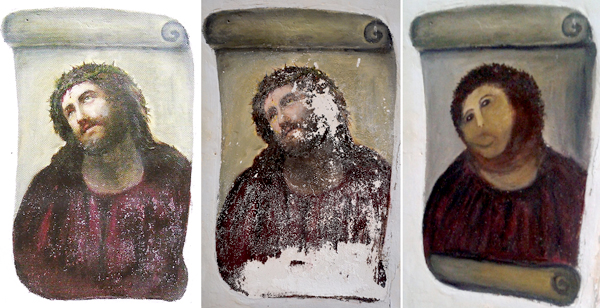
For the commenters and others who recently objected that art can’t be objectively measured–I agree to a point. Far be it for me to claim that beauty isn’t a subjective experience! But there’s a difference between “Beauty is in the eye of the beholder” and “Storytelling has no standards.” Claiming there are no standards and everything is popularity is post-modern nihilism. I present as evidence the recent restoration of Ecce Homo.

A combination of three documents provided by the Centre de Estudios Borjanos on August 22, 2012 shows the original version of the painting Ecce Homo (L) by 19th-century painter Elias Garcia Martinez, the deteriorated version (C) and the restored version by an elderly woman in Spain. An elderly woman's catastrophic attempt to "restore" a century-old oil painting of Christ in a Spanish church has provoked popular uproar, and amusement. Titled "Ecce Homo" (Behold the Man), the original was no masterpiece, painted in two hours in 1910 by a certain Elias Garcia Martinez directly on a column in the church at Borja, northeastern Spain. The well-intentioned but ham-fisted amateur artist, in her 80s, took it upon herself to fill in the patches and paint over the original work, which depicted Christ crowned with thorns, his sorrowful gaze lifted to heaven.  = RESTRICTED TO EDITORIAL USE - MANDATORY CREDIT " AFP PHOTO/ CENTRO DE ESTUDIOS BORJANOS" - NO MARKETING NO ADVERTISING CAMPAIGNS - DISTRIBUTED AS A SERVICE TO CLIENTS =-/AFP/GettyImages           NYTCREDIT: -/Agence France-Presse -- Getty Images

A combination of three documents provided by the Centre de Estudios Borjanos on August 22, 2012 shows the original version of the painting Ecce Homo (L) by 19th-century painter Elias Garcia Martinez, the deteriorated version (C) and the restored version by an elderly woman in Spain. An elderly woman’s catastrophic attempt to “restore” a century-old oil painting of Christ in a Spanish church has provoked popular uproar, and amusement. Titled “Ecce Homo” (Behold the Man), the original was no masterpiece, painted in two hours in 1910 by a certain Elias Garcia Martinez directly on a column in the church at Borja, northeastern Spain. The well-intentioned but ham-fisted amateur artist, in her 80s, took it upon herself to fill in the patches and paint over the original work, which depicted Christ crowned with thorns, his sorrowful gaze lifted to heaven. = RESTRICTED TO EDITORIAL USE – MANDATORY CREDIT ” AFP PHOTO/ CENTRO DE ESTUDIOS BORJANOS” – NO MARKETING NO ADVERTISING CAMPAIGNS – DISTRIBUTED AS A SERVICE TO CLIENTS =-/AFP/GettyImages NYTCREDIT: -/Agence France-Presse — Getty Images

Are there standards, or are these equally good?

Apr 282015
 

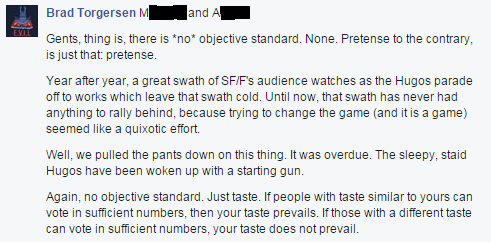
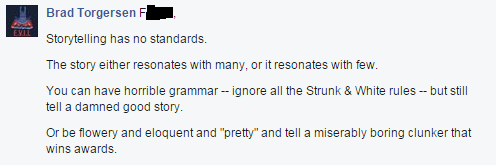
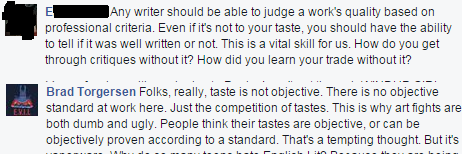
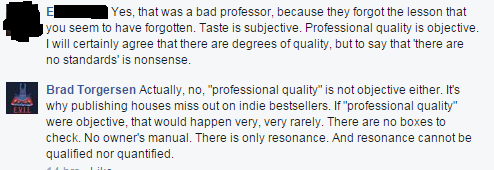
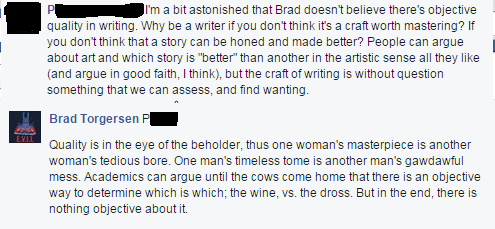
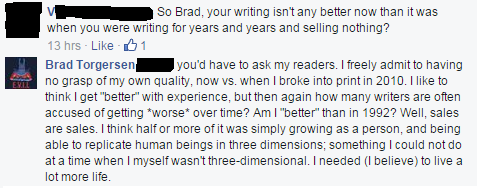
full-retardSo I was wrong about being done with the Puppies posts, because I just had the surprising pleasure of watching Brad Torgersen, self-avowed conservative, go Full Post-Modern. Pics included to show I’m not making this up.

Gents, thing is, there is *no* objective standard. None. Pretense to the contrary, is just that: pretense.

Again, no objective standard. Just taste. If people with taste similar to yours can vote in sufficient numbers, then your taste prevails. If those with a different taste can vote in sufficient numbers, your taste does not prevail.”

brad cropped1

Storytelling has no standards.
The story either resonates with many, or it resonates with few.”

brad cropped2

(in response to “Any writer should be able to judge a work’s quality based on professional criteria. Even if it’s not to your taste, you should have the ability to tell if it was well written or not. This is a vital skill for us. How do you get through critiques without it? How did you learn your trade without it?“)

“Folks, really, taste is not objective. There is no objective standard at work here. Just the competition of tastes.”

brad cropped2b

(in response to “Taste is subjective. Professional quality is objective. I will certainly agree that there are degrees of quality, but to say that ‘there are no standards’ is nonsense.“)

“Actually, no, “professional quality” is not objective either. … There are no boxes to check. No owner’s manual. There is only resonance. And resonance cannot be qualified nor quantified.”

brad cropped3

(in response to “Why be a writer if you don’t think it’s a craft worth mastering? If you don’t think that a story can be honed and made better? People can argue about art and which story is “better” than another in the artistic sense all they like (and argue in good faith, I think), but the craft of writing is without question something that we can assess, and find wanting.“)

Quality is in the eye of the beholder … in the end, there is nothing objective about it. … Nobody gets away from it. Because there is no objective measurement. Just audience and reader satisfaction.”

brad cropped5

(in response to “So Brad, your writing isn’t any better now than it was when you were writing for years and years and selling nothing?“)

you’d have to ask my readers. I freely admit to having no grasp of my own quality, now vs. when I broke into print in 2010 … Am I “better” than in 1992? Well, sales are sales…”

brado cropped 6

Now, I don’t want to say Brad doesn’t have any point at all, certainly much of art appreciation is subjective. But to see him go full “There are no standards, there is only resonance!” is delightful.

In retrospect, I guess it was kinda inevitable.

I expect that for Sad Puppies 4, Brad will give us an address to which we can send anything we had published in the previous year, and he will then pick five works at random to go on the slate, since everything is equally good and it’s all just subjective taste. We’ll re-name the Hugos “The Rando’s” and enjoy it as the biggest piece of Post Modern Performance Art of this decade. It’ll be like we’re all in the 90s again! :)

Apr 242015
 

hugoAs always, I have done my best to find the Hugo Nominated Short Stories and Novelettes that are available free online and post the links here, for the convenience of my book club.


Short Stories

On A Spiritual Plain”, Lou Antonelli (also in pdf)

The Parliament of Beasts and Birds”, John C. Wright

“A Single Samurai”, Steven Diamond – this doesn’t appear to be available free online

Totaled”, Kary English

Turncoat”, Steve Rzasa

The Short Stories are all Puppy-slate works.


Novelettes

Ashes to Ashes, Dust to Dust, Earth to Alluvium”, Gray Rinehart

Championship B’tok”, Edward M. Lerner

The Day the World Turned Upside Down”, Thomas Olde Heuvelt, Lia Belt translator (audio version available at same link) – The only non-Puppy work in this category.

The Journeyman: In the Stone House”, Michael F. Flynn

The Triple Sun: A Golden Age Tale”, Rajnar Vajra

Apr 232015
 

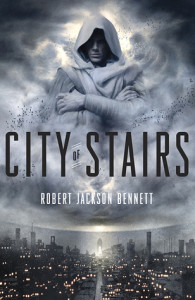
city of stairsCity of Stairs, by Robert Jackson Bennett
Synopsis: In a steampunk setting, an Agatha Heterodyne-esque government agent investigates a professor’s murder and finds herself wrapped up in political machinations, and the cultists of a long-dead god.

Book Review: The first chapter was boring and unnecessary, the rest of the book is great!

The thing that most stands out about this novel is that the characters POP! In lots of books I forget most of the charecters very quickly after putting them down, but this cast jumps off the page and stays distinct. It was as startling as the first time I played a cell-shaded game. The protagonist (Shara) is half Agatha Heterodyne, half Sherlock Holmes, and has all the drive and wits you’d expect from such a character. Her bodyguard/secretary (Sigrud) is the absolute epitome of the manly badass. He rarely talks, never shows emotion, delights in killing, and murders the hell out of anything that threatens the protagonist. The two major supporting characters are an incredibly charming gay gentleman that is almost the internet persona of George Takei, and a tough-as-nails military colonel who you can’t help but see chomping on a cigar and sneer all the time, even when she is not in any way doing those things on the page. And the villain… oh MAN do you hate him! It is utterly delightful!

City of Stairs also does an excellent job of using our cultural background to mold our expectations and uses that to drive our emotional response. The story takes place on “the Continent”, an analog to the British Empire just after its peak. Shara is a “Saypuri”, which is an obvious analog to India. They have just thrown off their British oppressors, so we are entirely on their side! We are for the underdogs, especially when they’ve just won their freedom from an oppressive British Empire (we can kinda relate to that…). Screw the colonialist pigs! We even get vivid descriptions of the atrocities committed during their subjugation. But… the Saypuri’s want to be secure, they don’t want the threat of being reconquered, so they’ve invaded the Continent and taken it over, and now they are the ruling class. They literally murder the Continent’s Gods, which required a genocide of all the people who have some of the God’s blood in them. This, of course, happened nearly a century ago, no one alive now is responsible. And it was necessary, because the Gods are weapons of mass destruction and cannot be allowed to exist in enemy hands. But… all of a sudden our love of and identification with the Saypuris doesn’t feel quite so good. And this wouldn’t have worked out nearly as well if Bennett hadn’t made the initial British/Indian connection so well up front.

On the down sides, Bennett makes things a bit too easy for our heroes. Shara doesn’t feel like she’s ever at the end of her rope and on the edge of losing. Sigrud is so bad-ass that when he went up against a multi-ton eldritch monstrosity single-handedly I never worried he might lose. The tension never got very high.

Nuance is also a bit lacking in the book. The themes of security vs compassion weren’t really explored in the way that you’d imagine a story that involves a choice between mass-murder and leaving Nukes in the hands of your enemy would… it’s barely touched on at all. The big theme (which I won’t mention due to spoilers) is literally stated by the characters, several times. That’s not very artful. Likewise, a lot of the foreshadowing is done too heavily, so that the reveals aren’t surprising because the author did too good of a job telegraphing them. And everyone that isn’t a main character feels rather flat. Much of the time it felt like the Continentals were caricatures of religious fanatics rather than a real society of people.

But… did I mention the story has Gods?! I absolutely love any story with real, honest-to-goodness created-the-world style of Gods. That’s a huge button for me, and gets major bonuses in my book. There’s tons of wry humor, and quite a bit of action. And on top of all that, at least once the protagonist goes into full-Sherlock Rationalist mode, where she lays out all options in her mind, dissects and evaluates them, then goes with the one she sees as most advantageous. I really wish that sort of thing had happened more. While the book has a few problems, it’s a fantastically fun read. If you enjoy adventure, smart characters, and a bit of ambiguity, you’ll love this. I certainly did. Recommended!

Book Club Review: This is a tough call for me. On the one hand, it’s a really fun book, and (almost) everyone really enjoyed it! Just talking about the cool parts, and the few flubs, was a good time in itself. And there was some level of conversational grit, what with the religious fanatics, realpolitik, and vibrant characters. But the really interesting stuff was mentioned once and then not developed. There was a lack of depth to the conversation. Which is OK too, sometimes it’s good just to read something fun and chat, but it’s not ideal for a book club.

I would say, if you’ve read some heavier stuff recently and need a break just to enjoy and relax, this is a good book, and in that case Recommended. But in a one-on-one comparison with good-for-book-club books… not recommended.

Puppy Note: I’m not sure what the Puppies would think of this book. All the characters of importance are women. The three men are the bodyguard (with very little agency), the gay friend, and the villain. The protagonist is brown-skinned, the book implies that colonialism is a bad thing that we shouldn’t be proud of it, and nearly every religious character is portrayed as a violent fanatic. If I was a Puppy trying to classify a book as SJW-propaganda, I would claim that this one ticked all the important boxes, and that if it received any recognition it would because it propagated the SJW-agenda rather than because it was a good book.

But… this book is fun. It doesn’t dwell on any of these issues. It has a lot of humor and action, fantastic characters, and it’s a fun read. I would think it’s something that the Puppies would love! Isn’t this what they say they’re trying to bring SF back to? So if it didn’t get awards/recognition, would they claim that this was proof that fun, non-pretentious stories are being snubbed by the ivory-tower elites?

I am intensely curious as to how Brad/Larry/Vox and their fans are going to interpret this novel, which seems to fit them perfectly in some ways but oppose them in others. I’m going to go out on a limb and make a prediction. Despite the substance of the book, I get the feeling that the tone is what matters to the Puppies most. And, to me, this book reads like something that appeals to liberal/left sensibilities. I don’t think the Puppies will find this book enjoyable.

Not that there’s anything wrong with that.

Apr 222015
 

sad_puppies_3_patchAfter this I think I’m done with the Puppies for a while, aside from perhaps some Puppy Notes on my reviews. But I must say, I am puzzled by their choice of targets sometimes. They seem to hate Throne of the Crescent Moon, though I’m not sure why. It’s exactly what they want – mindless action, good guys who are good and bad guys who are bad, lack of nuance, no political message, etc. The entire thing is all surface. It should be right up their alley, but for some reason it’s boo’ed.

Anyway, two relevant links to close things up:

Heinlein On The Puppies
A quote from him about critics he dislikes – “He will permit any speculation at all — as long as it is about gadgets only and doesn’t touch people. He doesn’t care what mayhem you commit on physics, astronomy, or chemistry with your gadgets… but the people must be the same plain old wonderful jerks that live in his Home Town. Give him a good ole adventure story any time, with lots of Gee-Whiz in it and space ships blasting off and maybe the Good Guys (in white space ships) chasing the Bad Guys (in black space ships) but, brother, don’t you say anything about the Methodist Church, or the Flag, or incest, or homosexuality, or teleology, or theology, or the sacredness of marriage, or anything philosophical!  […] This of course rules out… a large fraction of my work — and all my future work, I think.”

On Brad and Larry trying to distance themselves from Vox Day
“Correia and Torgersen brought him onboard. Actively. Here’s a pro-sad-puppies podcast talking about that decision, back in March, before the shortlist came out. Here’s Brad Torgersen in particular way back in January defending Vox Day, describing him as a “gentleman.” […] The leadership of the campaign actively made the decision to bring in Vox Day and people like him. So it is impossible to argue Vox Day is not representative; they chose him as one.”

Apr 172015
 

220px-Eric_FlintEric Flint just wrote a long post where he expounds on what he believes is causing the divide between mass audiences and WorldCon voters. And, as has been pointed out by numerous people by now, it is not politics (as the Puppies initially claimed… and still do?)

It is, in fact, very long. However it is very insightful, and makes very good points, and has a really neat solution proposed at the end. In the interest of getting to the chase, I am snipping out the parts I personally thought were the most interesting and pasting them below (And even then it’s still kinda long). Please note that ALL OF THIS IS THE WORDS OF ERIC FLINT. I do not have the talent or insight to write this, and I do not want to claim any credit for his work. Please go check out his original post, or buy some of his books, or something. :)


Due to massive changes in the market for F&SF the structure of the major awards no longer bears any relationship to the real world in which professional authors live and work.

Three out of four awards are given for short fiction. Forty or fifty years ago, that made perfect sense. It was an accurate reflection of the reality of the field for working authors. Today, F&SF is overwhelmingly a novel market. Short fiction doesn’t generate more than 1% or 2% of all income for writers. And even measured in terms of readership, short fiction doesn’t account for more than 5% of the market.

To make the situation still worse, the official rules for both the Hugo and Nebula define a “novel” as any story more than 40,000 words long. Half a century ago, that was reasonable. The average length of an SF novel was between 40,000 and 60,000 words. But today that definition is simply laughable. Every professional author and editor in our field knows perfectly well that no major publisher, outside of the YA market, will accept a “novel” manuscript that’s less than 80,000 words long—and they usually want between 90-120,000 words.

Then, it gets worse. Because the market today isn’t simply a novel market. It’s become predominantly a market that wants long series, not stand-alone novels. And the existing award structure is very poorly designed to handle long series. About the only way it can do it is by—quite artificially, in most cases—cutting one book out of a series and pretending for the moment that it’s a “this year only” quasi-stand alone story.

That can be done with some series, which are designed by their authors to consist of stories that are only somewhat loosely connected. But other series are quite different. To name just one example, the current situation with David Weber’s long-running Honor Harrington series is that no fewer than three novels are running more or less simultaneously with each other, with the action of the various characters penetrating from one story to the other—and, just to put the icing on the cake, a number of the major characters were first developed in short fiction published in one or another of the anthologies that are part of the series, and some of them by authors other than Weber himself. Trying to separate any of these out as “best this or that of Year X” would be an exercise in futility.

And never mind that Weber is doing something well enough that the Honor Harrington series is one of the very few purely SF series that regularly makes the New York Times bestseller list. His narrative structure doesn’t match what the awards are comfortable with, so to hell with him. And to hell with what the mass audience thinks.

The end result is the ever-growing division you see today between those authors whom the mass audience perceives as the major authors in F&SF and those authors whom the comparatively tiny but socially prestigious award-voting and critical in-crowds consider major authors. It’s a division which is getting worse, not better, as time goes on.

This is by no means peculiar to F&SF. In just about every field of literary or artistic endeavor—hell, just plain hobbies, when you get down to it—you tend to get a division between the interests and concerns of the mass audience involved in that field and the much smaller inner circles of aficionados.

I think of it as the movie reviewer’s syndrome. I noticed many years ago that almost all movie reviewers will automatically deduct at least one point from their rating of a movie if it contains a car chase. Why? Well, it’s not hard to understand. Seeing three or four or five movies a week the way they do, they get sick and tired of car chases.

But the average movie-goer doesn’t watch new movies four times a week. For them, movies are a relatively occasional experience—and, what the hell, car chases are kinda fun.
What you get with literature, including any and all forms of genre fiction, is the following division:

What the mass audience wants, first and foremost is a good story. Period.

But, sooner or later, that stops being sufficient for the in-crowds. At first, they want more than just a good story. Which, in and of itself, is fair enough. The problem is that as time goes by “more than just a good story” often starts sliding into “I really don’t care how good the story is, it’s the other stuff that really matters.”

To put it another way, every successful author has to master two skills which, although related, are still quite distinct: they have to be good story-tellers; and they have to be good writers.

Of those two skills, being a terrific story-teller but a journeyman writer will win you a mass audience, and is likely to keep it. On the flip side, being a journeyman story-teller but a terrific wordsmith will win you critical plaudits but won’t usually get you much in the way of an audience.

I can tell you that under the existing category of “novel” there are at least four different types of stories each of which pose as many separate challenges and require as many varied sets of skills as the differences between writing a short story, a novelette and a novella.
Those are:

1) Short novels. Stories from about 40,000 to 80,000 words.

2) Full length stand-alone novels.

3) Mega-novels. These are stories which are actually a single “novel” in the sense that they are based on an integrated story arch, but which are so long that for practical and commercial reasons they have to be published in multiple volumes. Probably the classic instance in our field is Tolkien’s The Lord of the Rings. It is usually called a “trilogy,” but it is in fact a single novel.

An example from my own work would be the six-volume Belisarius “series,” which is really just one great big novel.

4) Series, properly speaking. These are stories which share a common setting and usually a common set of characters, but do not possess a single story arch.

Just to make things more complicated, there is really quite a big difference between two kinds of series: the traditional “beads on a string” series, which proceed as Volumes 1, 2, 3, etc., and the more complex kind of series where the stories branch off from each other, often run parallel to each other, and can’t be neatly assigned to any clear and definite chronological sequence.

I’ve worked in both kinds, and they really do require different skill sets, although of course there’s a lot of overlap. (My Trail of Glory series is a “beads on a string” type series. My 1632 series and Joe’s World series are of the more complex “branching bush” type.)

So what are we supposed to do? Scrap the existing best novel award for four or possibly even five different awards?

And if that seems excessive, contemplate this:

As long as we’re considering solving award problems by expanding the number of awards, let us not overlook the still more long-standing problem that comedy is always lumped in with dramatic story-telling even though everybody who knows anything about stories know perfectly well that:

—comedy is really, really hard to do well;

—and it never gets any critical respect.

That’s partly what explains the preposterous fact that Terry Pratchett got so few nominations in his entire career. And it’s also the reason that the Golden Globe movie awards, unlike the Oscars, make a distinction between comedic films and dramatic films.
I can see it already…

We’d have seven different literary awards instead of four, and then duplicate each of them for comedic treatment for a total of fourteen awards handed out every year.

Somehow, that strikes me as more than a little goofy.

But I personally think the best solution, if there is one at all, is to scrap the whole existing set-up. Of all the awards handed out for literary merit, the only ones that seems to maintain any sort of ongoing more-or-less objective relationship to the real world are those given out for often broadly-defined achievement. They’re not awards given out for “best XYZ of year ABC.” Instead, they are achievement awards handed out for a body of work, that may be anchored to something specific but takes other considerations into account, and perhaps most importantly is not tied to an annual cycle.

That allows such awards to adapt to changes in the market (or the equivalent in other fields), not to be forced into making snap judgments—and, perhaps most important of all, allows the voters to consider the ongoing and cumulative impact of an author’s work rather than artificially dividing it up between Works 1, 2, 3, etc., etc.

It is simply not the case that every author’s importance to the field can be gauged in terms of this or that specific story, matched up against all other stories in the year it came out. In the case of many authors, even though they may never have written any single work that anyone (including themselves) would consider “the best whatever” of Year ABC, they manage to produce a body of work over many years that, taken as a whole, often outshines—even dwarfs—the overall body of work of authors who might have won annual awards fairly regularly.

All that said, I think the likelihood that either the Hugo or the Nebula will be scrapped in favor of general achievement awards is probably indistinguishable from zero. These things tend to develop a tremendous institutional inertia. If such an award started with a very large and prestigious body of sponsors, it might have a chance of getting off the ground, I suppose. My problem is that, deep down inside, a little voice is whispering to me….

Oh, great. Just what the world needs. Another goddam award that nobody pays any attention to except the people who voted for it.

Apr 162015
 

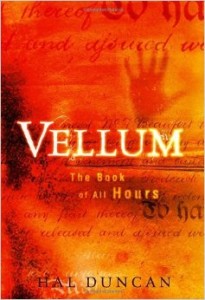
hal duncan vellumIf I momentarily have the attention of anyone who loved If You Were A Dinosaur, My Love… may I also recommend Hal Duncan’s Vellum? It is my favorite book EVER, and the entire thing is a master stroke of experimenting with structure. And it has the same theme as Dinosaur does too. To briefly quote myself from previous posts:

In Vellum, something happened, but the enormity of the event can never be put into words. So instead the event is repeated and re-examined, over and over, from countless different angles. Every story is a separate story, not a continuing narrative, with separate characters. But every story is the same story, and the characters are always the same – in essence if not in flesh.

It isn’t written linearly, because its story isn’t a linear story. It is a mosaic which you can only see small pieces of at a time, and once you’ve read the whole thing you have all the pieces and you can hold them in your mind and mentally take several large steps backwards and finally see the actual picture.

Importantly, all the parts that make up the whole are themselves awesome. Like a mosaic, the various pieces may be different colors or shapes – there’s cyberpunk, there’s modern Lovecraftian horror (which is the best piece of modern Lovecraft I’ve read, but I am biased), there’s steampunk, there’s angels destroying each other in holy wars. But despite the differences, each piece is made of the same material as all the others, and the differences mainly serve to point this out.

And the overall picture, the theme that all the different pieces keep circling around and coming back to, is extremely relevant to me. It’s a simple theme, and if the sparking event of the novel could be put into words, it would be a simple two-word story: people die.

It’s hard to get people to read this. Most of the people I tried to get to read it didn’t get far, because they didn’t like it. But if you do give it a shot, and you like it, please let me know. It would be awesome to personally know someone else who’s also in love with Vellum.

Apr 152015
 

unstoppable t-rexI’ve had a few people call me out on my statement that  Rachel Swirsky’s “If You Were A Dinosaur, My Love” is simply good writing regardless of if it appeals to one’s taste or not (previous post). They said I should put my money where my mouth is and say why it is good.

Before we begin, if you haven’t read it yet and you’re going to read the rest of this post, go read it first. It’s 12 stanzas, average of 80 words per stanza. At under 1000 words most markets would count it as Flash Fiction. If you want to get straight to my argument, jump to section C.

A. The Disclaimer

This is the part where I grumble and make excuses about why I’m not the right person for this job.

First, I’m not any sort of authority. I don’t have a degree (in anything, actually, I dropped out of college). I don’t have any training as a critic. I’m not a respected authority. Hell, I’ve barely even been published. All I am is some guy with a blog who posts his opinions and reads a bunch. And I don’t even read nearly as much as I used anymore! (I blame all the new projects I’ve undertaken)

And second, as I stated before, it wasn’t my favorite story. I mean, it’s good, but there were several I liked more, none of which got on the Hugo ballot! In fact, it wasn’t even my favorite Rachel Swirsky story of that year. I feel like someone who loved it with their full soul would be much better at making this case.

B. The Googling

For that reason, I looked to see if someone else had already done this. I would like to direct your attention to these three fine posts, which do their part to explain what makes this story good.

Anaea Lay: “The only other place I can think of off-hand that has a structure like this is a lullaby and I don’t think that’s an accident. It’s an extremely popular lullaby, and by subconsciously triggering associations with it, Swirsky is immediately lulling her readers, as it were, and invoking a sense of deep, unwavering love. …  the structure of the story as a series of If/then statements …  Her compassion for the families of the people who nearly killed her fiancé is so relentless that it interrupts the coping mechanism she’s using to deal with that same tragedy. Reader, Rachel Swirsky just stabbed you in the guts by breaking a pattern.  You have been shivved by a master.

Jody/Bookgazing: “Her word choice also makes him sound breakable and easy to damage; a person/dinosaur that requires the greatest of care. On reflection, this description sounds a warning bell for the story’s later revelations. … When it comes, the twist is the kind of quiet reveal that will knock you down and then flower into a hundred ‘ohs’ of understanding as you re-consider the entire story. Absolutely everything looks different after that twist … While the twist provides a real gut punch it was the simplicity of Swirsky’s story that drove it deep into my heart. I suppose it might be characterised as a slightly removed tone – the way someone tells the story of an alternate reality to comfort or to keep themselves from feeling what is happening around them. Perhaps the story teller notes so many sharp details to keep from absorbing the wider consequences of what is in front of her.”

Little Redhead Reviewer: “This is not a story, this is a kaleidoscope, with each touch, each incremental move of the barrel bringing something completely different into focus, taking you somewhere else, taking you one step closer to where the narrator is, at first, afraid to go.

C. My Own Sad Attempt At Explaining Myself

So what is it that makes this story artistically good, even if you don’t like it?

I. Structure.

This story is written to mimic the If/Then structure of the hugely popular “If You Give A Mouse A Cookie” children’s books (which incidentally first came out while I was a child, so this story hit me right in the Target Demographic. But I assume by now everyone is acquainted with them, either as someone who’s had the books read to them, or as someone who read it to youngsters of their own). It’s a chain story, were each new section is a consequence of the previous one (If you give a mouse a cookie, he’ll want a glass of milk to drink with it. If you give him a glass of milk, he’ll want a mirror to avoid a milk mustache. If you give him a mirror, etc). It establishes this pattern immediately, so at the end of every page the child immediately thinks “I have to know what this crazy mouse will want as a consequence of the latest thing he got!”

First, Rachel taps into this same dynamic to keep us going from one stanza to the next. But more importantly, she evokes this childhood play structure that we’ve internalized (and as Anaea pointed out, it’s deeper than Mouse, it goes back to old timey lullabyes). And she exploits that by giving us a whimsical visual – a 5-foot, awkward T-Rex! She initially keeps the tone very much in the realm of whimsical, near-childish sing-song nonsense. He’d sing on Broadway! And all the while she’s slipping in these clues, these undertones that point to what’s coming, but we don’t notice because we’re thoroughly wrapped up in our childhoods, safe in our beds while our parents are reading us a safely child-friendly story.

So when she breaks that structure once, right in the middle, to reveal what we’re actually reading, it drops us right into cold reality. That stanza doesn’t start with an If. It is a straight-up sob, and we realize that the entire If/Then edifice is a fantasy the narrator’s using to avoid dealing with the horror of her life, and that fantasy has been momentarily pierced. The protective narrative is gone, reality is laid bare, the structure is broken, the narrator is broken, the world is broken, and everything is pain and pain and pain.

And then she returns to the If/Then structure. Begins to build that protective wall up again. Because reality is too shitty to face right now. The sing-song returns. But now that we know the truth, we see that she’s using her memories of childhood safety as a shield, and the shield doesn’t do a damn thing to make reality better. All it does is stab us repeatedly in the childhood, because Swirsky managed to evoke our childhoods so effectively and then link them to this horror. Which, you know – ಠ_ಠ But it’s damned effective writing.

II. Masterful Word Crafting

Notice that in under 1,000 words, while describing her lover almost entirely in dinosaur-related terms, and sticking with a lyrical, sing-song flow that is reminiscent of good children’s books, Swirsky managed to paint an extraordinary picture in our minds of her lover, and of their relationship. You don’t get to that point without a lot of practice and a great deal of skill.

Notice also that she slipped in all sorts of clues that created undertones that aren’t apparent at first, but that were priming us subconsciously for something bad coming up. Things that stand out like crazy in the second reading. Why does he sing unrequited love songs? Why can’t SHE marry him? The joke about “it’s best to marry someone who shares your genetic template” lets us breeze over something that should have stopped us. It’s unrequited, and she can’t marry him, because he’s basically dead. That was taken from them.

III. Theme

It’s a basic theme. It’s been an obsession of mankind since forever. Loving something is dangerous, it makes you vulnerable. If you love something, you can be hurt when that thing is hurt, or taken away, or murdered. Usually it’s better not to risk that. And when we do risk that, our greatest wish and fantasy is that this love be immune to the devastations of the world. That it be strong, with powerful jaws and flashing teeth that would rend any who dare harm it. The worst thing about the world is that the people we love die, and fuck all the gods for letting that be a reality. All we want is for our lover to be a dinosaur, so they/me/we won’t have to hurt.

Simply having a theme is not enough, which is why I put it at the end. Lots of stories have themes. Most of them fail to deliver them effectively, for many sundry reasons. But this particular story chose to deliver its theme through a structural laser-guided missile, and Swirsky did it right, with the help of mastery of the language.

Not all works of artistic merit have to have a strong theme, I guess? But it does help. And this one does.

D. The End

This is by no means an exhaustive list of what can make a work good. Nor are any of the three I mentioned *required* in any particular work in order to make it good. But they are ways that a story can be judged, and in all three respects this story succeeded amazingly. There are things you can dislike about it, but to say it wasn’t well-written is… wrong.

[EDIT: btw, may I recommend Vellum?]