Jan 222016
 

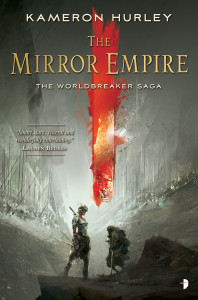
TheMirrorEmpire-144dpiThe Mirror Empire, by Kameron Hurley

Synopsis: A fantasy world is invaded by its own recently(?)-divergent parallel universe.

Book Review: The Mirror Empire had a lot of promise. It starts with interesting societies (one where the social norm is that there is no physical touch without explicit consent beforehand! I know a number people who would love that), an awesome post-post-apocalyptic world (a thousand years ago it was made nearly uninhabitable via magical warfare, now society has recovered but is under constant strain), and the promise that these people (the entire populace, in fact) are going to have to fight their own doppelgangers! That’s a hell of a way to start!

But it bogs down very quickly, and soon becomes a chore. There are several ethnicities across multiple countries (and two worlds) which are never well differentiated. Everyone is basically baseline human without distinguishing features. I found myself longing for elves that are tall and thin, and dwarfs that are short and hairy. Yes, they’re stereotypes, but they help distinguish peoples quickly and definitively. This is further complicated by every ethnicity having several internal factions working at cross-purposes. And each faction has complicated familial ties and alliances with outsiders. I felt like I should be taking notes.

Making the problem worse is that Hurley creates new words where currently-existing words in common usage would suffice. Why create the term “Ora” when the word “Priest” already exists? Why use the term “-jista” with the term “-mage” already exists? It’s another thing for us to have to mentally catalogue in a book already full of complex plots, double-dealing, and extended family trees.

There are some really great moments in the book. I love realpolitik and cynicism, and The Mirror Empire has them in spades. But it began to feel very tropey very quickly. If you’ve read much grimdark the action quickly becomes very easy to predict. None of the characters are all that relatable (except the character who gets the least amount of screen time), and this is a much bigger problem with grimdark than with other genres IMHO. If you don’t viscerally want the protagonists to do the terrible things they are doing despite yourself, you aren’t getting that kick of horror-as-you-look-in-the-mirror that we relish. Not Recommended.

Book Club Review: Almost no one in the book club finished the book. In addition to the problems I mentioned above, it’s quite long, which led to a high drop-out rate. Even those who finished didn’t have all that much to say about it, as there was nothing very divisive or controversial about it. Not Recommended.

Jan 212016
 

vaping1I’ve recently seen two vape-shaming attacks. I’d like to point out this is different from mocking people for their hat or beard styles. If this sort of thing succeeds in reducing incidence of vaping it will
A. make your enviroment less pleasant (assuming you dislike the smell of tobacco smoke) and
B. lead directly to more preventable deaths from lung cancer.
If you vape-shame, you are contributing to deaths that could be prevented. Might as well mock designated-drivers while you’re at it.

Jan 202016
 

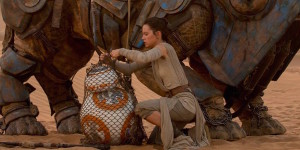
star-wars-force-awakens-rey-bb8-daisy-ridley1(minor spoiler for The Force Awakens below)

I broke down and saw the new Star Wars movie, in large part so that I could participate in conversations with my friends. I was hoping I’d be surprised, but I didn’t expect to be bored. I left confused, because there’s all sorts of really great things to like about the movie, but when you put them all together, the whole is less than the sum of its parts. Why was it so damn boring?

After days of pondering, I’m pretty sure the movie lost me very early on, in one fatal scene. That being the scene where Rey steals BB8 from a fellow scavenger.

Not because I have a problem with the action itself, but rather because the scavenger doesn’t react. Ray runs up, yells a few mean words at the scavenger, then rips BB8 from the scavenger’s mount to claim him. She scoots away a few steps and starts inspecting her new-found loot. The scavenger scowls and goes about his business.

This is utterly unbelievable. No way is someone going to run up to me while I’m driving, take valuables out of my car, and then wander away a few steps before settling down, without SOME SORT of reaction from me. Especially if I’m a desperate scavenger barely eking out a living. The scavenger presented in that scene is there soley to deliver BB8 to Rey. He didn’t exist before that moment and he won’t exist after it, and he knows this and accepts it.

To make matters worse, Rey is also aware of this. She doesn’t bother to flee or take a defensive position or even keep an eye on the scavenger. She accepts that his role is complete, and he can now pass gracefully from this mortal coil.

In those few seconds, the movie told me everything I needed to know to completely destroy my enjoyment. The director (or writer?) has no respect for his audience. He doesn’t care to speak with them. This is not a story. This is merely a number of set-pieces, loosely strung together. All action loses meaning, because there are no people in this movie. There are only philosophical zombies, progressing through a chronology of events without intention or awareness.

This is not a narrative, it is a 2-hour toy commercial. Made by people who have forgotten how to play with toys.

I realize that all stories are predetermined narratives, all “freely chosen actions” are contrived by the author to suit his goals. But those goals are supposed to include causing his audience to generate a model of a person in their head, and empathizing with that person. When it is clear that the author’s model of the characters aren’t living people, but rather of empty dolls that fill in the people-shaped holes in a spectacle, it becomes impossible to empathize with them. And so, watching hollow plastic pieces being continuously re-arranged in dramatic poses for the camera, I was bored.

It could have been a good story, had anyone cared to tell one.

Jan 072016
 

In response to yesterday’s post, this comment was made on the reddit HPMoR subforum:
I sort of see “encouraging a fanbase to all buy supporting memberships to Worldcon to get specific items added to the ballot” as more of a questionable action

I’d much prefer to get more people involved in WorldCon in general. I would be disappointed if people bought the membership just to get HPMoR on the ballot, and I also think that’d be a waste of money. $50 is far better spent on donating to a charitable cause if that’s your only motivation. But I love WorldCon, and I’m excited about it, and I’m trying to encourage others to share in that fun. If it’s something that seems like it could be up your alley but you’ve never done it before, this is a great year to jump in! But please don’t take it as a call-to-action for HPMoR’s sake or anything. Do it because you’re enthusiastic about SF! (if you are)

Jan 062016
 

HPMoR-Podcast-Small (1)I think it’d be great if HPMoR was nominated for a Hugo, and I feel it deserves at least a nomination. To that effect, I wrote this post. Mirror below.


What are the Hugo Awards?

The Hugo Awards are one of the most prestigious Science Fiction and Fantasy awards. They are also the only ones awarded based on popular vote. Every year the World Science Fiction Con attendees vote for the works they liked best in the previous year. And since the convention travels around the world, and not everyone who wishes to attend can be physically present every year, anyone is allowed to purchase a Supporting Membership rather than attending in person, and can still cast a vote that way. That means that for a nominal fee, any Science Fiction or Fantasy fan in the world can vote for the works they liked best that were published in the previous year.

Is Harry Potter and the Methods of Rationality eligible?

Harry Potter and the Methods of Rationality is a serially published work, whose final instalment was published in 2015. Under the WorldCon rules, this means it is eligible for a Hugo at the 2016 WorldCon. Per Section 3.2.4 – “a work appearing in a number of parts shall be eligible for the year of the final part.” There was a minor kerfuffle  in 2014 when The Wheel of Time was nominated for Best Novel, as it consists of 14 books published over 13 years. The nomination was allowed, but not without objection. However HPMoR should receive no such objections, as it is very clearly a serial work of the type that this rule was originally written to explicitly allow.

And yes, fanfiction is eligible. Don’t let anyone tell you it isn’t. First, there is no rule against it. Perhaps more importantly: well-regarded fanfiction has been nominated before. Peter Watts’s “The Things” is an explicit fanfic of “The Thing” and was nominated in 2011. (Incidentally, you should go read it. It is rationalist, short, available free online, and ABSOLUTELY FANTASTIC) John Scalzi’s “Redshirts” is a barely-disguised fanfic of Star Trek (the original series), and won the 2014 Hugo Award for Best Novel. Obviously fanfic is eligible.

But is HPMoR the best work of 2015?

I’ve been participating in the Hugos for a number of years. Every participant gets five nominations they can use to nominate works they want to be considered for the Hugo Award. I can’t definitively say that Harry Potter and the Methods of Rationality is the best work published in 2015. I have not read every work published in 2015. And my opinion is just one of many. However, I can say that HPMoR had a profound impact on my life, much more than most fiction I read. And it was certainly within the Top Five Most Important Fictional Works To Me That’s Eligible For a 2016 Hugo Award. Among the five nominations I get for Best Novel of 2015, there’s no way HPMoR wouldn’t deserve one of them.

If HPMoR made an impact in your life, and you truly enjoyed it, I encourage you to participate. As long as it was meaningful to you, you can nominate it. Once it has been drawn to the attention of the wider SF-reading world, we can let the world’s fans weigh it along with the other nominees to decide if they think it’s deserving of the award. And, of course, we’ll be reading the other four nominees and giving our input as well. Personally, I think HPMoR has a good shot.

Why do this?

First, because you get to be a part of SF History! That in itself is pretty fun!

Second, voters get a packet that contains many of the nominated works in e-format. (Usually not all of them though). This makes it easy to read all the nominees, and exposes you to a lot of very good stories that you often wouldn’t have picked up on your own. If nothing else, it lets you be part of the conversation. If this is your first time supporting the Hugos, you get to experience the process. If you choose to attend as well, you get to be in a hugely geeky major con that’s a lot of fun and meet fellow HPMoR fans IRL!

Third, a number of people who may have passed over HPMoR because it was “just fanfiction” may be willing to take a closer look. Especially if a lot of the wider WorldCon-going public gives HPMoR a look and says “Hey, this is pretty intriguing!”

Fourth, as I said in the previous section, I honestly believe it deserves at least a nomination. It has been impactful on my life. I would like to do what little I can to celebrate that. Even if it doesn’t win, a nomination is a great honor.

Alright, how do I do this thing?

But before anything else, HPMoR must be nominated to the list of finalists. The nomination period is opening soon. If you want to participate, you must purchase a membership before the end of January. If this is something you want to do–don’t put it off. You’ll forget. At the very least, write yourself a note or send yourself a text. The days slip by way too fast on these sorts of things!

Register at the MidAmericaCon2.org registration page. Choose either Attending (if you can go to the con, also allows nominating & voting) or Supporting (to just nominate & vote). There are two discount categories (Military, Young Adult) which convey all the same rights as Attending but are cheaper. I would strongly encourage everyone to go in person, if they can afford to do so. It’s in Kansas City this year. I’ve gone to two previous cons, and they are a wonderful experience! I cannot recommend it enough. I’ll be going to the 2016 WorldCon in person too, so we can all meet up together! If you’d rather not, but still wish to nominate and vote, choose Supporting. Remember, register before the end of January!

What about the podcast?

You know, I’m not sure. I think the closest match is Best Fancast, “Any generally available non-professional audio or video periodical devoted to science fiction, fantasy, or related subjects”. Traditionally these go to talk-show type podcasts, where interested people talk about a subject, such as SF Signal or The SF Squeecast. Generally the fiction podcasts don’t fall into this category, because they are counted a semiprozines. But HPMoR simply is not a Semiprozine, it doesn’t fit any of the criteria. And Dramatic Presentation is really a stretch.

HPMoR is both a Podcast and a purely Fan work, so Fancast fits well. Also, in 2015 Welcome to Night Vale had 28 nominating votes for Best Fancast last year (not enough to make it an official Nominee, but enough to show up on the Long List in the Full Breakdown PDF). It is also a continuing story that is podcasted regularly, so I feel there’s a wee bit of precedent, even if it’s not fully official.

In short: Best Fancast, if you are so inclined.

I have more questions!

First, please check out the official Hugo FAQ. If you’ve done so, or have a specific HPMoR-related question, comment here. Or write me at hpmorpodcast at gmail.com.

Jan 042016
 

henry goldblattEntertainment Weekly took a GIANT SHIT all over the very concept of writing fiction of any sort, let alone fanfiction. “Submit your best fanfic” they say. From the terms and conditions: “Entries become sole property of Sponsor and none will be acknowledged or returned.” To quote Rachael Acks:

“if you EVER see anything that says anyone other than you becomes the sole owner of your writing, unless it comes with a fucking enormous check (and it better be HUGE), you say NO.

In non-abusive contracts, it’s all about the assignment of extremely specific rights (eg: first world electronic rights) with rights not negotiated still remaining with the writer. The writer still retains copyright. You as the writer still own the story; you are negotiating with the publisher for their use of it.”

It’s worth reading the rest of her post, it’s short. This is an abusive contract so bad the people who proposed it should be fired and never let near the publishing industry again. Yeah, I know, “It’s just fanfic”, right? No, screw that. It’s not about the content. No contract offered by a professional publisher should ever contain such a ridiculous rights-grab unless both parties are very aware what is going on, and there is a big payout. This is pure exploitation, and the callous indifference it requires to offer such a contract to excited new writers is disgusting. Anyone with a shred of professional integrity or self-respect would have stopped this dead in its tracks on principle.

At the very least, the person who approved this has a lot of answer for, and a hell of an apology to make. This sort of contempt of the rights of writers shows a contempt for fiction in its entirety.

EW’s editor is Henry Goldblatt, on facebook and twitter. Does he know what’s happening at his magazine?

Dec 312015
 

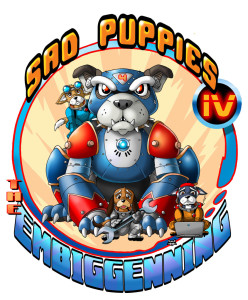
Sad-Puppies-4-RoboButch-final-845x1024One of the organizers of Sad Puppies 4 recently requested one or more panel slots at the 2016 WorldCon (where the Hugos are awarded). I am all for this!!!

Last year’s WorldCon was marred by the Sad/Rabid Puppies fiasco, but you’d barely know it if you were just a general attendee. Basically nothing was said about it publicly, aside from a veiled mention here and there, and half of a single panel that obliquely discussed it without mentioning it directly. The only time it was directly talked about was during the Awards Ceremony itself. It was like the family matriarch had just been diagnosed with cancer and no one was willing to talk about it yet.

I am a strong advocate for getting things out in the open. Last year there was virtually no cross-talk between the factions, because everything was so hushed up. Everyone stayed in their own little cliques. If we won’t talk with each other, then we cannot resolve our grievances. This year I think having a panel in the largest room available, with luminaries from both sides, would be fantastic. For every Kate Paulk or Larry Correia on the panel, we need a John Scalzi or George RR Martin as well. Smart, charismatic, well-spoken people who are willing to engage the other side respectfully. With a neutral moderator, of course.

And they should not be allowed to sit at opposite sides of the table. Too much like having opposing sides with borders. Mix them up, keep the human aspect real.

I admit, I’m a bit disappointed that this is only now happening. In 2015 I was a coordinator of literary programming for Denver Comic Con. We had two Sad Puppy nominated authors at our con (Kevin Anderson and Jim Butcher, both nominated for Best Novel)! I attempted to set up a panel discussing the Sad Puppy controversy, and both declined. I can kinda understand it from their side–as authors without direct involvement in the movement, they didn’t want to get too mixed up in the controversy (although in my opinion their silence and acceptance of the nomination was a tacit endorsement anyway). However I also put a lot of effort into getting Sarah Hoyt to come to Denver Comic Con. She was a very vocal Sad Puppy supporter. This year she’s one of the Sad Puppy 4 leadership! She also turned me down, and ultimately I had to cancel the panel because no Pro-Puppy people would agree to talk about the issue. I was unwilling to have a one-sided panel of people bashing the Puppies. I am glad to see that she’s changed her mind, and is now willing to talk about the Sad Puppies. But I wish she’d have been willing to do so at DCC2015, I would have loved to have a panel on the topic then. Maybe I’ll try again this year. :)

The vile Vox Day, of course, shouldn’t even be let in the building.

Dec 302015
 

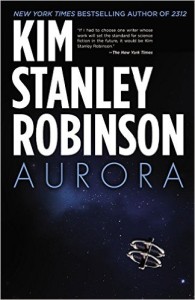
auroraAurora, by Kim Stanley Robinson

Synopsis: A generation ship arrives at the world it is supposed to colonize, and finds it uncolonizable.

Book Review: I like grimdark, and I like enthusiastic exuberant fiction. I don’t consider this contradictory, because both types of fiction make you feel something strongly, even if the emotions are dissimilar. What I want out of fiction is to be made to feel some suite of emotions intensely. Aurora is the opposite of that.

Aurora’s nominal protagonist is dull, in multiple senses of the word. She is literally dumb, described and shown to be of below average intellect. She has no ambition, and has very little to contribute to anything. She drifts about the ship, relying on the fact that her mother is incredibly important and famous. In the rare cases that that fails, she defaults to her stunning good looks and above-average physical size to get what she wants. It’s like reading a novel about Paris Hilton in space. Not the real Paris Hilton, the savvy business-woman; but rather the bimbo Paris-Hilton-caricature she played on her TV show, that was barely smart enough to draw breath and relied on her wealthy father and good looks to flounce through life. This is not a protagonist I care about.

The narrator of the story is the ship’s AI (referred to as “Ship”). Robinson takes full advantage of his narrator’s lack of emotion and literal outlook to present us with the most clinically detached prose one could write. Now, I must acknowledge his skill in doing so – I don’t think anyone could write something this detached and dry on accident, it must have taken some skill! But the fact remains that the entire (first half of) the novel reads like those terrible History textbooks back when no one knew how to write an engaging textbook. Lists of facts and events and dates, with nothing compelling about them. Every time an emotional scene could be shown, it is summarized in a couple sentences instead. Every time there could be action, it is belavored into a dry recounting of cause-and-effect.

There is a period where the AI introspects deeply upon language and its purpose. The nature of metaphor, etc. This section was extremely interesting, in fact the only interesting thing in the (first half of) the novel! Unfortunately it is soon abandoned, and not touched on again. The AI doesn’t seem to learn anything about story telling from it, as the story telling remains awful.

Robinson appeared to be pursuing a theme of “Narrative is a terrible way to convey historical events. It can never truly capture what was actually happening, what was actually important; and it is hopelessly biased by the author/teller.” That is an interesting theme, and I would like to see it pursued in a novel that actually has some story telling or narrative in it. To advance that thesis in THIS book is like proving you’re a better fighter than Mohammad Ali by drugging him, stabbing him repeatedly, and then dragging him into a boxing ring to fight you. It’s not actually indicative of the strength of your thesis.

That being said, this novel is an excellent treatment for insomnia. I fell asleep quickly many times while trying to read it. I finally gave up after I crossed the halfway point and nothing was getting better.

Oh, and by the way, exploring space is hopeless, we’ll be stuck on Earth forever due to reasons that’ll make you fall asleep.

Not Recommended.

Book Club Review: I was seriously surprised by how much discussion this book sparked. Most people finished the book! And they had quite a few things to say about it. There was talk about the feasibility of extra-terrestrial colonization. There was discussion of how Robinson’s Buddhism is strongly apparent in his fiction, and how the protagonist’s journey is a recapitulation of the Buddhist philosophy (of which I know nothing, nor did I finish the book, so I can’t personally comment on that, but it was interesting to hear others discussing it!). There was discussion of what can be conveyed via language, and/or via narrative. There was much praise of the AI’s Crowning Moment of Glory near the end, where he’s heroic and humorous and rather human, and he made some of our readers cry. I enjoyed our entire evening, as did everyone else, regardless of how they felt about the book as a piece of fiction. So for book clubs I have to give this a surprised but honest: Recommended!

Dec 182015
 

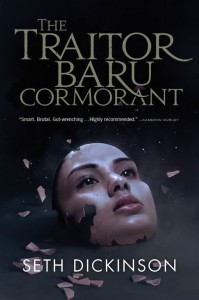
the-traitor-baru-cormorantThis post contains MASSIVE spoilers for The Traitor Baru Cormorant, by Seth Dickinson. Please note that this is one of the few books were that is actually a really big deal. The ending changes a lot about what you thought you knew, and knowing that beforehand changes how you will read the book. If you have any desire at all to read the book, turn back now.

If you don’t have any desire to read the book, but have time to read a short story, consider reading the short story before you continue. Because, again, the spoilers I’m going to be getting into are really big, and I would hate to deny anyone the opportunity to read such an amazing piece of fiction unspoiled.

.

.

.

.

You know those people who go to see a movie adapted from a book, and then turn up their nose afterwards and say “The book was better”? Everyone hates those people. Of course the first medium you experienced the story in will always be better! Get over yourself! I really, really hate to be that person. But the Traitor Baru short story was better than the Traitor Baru novel. The novel was still good! Just not as good. I’ve been trying to figure out why. And I succeeded.

Well ok, I have a half-assed theory. But it’s something.

The Traitor Baru short story takes place after The Twist. We only see Baru after she’s betrayed everyone she loves for the greater good. Everyone who ever cared for her despises her now (if they’re still alive), and the populace of the country she was fighting for consider her a villain. This is all conveyed indirectly, via precision-guided sentences that get the point across as emotionally as possible with as little word-count as possible.  This leaves us to fill in all the blanks. And what do we do when we fill in the blanks? We fall back on Tropes. Or Cultural Myths, or Archetypes, or whatever you want to call them.

What this means is that Baru was the Rebel Princess in my mind. The Leia or the Xena – a shining leader, beloved by her lieutenants and loyal soldiers. When she betrayed them, it was like Leia killing Luke, Han, and Chewie in cold blood, and giving their corpses to the Emperor. It was all the people of those planets, fighting for the Rebels, suddenly under the Empire’s heel again, and he is NOT happy with what’s been going on. Seriously bad times for all.

Likewise, I filled in Baru’s relationship with her lover as deep and passionate, having withstood all the typical fantasy trials. When Baru gave Tain Hu up, Baru was The Dread Pirate Roberts/Wesley, handing over Buttercup to Humperdink.

That was why the brain injury was such a central part of the short story. It was Baru’s escape mechanism. She could turn her blind side on her betrayals, and she would forget about them. She could turn away from her lover, and she wasn’t there anymore. It was the Novocain for her soul, the past-annihilating numbness that allowed her to live with what she’d done. Without that escape mechanism, she likely would have killed herself already. At the very least, she’d be an ineffectual infiltrator, since her guilt-wracked conscience would give her away.

And that was what made the ending so simultaneously heart-wrenching and gratifying. In the end, Baru turns toward her lover. She could look away, have the execution erased from her mind, but instead she watches as Tain Hu is dashed against the rocks over and over. It is an acceptance. An acceptance of Tain Hu’s sacrifice, and her love. It it’s Baru’s moment of growth, where she realizes she is strong enough to continue forward. It is her reaffirmation that her goal (freedom from the evil empire) is worth the price she has paid and is paying. Fuck them. She can overcome even this. They will have nothing to use against her.

(I also love this story because it acknowledges that love for your loved ones is a weapon that your enemies can use against you, which is a deep and unreasonable fear of mine, and which is why I’ve kept myself emotionally isolated much of my life. This story is an affirmation that you can love, and have that love used against you, and still not be destroyed. It’s like the counter-thesis  to that Iain Banks novel that I won’t name because I don’t want to spoil yet another novel. Point is, I love this story, and I love Seth Dickinson for writing it.)

The “problem” with the novel is that it doesn’t conform to the standard fantasy tropes.

“What?” you say. “How is that a problem? I’m sick and tired of all the standard fantasy tropes!” I agree, I am too. And obviously Seth Dickinson was as well. Can you imagine sitting down to write 100,000 words of fantasy to pound out another cliché Rebels vs Empire story? Ain’t nobody want to do that, least of all an aspirational rising talent! So instead he wrote an interesting plot, full of interesting characters, with lots of intrigue and political wrangling, and very shrewd and intelligent gambits. It’s a good story, and it would make a good novel, except it is supposed to bring us back to the Baru of the short story.

I had come into the novel expecting to see some sort of Star Wars-like story, with strong bonds between the rebels, and a passionate ongoing romance with Tain Hu. Instead we see rebels that are constantly infighting, suspicious, looking to back-stab each other, and are clearly using Baru simply to further their own agendas. I don’t mind as much when these people are betrayed. The empire, rather than being typical Fantasy Nazis, are distasteful and sometime horrifying, but ultimately more pragmatic than pure evil, and they bring a lot of good things to the people they conquer to offset some of the evil & oppression. Tain Hu, rather than being the love of Baru’s life, is kept at a distance the entire book, and they don’t even confess their love to each other until just a few pages before the betrayal. That’s not Wesley and Buttercup. It’s more akin to Trinity’s confession to Neo.

I was asked in my book club “What was the brain injury in the last chapter for?”, which I think is a great encapsulation of the problem with the novel. In the short story it is a crucial aspect of the story, the characters, and the resolution. In the novel it shows up so briefly that it doesn’t have any narrative weight. It feels extraneous. The short story depends, ultimately, on a subversion of classic fantasy tropes. We already have the entire Rebel Princess story in our minds, and Traitor Baru takes that story, turns it upside down, then puts it right-side up again, while stabbing you repeatedly and telling you “This is what it takes to win in the real world. If your fantasy stories were real, these are the choices your heroes would be facing. Isn’t this a better story?” AND IT IS! When Dickinson wrote the novel, he kept that Rationalist view. He wrote a fantasy story that would make sense if it was in the real world. Not Fantasy Nazis and Shining Heroes, but real people and realpolitik. And that blunts what made the Traitor Baru story such a knife-in-the-heart to me. The betrayal at the end of the novel didn’t feel like someone amputating their own limbs. It wasn’t a loss of everything good. It was just another manipulation in a book full of manipulations and treachery. A bigger one than any we had seen previous, of course. But not unusual. It was true to character, rather than a betrayal of our ideals. I didn’t feel it would lead to suicidal levels of guilt and self-hatred.

That being said, I HATE to have said all this. I contemplated for many days before posting this. Because (as Seth has said in the past) nowadays no one engages short fiction. Traitor Baru is excellent, and I’ve recommended it a few times to people. But I’ve never posted about it at length deconstructing what made it great, until the novel came out. The Traitor Baru novel has been mentioned many times on many “Best of 2015” lists, but was the short story on any such lists? Even though the short story is better? For that matter, do you recall seeing very many “Best Short Story” lists ever, at NPR or IO9 or wherever you get your news? Nope. People simply value novels far more than short stories, and it’s a damned shame. It’s likely that the Traitor Baru novel has gotten far more reads than the Traitor Baru story, even though the story is less than 1/10th the length, has been out far longer, and is freely available to everyone online! (and IMHO is better)

I even feel guilty trying to point people at the story rather than the novel, because Dickinson has got to pay his rent and buy food, and short stories don’t pay. If you want to make a living writing, you have to write novels. Each person that I convince to read the short story instead of the novel is money I am taking out of Dickinson’s pocket. :( And, if I was given the choice to read either the story or the novel, I would tell past-me to read the story instead, and pay more for the privilege than I would have paid for the novel. It is a far more efficient use of my time, and I am willing to pay extra to get the same emotional payoff (“entertainment” as I call it) in less time. It leaves me more free time to pursue my other pursuits.

So, if you really like the Traitor Baru short story, please do not punish Seth Dickinson for his genius. Buy the novel, to say thank you, even if you don’t read it. And, next time you read a truly amazing short work, please consider purchasing something from the author, even if you’ll never read it, to support their work.
Dec 152015
 
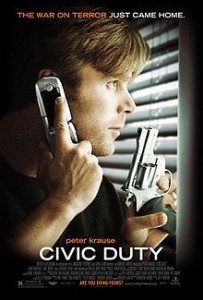
220px-Civic_duty

I’ve never seen this movie, or even heard of it before 5 minutes ago. I have no opinion on it.

I.

I prefer to be around self-identified Aspiring Rationalists. I feel like a fraud when I’m around them, because I am not nearly as smart or as rigorous as the Rationalists I read. But I just can’t stand how most people talk about reality, because most people DON’T EVEN TRY to talk about reality. And the thing I really love about Rationalists is that they at least really freakin’ try to talk about reality itself when they discuss the world.

II.

I was linked to an article that asserted in the first sentence that a woman “fired wildly at a crowd in the parking lot of an Auburn Hills Home Depot” in an attempt stop fleeing shoplifters. A bit later it says “[the shoplifters] were not in any way threatening anyone.” The article then stated that the woman received 18 months of probation on one count of “reckless discharge”, and lost her concealed-carry permit.

This immediately set off my “I am confused” alarm at the volume of an air raid siren. Maybe I’m an idealist, but I couldn’t believe that an action as depraved as firing wildly into a crowd would result in probation on a minor charge and the loss of a license. Our justice system is not THAT fucked up. Right?

More careful Googling shows that the parking lot was as empty as you’d expect a Home Dept parking lot to be. There was no one near her target. And that the woman wasn’t trying to execute anyone, she was shooting at the tires. And she only fired two rounds. And that, as her attorney claims, she’s actually a pretty good shot, because she managed to blow out the rear tire on an SUV with only two shots.

III.

As far as I can tell, the right-leaning segment of this country wants to return to a more civic-duty minded system. One where the populace actively intervenes in crimes-in-progress. A historical model would be law enforcement in medieval Europe, where typically if someone cries for help (to stop a theft or assault, perhaps) it is the duty of all bystanders to mob the assailant. In this article debunking the myth of a “town watch” (in standard medieval European fantasy settings) the author cites several sources, and admiringly tells us that our ancestors were unbelievably tough.

The gold standard of this civic-duty nowadays is Flight 93. Terrorists hijacked a plane, the passengers rushed them, and though they lost their lives, they saved hundreds or thousands more. It’s hard to say they’re anything but heroes.

If I may speak for the left-leaning, we think this is in general a bad idea. There are exceptional circumstances, yes… but in almost all situations that ever actually occur, people should de-escalate and/or flee, and let the professionals handle it. To be honest, we generally don’t trust you guys. Not just because sometimes you’re ill-trained and end up shooting the people you were trying to help. Or because we see some of you stalking innocent people you don’t like and then murdering them, claiming it’s self-defense.

No, in large part it’s because we don’t trust the justice of the mob to actually be just. In medieval towns “there’s a tradition of lynch justice and nobody gets into trouble for string-up a thief caught red-handed.” We’re really not OK with that. We think it makes it far too easy for someone to claim that a person they don’t like (for whatever reason) is committing a crime. We like our due process with a bit more process.

IV.

But the Duva-Rodriguez case (the woman attempting to stop the shoplifters in part II) makes for a very interesting edge case. She saw a man running from security, and she had just heard screaming from inside. For all she knows, this could be a murderer fleeing the scene. She didn’t try to kill or wound anyone – she attempted to disable the getaway vehicle, in order to make it easier for the proper authorities to apprehend the suspects. Once they are in custody, due process could proceed duly. Her success in blowing out a tire suggests she’s decently trained. Honestly, this is a situation worth discussing. (Based on the judge’s ruling though, the consensus seems to have settled on “We want less of this sort of thing”)

In a group of rationalists, this could be an actual discussion. Perhaps people would attempt to quantify how many murders are prevented by Uber drivers intervening when someone actually shoots into a crowd, versus how many taxi drivers are nearly murdered by people thinking they’re fighting ISIS. Can we put numbers on lives saved by sane civic-duty-minded citizens versus lives lost by unhinged civic-duty-minded citizens? Should we push society to encourage more direct involvement by bystanders, or encourage less?

But unless I’m talking with rationalists, I can’t even bring this up. Because everyone else will make up the most unbelievable bullshit to support their side. Instead of discussing reality, they will claim this woman shot wildly into a crowd! Or they will claim that gun control will result in Syria.

I want a world in which the facts matter. More than anything else, I wish I knew of a way to make people actually care about the truth. I’ve long said that there’s no need to convince people religion is false. All you need to do is make someone love the truth enough, and eventually they’ll reach that position on their own. I just don’t know how to make anyone actually love the truth.