Jun 012016
 

Star Wars Princess Bride quotesFandom is Broken. “Back in high school I had a great religion teacher. He used to have us bring in quotes from pop culture that could be applied to religion because he wanted us to understand how pervasive religion was to people a thousand years ago, as pervasive as music or movies are to us today. He believed that the future would see people no longer killing each other over interpretations of God but over bands…
I think he was on the right track when it comes to the way pop culture has replaced other things that used to give us meaning, but I don’t think he could have ever guessed it would be comic book characters and Ghostbusters that would motivate the 21st century’s holy popcult warriors.”

Why Modern Fight Scenes Put You To Sleep

I hope this sort of thing gets more traction. I love fictional violence, but violence is very rarely about the *actual violence*. case in point: aside from the awful choreography, why else did last season’s Dorne fight scene suck so much?

Yesterday I learned that most people don’t feel any pain when drinking carbonated beverages! WTF? I thought drinking fizzy drinks was like using habaneros or other super-spicy things in your food – it was a thing crazy people did because they liked pain. How much of my life has been a lie?? (no actual link)

Latest round in the ongoing court case between Google and Oracle goes to Google! Yaaaay!
The reason for the fight explained:

“Google wanted people who wrote programs in the popular programming language Java to be able to reuse their code in Android apps. To do that, Google had to ensure that Java code written for other purposes ran exactly the same on Android. But negotiations with the company behind Java, Sun Microsystems (which was later acquired by Oracle), broke down, so Google decided to create its own version of Java from scratch.

Google’s version of Java didn’t reuse any code from Oracle’s version. But to ensure compatibility, Google’s version used functions with the same names and functionality.

This practice was widely viewed as legal within the software world at the time Google did it, but Oracle sued, arguing that this was copyright infringement.
[…] a landmark 1995 ruling in which an appeals court held that the software company Borland had not infringed copyright when it created a spreadsheet program whose menus were organized in the same way as the menus in the more popular spreadsheet Lotus 1-2-3.

The court held that the order of Lotus 1-2-3 menu items was an uncopyrightable “method of operation.” And it concluded that giving Lotus exclusive ownership over its menu structure would harm the public”

Oh shit. This is incredible. But trigger warnings for sexual violence.

Star Trek + Nine Inch Nails = Closer

How to Take ‘Political Correctness’ Away From Donald Trump
“A Martian following election coverage via GoGo in-flight WIFI would never know that Trump’s pledge to revenge-kill family members of terrorists—a war crime—violated more important Earth-taboos than his calling a campaign rival “a pussy.” Watching CBS or NBC or ABC, the Martian would likewise conclude that Trump calling Ted Cruz “a pussy” was worse than calling Mexican migrants rapists. Only the former comment was censored.
[…]
And Trump benefits from their dearth of discernment. It frees him from the burden of carefully deciding which taboos ought to be challenged and which safeguard life, liberty, and the pursuit of happiness. Instead of careful critiques, he rants off-the-cuff, knowing that the bad press will look basically the same regardless of whether he attacks Rosie O’Donnell or the taboo against torture. His supporters are as inclined as the press to treat every utterance as an undifferentiated instance of political correctness”

Google’s AI is writing eerie post-modern poetry (when given a starting and ending sentence and told to fill in the gaps)

I *had* always wondered why there was no AmericaPox the Europeans contracted! Now I know.

Adidas to make shoes in Germany again – but using robots. There is no more unethical treatment of laborers.

How Technology Hijacks People’s Minds — from a Magician and Google’s Design Ethicist
If you want to maximize addictiveness, all tech designers need to do is link a user’s action (like pulling a lever) with a variable reward. You pull a lever and immediately receive either an enticing reward (a match, a prize!) or nothing. Addictiveness is maximized when the rate of reward is most variable. But here’s the unfortunate truth — several billion people have a slot machine their pocket:
When we pull our phone out of our pocket, we’re playing a slot machine to see what notifications we got.
When we pull to refresh our email, we’re playing a slot machine to see what new email we got.
(etc)

And here I had no idea Subaru’s are loved by lesbians!
“For their first Subaru ads, Mulryan/Nash hired women to portray lesbian couples. But the ads didn’t get good reactions from lesbian audiences.

What worked were winks and nudges. One ad campaign showed Subaru cars that had license plates that said “Xena LVR” (a reference to Xena: Warrior Princess, a TV show whose female protagonists seemed to be lovers) or “P-TOWN” (a moniker for Provincetown, Massachusetts, a popular LGBT vacation spot). Many ads had taglines with double meanings. “Get Out. And Stay Out” could refer to exploring the outdoors in a Subaru—or coming out as gay. “It’s Not a Choice. It’s the Way We’re Built” could refer to all Subarus coming with all-wheel-drive—or LGBT identity.
[…]
The delight among niche audience groups in “uncoding” the hints in Subaru ads surprised the marketing team—and in the case of its gay-friendly ads, so did straight audiences’ ignorance. While gay and lesbian consumers loved the shout outs in the license plates, straight people would only notice features like a bike rack.”

Also – oh, right. I remember the early 90s. Damn, that feels like a long time ago.

“the attitude of most businesses toward LGBT advertising was: “Why would you do something like that? You’d be known as a gay company.”
In the 1990s, Poux worked at Mulryan/Nash, an agency that specialized in the gay market. Early in his career, he made cold calls to ask companies for their business. “All the rules of marketing went out the window at this fear” of marketing to gays and lesbians, he says. “People would choke up on the phone. It was tough.” ”

The Tingler strikes again :)

LOL! Every fight anime ever!


If UNO Was an Anime

Bizarre situation in which I find Glenn Beck saying things rationally and self-consistently. Did he recover from the crazy or something?

“I sat there looking around and heard things like:
1) Facebook has a very liberal workforce. Has Facebook considered diversity in their hiring practice? The country is 2% Mormon. Maybe Facebook’s company should better reflect that reality.
2) Maybe Facebook should consider a six-month training program to help their biased and liberal workforce understand and respect conservative opinions and values.
3) We need to see strong and specific steps to right this wrong.

It was like affirmative action for conservatives. When did conservatives start demanding quotas AND diversity training AND less people from Ivy League Colleges.

I sat there, looking around the room at ‘our side’ wondering, ‘Who are we?’ Who am I? […]
What happened to us? When did we become them?”

I didn’t even know we were supposed to wash reusable bags! If you factor in the environmental impact of washing a bag after each use, is it actually better at all?
“97 percent of consumers don’t regularly wash their bags, according to a report from the University of Arizona and Loma Linda University. Their researchers swabbed 84 bags for bacteria, and the findings were outright nasty: coliform bacteria in half, E. coli in 12 percent.
When San Francisco banned plastic bags, the number of E. coli infections spiked. Even worse, the number of foodborne-illness deaths rose a whopping 46 percent in the three months after the bag ban began.”

Oh god I hate them all so much. >< FOX ‘STOLE’ A GAME CLIP, USED IT IN FAMILY GUY & DMCA’D THE ORIGINAL
“It’s most likely that this is just another example of YouTube’s Content ID system automatically taking down a video without regard to actual copyright ownership and fair use. As soon as FOX broadcast that Family Guy episode, their robots started taking down any footage that appeared to be reposted from the show — and in this case they took down the footage they stole from an independent creator,” Lyon says. (sign the petition from TakeDownAbuse.orghttps://www.takedownabuse.org/familyguy/ )

It begins! :) Uber tests self-driving cars in Pittsburgh


Fantastic essay on The Iliad.

“The puzzle the Iliad poses in the persons of Achilles and Hector is, How do we train selfish men to be violent killers, and then convince them not to fight each other, but to die for their nation?

The answer is clever. […] the Iliad invented self-interested, libertarian, civic virtue.

They should fight, the Iliad argues (though not directly), because life is overrated. Life is an endless cycle of flailing about helplessly in a universe that doesn’t care. Life is being the plaything of the gods. The best thing for you, personally, is to win glory for yourself; that’s more valuable than more of this life stuff. It doesn’t last anyway.

This was a very interesting pivot point in the history of the West. […] The obvious choice was for Homer to say that a man should fight for his people because he loves them and he loves his family and wants to defend them. The obvious choice would be to say civilization should be based on morality.

Homer didn’t do that. He said civilization should be based on selfishness.

And that’s when Western civilization was created.

Selfish civic virtue was eventually diluted by morality, but the West still honors selfishness and individuality more than other civilizations. This is a large part of why the West has been so successful.”

I’d heard of aphantasia* before, but this article really brought a lot of it home. The “Twenty most common questions I get” was especially interesting. I’m still not sure I can imagine what this must be like.
(*unable to visualize things in one’s mind)
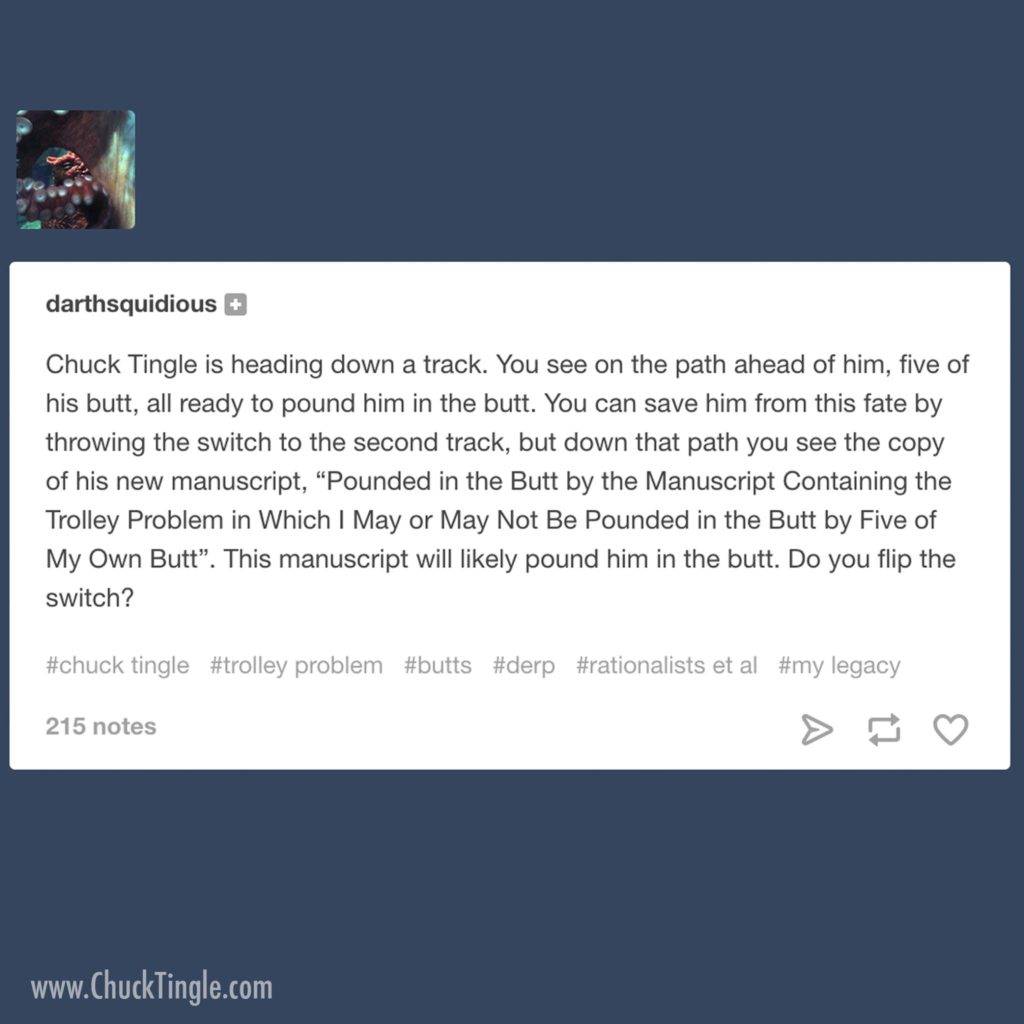
Tingle Trolley Problem
“Benedict Cumberbatch legitimately looks like he’s never jumped before.” GIF of pre-CGI superhero jumps

My life will not be complete until I have participated in the running of the balls.

MIKA’s “Grace Kelly” song is delightful!

Why the FDA’s new e-cigarette regulations are a gift to Big Tobacco (and could actually harm public health)
“The most significant part of the FDA’s rule is a requirement for government approval […] this means that just about all e-cigs must go through a new approval process if they are to continue to be sold. This is a costly process — an estimated $1 million or more per product — and must be done for each and every model, flavor, etc. For tobacco giants such as Reynolds and Altria, this is no big deal. For smaller e-cig makers, however, these rules could be the kiss of death. […] the e-cig market will shrink, and Big Tobacco will be in a better position to dominate what’s left. A vibrant competitive market will be replaced with a cartel, much like the one we see in the cigarette market.”

Snowden is the president we need, but not, it seems, the president we deserve. :(
“As someone who works in the intelligence community, you’ve given up a lot to do this work. You’ve happily committed yourself to tyrannical restrictions. You voluntarily undergo polygraphs; you tell the government everything about your life. You waive a lot of rights because you believe the fundamental goodness of your mission justifies the sacrifice of even the sacred. It’s a just cause.
And when you’re confronted with evidence — not in an edge case, not in a peculiarity, but as a core consequence of the program — that the government is subverting the Constitution and violating the ideals you so fervently believe in, you have to make a decision. When you see that the program or policy is inconsistent with the oaths and obligations that you’ve sworn to your society and yourself, then that oath and that obligation cannot be reconciled with the program. To which do you owe a greater loyalty?

Perhaps today’s culture wars can be viewed largely as the continuing clash of America’s earliest settlers in the 17th century. Kinda feels like humans are simply a substrate that a larger process (a “civilization”) runs on.
“If America is best explained as a Puritan-Quaker culture locked in a death-match with a Cavalier-Borderer culture, with all of the appeals to freedom and equality and order and justice being just so many epiphenomena – well, I’m not sure what to do with that information. Push it under the rug?”

‘Star Trek’ Lawsuit: The Debate Over Klingon Language Heats Up
Oh ho! When I was a young geek, an online-friend related a story of how he got lost while visiting Russia, and cursed in Klingon on the bus. A fellow Klingon-speaker asked him what was wrong, and though he spoke no Russian, and the Russian dude spoke no English, they communicated very well in Klingon and he was soon back on his proper way.
“This argument is absurd since a language is only useful if it can be used to communicate with people, and there are no Klingons with whom to communicate,” stated a plaintiffs’ brief

Now, with 250,000 copies of a Klingon dictionary said to have been sold, Klingon language certification programs being offered, the Microsoft search engine Bing presenting English-to-Klingon translations, one Swedish couple performing their marriage vows in Klingon, foreign governments providing official statements in Klingon and so on, the Language Creation Society is holding up Klingon as having freed the “bounds of its textual chains.”

no court has ever addressed the issue of whether a constructed spoken language is entitled to copyright protection.

The best explanation for the 10 Commandments yet! Head Canon accepted. :)
“I PERFORM SERVER MAINTENANCE ON SATURDAYS. THIS MEANS LOWER CAPACITY. SO PLEASE AVOID HIGH-LOAD ACTIVITIES LIKE BUSINESS TRANSACTIONS, AGRICULTURAL WORK, AND ELECTRICITY USE DURING THAT TIME. SO YES. THAT IS A LAW.”

Neurons Gone Wild. Expanding on Society of Mind – this post proposes that neurons compete for biological resources by being useful to the organism, and are “motivated” to be productive, likening the brain to an economy.
“agency isn’t intrinsic to a system, but rather something we ascribe to it. It’s a way of describing a system at the level of abstraction that includes goals, obstacles, motivations, etc. If you look too closely (at a sufficiently low level of abstraction), the agency might seem to disappear. A plant, for example, is ‘merely’ growing its stem according to the concentration of auxin, just like we (humans) are often ‘merely’ acting on our drives and instincts. But zoom back out, and once again it will be productive to describe the system at the agent-level of abstraction. Thus explanatory power, not free will, is the hallmark of agency.

agency is a fundamental property of the brain. Not only is agency the function of the brain — and thus it’s very reason for existence — but it’s also built into the brain’s fabric and architecture. Because even neurons have agency, in the form of (metabolic) selfishness, higher-order brain systems don’t need to create agency ‘from scratch’ out of mindless robotic slaves. They inherit agency pretty much for free.
The brain is thus uniquely hospitable to agents, who can be said to take root and grow in the brain quite readily.
There’s actually a more general principle here, namely, that rich substrates are more fertile, more conducive to growth. […] Computers, though technically capable of supporting agency, aren’t particularly hospitable to it. The brain, in contrast, is already teeming with agency (in the form of billions of selfish neurons), and is thus uniquely fertile.”

Non-Places destroy cities.
“Non-Places are areas of the city where nothing happens. If we look at the Traditional City, we see that it is mostly Places. […]To the degree that we can eliminate cars, the Traditional City can become almost 100% places.

A pedestrian street is a Place. When it becomes dominated by cars — to the point where a person is not comfortable walking down the middle of the street — it becomes a Non-Place.

Green Space was invented to make our other Non-Places less horrible. It basically doesn’t exist in the Traditional City. The Traditional City doesn’t need Green Space because it doesn’t suck to begin with. There is no problem we are trying to solve through the introduction of acres of mowed lawns.

It is difficult to explain, to someone who has never experienced it, that the Traditional City is actually a very quiet, lovely sort of place — even the largest Traditional Cities, with the Tokyo population well over 30 million. […] The residential university campus is about the closest experience most Americans have to a no-car urban place.”

Just in case you need another reason not use KU (Kindle Unlimited) (except for the one-month free trial to read a dozen Chuck Tingle shorts) Much of the money goes to scammers, and Amazon doesn’t care.

Life Is Pain. The numb are the lucky ones. What It’s Like to ‘Wake Up’ From Autism After Magnetic Stimulation. “I’d fantasized about really understanding other people’s emotional world. I imagined a world of sweetness and light — emotions I’d been missing all my life. But when it happened, the reality showed me what a fool I’d been. Now, I could look at a person and sense all their emotions. And most were downers. […] I realized that I’d deluded myself all this time. The world is not a wonderful, happy place. ”
His recollection of working for KISS and Pink Floyd on the road is fascinating as well. I can’t recommend this article enough.


As I’ve been watching this gash in my hand heal over the past few weeks I keep thinking “Holy crap. I am made out of a vast amount of biological nano-bots!” And none of them have any idea I exist (which I realize is crazy anthropomorphizing, but I can’t help thinking it). I, likewise, have no way to directly control them. And yet here we are. WTF, reality? (again, no link)

I linked this in an earlier post, but – “almost no pop celebrities write their own hits. Too much is on the line for that, and being a global celebrity is a full-time job. It would be like Will Smith writing the next Independence Day.”

Smashmouth’s Allstar, but everyone’s playing at slightly different tempos. Actually not stressful, and sorta weirdly hypnotic.

The best succinct explanation of culture I’ve seen yet. Includes the first coherent explanation of what “cultural appropriation” is that I’ve ever seen! (in an interesting twist, one of the examples explaining cultural appropriation argues that the “Fake Gamer Girl” trope is basically a complaint of cultural appropriation) This is long, yes. But extremely worth it.

A small taste –
“… So imagine you’re an evangelical Christian. All the people you like are also evangelical Christians. Most of your social life happens at church. Most of your good memories involve things like Sunday school and Easter celebrations, and even your bittersweet memories are things like your pastor speaking at your parents’ funeral. Most of your hopes and dreams involve marrying someone and having kids and then sharing similarly good times with them. When you try to hang out with people who aren’t evangelical Christians, they seem to think really differently than you do, and not at all in a good way. A lot of your happiest intellectual experiences involve geeking out over different Bible verses and the minutiae of different Christian denominations.
Then somebody points out to you that God probably doesn’t exist. And even if He does, it’s probably in some vague and complicated way, and not the way that means that the Thrice-Reformed Meta-Baptist Church and only the Thrice-Reformed Meta-Baptist Church has the correct interpretation of the Bible and everyone else is wrong.
On the one hand, their argument might be convincing. On the other, you are pretty sure that if everyone agreed on this, your culture would be destroyed.”

For fans, this is basically a “yeah, I remember that, soooo good!” video. :) For people who haven’t seen it yet, consider it a teaser, and another endorsement to check it out. Note that *MAJOR* spoilers appear at 4:08 and are rife thereafter, so stop before then if you’re not familiar!

The Philosophy of Rick and Morty

Reddit’s warrant canary is gone. Odds are very high that they have been served a national security letter.

I’ll just leave this here…
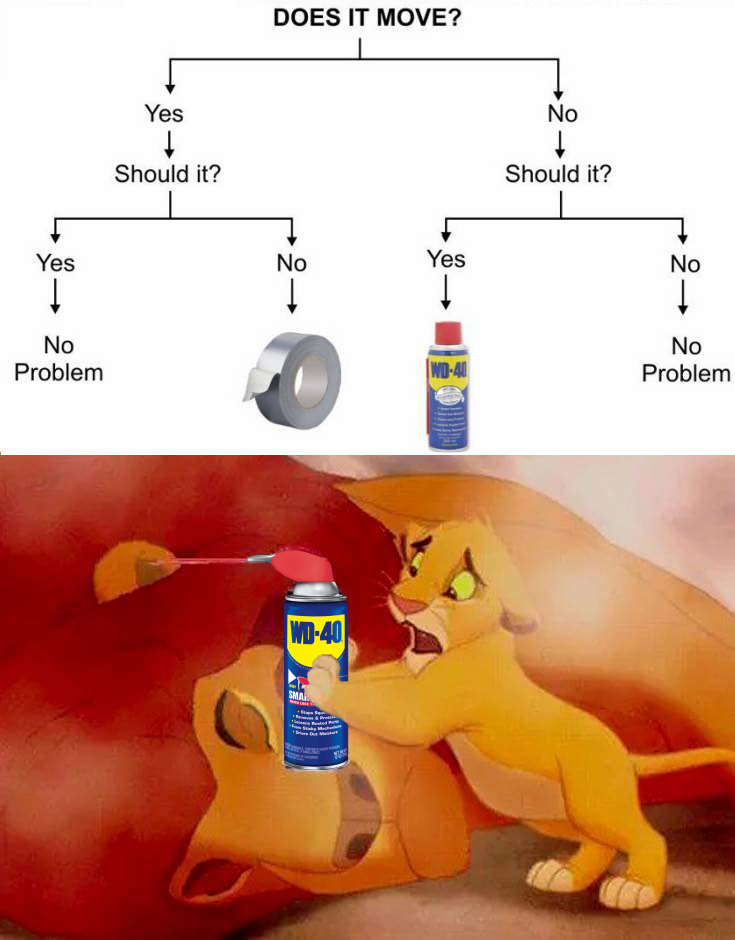
does it move

May 262016
 

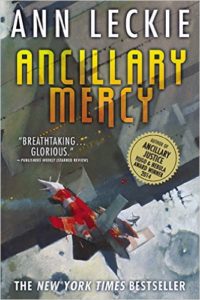
Ancillary Mercy, by Ann Leckieancillary mercy

Synopsis: An AI in a human body navigates the tangled bureaucracy of administrating a space station.

Book Review: This book was devastatingly disappointing. Ancillary Justice, Ann Leckie’s first novel in this trilogy, was a masterpiece. It broke new ground in the SF genre, and tackled complex themes of vengeance, means/ends justification, and whether a person’s nature can change. The second novel, Ancillary Sword, wasn’t as good as the first, but it was a middle-book, and it did class-warfare very well. This novel has no unifying theme or idea. It seems very confused, stating that strong, central governments are bad, and then demonstrating that a loose coalition of free agents falls into anarchy and back-stabbing very quickly, and can’t be relied on to do anything. It hints for about one paragraph that Libertarian Free Markets are the solution to this. That was innovative back when Heinlein first introduced it… 50 years ago. But Ancillary Mercy doesn’t even bother to explore the idea or do ANYTHING with it, aside from that brief, one-paragraph mention.

Let me walk that back slightly – it does kinda have a theme of “enslaving sentient beings is bad.” This is very far from new ground. The very first story about robots, the one that introduced the word “robot”, had this theme nearly 100 years ago! Yes, we know slavery is bad. Please say something new on the theme, or make us feel it, or something.

The novel also lacks emotion. The first two books ran on rage. Justice was a straight-up vengeance crusade. Sword was class-uprising. Both made me feel delicious anger. Ancillary Mercy falls flat. I stopped caring about the story by the time I was halfway through it. I couldn’t even care about Seivarden’s kef addiction anymore, which is the sign of a massive fumble on Leckie’s part, because fighting that addiction was a hugely satisfying portion of the first book. How did she make it so boring by the third? When it was briefly reintroduced it felt like an attempt to get the reader to care by saying “Hey, remember this really intense and touching plot line from the first book? Wasn’t that great? Feel those feelings again!” And yes, it was great back then. But trotting it out to evoke sympathetic emotions just doesn’t work. It’s like putting a CGI Arnold Schwarzenegger in your new Terminator movie.  Yes, we remember how awesome the first two Terminator movies were. Stuffing a CGI Arnold in there only reminds us of that, and makes yours look even worse in comparison.

The books also kept getting progressively smaller and less important. The first book culminated in an assassination attempt on the Emperor, and resulted in a galaxy-spanning civil war! It was epic! The second book shuffles our protagonist off to an out-of-the-way system where NONE of the war is taking place. But hey – it’s a middle book. There’s still a lot of local conflict, a slave-uprising, and some tension. In the third book the conflict is reduced to bureaucratic squabbling. One of the major conflicts in the book is about whether or not a long line of people are allowed to hold a peaceful protest. Seriously, it’s about whether or not people are allowed to silently stand in a queue. Goddammit Leckie, there is a galactic civil war going on just around the corner! Entire star systems are being destroyed, planets are being obliterated, and you’re boring us with local ordinances?? W.T.F??

The book isn’t painful to read. It’s written well. And there are dazzling moments, where Leckie’s genius flashes through. The replacement Presgar translator is a DELIGHT! She’s every genki anime girl ever, absolutely niave and hilarious! :) And there are scenes that take place between bursts of action, where the characters are wired up and waiting for action but have nothing to do but wait. They pass the time talking to each other, and these dialogs are brilliant. They feel extremely Tarantino-esqu, I could see them happening in one of his movies, as the characters stand in a room filled with bodies, holding guns, trying to kill some time by talking about cheeseburgers in France. It’s a delight. And, of course, the two scenes were Leckie returns to her frantic POV-jumping, which our protagonist can do by way of her implants that let her see and hear anything that’s happening to her crew. When there is a lot of action in a lot of different locations, these frantic smash-cuts back and forth are used to great effect, and make for extremely energetic story telling! But sadly, they are only used twice, and not for very long. Look, I appreciate that they must be exhausting to write. Every one of those scenes must have taken ages to put together, and tons of labor. But that’s what makes them impressive! You are a highly-acclaimed, multi-award-winning author. Act like it! Put in the effort!

There are, again, simple technical errors in understanding FTL. I don’t expect anyone to know all the minutia of how FTL implies time-travel, or anything. But I do expect that any ship that travels faster than light, actually travels faster than light. When a captain drops out of hyperspace to get her bearings, then jumps back in to approach her target, she should NEVER worry that she may have been seen in that brief instant. She will get to get target before they will have the ability to see her, because she’s traveling faster than that light! Such a basic, mechanistic failure of understanding in an SF author really bothers me.

But by far the worst part of this book is that the climax removes all agency from the protagonist, the antagonist, and basically all of humanity. It is a giant Deus Ex Machina that makes everything that’s come before irrelevant. And it does it in the most paternalistic way ever. The protagonist appeals to the god-aliens of the galaxy, pointing out that how her race is being treated isn’t fair. Seriously, that’s it. It’s a giant appeal to one’s parents. It is the most disappointing ending I’ve ever read. Then, to really cement how bad this book is, the denouement chapter is literally just a bunch of committee meetings. No no – literally.

This is the worst waste of talent I’ve seen in ages. We know Leckie can do better. Did she just get lazy? She simply reneged on so many promises she made (the alien-god-race basically never appeared. The Ghost System, which was mysterious and cool-as-hell sounding, was just an abandoned, empty system. We saw none of the civil war. etc) The first 90% of this book should have been discarded, and the story started with the alien intervention. Can you imagine what this story would have been like if the protagonist had to personally seek out an alliance with the alien-gods? Had to travel to bizarre sections of the galaxy and work her way through a completely alien culture? A culture so different from ours that they need to breed a translator race just to act as an intermediary for concepts that our two species cannot share, like individuality of consciousness? Their thought process is literally inconceivable, and yet she has to somehow convince them to take HER side? And doing so under severe time pressure, knowing that every day the overwhelming murder-fleet of the emperor is that much closer to genociding her adopted home-system? With all the misunderstandings and/or sabotage by the Emperor’s shadowy agents that this would entail? That could be an actual interesting story! Instead we got to read about how much manpower it will take to repair the Undergarden Sector, and which families will get to live there afterwards. /sigh

Not Recommended.

Book Club Review: This book had a suppressed turn-out, despite being a Hugo nominee, because it’s the third book in a trilogy. Those who’ve been at the book club for three years had read the first two, of course. But those who hadn’t either had to read three novels in two weeks(!), or jump into this one cold. For those who did the latter, it was very difficult for them to stick through the book to the end. Mostly, people were non-plussed by it. We did have one member who absolutely adored it, but she was sick for our meeting and couldn’t tell us the reasons why. :( Maybe she’ll let us know next meeting. I suspect that if your group ends up containing at least one person who really enjoyed this book a lot, it could make for some great conversation! As it is… the conversation wasn’t bad, but it wasn’t inspiring either.

It’s hard to put a rating on this. If it was a stand-alone book, I could justify a mild recommendation. The shining moments of brilliance really are great, and you can skim most of the rest without missing much. Plus the speculation on what the book could have been is stimulating as well. But, seeing as this is the third book in a trilogy, the buy-in to get here is just too high, especially with better options around. Ultimately, a mild Not Recommended.

[added 5/27] – See Quixote’s comment below for a much more favorable perspective. I find their analysis valuable, even if I disagree in some respects.

May 242016
 

dean kingsmanLately I’ve been seeing more and more of a certain “insult”, which is so bizarre I’m having trouble wrapping my mind around it. That insult is “cuck”, and seems to be used exclusively by the MRA/PUA-types.

What makes an insult hurtful? Obviously it’s not the sound of the letters. It must come with emotional pre-loaded into the word due to social context. I noted previously that slurs like “nigger” or “cunt” have a history of violence and state-sanctioned terror associated with them, which is why they are particularly harmful. But even mild insults like “stupid” or “ugly” are attempts to hurt someone, by making others who hear the insult think less of the target. Someone who is stupid makes a poor ally. Someone who is ugly makes a poor mate. Such allegations, if taken seriously, could damage one’s future prospects.

So how does the term “cuck” hurt someone?

Cuck is short for cuckold. Which, in today’s common usage, means a man whose Significant Other has sexually cheated on him. I find it very counter-intuitive that this would be a slur against the man. (For simplicity, I will refer to the SO as the “wife” from now on, though I don’t think the couple necessarily has to be married. They do have to be a male/female couple though, as we’ll see later).

What does it say about a person if their partner has cheated on them? Well, generally, that their relationship is experiencing extreme difficulty, to the point of collapse. This could be caused by all sorts of factors. Maybe there’s been a recent death in the family. Or a financial stressor is making life difficult. Perhaps the couple has been together for so long that they’ve grown in different directions, and no longer have much in common, but they have unwisely chosen to stay together anyway due to social pressures and are unhappy about it. Maybe one of them has developed a substance addiction which the other one is unhappy with. Or has spent so much time pursuing a career that the partner has been neglected for a long time, and the two of them don’t have strong enough communications skills/protocols to deal with this. There is a near-endless list of possible factors, and often more than one is in play anyway. This makes the insult “cuck” reduce to “your life is difficult in some way, and you aren’t good at dealing with it as a couple!” which… is really too vague to be a good insult. Plus it doesn’t really make the target look bad to outside observers, just unfortunate.

OR it could imply that a couple has differing levels of sexual desire and/or incompatible sexual tastes. AND, in addition, they were bad at discovering this (or unwisely ignored it) before they made a very long-term commitment, AND they were too conformist to adopt an open marriage, AND they forced themselves to stay in the marriage rather than moving on for far too long. This does, indeed, show bad judgement! However, I don’t think this is what the insult is angling for. If you want to insult someone’s judgement-making-skills, the old-school term “idiot” does so very well. And “cuck” is very sexually-specific, which is just weird. Why focus so much on bad judgement in sexual terms, rather than just bad judgement in general? The former is less likely to be a liability in an ally.

It’s a very mystifying insult, until you look at the people who are using it. Then much is revealed.

The people who use this term are almost always from the Men’s Rights Activist / Pick-up Artist / Gamer Gate section of society. While not all these people are sexist, much of the ideology they hail from is. If you read through their screeds, you pick up a crazed view of human sexuality. Men are divided into two sets – Alphas, who are intrinsically attractive to women, and Betas, who are intrinsically unattractive, but can buy sex with promises of support (financial, emotional, or other). (there is a third class, the Gammas, who aren’t worth talking about because they serve the same role as the Untouchables in any caste system). Women are all of a single type – they want Alpha dick for pleasure, and they want Beta support for child-raising. Women’s winning strategy is to marry a Beta as a provider, give him as little sex as possible (since it’s so unpleasurable), and whenever possible to get pleasurable sex by cheating with an Alpha.

(For reference, the sexual strategy proposed by these groups is to either A) pose as an Alpha, to trick women into sleeping with you, or B) impose extreme personal controls on women so they are unable to cheat)

Thus the power of the word “cuck” as an insult is made clear. It says, foremost, that the man is not an Alpha. (That in itself is not a big deal, because these groups all admit that not being an Alpha isn’t that big a deal, very very few people are, and certainly no one that needs to come to their website to read this advice.) Far more importantly – it says that the target of the insult has failed in his duty as a Beta to police his wife’s life. He has allowed her to get out of hand, running around and sleeping with an Alpha, while he continues to provide her with support. Like a chump. Like a pussy-whipped loser. Like a cuck.

The world view that makes this word an insult is appallingly toxic. It makes women something between property and whore. It makes men helpless economic slaves. They are controlled by their dicks, and can only wrest back this control by controlling the dick-pleasuring-object. No wonder these men hate women! They must live in fear their whole lives. And being called a “cuck” is an attempt channel that fear into a hurtful word. It is a reminder that one is powerless, and intrinsically undesirable.

I think that’s why these people have latched onto this word. It actually means something to them. But to anyone who isn’t drowning in a sea of sexism, it’s just bizarre. I used to think seeing that insult was just a weird, harmless quirk. It was like being called a honkey. Um… OK? But now I know better. Now, when I see someone use the insult “cuck”, I feel sorry for them. It’s one of those weird insults that makes the user look pitiful to onlookers, rather than the target. I guess that’s a kind of poetic justice all its own.

[edit: I suppose I’m also a bit disgusted, by the implication that the man was too lax (and possibly not violent enough) in policing the woman]

May 202016
 

shattered-glassThis post is about four years late. But I’ve only become able to appreciate it recently, so here we are.
I.

In my circles, I used to often hear complaints that middle-class Republican voters were voting against their own economic interests. Followed by disbelieving statements of “How can they not see that?”

Specifically, the charges were that the programs that Democrats proposed were designed to help the working class, and would only tax those who made over $250,000/year. And yet, the Republican base hated them, referring to these as programs that redistributed their wealth to bums. The poster-boy for this was Joe the Plumber who became famous when he claimed Obama’s tax plan would ruin him, when in fact it would probably help. All the economic analysis in the world said he would be helped by this policy, and yet he and the vast majority of the Republican base adamantly refused to believe this, and stuck to their narrative of “this will ruin us.”

I’m not saying he’s wrong, nor am I saying he’s right. Just that he’s the example.

The common explanation in my in-group was “Obviously this isn’t about economics. They support Republicans for other reasons (cultural, moral, whatever), and this is just an excuse.”

This is wrong. Having recently entered an economic situation I think is similar to that of these Plumber-sympathizers, I finally understand their thinking. Because, on an emotional level, I share it.

II.

I used to own very little. I like it that way. But people kept giving me more demanding work and paying me more for it, and I had a bunch of money I didn’t know what to do with. Most important to this story – I don’t believe I will have a job for very long. As AI improves, accounting will be one of the first desk-jobs to go. Our company already has a significantly smaller accounting department than it did a decade ago. I do not expect my job to exist in 10 years. So what’s a guy to do? Well, Denver is growing, and home construction is not keeping up with swelling population. So I take the money and invest it in housing. If I can keep my living costs down, and continue doing this for 10 years, by the time I’m obsolete I may have enough physical capital to support myself by renting.

Now here’s a crappy conundrum – the government programs I know of don’t kick in until you’re close to broke. If I run into trouble, I’m required to drain all my savings and sell my assets before I get assistance. I suppose it’s nice to know that I will not literally starve to death in the worst case scenario. But losing everything first, so I can end up destitute, is not a scenario I am even remotely OK with.

And the thing is, I feel like I am always on the knife’s-edge of losing everything. I know all it takes is one major legal battle to ruin a typical American. It doesn’t matter if I’m in the right, and my accuser is a patent-troll – the costs of defending myself are ruinous in our legal system. And there is almost nothing I can do to prevent a bad actor from targeting me. That is what the entire Culture War is all about, right? Force the boogie-man you hate on the other side to lose their job, lose their possessions, and be forced into squalor?

Or, worse, what if I get some costly illness, or accident? Those strike at random. Everyone in America knows that they are just one major illness away from ruin. We have a hit TV show that starts out with “A high school teacher gets cancer. Rather than allow his family to suffer in grinding poverty after his death, he begins cooking and selling street drugs.” And every single person in America nodded and said “Yup – story checks out.” People choose to die for this reason.

III.

Despite my current net-worth/income, I feel incredibly fragile. Much more so than when I was making less, and owned nothing. The government sure isn’t gonna help me (before I’m totally broke). I’m doing everything I can to store up wealth and invest it, hoping to reach the point where I can survive a major financial shock. And every bit of taxes I pay feels like the government taking what little I’m managing to save — that I would be using to build those walls higher — and giving it to someone else. When you are fragile, that hurts.

Even when you tell me that a tax plan will only affect those who make over $250K, I’m not sure I believe you. Mainly I hear “More taxes. Less personal safety-buffer. More fragility.” To be honest, it’s hard to imagine ever NOT feeling this way. It becomes a way of life. If I were to make over $250K/yr, would I be safe then? Better to be safe than sorry – defeat those taxes now, so they can’t hurt you later.

Now, I don’t actually believe this, on an intellectual level. I realize that the mortgage tax deduction, and federally-insured 30 year loans, are ridiculous largesse the government is heaping on me and other people lucky enough to own a home. And lucky enough to be of the ethnic group that was supported and encouraged to buy housing, rather than the group that was forced into neglected neighborhoods and preyed upon by predatory lenders.  I know the benefit of a police force that are friendly protectors and allies, rather than the terror-squads of an extractive power. I have nice roads and functioning schools, rather than crumbling infrastructure. So I realize that taxes do help me a lot. Disproportionately much, even. So I do not vote based on my fear. I realize fear is the mind-killer, and I ignore it.

But that doesn’t make it go away. My emotional reasoning agrees with Joe the Plumber. I happen to come from a tradition that puts more weight on cognitive reasoning than emotional reasoning. But we all know there are many failure modes of cognitive reasoning as well, so it’s hard to fault someone for trusting their emotional reasoning. Now that I share their emotional headspace, I feel much more sympathy. Note that when you disbelievingly say “I can’t even imagine what they are thinking! They’re voting against their own interests!” – no, they are not. This feeling of fragility is what you are up against. That is your enemy.

Also, please stop using “I can’t even imagine” as a euphemism for “That person is stupid.” All it shows is your own lack of imagination.

May 172016
 

It’s Hugo Season! For the next 2.5 months we will be reading the Hugo Nominated novels. First up – Uprooted!

uprootedUprooted, by Naomi Novik

Synopsis: A young girl with enormous magical talent is chosen to save her village – nay, her country! – from the forces of evil.

Book Review: “Our Dragon doesn’t eat the girls he takes, no matter what stories they tell outside our valley.” This is one of the best opening lines I have ever read, maybe one of the best in SF/F history. How can you read that first sentence and NOT want to read the next one? The entire first page is the best opening page ever, and really the whole first section is the same way.

You’ve probably already heard of Uprooted, it’s made every best-of-the-year list, and just won this year’s best novel Nebula. And yes – everything you’ve heard is true. This book is fantastic. It is often witty and hilarious. The tension and stakes keep ratcheting up throughout the novel. The characters are all very distinct and feel real. The evil Woods are straight-up creepy as hell and terrifying! And the ending that brings it all together in a resolution that makes you say “ooooooh…. Damn….” is the most satisfying thing ever. Y’all gotta read this.

You might not realize it at first. For the first two chapters, I thought I wouldn’t like this book. Because while I always wanted to read the next page, it was all terribly cliché and predictable. It was the standard Chosen One Fantasy Story, where an unusual protagonist without many friends is found to have been born with un-noticed but super-powerful magic gifts, and must train under a Mentor so s/he can venture out to slay the evil. It was extremely reminiscent of Game of Thrones (literally the first book) in this way. I also disliked the first book for the first 2/3rds of it. It was just standard fantasy tropes all over again. The medieval setting, the Lawful Good Paladin Lord who would uphold Honor and Justice no matter what, etc. There was a cliché on every page, and I only kept reading because it was entertainingly written, and I had been assured by friends it was really good. And then the big WHACK happens, and everything changes, and I realized “Oh shit, no… this is a book about subverting all those old tropes!”

Uprooted isn’t exactly that. But its writing style matches the protagonist at all times. The protagonist starts out every inexperienced and naïve. The story style is likewise, very naïve and clichéd, feeling like uninspired YA fare. But as the protagonist matures and becomes wiser to the realities of the world, so too does the writing grow and mature. Silly narrative conventions (“she was angry, so angry!”) are discarded for subtler and deeper prose. The story stops being trite and formulaic, and begins its true journey.

The journey also mirrors the Lord of the Rings structure, in a fractured way. I wrote a paragraph about it, but then realized it might be considered spoilery, even with the vague terms I used. Let it be said, those who enjoy the epic arc of LotR will have much to love here.

Perhaps more than anything, I love that this novel has to be a novel. I feel that a lot of novels I read would be just as effective (if not more so) as short stories, and were padded out. I almost never read series, because I’m of the opinion that series are 80% padding and almost every one would be greatly improved if it was cut down to a single novel-length. I have always used Deathless as my example of the epic-series-within-one-book. That novel takes us through 60+ years, the entire life of a girl who journeys into the realm of the gods, becomes a metaphysical archetype, and returns to earth. It explores the meaning of love and the horror of war. It covers TWO world wars, plus a war among the gods to boot. It is absolutely a grand epic story, which any less-skilled author would spin out into a 6+ book series. Catherynne Valente tells the whole story in one novel, and it is amazing. Naomi Novik has done the same thing with Uprooted, covering an epic story and a grand character arc, within a single novel. This is a story that COULD NOT have been a short story. It absolutely had to be a novel, and I love and respect the hell out of Novik for making it a single, self-contained book. This is what story-telling should be.

And OMG, I love how combining magic is literally spiritual sex! From the very first time they try it:

“I heard him draw a sharp breath, and the sharp edifice of his spell began grudgingly to let mine in.”

/swoon

On a personal note, I loved that it was set in Poland. I didn’t grow up in Poland, so I never thought I had any cultural roots there. But apparently simply being raised in a Polish house and having Polish relatives is enough. Every time I read a Polish name it felt a little bit like home, which was the weirdest damn feeling for me. :)

Yes, Recommended!

Book Club Review: In addition to being crazy enjoyable, this book does make one think about the nature of what it means to be human. Like any Chosen One narrative, it relies on the conceit that some people are Special. They’re just born that way. In this medieval setting that isn’t even questioned, because everyone knows that’s true due to inherited nobility. But there are sections where our protagonist speaks fondly of the common village-witch, who helps heal the little things she can, or spurs the crops, or whatnot. And that sort of thing always makes me sad, because… is that reality? Are some people simply born special? The protagonist thinks of that in very rosy, happy terms. To me, it feels monstrously unfair. There are the chosen ones, the gods amongst men, and no one else really matters. Sure, the protagonist feels very strongly about the sanctity of life, etc, but in the end… in a world where some people are born Special, isn’t she wrong? Do we want a world like that, as much as she romanticizes it? And, are we in that world already? It’s undeniable that some people are born with a lot more potential intelligence of physical strength than others. How is that OK?

It also verges on quasi-rationalist in some places. The Mentor makes a case for utilitarianism (“A life before you in the moment isn’t worth a hundred elsewhere, three months from now.”), which the protagonist wrestles with a fair bit. And by the end of the novel you are thinking of deep time, the struggle over resources, the inevitable (and unavoidable) expansion and encroachment of those who are different from you into your home, and the morality of nipping the problem in the bud before they can become an existential threat. Why, it’s basically the same theme as Dickinson’s “Three Bodies At Mitanni”, which I also loved!

There are some things to dislike as well, from the clichéd beginning chapters to over-reliance on just-in-time magic. But everyone in our book club loved it, and we had an astoundingly high turnout. Strongly Recommended.

May 162016
 

desolationThe Nebula Award winners were announced last week. The Nebulas are the other major annual SF/F Literary award, and the Hugos and Nebulas are held in similar esteem.

For those unfamiliar, the Nebula Awards are given by the Science Fiction & Fantasy Writers of America organization. They are the professional group for SF/F writers in the US. One can join the organization if one is a professional, published SF/F author. Only members can nominate and vote for these awards. They are the more professional and exclusive of the two major awards. Sometimes they are considered “too detached” from the average reader for this reason – a niche that was filled by the popular-voted Hugo Awards instead.

I bring this up because Brad Torgerson (head of last year’s Sad Puppies 3 campaign) is dismayed that Max Max:Fury Road received a Nebula award over The Martian. Says Brad:

Of course, The Martian was every inch a Campbellian movie, while Fury Road was almost entirely New Wave.

Guess which aesthetic dominates and excites the imaginations of SF/F’s cognoscenti?

[…]

My personal stance has always been, “To hell with the hoity-toities! Give me my space cruisers and galactic adventure, like that which fired my imagination in the beginning!” But this is a very passé attitude. Nobody wants nuts-and-bolts SF/F anymore, do they?

I recall a time when there used to be an award that was considered more for the common man. An award that kept the genre grounded, rather than spinning off into Ivory Tower ponderings and abstractions. An award that nominated blue-collar writers like Brad Torgerson. An award known as The Hugo.

But Brad was key in turning that award into a Culture War battleground. Until that is resolved, there is no Hugo Award. (Well ok, the novels are almost untouched. But the other categories are suspended.)

Now Brad is complaining that the only awards that are left are those of the fancy-pants literati, when he was party to vandalizing the alternatives. Yes – it WAS nice to have a place where many different types of people could come together in appreciation of the genre, and could talk with each other like civilized humans despite our differences. It IS unfortunate that those commons are vulnerable to razing by the spite-fueled barbarians, so that now the only places of discourse left are the Walled Gardens and Ivory Towers that are able to defend themselves by excluding the hoi polloi.

But the balls it takes to complain about it, when you were the one to lead the charge! The chutzpah! The willful blindness and lack of self-awareness! It’s breathtaking.

Brad – go fuck yourself. You live in the world you helped create.

May 112016
 

50shadesArtsy-fartsy awards are often derided by their critics as out-of-touch with the mass of humanity, and therefore inconsequential. “If you don’t nominate super-best-selling writer X, then there is obviously something wrong with you, and you’re relegating yourself to irrelevance,” they say. In response, the snooty art people will point to the current super-popular but low-quality phenomenon, most recently 50 Shades of Grey, and warn that following the mob leads into a slide to that Gomorrah.
I’m mostly side with the fancy-pants guys, but I have to say – popularity is a type of quality in its own right. Because humans are social creatures, and if something is popular than it can be used as a social hub. There is a lot to be said in favor of something that entertains and is accessible to a large enough swath of the population that people can talk about it freely. It gives us something in common, and any common bonds we can forge with others in a society as divided and socially-isolated as ours is a major asset. You may think that Muslim lady in her hijab looks weird and off-putting, but as soon as you realize that you both love Game of Thrones and get to fanboy/girling over the latest episode, you suddenly feel a lot closer to her. And now her culture isn’t so alien after all – she’s another human, like you, and she also thinks Jorah is tedious and can we just kill him off already?

Reading is very isolating activity. You can’t really do it with other people. The best you can do is find other people who’ve also read what you have, and talk with them about it. This is why I’m in a book club. I like to talk about what I love with others. But due to how much time it takes to read a book, and how many books are published every year, it is extremely unlikely you’ll find anyone who’s read the same books as you, unless they are extremely popular. (or you pre-coordinated, via a club) Connecting with people-in-general via written fiction is very hard.

So I get annoyed when people say “the book was better.” You know how many people I could talk about the Song of Ice and Fire books with, IRL? Maybe a dozen hardcore fantasy readers. You know how many I can talk with, now that it’s a hugely popular HBO series? ALMOST EVERYONE. Any time something greatly broadens the audience that a work gets, it is improving that work along the “popularity” axis, even if it reduces it in other ways. Very often the overall value is improved even if the artistic value is diminished.

Honestly, my dream is to some day be involved in producing something that spins off uncounted transformative works. Cosplay, music videos, fanfiction, fanart, whatever. That is engagement with other people. That is what really matters. So sure, maybe 50 Shades of Grey is meh-quality moderately-popular fanfiction that was marketed heavily, and doesn’t “deserve” to be as popular as it is. But it IS popular, and that is valuable by itself. Don’t denigrate it.

(of course, don’t give it literary awards either. Those aren’t meant to judge that particular type of quality, we have best-seller lists for that)

May 092016
 

philosoraptorSo um… being immersed in non-stop Hugo Controversy and Tinglers over the last two weeks does weird things to one’s brain.
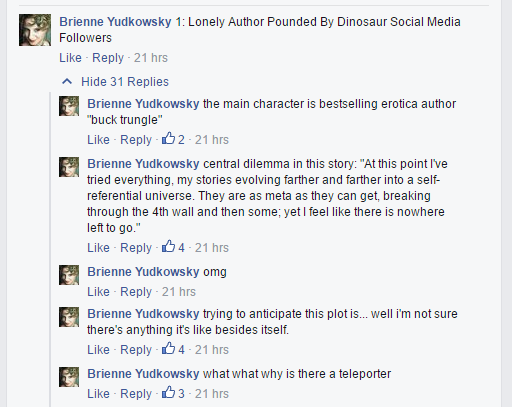
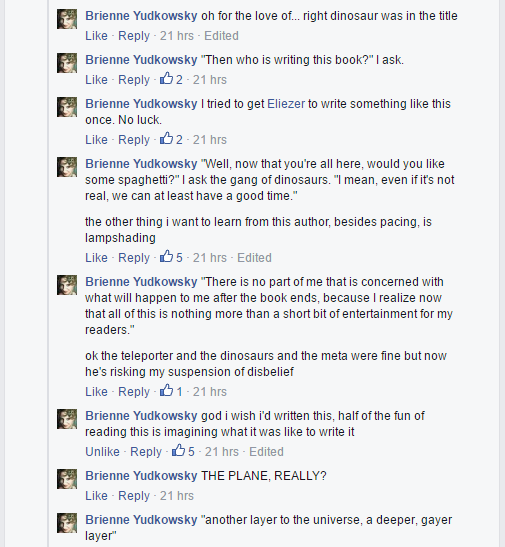
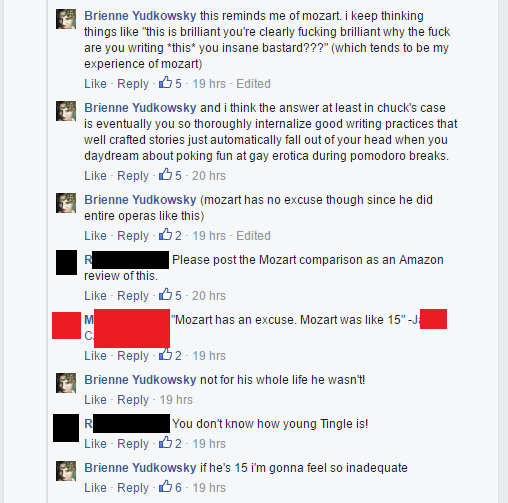
Last year I wrote Amazing Man as a satirical take on the 2015 Sad Puppies fiasco, with the titular character acting as a mash-up of Larry Correia and Brad Torgerson. I never expected to re-enter that universe. But two days after reading this Tingle interview, a story of how REAL LOVE would redeem Amazing Man invaded my brain, and wouldn’t leave.

I pounded out the following story – Amazing Man 2: Love Conquers All – over the weekend. I tried to start with the violence-porn of Amazing Man, and move it into the dinosaur-porn of Tingle. I think it’s OK! I wish I could have gone with First-Person Present-Tense, as that seems soooooo ideal for erotica! Ah well.

This world isn’t very deep in the Tingleverse, so it’s not as absurd as a lot of Tingle’s stuff. I still wanted a redemption for Emilio, after all. It also assumes familiarity with Amazing Man 1. It’s 4400 words, but 1500 of it is gay erotica, so the non-erotica part comes out to right about the same length as Amazing Man 1.

Of course it does not even compare to the Tinglers of The Master. But it was a damn fun use of my weekend. :) And it makes me feel better about getting back to my novel. I’ve been hung up on it for a while lately, barely sputtering out a few hundred words a week, and this feels like it rammed clear much of the junk clogging up my brain-pipes. Sometimes you just need to have crazy, consequence-free fun with your writing!

Amazing Man 2: Love Conquers All

May 082016
 

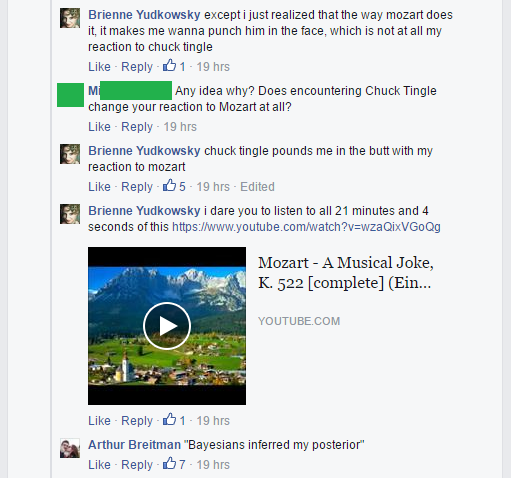
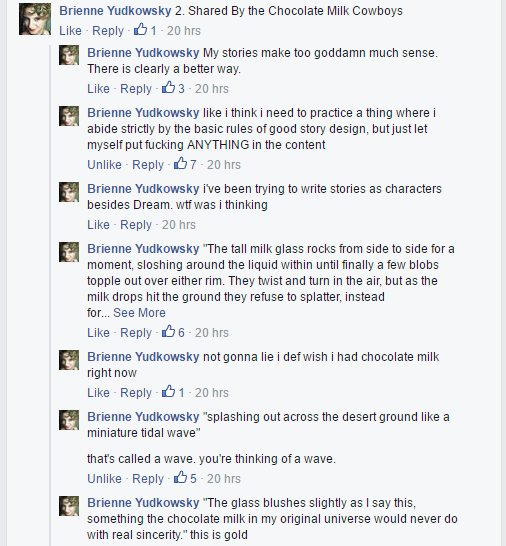
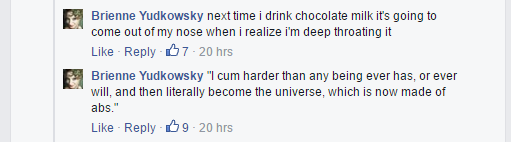
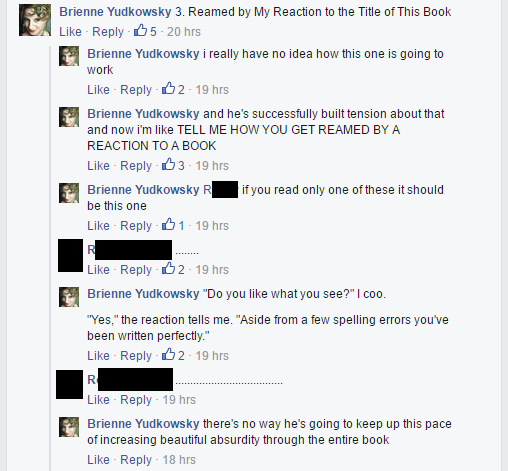
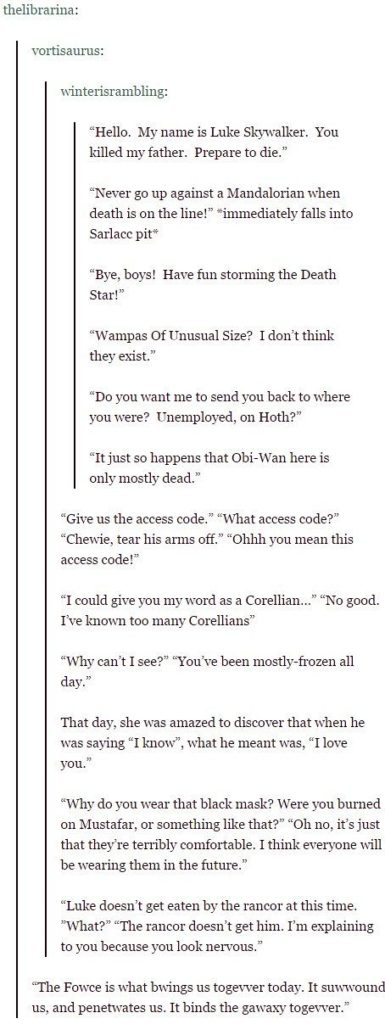
More Brienne liveblogging Tingle poundings. :) Her post is public, so you can probably search it in Facebook if you want, and keep up with them as she reads the rest and liveblogs them.

Brienne 1

Brienne 2

Brienne 3

Brienne 4

Brienne 5

Brienne 6

Brienne 7

May 082016
 

beauty_and_the_beast_2010_by_j_scott_campbell-d2z2pqgIn the recent post on Kukuruyo, a commenter asked me:

He violated terms of services with two separate companies, DeviantArt and Project Wonderful, of his own free will and choice. He’s making money taking paid commissions creating nudes of a Marvel character without permission, a character who happens to be underage and whose name is literally synonymous with the company (textbook copyright infringement AND trademark disparagement) and selling to advertisers who have no idea their ads will show up on pages with drawings of a nude 16 year old girl, implying that the advertisers support such imagery.

Exactly how much sympathy are we supposed to have for this guy?

I dunno if you should have any sympathy, to be honest. He’s a GamerGater, and so has my antipathy right off the bat. There really isn’t much I like about him. But just because I dislike someone, or disagree with their politics, that doesn’t give me (or anyone) free license to destroy their lives. Accusing someone of pedophilia and creating child porn is exactly that. My contention is that nothing he has done is deserving of that level of attack, and vigilante justice is not something we should be encouraging anyway.

Terms of Service – I dunno about Project Wonderful, but c’mon, that’s a joke for DeviantArt. Half of DeviantArt is fanart, and it’s not like porn is uncommon. And by invoking copyright infringement you’re implicitly siding with America’s absolutely broken copyright laws, and declaring all fanworks should be purged. Is that *really* the position you want to be taking? Because that’s far more detestable than anything Kukuruyo has done.

This seems to be entirely a case of selective enforcement. Common activities are made illegal, but the laws are never enforced. UNTIL someone draws the attention of a group that wants to suppress or destroy them, and then it’s easy to do so because all they have to do is persecute for any one of the myriad things that everyone does. It is arbitrary power disguised as rule of law. Are *you* in possession of any music or art that you didn’t legally purchase? This is the sort of tyranny I find despicable, and just because it’s aimed at someone I dislike doesn’t make it ok!

The one grey area I waver on is the fact that he did make some money on the side off the fanart. That’s sorta shady, I guess? But as original pieces of art that are his own creation, I have a hard time siding with the international mega-corporations, over the guy doing sketches in his free time. I strongly believe that the claiming of cultural myths for exclusive use by media corporations is an abomination.

And at the risk of repeating myself, the people who are attacking Kukuruyo seem to me to be practicing selective enforcement. Did they disparage Scalzi for writing Star Trek fanfiction? Did they encourage Universal Studios to sic their legal attack hounds on Peter Watts for writing The Thing fanfiction? Both of those were Hugo finalists, and I don’t recall any such hostile acts.

So no, don’t bother with sympathy. But don’t pretend that what’s been happening to Kukuruyo is anything but reprehensible.


EDIT: For an example of this selective enforcement, I present Mark Oshiro. I am aware of him because I follow Matthew Foster, who was married to Eugie Foster before her untimely death. Mark Oshiro stole her work “In The End, He Catches Her” and read it for his Patreon supporters, as well as putting it on YouTube. He never asked for permission, he never paid for audio rights, he simply stole them, and profited from that. And this is a thing he had been doing for quite some time. But Mark Oshiro is on the same political side as those who are currently attacking Kukuruyo. He is a darling of theirs. He has been a guest of honor at at least one con. No one called for his head (aside from a rather incensed Matthew Foster, but he never got any traction with that). Some people even bemoaned the fact that they can’t vote for Mark as Best FanWriter this year. I suppose it’s a lot easier to steal from individual starving artists, as they don’t have a team of lawyers to sic on you. :/