Feb 252014
 

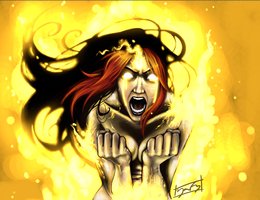
burning_rage_final_by_shadowphoenix88-d48hqdnCurrently there’s a trend in writing to avoid direct descriptives. Saying “he collapsed in exhausted” is a no-no. You describe his actions and let them speak for themselves, or you describe the physical sensations of exhaustion to let the reader feel the exhaustion. Such as “He dragged his leaden feet to the couch, eyes straining to stay open, until he could collapse in a heap on the cushions.” or “a deep ache suffused his body. It sunk to his core with a dull, constant pressure like weights pulling at his bones.” (respectively).

I don’t have an opinion either way on this. A trend is what it is, you go with it until it passes. But it does have two effects.

On the logistical side, it increases the word-count of stories. That’s irritating for someone who already struggles to fit within the limits most markets set, but it’s not that interesting.

The more fascinating part is that you begin to realize that writers have made up a veritable cornucopia of repetitive, unnecessary vocabulary.

As far as I know it’s always been considered a bit gauche to use the same word twice in quick succession. So if you’re trying to describe the faux pas of some maladroit bungler without looking awkward yourself, you need a plethora of words to do it gracefully. But really, how much difference is there between them? If they could be swapped willy-nilly without changing the meaning of the sentence, were all those extra words even needed?

I’m not trying to pick on fancy-pants writers in their ivory towers here. I think all humans in general over-imbue meaning onto simple subjective experiences. Consider something as simple and concrete as pain. We have a lot of words to flavor our pain. “Pain” is just pain, but misery often connotes a long, drawn-out process, and torment generally implies pain inflicted by an outside source.

But when you embrace the current trend and start describing the physical sensations of being in pain, you come to realize that this complexity is a conceit we force onto the concept. There are only a handful of ways we experience pain on the physical level. Our bodies are fairly simple organic mechanisms, with a few standard ways of throwing out distress signals. Because these signals are so simple and limited, they are often confused with each other and misinterpreted when their sources are not easily identifiable. (quick pro tip: get enough sleep, and exercise. That’s nearly half of emotional suffering.)

This doesn’t apply just to pain. Our emotional responses are really quite basic, and there’s only so many times you can describe a jump in heart rate or a tightening of the muscles. We humans like to think we’re so much more than basic stimulus-and-response. It’s the reason we invented all these words in the first place, isn’t it? To flatter ourselves. Now that the fancy words themselves aren’t enough we’re spending more and more time coming up with elaborate metaphors to paint a picture of what the word was originally supposed to evoke.

We no longer say: “I pushed through the pain of speaking those dreaded words.”

Now it’s “I forced up the core of dread that had been smoldering inside me for the last month, coals of hot regret. They burned me when I spoke.”

The second is certainly more poetic. But does it detract from the story to focus so much on the wording?

There is likely a happy medium which I, in my beginner’s exuberance, am entirely unaware of. Perhaps with time I’ll find it. Until then, my prose will alternate between stilted and purple. :)
Feb 212014
 
Not me

Not me

I recently had a story workshopped. Which, BTW, is the best thing ever, and every aspiring writer should do this. I gained three levels in one day. Anyway, in the story a male character is introduced and described by a female character as “tall, but not uncomfortably so.” A workshopper of the female persuasion asked me what the heck that meant.

“it isn’t clear who would be uncomfortable with (his) height or why (she) is considering potential uncomfortableness.  In what context is she making this observation?

(She) could be thinking that (he) is quite tall but not so tall that it would be awkward for him (socially? physically?) […] (She) could be thinking that (he) is quite tall but not so tall that it would be awkward for her (psychologically? romantically?)”

It took me a bit of thinking to understand this. I am a somewhat tall man – 6’2” (188cm for the non-Americans). When I run into someone more than a couple inches taller than me (over 195ish cm) I get a sort of instinctual “grrrrr” reaction. It’s stupid and I try to ignore it, but I’m wary of them. Who is this person daring to be that much taller than I am? What are they planning?

I should have realized this ages ago, but most women don’t have this reaction. Upon considering my workshopper’s questions I was reminded of something my SO told me not too long ago, which I obviously never internalized. Height is for women what boob-size is for men. The person can’t control it; it’s objectively stupid; and the sex appeal is undeniable and deeply ingrained. It’s very hard to ever reach the limit of “too much”. Swapping the two around when trying to think like the other gender can help quite a bit.

With that in mind, I suddenly saw exactly where the confusion arose. If I read “Her boobs were big, but not uncomfortably so” I’d immediately have the same questions. I had failed deeply at understanding a non-me POV. That line was atrocious.

I have much to learn.

Feb 192014
 

semiautopistolSo I read Veronica Roth’s Divergent, despite my exasperation with YA, because we’re reading it for our book club. I’m not going to talk about the book itself (which will come in a future review post), but rather about the whole concept of nitpicking.

It is very clear to any reader who’s handled a gun before that Roth doesn’t understand guns on a mechanical level. This is unfortunate, because handguns figure prominently in the climax of the novel. She makes a number of simple mistakes, the most frequent one being the “chambering of a bullet” that didn’t make sense. Normally one lets things like that pass by without comment, but this just kept happening over and over. Using semi-auto pistols people would chamber a bullet one-handed! They’d often do it as a threat, even when a bullet was already chambered. They’d do it directly after having fired the gun. WTF?

Eventually I figured that what she meant by “chambered a bullet” was “cocked the hammer”. Then it all made sense.

But this degraded my enjoyment of the book. It’s like reading a novel with car chases, whose climax features an extended car chase scene, where characters are constantly described as “changing gears” whenever what they’re actually doing is “slamming on the brakes”. “A building collapsed just ahead, filling the street with rubble. John grabbed the steering wheel and changed gears, bringing the car to a screeching halt.”

Should this matter? The characters are unchanged. Their interactions are unchanged. Roth is great at making us care about the protagonist and hate the antagonists, there is still a story and some character growth, the plot is unaffected. Maybe this shouldn’t bug me this much.

Suspension of disbelief is a tricky thing. Anyone who didn’t know much about guns would just keep reading without being violently thrown from the story. This is how Prometheus managed to be successful – enough people don’t know enough about science that the glaring basic mistakes didn’t hit them in the face. They probably wouldn’t be as forgiving of a Titanic movie that had the Titanic hit an iceberg and then continue on to port while people complained about how hard it was to make it from one side of the ship to the other now. Maybe I should be glad that so many people don’t know anything about guns, it could be a sign that people in our society are safe enough to concern themselves with less violent knowledge!

Still – being ejected from a story like that, repeatedly, sucks. Guns are common, and fairly simple. If they’re a big part of your story, couldn’t you at least get a basic familiarity with them? I don’t feel that’s asking too much.