Jun 102016
 

TOOL_TwitThis is just me complaining.

Tool is coming to Denver in October. Tickets went on sale today at 10:00. I was waiting at the tix-buying website at 9:58, and started refreshing regularly.

As soon as the tix went on sale the site crashed.

Kept retrying, finally got through at 10:03!! :) All the good tickets are gone!! :( Oh well, screw it, it’s Tool, I’ll buy crappy far away tickets. I click confirm and… crashes again. Reload. The whole show is sold out at 10:04.

Fuuuuuuuuuuuuuuuuuuuuu…..!!!!!

Resellers are charging over $170 for far away tix, and I’m not willing to pay that much to be half a mile away. The good tix I’d be willing to shell out $200 for are actually over a third of a grand! Guess I’m not going to see Tool. :( God I love Tool.

But hey, all is not lost! There’s this promising new band in Denver. They’re playing at a local venue tomorrow, and I *LOVE* small local venues because they are intimate as hell and you get to be right up next to the artist and see them freakin’ bleeding into their instruments and wailing their souls into the heavens. I’m hoping this will be a case of specialized tastes allowing one to save money while retaining pleasure. :)

Jun 082016
 

the-princess-brideSo in the process of creating the two Bayesian Conspiracy episodes on Polyamory, I think I may have discovered that most other people have a secret sixth-sense/emotion that I’ve been blind to this whole time. And boy howdy, is THAT ever confusing!

I got in a bit of a misunderstanding about when it’s appropriate to use the term boyfriend/girlfriend (I’m gonna default of female gender for the rest of this, since it’s about me, and I’m basically straight). I had thought that if someone has a friend, and they sleep with that friend with some regularity, that’s basically what a girlfriend is.

When I interact with other humans, my level of “liking” them can be (roughly, with some cajoling) split into two axes – Feelings of Friendship (“liking”), and Feelings of Sexual Attraction (“crushing”). Of course there’s feedback loops between the two. But that’s basically it. The qualitative difference between my best male friend and my best female friend is that “crushing” axis. Since the sexual attraction is what every romantic movie/book/etc focuses on, I used to call this the “romantic” axis, rather than the “crushing” axis.

But that’s not what romance is, I guess?? I was informed there’s a qualitative difference between “friend I sleep with” and “girlfriend.” That if one becomes too good of a friend with someone, they can “cross a line” into a different type of feelings that are called “romantic” feelings. Those feelings are qualitatively different. And NOT in the sexual-attraction way.

I suddenly felt entirely lost. I feel like the guy who found out in his 30s that he has aphantasia, and everyone else in the world can see things with their brain whenever they want, like some kind of super-power! Is there some sort of thing I’ve been entirely blind to my whole life? All I know is that I really like some people A LOT! Suddenly that doesn’t count as love? Then what have I been doing my whole life?

And a number of things suddenly made a lot more sense.

  • Like when I was trying to learn to be social, so I started up a conversation with a guy at a local rock show, and afterwards my best friend asked me “Dude, why where you hitting on that guy so much?” And I was like “WTF? I was just being friendly!” And he said “No, you were TOTALLY all over him.” And I’m all “But… I don’t even like guys. I was just chatting…”
  • Or why I was the only one who was always scarred and hurt when my friends moved away or lost contact or whatever. Every time it was like a chunk of me being ripped out. And it was just me. The friend just moved on, they never made that same connection. Not to the level I had. (I tend not to do that anymore, as a defensive measure)
  • Also why not everyone is just open about everything in their life with everyone else. I am a super-transparent person, and I’m happy to talk about nearly anything in my life with anyone. But I guess that’s a thing people reserve just for one “super-special” person? And such intimate talking with others would reduce the meaningfulness of their conversation with the super-special person.
  • Maybe being uncomfortable with Public Displays of Affection falls into this too?

It’s because all this is stuff that falls on the “romance” side of that friend/romance distinction. I never knew there was a distinction. To me there’s just varying levels of “friend!”

The first thing I did was google “aromantic” and read up on that, because I obviously didn’t have this “romantic sense” other people do. But that doesn’t really seem to fit. A common list describes things like “not understanding what a crush is” and “not understanding why people make a big deal out of crushes and/or falling in love”. I totally crush on people, and I love the hell out of falling in love/NRE. (Oh god… are those two different things too??) Various aromance tumblrs also seemed to focus on the not-having-strong-emotions-of-attraction part, which is the opposite of my experience.

My next thought was “OK, maybe I’m the opposite – panromantic(?)” I can/do get these strong feelings toward anyone, and it has nothing to do with sex. I would gladly marry my best guy friend, as long as we didn’t have to do any sex stuff. And all these tumblrs keep saying aromantic and asexual are separate things.

That makes sense, right? Maybe my mistake was that I confused the word “romantic” as meaning “on the sexual axis” when it should have meant “on the friendship axis”.

But then what the hell is a friend? What does THAT mean to people? And why do some straight people claim that “[straight] men and women can’t be friends”?  Apparently some married people don’t consider their mate their best friend?

Googling panromantic really didn’t bring up much though. Not nearly the same level of stuff as aromantic. Maybe I’m searching for the wrong term? What do you call someone who doesn’t grok the difference between “friend I like a ton, and enjoy sexing with” and “romantic partner”?

Like, seriously, does anyone know?

May 202016
 

shattered-glassThis post is about four years late. But I’ve only become able to appreciate it recently, so here we are.

I.

In my circles, I used to often hear complaints that middle-class Republican voters were voting against their own economic interests. Followed by disbelieving statements of “How can they not see that?”

Specifically, the charges were that the programs that Democrats proposed were designed to help the working class, and would only tax those who made over $250,000/year. And yet, the Republican base hated them, referring to these as programs that redistributed their wealth to bums. The poster-boy for this was Joe the Plumber who became famous when he claimed Obama’s tax plan would ruin him, when in fact it would probably help. All the economic analysis in the world said he would be helped by this policy, and yet he and the vast majority of the Republican base adamantly refused to believe this, and stuck to their narrative of “this will ruin us.”

I’m not saying he’s wrong, nor am I saying he’s right. Just that he’s the example.

The common explanation in my in-group was “Obviously this isn’t about economics. They support Republicans for other reasons (cultural, moral, whatever), and this is just an excuse.”

This is wrong. Having recently entered an economic situation I think is similar to that of these Plumber-sympathizers, I finally understand their thinking. Because, on an emotional level, I share it.

II.

I used to own very little. I like it that way. But people kept giving me more demanding work and paying me more for it, and I had a bunch of money I didn’t know what to do with. Most important to this story – I don’t believe I will have a job for very long. As AI improves, accounting will be one of the first desk-jobs to go. Our company already has a significantly smaller accounting department than it did a decade ago. I do not expect my job to exist in 10 years. So what’s a guy to do? Well, Denver is growing, and home construction is not keeping up with swelling population. So I take the money and invest it in housing. If I can keep my living costs down, and continue doing this for 10 years, by the time I’m obsolete I may have enough physical capital to support myself by renting.

Now here’s a crappy conundrum – the government programs I know of don’t kick in until you’re close to broke. If I run into trouble, I’m required to drain all my savings and sell my assets before I get assistance. I suppose it’s nice to know that I will not literally starve to death in the worst case scenario. But losing everything first, so I can end up destitute, is not a scenario I am even remotely OK with.

And the thing is, I feel like I am always on the knife’s-edge of losing everything. I know all it takes is one major legal battle to ruin a typical American. It doesn’t matter if I’m in the right, and my accuser is a patent-troll – the costs of defending myself are ruinous in our legal system. And there is almost nothing I can do to prevent a bad actor from targeting me. That is what the entire Culture War is all about, right? Force the boogie-man you hate on the other side to lose their job, lose their possessions, and be forced into squalor?

Or, worse, what if I get some costly illness, or accident? Those strike at random. Everyone in America knows that they are just one major illness away from ruin. We have a hit TV show that starts out with “A high school teacher gets cancer. Rather than allow his family to suffer in grinding poverty after his death, he begins cooking and selling street drugs.” And every single person in America nodded and said “Yup – story checks out.” People choose to die for this reason.

III.

Despite my current net-worth/income, I feel incredibly fragile. Much more so than when I was making less, and owned nothing. The government sure isn’t gonna help me (before I’m totally broke). I’m doing everything I can to store up wealth and invest it, hoping to reach the point where I can survive a major financial shock. And every bit of taxes I pay feels like the government taking what little I’m managing to save — that I would be using to build those walls higher — and giving it to someone else. When you are fragile, that hurts.

Even when you tell me that a tax plan will only affect those who make over $250K, I’m not sure I believe you. Mainly I hear “More taxes. Less personal safety-buffer. More fragility.” To be honest, it’s hard to imagine ever NOT feeling this way. It becomes a way of life. If I were to make over $250K/yr, would I be safe then? Better to be safe than sorry – defeat those taxes now, so they can’t hurt you later.

Now, I don’t actually believe this, on an intellectual level. I realize that the mortgage tax deduction, and federally-insured 30 year loans, are ridiculous largesse the government is heaping on me and other people lucky enough to own a home. And lucky enough to be of the ethnic group that was supported and encouraged to buy housing, rather than the group that was forced into neglected neighborhoods and preyed upon by predatory lenders.  I know the benefit of a police force that are friendly protectors and allies, rather than the terror-squads of an extractive power. I have nice roads and functioning schools, rather than crumbling infrastructure. So I realize that taxes do help me a lot. Disproportionately much, even. So I do not vote based on my fear. I realize fear is the mind-killer, and I ignore it.

But that doesn’t make it go away. My emotional reasoning agrees with Joe the Plumber. I happen to come from a tradition that puts more weight on cognitive reasoning than emotional reasoning. But we all know there are many failure modes of cognitive reasoning as well, so it’s hard to fault someone for trusting their emotional reasoning. Now that I share their emotional headspace, I feel much more sympathy. Note that when you disbelievingly say “I can’t even imagine what they are thinking! They’re voting against their own interests!” – no, they are not. This feeling of fragility is what you are up against. That is your enemy.

Also, please stop using “I can’t even imagine” as a euphemism for “That person is stupid.” All it shows is your own lack of imagination.

May 072016
 

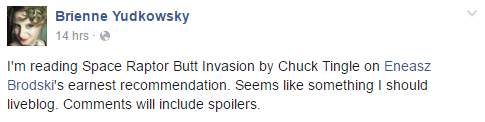
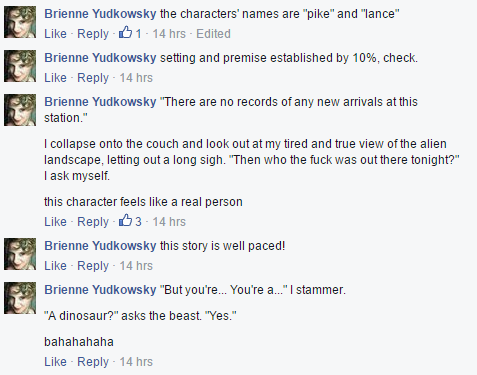
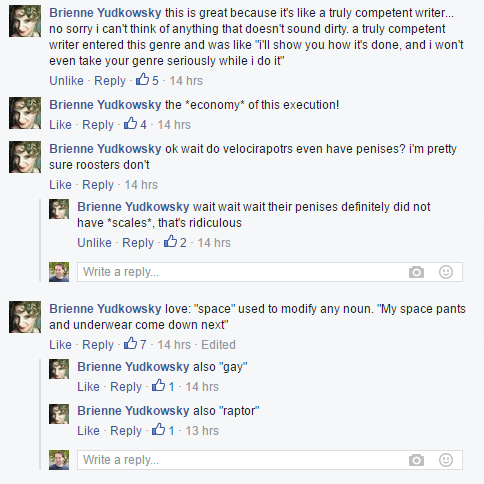
You’ve not lived until you’ve seen a friend liveblog reading Space Raptor Butt Invasion for the first time. :) This should be a thing. Here’s a friend’s reaction blogging.

SRBI 1

SRBI 2

SRBI 3

SRBI 4

SRBI 5


If anyone else has these sorts of reaction liveblogs, I’d love to see them! Drop me a link in the comments or something.

Also, it occurs to me that “Enjoys watching other’s reactions to art as much as the art itself” could make a good litmus test for “How social is this species?” :)

Mar 102016
 

This is a bit personal, but I needed to write it.

Recently I ran afoul of the type of leftist activist that, until that moment, I had always assumed was a ridiculous strawman constructed by racists. The kind you hear about in outrage-peddling articles about how awful “Social Justice Warriors” are. I understand that there really is a lunatic fringe on both sides, but I’d never been confronted with it before.

I mean, I’ve often been engaged by irrational, highly-emotive people. But in the past, they were always on the “other side.” The racists, the creationists, the sexists. It is easy to verbally joust with them, because I don’t care about their opinions of me. I don’t care about their friends’ opinions of me. I know they hate me, and I’m cool with that, I’m just here for the boxing match.

It was radically different when it was someone on “my” side of the issue. Because all of a sudden it felt like my place in the tribe was in jeopardy. I know that it wasn’t really in jeopardy. No one who knows me would care about some random troll’s yelling. But you can’t help feeling like… “this is how rumors get started”, ya know? And I don’t care about whatever rumors the racists may have… but when it’s my tribe, that’s actually a scary thing. It’s been two days, and I’m still processing my anxiety over this.

I’ve always been of the opinion that HOW one comes to their opinions is as important as WHAT their opinions are. But this incident really drove that home for me in an emotional way. It’s nice if someone has liberal democratic views, but I would rather someone be wrong for good reasons than be right for bad reasons, because one is self-correcting and the other is dumb luck (and can change). Epistemology is important.

I guess what it all comes down to, is that I now feel a distance between my “home” tribe of liberalism; and I feel a much greater appreciation of the growing tribe of rationalism. I still have a lot of processing to do, but this was eye-opening.

Feb 292016
 

usda_organic-logo-300x300This is for future reference for myself, so I don’t have to hunt down these links again every six months.


Organic pesticides must be cultivated from natural sources, rather than produces synthetically. They are toxic, because that’s the whole point. Where they are less toxic than synthetic compounds, they are used in greater amounts to compensate for that. Most importantly – organic pesticides aren’t studied in depth by the EPA. Synthetic pesticides are. The toxicities and effects of synthetic pesticides are very well known. Organic pesticides have been used for less than ten years, and aren’t well researched. If you are averse to being a “human guinea pig” then you should stay away from organics.


From https://www.ocf.berkeley.edu/~lhom/organictext.html

The difference between organic and synthetic pesticides is that organic pesticides must be derived from natural sources, not synthetically manufactured.

When you test synthetic chemicals for their ability to cause cancer, you find that about half of them are carcinogenic.

Until recently, nobody bothered to look at natural chemicals (such as organic pesticides), because it was assumed that they posed little risk. But when the studies were done, the results were somewhat shocking: you find that about half of the natural chemicals studied are carcinogenic as well.


A recent study compared the effectiveness of a rotenone-pyrethrin mixture versus a synthetic pesticide, imidan. Rotenone and pyrethrin are two common organic pesticides; imidan is considered a “soft” synthetic pesticide (i.e., designed to have a brief lifetime after application, and other traits that minimize unwanted effects). It was found that up to 7 applications of the rotenone- pyrethrin mixture were required to obtain the level of protection provided by 2 applications of imidan.

It should be noted, however, that we don’t know for certain which system is more harmful. This is because we do not look at organic pesticides the same way that we look at conventional pesticides. We don’t know how long these organic pesticides persist in the environment, or the full extent of their effects.


When you look at lists of pesticides allowed in organic agriculture, you find warnings such as, “Use with caution. The toxicological effects of [organic pesticide X] are largely unknown,” or “Its persistence in the soil is unknown.” Again, researchers haven’t bothered to study the effects of organic pesticides because it is assumed that “natural” chemicals are automatically safe.


From http://www.npr.org/sections/health-shots/2011/06/18/137249264/organic-pesticides-not-an-oxymoron


nearly 20 percent of organic lettuce tested positive for pesticide residues

It turns out that a key factor in chemicals being cleared for use on organic crops is whether they occur naturally. Spinosad, for example, comes from the soil bacterium Saccharopolyspora spinosa. It can fatally scramble the nervous systems of insects. It’s also poisonous to mollusks.

“To control fire blight on the same acre of land,” he explains, “I could use a tiny amount of a potent synthetic that has proved safe over the last 50 years, or a much larger amount of an organic pesticide.” He demurs on saying which is better, saying, “I want people to know that there are definitely tradeoffs.”

In the USDA tests, there was ten times as much spinosad on organic lettuce than was found on conventionally cultivated fruits and vegetables.

Copper compounds are used to fight fungal and bacterial diseases in plants. Copper isn’t very toxic to humans, but it can accumulate in the soil and eventually become poisonous to plants and even worms at high concentrations.

The seeming contradiction between organic labeling and potentially harmful pesticide practices may lie in the relative leniency of the USDA organic guidelines


From http://blogs.scientificamerican.com/science-sushi/httpblogsscientificamericancomscience-sushi20110718mythbusting-101-organic-farming-conventional-agriculture/

the actual volume usage of pesticides on organic farms is not recorded by the government. Why the government isn’t keeping watch on organic pesticide and fungicide use is a damn good question, especially considering that many organic pesticides that are also used by conventional farmers are used more intensively than synthetic ones due to their lower levels of effectiveness. According to the National Center for Food and Agricultural Policy, the top two organic fungicides, copper and sulfur, were used at a rate of 4 and 34 pounds per acre in 1971 1. In contrast, the synthetic fungicides only required a rate of 1.6 lbs per acre

Rotenone is widely used in the US as an organic pesticide. Because it is natural in origin, occurring in the roots and stems of a small number of subtropical plants, it was considered “safe” as well as “organic”. However, research has shown that rotenone is highly dangerous because it kills by attacking mitochondria, the energy powerhouses of all living cells. Research found that exposure to rotenone caused Parkinson’s Disease-like symptoms in rats, and had the potential to kill many species, including humans.

nearly half of the pesticides that are currently approved for use by organic farmers in Europe failed to pass the European Union’s safety evaluation that is required by law

Canadian scientists pitted ‘reduced-risk’ organic and synthetic pesticides against each other in controlling a problematic pest, the soybean aphid. They found that not only were the synthetic pesticides more effective means of control, the organic pesticides were more ecologically damaging, including causing higher mortality in other, non-target species like the aphid’s predators. Of course, some organic pesticides may fare better than these ones did in similar head-to-head tests, but studies like this one reveal that the assumption that natural is better for the environment could be very dangerous.

This isn’t pesticide related, but – organic foods tend to have higher levels of potential pathogens. One study, for example, found E. coli in produce from almost 10% of organic farms samples, but only 2% of conventional ones10. The same study also found Salmonella only in samples from organic farms, though at a low prevalence rate. The reason for the higher pathogen prevalence is likely due to the use of manure instead of artificial fertilizers, as many pathogens are spread through fecal contamination. Conventional farms often use manure, too, but they use irradiation and a full array of non-organic anti-microbial agents as well, and without those, organic foods run a higher risk of containing something that will make a person sick.


From https://www.geneticliteracyproject.org/2015/12/07/myth-busting-on-pesticides-despite-demonization-organic-farmers-widely-use-them/

Bt (the bacterium Bacillus thuringiensis) is the most widely used organic pesticide. (This is the pesticide that causes insect’s stomachs to burst)

Feb 242016
 

thecaldera_by_rationalparadox-itunesBecause projects seem to multiply over time, I am now part of a new podcast on Rationality! It’s a conversational podcast for people familiar with Less Wrong/SSC and the new Rationalist movement, but who don’t consider themselves Black-Belt Bayesians.

I expect the few first episodes to be a bit rough, but give it a listen if you’re interested. We’ll be smoothing out the rough edges and getting better as we figure out how to drive this thing. :)

Home or iTunes

Dec 182015
 

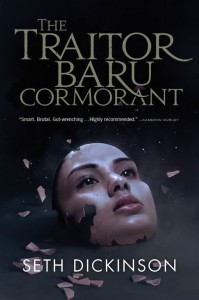
the-traitor-baru-cormorantThis post contains MASSIVE spoilers for The Traitor Baru Cormorant, by Seth Dickinson. Please note that this is one of the few books were that is actually a really big deal. The ending changes a lot about what you thought you knew, and knowing that beforehand changes how you will read the book. If you have any desire at all to read the book, turn back now.

If you don’t have any desire to read the book, but have time to read a short story, consider reading the short story before you continue. Because, again, the spoilers I’m going to be getting into are really big, and I would hate to deny anyone the opportunity to read such an amazing piece of fiction unspoiled.

.

.

.

.

You know those people who go to see a movie adapted from a book, and then turn up their nose afterwards and say “The book was better”? Everyone hates those people. Of course the first medium you experienced the story in will always be better! Get over yourself! I really, really hate to be that person. But the Traitor Baru short story was better than the Traitor Baru novel. The novel was still good! Just not as good. I’ve been trying to figure out why. And I succeeded.

Well ok, I have a half-assed theory. But it’s something.

The Traitor Baru short story takes place after The Twist. We only see Baru after she’s betrayed everyone she loves for the greater good. Everyone who ever cared for her despises her now (if they’re still alive), and the populace of the country she was fighting for consider her a villain. This is all conveyed indirectly, via precision-guided sentences that get the point across as emotionally as possible with as little word-count as possible.  This leaves us to fill in all the blanks. And what do we do when we fill in the blanks? We fall back on Tropes. Or Cultural Myths, or Archetypes, or whatever you want to call them.

What this means is that Baru was the Rebel Princess in my mind. The Leia or the Xena – a shining leader, beloved by her lieutenants and loyal soldiers. When she betrayed them, it was like Leia killing Luke, Han, and Chewie in cold blood, and giving their corpses to the Emperor. It was all the people of those planets, fighting for the Rebels, suddenly under the Empire’s heel again, and he is NOT happy with what’s been going on. Seriously bad times for all.

Likewise, I filled in Baru’s relationship with her lover as deep and passionate, having withstood all the typical fantasy trials. When Baru gave Tain Hu up, Baru was The Dread Pirate Roberts/Wesley, handing over Buttercup to Humperdink.

That was why the brain injury was such a central part of the short story. It was Baru’s escape mechanism. She could turn her blind side on her betrayals, and she would forget about them. She could turn away from her lover, and she wasn’t there anymore. It was the Novocain for her soul, the past-annihilating numbness that allowed her to live with what she’d done. Without that escape mechanism, she likely would have killed herself already. At the very least, she’d be an ineffectual infiltrator, since her guilt-wracked conscience would give her away.

And that was what made the ending so simultaneously heart-wrenching and gratifying. In the end, Baru turns toward her lover. She could look away, have the execution erased from her mind, but instead she watches as Tain Hu is dashed against the rocks over and over. It is an acceptance. An acceptance of Tain Hu’s sacrifice, and her love. It it’s Baru’s moment of growth, where she realizes she is strong enough to continue forward. It is her reaffirmation that her goal (freedom from the evil empire) is worth the price she has paid and is paying. Fuck them. She can overcome even this. They will have nothing to use against her.

(I also love this story because it acknowledges that love for your loved ones is a weapon that your enemies can use against you, which is a deep and unreasonable fear of mine, and which is why I’ve kept myself emotionally isolated much of my life. This story is an affirmation that you can love, and have that love used against you, and still not be destroyed. It’s like the counter-thesis  to that Iain Banks novel that I won’t name because I don’t want to spoil yet another novel. Point is, I love this story, and I love Seth Dickinson for writing it.)

The “problem” with the novel is that it doesn’t conform to the standard fantasy tropes.

“What?” you say. “How is that a problem? I’m sick and tired of all the standard fantasy tropes!” I agree, I am too. And obviously Seth Dickinson was as well. Can you imagine sitting down to write 100,000 words of fantasy to pound out another cliché Rebels vs Empire story? Ain’t nobody want to do that, least of all an aspirational rising talent! So instead he wrote an interesting plot, full of interesting characters, with lots of intrigue and political wrangling, and very shrewd and intelligent gambits. It’s a good story, and it would make a good novel, except it is supposed to bring us back to the Baru of the short story.

I had come into the novel expecting to see some sort of Star Wars-like story, with strong bonds between the rebels, and a passionate ongoing romance with Tain Hu. Instead we see rebels that are constantly infighting, suspicious, looking to back-stab each other, and are clearly using Baru simply to further their own agendas. I don’t mind as much when these people are betrayed. The empire, rather than being typical Fantasy Nazis, are distasteful and sometime horrifying, but ultimately more pragmatic than pure evil, and they bring a lot of good things to the people they conquer to offset some of the evil & oppression. Tain Hu, rather than being the love of Baru’s life, is kept at a distance the entire book, and they don’t even confess their love to each other until just a few pages before the betrayal. That’s not Wesley and Buttercup. It’s more akin to Trinity’s confession to Neo.

I was asked in my book club “What was the brain injury in the last chapter for?”, which I think is a great encapsulation of the problem with the novel. In the short story it is a crucial aspect of the story, the characters, and the resolution. In the novel it shows up so briefly that it doesn’t have any narrative weight. It feels extraneous. The short story depends, ultimately, on a subversion of classic fantasy tropes. We already have the entire Rebel Princess story in our minds, and Traitor Baru takes that story, turns it upside down, then puts it right-side up again, while stabbing you repeatedly and telling you “This is what it takes to win in the real world. If your fantasy stories were real, these are the choices your heroes would be facing. Isn’t this a better story?” AND IT IS! When Dickinson wrote the novel, he kept that Rationalist view. He wrote a fantasy story that would make sense if it was in the real world. Not Fantasy Nazis and Shining Heroes, but real people and realpolitik. And that blunts what made the Traitor Baru story such a knife-in-the-heart to me. The betrayal at the end of the novel didn’t feel like someone amputating their own limbs. It wasn’t a loss of everything good. It was just another manipulation in a book full of manipulations and treachery. A bigger one than any we had seen previous, of course. But not unusual. It was true to character, rather than a betrayal of our ideals. I didn’t feel it would lead to suicidal levels of guilt and self-hatred.

That being said, I HATE to have said all this. I contemplated for many days before posting this. Because (as Seth has said in the past) nowadays no one engages short fiction. Traitor Baru is excellent, and I’ve recommended it a few times to people. But I’ve never posted about it at length deconstructing what made it great, until the novel came out. The Traitor Baru novel has been mentioned many times on many “Best of 2015” lists, but was the short story on any such lists? Even though the short story is better? For that matter, do you recall seeing very many “Best Short Story” lists ever, at NPR or IO9 or wherever you get your news? Nope. People simply value novels far more than short stories, and it’s a damned shame. It’s likely that the Traitor Baru novel has gotten far more reads than the Traitor Baru story, even though the story is less than 1/10th the length, has been out far longer, and is freely available to everyone online! (and IMHO is better)

I even feel guilty trying to point people at the story rather than the novel, because Dickinson has got to pay his rent and buy food, and short stories don’t pay. If you want to make a living writing, you have to write novels. Each person that I convince to read the short story instead of the novel is money I am taking out of Dickinson’s pocket. :( And, if I was given the choice to read either the story or the novel, I would tell past-me to read the story instead, and pay more for the privilege than I would have paid for the novel. It is a far more efficient use of my time, and I am willing to pay extra to get the same emotional payoff (“entertainment” as I call it) in less time. It leaves me more free time to pursue my other pursuits.

So, if you really like the Traitor Baru short story, please do not punish Seth Dickinson for his genius. Buy the novel, to say thank you, even if you don’t read it. And, next time you read a truly amazing short work, please consider purchasing something from the author, even if you’ll never read it, to support their work.
Nov 032015
 

pixels movieTwo cultural appropriation notes.

1.

I attended MileHiCon over the weekend (an awesome local SF Lit con), during which time I went to a “Writing Characters with Mental Illness” panel. A relative of mine has fairly severe shizoaffective disorder, so I’m familiar with what mental illness looks like IRL, but I’m not a healthcare professional so I like to get some actual professional views on the matter, ya know? The panelists were all either suffering from mental illness themselves or professionals in the field. And I did get some use out of the panel, but not nearly as much as I could have. Part of the reason why? They spent a big chunk of time helping everyone defend themselves from charges of Cultural Appropriation. You gotta say “It’s not a disability, it’s a different-ability” sort of thing. FFS. At one point one of the panelists said “No matter what you do, some people will attack you for writing mental illness. Ignore them, please! Do it anyway! We need more characters struggling with mental illness in our fiction.”

So yeah, the CA-police are having a chilling effect, but people are pushing back. So, hooray for that?

2.

I’ve been told a few times that straight white guys will never feel the sting of Cultural Appropriation. (Actually I was told this by a straight white guy who said he’d never feel it, so he didn’t have any right to have a voice in the conversation.) I think that’s a very silly thing to claim, because there are many types of culture, and almost everyone belongs to SOME minority culture that can be “appropriated.” As proof of this I would like to submit this review of the movie “Pixels” by Movie Bob.

Movie Bob is LIVID about the appropriation of video gaming culture by one of Hollywood’s biggest douchebags, Adam Sandler. Says Movie Bob:

>“it’s so oppressively, endlessly, bald-faced cynical about the disingenuous appropriation of its own supposed reason for existing.”

“[It’s] so fucking glib and self-satisfied with its own sleazy cash-grab existence that it takes time out to make sure it also shits on the sort of more earnest, heart-felt version of the same idea that someone who gave two shits might have made”

“It plays at being this sentimental ode to glory days of classic video games, but clearly doesn’t have a fucking drop of sincere interest of what’s made these characters and imagery so enduring or even what made the game so compelling for all these years.”

“It’s always nakedly the work of a bunch of shit-gargling fuckwits with zero love or understanding of this stuff beyond the ability to sell tickets based on ‘Hey, remember Pac-Man?’”

As a video game geek myself (and old enough to have played most of these games in my childhood), I sympathize strongly with every single thing Movie Bob says. In fact, I challenge every white male video game geek who thinks Cultural Appropriation is bullshit to watch this review so they can understand what other people feel when they say their culture is being appropriated. Are you telling me to you don’t feel even a spark of anger at Sandler/Hollywood after seeing that impassioned rant? Cuz I’m not sure that’s possible.

And now, having seen the other side, reconsider your position on cultural appropriation. Don’t just take a reactionary “Screw you, I can do what I want” stand. Take a principled stand. Stand firm with “It is better to allow cultures to mix. The things that are bad about “Cultural Appropriation” are more correctly termed either “Racism” or “Being An Asshole” and should be fought as such, and the things that are good about Cultural Mixing are being destroyed by the Cultural Appropriation Police. That is why the term Cultural Appropriation is toxic. Its only real effect is to eliminate the good things that we want to keep around!”

Hate Pixels because it is shit. Don’t support Cultural Appropriation Policing, because that would destroy wonderful things like The Wizard and The Last Starfighter as well. We will accept Pixels because sharing culture and understanding between groups is more important than making sure Adam Sandler can’t shit on a culture’s values. We will not raze the commons in an effort to punish the free-rider.

Oct 222015
 

interview-with-the-vampireA literary agent I’m acquainted with recently posted “we’re getting wind that publishers are extremely wary of buying diverse books by “non-diverse” authors because they don’t want to deal with readers’ accusations of cultural appropriation.”

If I can only ever write white male middle-class characters in my stories, I will kill myself.

It’s just plain bad art too. I remember reading a book where every character read like a middle-aged Canadian male, (yes, including the teenage girl and the alien intelligence) and I was bored to tears. I want multiple perspectives from various people in my novels, and most of them will not match that of the author.

And do the people pushing this not bother thinking about the consequences of their own agendas? If gay authors can only write gay characters, women authors can only write women characters, black authors can only write black characters, etc, this hurts everyone. There will be less interesting fiction to read, and far fewer stories that any author can tell. How does it help women authors to tell Anne Rice that only men are allowed to write male POV sections?

Ugh.