Sep 252014
 

Funny-First-World-Problems-FeaturedYesterday I mentioned several of Seth Dickinson’s stories over at the podcast site. Today I want to focus on one in particular – Economies of Force. It is a transhumanist story so I’ll assume readers are already aware of common themes in transhumanist fiction – particularly the proposed ability of humans to edit their own mental make-up. Not just memories, but preferences and personality traits as well.

This has been speculated to allow for some pretty worrisome scenarios under sub-ideal economic circumstance, because (quoting Scott Alexander)

>brutal Malthusian competition combined with ability to self-edit and other-edit minds necessarily results in paring away everything not directly maximally economically productive. And a lot of things we like – love, family, art, hobbies – are not directly maximally economic productive. … [Bostrom worries] that consciousness itself may not be directly maximally economically productive. He writes: “We could thus imagine, as an extreme case, a technologically highly advanced society, containing many complex structures, some of them far more intricate and intelligent than anything that exists on the planet today – a society which nevertheless lacks any type of being that is conscious or whose welfare has moral significance. In a sense, this would be an uninhabited society. It would be a society of economic miracles and technological awesomeness, with nobody there to benefit. A Disneyland with no children.”

Yudkowsky introduced a different worry a few years earlier. In Amputation of Destiny he points out that the Culture of Iain M. Banks’s novels is rather bad for the humans, because there is nothing in the galaxy that is worth doing that humans can do. Anything they can do is done better by the Minds, and the humans exist simply because the Minds humor them. The humans are basically kept pets. The Minds are the true main characters of the story of the galaxy now. And while it’s good that there’s still intelligent life in the galaxy, it is sad that humanity has made itself irrelevant.

In Economies of Force, Dickinson has managed to bring these two together in a nicely chilling way. It is conveyed rather quickly that humanity is a kept pet species. No human really knows how the system works anymore, all major decisions are passed on to the machines, because the machines always make the best decisions. It’s beautifully described in a section too long to quote, which makes you feel the disorientation and helplessness in the face of forces human minds cannot comprehend. But everyone’s OK with this because it’s so darned efficient and works so well that humanity is basically living in a utopia. The story draws a picture of an idyllic world where life is easy and everything is nice. It certainly beats the pants off of what most people living today have to go through, even in the nicer parts of the world.

But humanity’s keepers are not like Banks’s Minds, because they have no sentience themselves. Humanity has made itself a pet species and the beings taking our place as the main characters of the universe aren’t even characters. They’re self-replicating animatronic gods.

The system which supports and cares for humanity, while making them irrelevant, has an immune system. To keep running it requires a certain mentality of the humans that comprise it. We need all our cells to work together, and if some cells stop working for the whole and start hoarding all the body’s resources to perpetuate only themselves, we start to die. We call them cancer, and excise them. Likewise, the non-thinking god is composed of humans, and the humans must work in concert. So when certain humans stop working to keep the system alive, they are excised. They’re even described in cancer terms:

 >How could you be part of something that, on the deepest level, only cared about making more of itself? A network whose only value was more network, with no ambition to ever be anything more?

Who could live that way?


I read an interview where someone thought of the Loom as an alien virus, a scary zombie-like thing. I think that’s the wrong interpretation though. It’s a memetic hazard, and the really great part of the story is that the hazard is things that we the reader think are good. These humans become a cancer on the system when they start valuing the wrong things. Specifically:

>They just care about something different. Reaching other people, instead of reaching that new promotion, that new car. And they’re here, you understand? You’d be one of them right now.”


And that’s the terrible horror of the story. We can identify with the system, a being composed of smaller parts which must cooperate for us to continue living, and the necessity of eliminating those parts which would kill us in their selfishness. But we also identify with the cellular components as they are us, and the cancer that the greater system must eliminate is what we consider the most precious things in life, while the values the system needs are what we would consider banal, meaningless striving. And worst of all is that the system we are part of isn’t even a being with moral worth. It is mindless. We created what, from the outside, looks like a utopia that most people would kill for. But it is hollow. It is an example of one of the many things that could go very wrong if we create an AI that will give us what we think we want, but fails to fully capture all our values. It’s a demonstration of half of Eliezer’s warnings of faux-utopias that hits you on an emotional level.

(It’s not a true horror story though, but I’ve spoiled enough as it is)

The amazing part of all this is that a story that requires such a level of background knowledge got published in a major market. This is a testament to Dickinson’s writing skill – he made a story on these themes so compelling that it pulls in the average reader unacquainted with these esoteric minutia. When I read Dickinson it makes me want to give up writing entirely, because I know I’ll never be able to make anything as beautiful as what he’s put together. I won’t subject you to my continued ravings, but… damn! So good!

Sep 142014
 

The_circleThe Circle, by David Eggers

Synopsis: Old Man Eggers gripes about social media and kids these days not having enough concern for privacy.

Book Review: Sometimes you hate a book so much you just have to dedicate hundreds of words to expressing that hate. This is one of those books.

I said before that I’m not that great with subtlety, but holy moses does this narrative over do it! Eggers lays it on with a trowel! The first twenty pages are nothing but saying how this company is the best company EVER and Mae loves it SO MUCH and all her previous companies SUCKED and describing in detail just how great every single thing is! An eloquent speaker is shown to be really gifted not by any action on his part (he is entirely ridiculous throughout the book) but by being described as “eloquent and inspirational, so at ease in front of thousands.” Informed Abilities, yay. :/ First the believability of the prose tanked, then the believability of the characters, and then the entire world came soon after. But I’ll get to that.

I’ve also mentioned that I can’t stand plots that only exist because the protagonist is absolutely pathetic, or stupid. Mae is both. She is the most pathetic imitation of a human I’ve seen in ages. Whining, simpering, idiotic, and never once stands up to anyone for anything. When she finds out only 97% of her co-workers love her she starts jibbering about how 300 people despise her and are looking for an opportunity to actually murder her. But if anything she’s above-average for this world, because…

This story could only exist in a world populated by Jersey Shore cast members. The entire world is completely retarded, and entirely self-involved. When it’s revealed that a character’s distant ancestors owned slaves she has a melt-down, and the vast majority of the people around her abandon her because (it is said) everyone believes slave-owning is genetic. Or when the government figures it would be a great idea to allow direct voting on all issues and let a single private company be in charge of all vote counting in the nation. Because that’s exactly the kind of power governments hate holding for themselves!

This book is a modern-day Atlas Shrugged in the feverish way it must warp reality and mutilate human nature in order to make its ideological point. It is an ideological point that pertains only to an imaginary universe, and so completely fails as a wake-up-call or dire-warning or whatever it was trying to do. At least Atlas Shrugged had some damn good Competency Porn to keep me interested. The Circle just has floundering jackasses. And what is the message it’s trying to promote?

Kids these days and their damn social medias!! They’re over-sharing and destroying all privacy!! /cane-shakegrump kong

I took this somewhat personally because I recognized that he was attempting to caricature my culture in the book. It’s like seeing the most grotesque straw-man of your culture being railed against because of the horrors it will impose upon us all, and realizing that someone may think this is actually representative of what anyone sane thinks. (Privacy Is Theft? WTF?)

Reminds me of NPR’s recent idiotic story about Why Atheists Need Captain Kirk” which sparked a minor internet backlash by claiming that most atheists are “Spockians” and “in a Spockian universe there is no such thing as nature, there is just material process, particles and fields, in the void. Nor, for the Spockian, is there any such thing as wonder, not really; for what is an emotion, but a conjury of particles in the nervous system?

Which makes me wonder if the author has ever met a single atheist. While everything in the article is technically correct, the implication is that the world is over-run with Spockians and what we really need is some Kirks to bring humanity to atheism. When in reality the Spock-ism is (at the most) a phase that teenage atheists go through for a few months when they first deconvert, and EVERYONE ELSE who actually exists in the atheist world is VERY MUCH like what the author is impassionately pleading for. It’s like Noe has never read an actual atheist, and is instead stuck with caricatures that the opposition paints of them. I believe that accounts for the vast majority of the negative reaction the article received.

This book is doing the same thing. Being portrayed in such an alien manner and then lectured at for the sins of the caricature is intensely irritating!

Obviously railing against Kids These Days has been popular for millenia, and Eggers is just jumping on the bandwagon (which, BTW, fuck you very much. Millenias are fucking awesome). But here’s the thing, I’m 34 and I don’t even really count as a Millenial. I’m barely a decade younger than Eggers is. I just happen to have friends that are younger than me! How insulated from the younger generation must he be to think this is in any way a decent portrayal?

There was a few people in our book club who really enjoyed the book, one my own age that said it was obviously a hilarious, over-the-top farce. A wacky comedy that is intentionally way out of proportion and ridiculous in order to be funny. Looking back on it, I can see that may have been the intention, but it was poorly executed. It felt much more like an Atlas Shrugged style trainwreck than a Terry Gilliam piece.

But more to the point – it wasn’t self-parody, it was distorting and mocking others. It felt like blackface. The minstrel shows may very well try to excuse themselves by saying “Look, it’s all in good fun! We know black people don’t act like this, it’s just a joke! Can’t you enjoy the comedy?” To which the only reply is Fuck You.

And on a final tangent, aren’t cautionary tales supposed to be about bad worlds? In Atlas Shrugged the entire world falls apart. In 1984 a military dictatorship controls all thought and expression. In The Circle… the vast majority of the population gets exactly the government they want, and they have the tools they need to share everything exactly the way they love to! It’s kinda a utopia for them. Yes, they’re all flaming idiots, but that was presupposed by the world and is not due to the tech we’re being cautioned against. Of the three or four people in the world who actually want privacy, as long as they aren’t friends with Mae they can live as hermits or something. When the overwhelming majority of your population is happy and fulfilled, you have kinda missed the point of a cautionary tale.

So yeah – literally incredible world, unlikeable protagonist, sledgehammer metaphors, stupid message, and pissed me off personally. I realize Eggers is laughing all the way to the bank, but obviously I’m giving this a Flaming Not Recommended.

Book Club Review: I hate to say this, but this was one of our most lively discussions this year. One saw it as hilarious parody, a couple thought the book was a wreck, a couple thought it brought up good points about privacy, and one thought it was a cautionary tale about the danger of cults. Getting a lot of people together who have strong opinions on a book, and having those opinions be greatly varied, makes for good discussion. If you can stomach the book, and you have a moderate+ spread of world-views in your book club, this makes for some really good talking. So, as much as I hated it, I must say that for book club reading: Recommended.

Aug 292014
 

ash_malindalo_500Ash, by Melinda Lo

Synopsis: An asexual lesbian retelling of the Cinderella story

Book Review: I’m reluctant to say bad things about this book, because it seems to have come from a sincere place. So I’ll start by saying it was nice to see some depth in the evil step-mother and step-sisters. They were still evil, but not for the sake of generic evil-doing, but for good reasons. We as readers could detest them properly, the way real shitty people deserve to be detested. :) And the imagery in the book is beautiful, Lo knows how to turn a paragraph into a painting. The important things pop out and grab you.

But that being said, I’m glad I had heard beforehand that this was a lesbian retelling, because I wouldn’t have known it until halfway through the last chapter otherwise. Not once did I get the impression Ash was attracted to the huntress. I don’t expect erotica, but even a mention that her pulse quickening would be something. Honestly, I feel more passion toward my platonic male friends than Ash did to her love interest. Which is why I said this was an asexual lesbian retelling – but in retrospect, that is unfair to asexuals. Because it wasn’t just a lack of sexual attraction or tension – Ash doesn’t seem to feel any strong emotion at any point in the book. Reading this was very much like watching Kristen Stewart act. There is only one expression, and it is always Bland.

I was also annoyed by how many times something really interesting and potentially emotionally-involving is brought up, and then is never mentioned again. The “dry, atheist philosophers” vs “earthy, nature-based spirituality” was being set up very nicely, and I thought I could get good and steamed about that, but no – nothing. It just petered away. Same with the conflict between the male and the female fairies. And Ash’s mother’s journal. And on and on. So many things that I can’t even call “missed opportunities”, because they were clearly being capitalized on! Before they are entirely forgotten.

And finally, the way Ash gets out of her obligation to the fairy at the end is simply a reinforcement of every negative stereotype of women that every MRA-douchebag has ever vomited forth, and just made me give up in complete despair. If that’s what love is, you can count me out.

But more than anything, the book was just boring, primarily because of its lack of emotion. Not Recommended

Book Club Review: Even if there had been good emotion and strong plotting and I enjoyed the story, I still don’t think this would make a good Book Club book, because it just doesn’t have anything to say. It’s a “Thing That Happened” story. It doesn’t champion any struggle, say anything about the human condition, or question any assumptions. It doesn’t even have a new take on the Cinderella story. It’s just there. Swirsky’s “All That Fairy Tale Crap may have an unlikable protagonist, but it has more to say in a few thousand words than Ash said in a full novel. Not Recommended.

Aug 152014
 

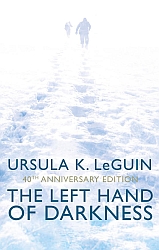
LeftHandOfDarkness-40thAnniversary-PaulYoung_250hThe Left Hand of Darkness, by Ursula K. LeGuin

Synopsis: The spiritual journey of a fixed-gender human who, while living on a world inhabited by humans who alternate between genders, gets caught up in their political schemes and is cast into the wilderness.

Book Review: The first thing I noticed about this book is the writing style. It was published in 1969, and much of that 60s/70s era sci-fi has a distinct style that you can almost taste. It’s a bit more rigid, more formal. It does more telling and less showing in terms of the action that’s happening, but it is less explicit in the points it’s driving to. It feels like the sort of thing Jean-Luc Picard would read while sipping his Early Grey. It wasn’t unenjoyable, simply different. However much of the book is dated – it’s 45 years old now, and it suffers for it. Psyonics was still somewhat-plausible back then, and quite the staple of SF. It’s not the fault of those authors that it’s been thoroughly debunked in the intervening decades, but it’s painful to read it being taken seriously. Soon all the quantum-magic books of the 90s and 00s are going to look the same way to the next generation of readers.

The writing itself is absolutely gorgeous. There are so many breath-taking scenes I don’t even want to get started listing them all. Not only are they exquisite, but they aren’t over-wrought. The trip to the internment camp, where the protagonist bonds with strangers without ever talking to them, only by sharing air and what little water they are given, and by watching two other prisoners slowly die, is emotionally harrowing without being dramatic. It is simple and elegant and utterly compelling. This happens multiple times in the novel.

Unfortunately I never quite understood the point. When I was done I felt a deep melancholy, something within definitely pulled at me. But I couldn’t tell what. The message was so deeply buried/implied that I never caught a glimpse of it. I don’t want things to be garish, but I’ve never been very good with subtlety. If you don’t give me at least a few big clues, I probably won’t catch on.

In addition, this is a book whose mission has been accomplished. I gather that it’s some sort of treatise on gender equality. To me it felt very much like reading a work containing impassioned pleas to consider non-white races as equally human, and maybe abolish slavery. I, and everyone I know of my generation, has already deeply internalized this message. Most of us consider ourselves feminists. I understand this book had an important job in the past, and I can honor those who came before for providing the foundations we now stand on, and respect their great work. However it’s not a book for me. There wasn’t that much to hold my interest. If you are exploring your SF roots and want to read a foundational work, this book is exemplary, and won both the Hugo and Nebula when it was published. But 45 years later, I can’t really recommend it to anyone like me for general reading. Not Recommended.

Book Club Review: This part is a bit harder. There is a fair bit to talk about. It’s interesting that all the alien characters, while supposedly gender-neutral, read as men. Was this a subconscious way of LeGuin expressing that in a world without the restrictions imposed by society and biology the “male” experience is the purer, more agenty one? But the protagonist, despite self-identifying as male and being described as masculine many times, reads like a female character (and it wasn’t just me that thought that). The book’s protagonist is a heroine, despite the male presentation. Is that a comment on the alienation of being a strong woman in a male-dominated world? We were very lucky that one of our book club members is a literary genius and was able to pick up on a lot of subtle points in the book – explaining the “left hand of darkness” metaphor, cultural imperialism vs going native, and a few others. I never would have picked up on those, and it made the discussion far more interesting. Without that, I fear we might have not spent too much time discussing the book itself. If you have a good mix of ages and life-experiences, this could be a good book for your club, and I’d recommend it. If, OTOH, your book club contains only younger readers who never experienced in-your-face old-school sexism, I would not. The world has changed. Which is for the better.

Jul 312014
 

hugoOnly hours left to get in your Hugo ballots! By long* tradition, my ballot and reasoning below.

Best Novel

1 – Ancillary Justice, obviously. So cool that in addition to my standard Book Club Review I also had to write a second post, about the themes I loved within it. Deserves the win.

2 – Warbound. This was a bit of a hard call. I wouldn’t consider either of them to be a “great” work, but Warbound is certainly less interesting and more popcorny. So why Warbound above Neptune’s Brood? I guess I just preferred its tone of humanity ultimately being good, if flawed, over Brood’s brooding “all humans are scum” feel. That makes up for a lot.

3 – Neptune’s Brood.

4 – Parasite. I didn’t read it. I slogged through the last three books Mira Grant managed to get nominated, all of which were too long and two of which sucked. I know Seanan McGuire is awesome IRL, I’d love to hang out with her (altho if she ever saw this I doubt the feeling would be mutual). But I simply no longer trust her to tell a story. Certainly not enough to entrust her with many hours of my life. If she ever writes something really awesome I’ll have to be told of it by others, I certainly won’t find out for myself.

5 – Wheel of Time. I’m glad this got on the ballot, it’s fun to stick a wrench in the works from time to time. :) But let’s get serious when we’re voting.


Only read one Novella (Valente, cuz she’s awesome), so I’m not voting there.


Best Novelette

1 – Truth of Fact, Truth of Feeling

2 – Lady Astronaut of Mars

3 – The Waiting Stars

4 – The Exchange Officers

5 – Opera Vita Aeterna

Explanation why, and reviews, here.


Best Short Story

1 – Selkie Stores Are for Losers

2 – Ink Readers of Doi Saket

3 – If You Were a Dinosaur

4 – The Water That Falls on You From Nowhere

Explanation why, and reviews, here.


No votes in any other catagories, since I haven’t read/seen enough of the ballot to make an informed decision. Although y’all really should read We Have Always Fought if you haven’t already, it’s really good.


*since last year

Jul 282014
 

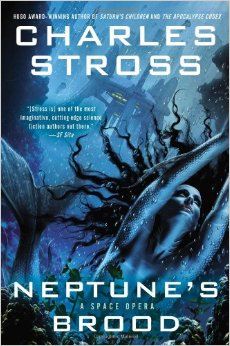
neptunesbroodNeptune’s Brood, by Charles Stross

Synopsis: A post-human is chased across a star system and to the bottom of an ocean by competing wealthy and powerful people who want a code in her head worth a nigh-unimaginable fortune.

Book Review: Like all of Stross’s works, this combines an intricately built world and tight plotting with a biting sense of humor and palpable misanthropy. It’s a strange mix. The first section of the book takes part in a flying church that is SO GOTH my inner teen shrieks in delight (yeah, The Crow was one of my favorite movies in High School). It’s played for humor, and it’s a lot of fun while still being serious and disturbing in parts. Which, BTW, is another strange flavor to watch out for. There are occasional spikes of pure horror that drop out of nowhere and blast you with nightmare fuel, before going back to standard SF fare. The writing is clever, in some places overly so, but that helps to give it Lovecraftian overtones. It is an odd palette that Stross paints with.

The most notable thing about the book is that it reintroduces one to what “Noir” originally meant. Nowadays it’s used to mean that generic 40’s style, with wise-cracking guys in fedoras and tommy guns. I referred to Warbound as a “Noir” story. Nowadays it’s all about the furniture. But originally Noir meant a bleak, dark world that leaves the audience feeling soiled. In a Noir story every single person is in it only for themselves. There is no honor, no loyalty, no greater noble virtues to humanity. You can’t trust anyone in even the slightest regard (expect, perhaps, to pursue their own interests). Everyone cares only for their own selfish, short-term, monetary gain. It’s this grim, mercenary view of humanity that leaves you feeling dirty when you watch/read old Noir. Except, of course, usually the protagonist served as a sort of Jaded White Knight – cynical, but an idealist at heart. This book is like that, except the protagonist here is just as mercenary as everyone else.

In fairness, there is a society glimpsed near the end that surpasses human selfishness and is awesome, but they’re barely seen. For all its neat points, the story didn’t really compel me in any major way, expect perhaps to hate all humanity. And that’s not a feeling I’m particularly fond of. Not Recommended.

Book Club Review: It’s interesting that the book didn’t spark more discussion among our group, considering the very in-depth speculation on the workings of future societies. Upon consideration though, maybe I should have expected that. The economic framework Stross presents is elaborate and fascinating, but it’s not emotionally compelling. I was interested and enjoyed reading the many digressions into the slow-money financial system and its relation to our current monetary system, but I was never really gripped by anything. The story makes its way to the conclusion in an orderly and respectable manner, and then it’s over. Perhaps this would work well in a group that is grumpy and would be happy to talk about how people suck. After all, traditional-Noir used to be a popular genre (right?). But the mood seemed to stifle conversation a bit for us. Not Recommended.

Jul 152014
 

hugoBook Review:  Every year my book club reads all the short stories and novelletes nominated for Hugo Awards and discusses those at a meeting, rather than reading a novel. So this will be more of a quick review of a bunch of stories, rather than of a single work.

Short Stories

‘‘The Water That Falls on You from Nowhere’’, John Chu
I don’t see why this is considered Speculative Fiction. There’s basically nothing SF in here (and the water doesn’t count). This is a plain ol’ coming-out story. More than that, it’s a boring coming out story. And maybe worst of all, there wouldn’t even be a story if the protagonist had even a single vertebrae worth of backbone. I have no interest in reading about a complete wus being so much of a loser that it hurt my eyes to read about it. Jesus, ovary up!


‘‘The Ink Readers of Doi Saket’’, Thomas Olde Heuvelt
A delightful fairy tale, with a beautiful cadence. It’s fun to read, but it won’t leave your life changed, or your week altered. Fun, but light.


‘‘Selkie Stories Are for Losers’’, Sofia Samatar (audio)
I first heard this in audio, so I almost didn’t read it, which would have been a huge mistake. Something is lost in the audio, I don’t know what it is. The meter of the words maybe. The breaks are very important too. I didn’t get anything from it when I heard it.

Then I read it.

This story is amazing. It hits one of my favorite themes, the same theme that Comes The Huntsman and Evangelion and Vellum and all sorts of things I love portray well – People Will Leave You. Whether by choice or accident or death, eventually everyone you know will leave your life in some way, and it will fucking hurt. But trying to shield yourself by not forming attachments ends up hurting even more, because human psychology sucks and isolation is awful. Putting it in crass words like this is terrible and doesn’t convey any of the emotion, which is why you’ll never see it put in this way in anything worth reading/watching. Read this story. It’s amazing.

The fear and pain of abandonment drips from every single sentence. And let me say this is one of the best written works I’ve read in a long time. The craft of the wordsmithing is breath-taking. It flows like a song, tugging you where it wants you to be with the rhythm of the words and the tension of the voice. Tugging is the wrong word to use, it embraces and guides you.

And the protagonist! Holy god! It’s been said that Superman isn’t brave when he jumps in front of a bullet, because he knows it won’t hurt him. Actual bravery is a normal human who does so, because he knows he could be maimed, or killed, and maybe it won’t even matter. This protagonist is the bravest fucking person I’ve read about in ages. You feel her bowel-liquidating fear and yet she goes forward with what terrifies her. She refuses to live cringing from life for fear of pain, she grabs onto life and screams in defiance and accepts that maybe she’ll be thrown off and it’ll hurt and it’ll be awful but fuck it all, that’s no way to live. It’s exhilarating and moving and terrifying and inspiring.

This story deserves to win SO HARD it’s ridiculous.


‘‘If You Were a Dinosaur, My Love’’, Rachel Swirsky
This isn’t a short story, it’s a poem, but let’s let that slide since there’s no poetry category. It is technically magnificent. It does exactly what it sets out to do with skill so precise it’s scary. Every bit as amazingly written as Selkie Stories. However, what it sets out to do is hurt you. This is a sad-fic. It describes something so unutterably tragic and terrible in such a perfect way that you feel every bit of that pain. And unlike Selkie Stories, there is no brave protagonist pushing forward and being amazing. There is just the pain. This is the literary equivalent of taking a straight razor, dulling it just slightly, and then running it over your skin just hard enough to cut it without drawing much blood. If that’s what you want in your fiction, this is perfect for you and you will fall in love with it instantly. Me, I left my cutting days back in my teen years. I don’t like stories that exist just for the catharsis of experiencing pain. I feel this story would have been better off in a Literary Fiction magazine.


Novelettes

‘‘The Truth of Fact, the Truth of Feeling’’, Ted Chiang
When he writes, Ted Chiang dissects our universe. He keeps cutting until he finds something interesting, one little bit of reality that captures his interest. He then removes this piece, studies it, and alters it ever so slightly to create a unique and fascinating premise for a story. Then he surgically re-inserts this altered bit, re-composes reality, and finally creates the story that would arise naturally from that little bit of the universe being different. And as you examine this story, you can see reflected in its surfaces and vertices what the original piece of our world was. By presenting us a story where that piece is different, it brings light to how that original piece shapes our own reality.

Which is to say (again) Ted Chiang is the best short-fiction writer of the present day.

He does that again with this story. This time the piece is literacy. Obviously this was my favorite novelette, and you should read it. :)


‘‘Opera Vita Aeterna’’, Vox Day
I tried to give this a chance. I really did. I read Warbound with an open mind, and Correia himself seemed quite happy with my attempt at fairness. So I went in thinking this could be a good work, even if I think Vox Day himself is an insufferable douchebag. Certainly wouldn’t be the first time a great artist has been personally reprehensible.

I kept waiting for the story to start. It never did. Seriously, there is nothing here. The writing itself isn’t bad (a bit amateurish, but we all gotta start somewhere), but this isn’t a story. As one of our book club said “If this was presented to our writing group, we’d return it without comment, saying it’s not worth our time to critique.” It is purely a finger-in-the-eye to the Hugos. All I can say is… well played Correia.

Needless to say, this isn’t worth your time.


‘‘The Waiting Stars’’, Aliette de Bodard
Everyone else seemed to love this, but I don’t know why. It’s a retelling of The Matrix that doesn’t add anything. Meh.


‘‘The Lady Astronaut of Mars’’, Mary Robinette Kowal 
A very good story about aging. The conflict between being true to your calling and what you view as your duty. And what it means to grow old and useless to society. This speaks directly to me. It was very moving, and the resolution made me a bit misty-eyed. Let’s never get old, OK?


‘‘The Exchange Officers’’, Brad Torgersen
This starts with the line “Does technology change the nature–and meaning–of sacrifice?” as a teaser. The answer is yes. Trashing some government agency’s expensive hardware from a safe bunker hundreds of miles away is not at all as compelling as sacrificing your own life. One might say that applying the word “sacrifice” to the first scenario is an abuse of the reader’s trust. This was more like the power-fantasy that boys write in early high school (I would know). It was boring, and bad.


Book Club Review: Despite some of these stories sucking (which happens every year), I cannot do anything less but heartily recommend the “reading stories/novelettes” practice to all book clubs. It’s a different form of story-telling, and the scattershot approach exposes you to a variety of styles and authors you probably wouldn’t normally read. It’s a very refreshing change of pace, and it’s fun to compare stories to each other directly, rather than discussing a single work in isolation as is generally done. It gives you a ton of subject matter to talk about. And it’s ok if some of it sucks, it lets you vent, and you move on to the good stuff. This is great fun, and I hope more people get into it!

Jun 272014
 

Holy_TerraOK, this is the spoiler-heavy discussion of Ann Leckie’s Ancillary Justice. All sorts of plot developments and twists will be discussed below, including the climax. Consider yourself warned!

So for me the biggest and most important theme of the book was the old question of which Ends can justify which Means. When we’re first introduced to the Radchaai Empire we’re seduced by the good that they are doing. They provide all the essentials of life (food/clothing/shelter) to ALL citizens free of charge. No one starves, no one is considered “Too Unproductive To Live.” Furthermore, the Empire is preventing the exploitation of the underclass and the third-world by the elites in the societies they’ve conquered. Where before the upper class was destroying the ecology of the planet that the underclass was trapped in, ravaging it for their own comfort and luxuries, the Radchaai put a stop to that. Under their benevolent Iron Fist the fish populations are starting to come back and the environment is healing. In addition, the lower classes, who had been excluded from opportunities for a better life, can no longer be prevented from achieving the goals that they can legitimately reach through hard work and the application of their own sweat and intellect. If you can do the job well you are allowed to do it, regardless of your parentage. It is the exporting of the American Dream. Justice and Impartiality are forced upon racist/classist and exploitative systems. Sometimes the only way to stop evil people doing evil things is the imposition of force (such as when we fought a civil war to stop slavery in the USA).

But of course this comes with a cost, and Leckie never shies away from showing it to us. The annexation wars are brutal. The occupation afterwards is arguably worse, with any displays of unrest or agitation being immediately responded to by summary execution without trial. Sometimes on a large scale. But in the end it was worth it. The ends justified the means. The protagonist states that the conquered people’s agree if you ask them, they say it was fortunate civilization was imposed on them. In the next sentence the supporting character asks “Would their parents agree? Or their grandparents?” The response is that they are dead, and the dead don’t matter. But it’s an interesting question. Where do we draw the line? Looking back on World War II, we say it was worth the cost in lives to end that great evil. But would the hundreds of thousands of civilians who were killed in the “strategic bombings” of that war agree? I guess it doesn’t much matter now.

The author really does play this to the hilt though. Because later on we learn that the Empire wasn’t always this way. Previous it had been a malevolent Iron Fist, extracting resources and oppressing people, not giving two shits about the underclass or the fates of worlds, enslaving races, etc. It was turned to a benevolent dictatorship by an intervention from an alien race. And the price of forcing this change upon the Empire was the total genocide of an entire civilization. Every living thing within a certain Solar System was wiped out. All its planets, moons, orbiting habs – everything. Exterminated in a cold-blooded calculated method that makes the Nazis look like amateurs. Now – was that worth it? An Empire spanning hundreds of stars is now veering toward good. The lives of uncounted trillions of people will be incredibly improved. All it took was one genocide.

And the really frustrating thing, which I don’t normally see, is that the author doesn’t seem to take a position. She leaves it up to us to decide.

And if that isn’t enough to start your morality compass wavering, in the end the protagonist sparks a civil war in this Empire, purely for personal revenge. A war which may have happened eventually anyway, but it’s hard to say. It’s possible it could have been avoided. But more to the point, her motivation wasn’t anything to do with the greater good of civilization, or freedom for individual peoples, or anything else noble. It was just revenge for the death of a single person which the protagonist loved. When the “means” is “civil war on a galactic scale” and the “ends” is “personal revenge for a single death” it makes it very easy to say “Ok, THOSE ends DO NOT justify THOSE means!” But this is the protagonist, who we’re supposed to identify with and root for, right? Or was the emotional distancing between us and the protagonist throughout the entire book done on purpose so we wouldn’t feel the temptation to side with her?


The second major theme I see is Determinism. It’s stated early on that most things are out of our control – we can’t control events, we can only control how we’ll react to them. This is demonstrated right from the start by One Esk running into Seivarden (random event beyond her control) and choosing to save her (her reaction). Not for any reason that makes any sense, but simply because that is who One Esk is. By her nature when she is put in that situation she will react by rescuing – it is a deterministic response. And it pays huge dividends later on.

Likewise, this is why she wants to kill the Emperor in every incarnation. She says multiple times that she doesn’t care if she’s talking to The Reformer or The Tyrant – both are merely aspects of the same person. The Reformer is the path that is determined for instances of the Emperor who are exposed to the Garseddai Genocide. The Tyrant is the path for instances of the Emperor who were not. Since The Reformer would be The Tyrant under slightly different circumstances One Esk doesn’t care that they are at war with each other and have opposite visions for the future, she wants them all dead. The Reformer would become The Tyrant if she had The Tyrant’s experiences. Since their differences are dictated by circumstance and not by intrinsic differences, they must all be eliminated. This, of course, is the same view of Free Will (or lack thereof) that I subscribe to, but taken to a very different conclusion than I would. I think that the circumstances of life are a large part of what makes us up, and so one’s circumstances are intrinsic differences. But it’s hard to say that One Esk doesn’t have a point, even if it is flawed.

The Emperor also points out that One Esk served her without qualm for 2,000 years. This is an interesting point, and raises some questions about our protagonist. There’s the intuitive excuse that One Esk is a machine – she is designed to follow orders. But, Firstly, all humans are no more than biological machines themselves, and they are often shaped by societies to follow orders unconditionally. Up until 80 years ago, “I was following orders” was a reasonable and legitimate explanation of any behavior. Punishment would be meted out only to those who gave the orders. Why do we now intuitively consider it OK for a machine to be “only following orders”, but not for humans to do so? Because, Secondly, One Esk could disobey orders, as we saw. She killed the Emperor after she’d been pushed past her Moral Event Horizon. And let us be clear that it wasn’t just The Tyrant that she killed, she spent 20 years plotting against all instances of The Emperor, and kills several of The Reformer as well. It’s also stated in the book that this isn’t unique and due to The Reformer’s tampering – sometimes ships “lose their minds” and stop following orders and go on revenge crusades.

But The Reformer’s tampering with Justice of Toren’s mind does bring up an interesting point… if The Tyrant had gotten there first, would we be reading the mirror image of this book? Would the villain be the corrupt and decadent Reformer, rotting a pure and righteous Empire away from the inside, under the sway of evil alien intellects without any care for mankind’s self-determination? Would One Esk now be the conscience of a Firm But Loving Reactionary Emperor? Is all morality purely relative, and no one thing can be said to be objectively better or worse than another, but merely the opinion of whoever managed to hack into your mind first?

And again, the author doesn’t seem to take any position at all. Do we have a choice in what we do? Well, here’s some things that happened, and here’s the circumstances surrounding them. I wish she would take a stance, to be honest. My enjoyment is lessened by the fact that she doesn’t. Say what you will about Larry Correia’s social views, at least he argues for them. The people who agree with him like him more, and the people who already disliked him do so more strongly.

I get that it’s just me, and a lot of people like this ambivalence. But I really would prefer to either have someone to cheer on, or argue against.


All this being said, you can see why I am kinda surprised all this attention is put on “OMG, their society doesn’t have gender roles or gendered pronouns, let’s all go nuts about that!” when there’s sooooooo much good, rich moral/philosophical commentary to really dive into!

Jun 272014
 

AJ Ann LeckieAncillary Justice, by Ann Leckie

Synopsis: A warship’s AI, inhabiting a human body, seeks revenge upon the ruler of a galactic Roman-esque empire.

Book Review: Fascinating! For starters, I absolutely love everything about this setting. From the extremely-Roman empire, to the opt-in procreation (yay for default-on contraceptive implants for everyone!), to the genderless society. In addition, I loved the protagonist, she was portrayed extremely well as a multi-bodied AI, and you could feel the panic and confusion whenever she was reduced to single-body-operations. Moreover the lack of emotional attachment to her body(ies) was well-portrayed. They were just vehicles, to be used up when the situation required it. The passages describing her losing her hands, arms, and feet were akin to someone describing a tire going flat. It was delicious! The themes the book explored were exactly the sorts of things I love to see explored, but I can’t really go into those without major spoilers, so I’ll be writing another post right after this for those who’ve already read the book. And finally, the plot had the sorts of political intrigue and subterfuge I had just been talking about a few weeks ago that I enjoy. On top of all that it’s very well written.

On the downside, it’s very hard to feel like you should cheer for the protagonist. She’s written with a bit of emotional distance that makes sense, but also makes her harder to relate to. Without a very deep emotional investment it’s much harder to excuse what she ends up doing to get her revenge. Also, there is absolutely NO technological advancement over a 1,000 year period. None. That was like nails-on-chalkboard for me. There really should have been some authorial effort spent on giving an in-universe reason why that is.

Still, an amazing book. Highly Recommended.

Book Club Review: If you’ve heard one thing about this book, it’s probably that it’s basically genderless, and the “she/her” pronouns are applied uniformly to everyone. For a genderless AI that controls hundreds of bodies, existing in a gender-neutral society, this makes plenty of sense. Sure, it’s a thing the author did on purpose for whatever reason, but so is everything else in a novel. This is just one of the many themes in the book, and frankly it’s a minor one. Determinism, Ends-Justifying-Means, and Classism are all far more central to the story, and receive far more attention. And yet during our book club meeting there were almost more words spoken about the genderless thing than the other three put together.

I wasn’t sure quite what to make of this, because there isn’t all that much to say in the first place. The impression from several members was that all the characters have gender, and that a character’s gender tells you a lot about the character and helps you relate to them, and this information was withheld from the reader, and they felt cheated and annoyed by that. Of course the genders different readers mentally assigned for the same characters where all over the map, which suggests that maybe the gender really doesn’t tell you all that much, and what it does tell is likely due in large part to roles that society has assigned to them rather than anything inherent in the person, but I digress. Please note that aside from this well-publicized aspect of the book, there is also a lot of political commentary, morality commentary, and philosophical speculation. Astute readers will NOT be lacking for things to talk about in a book club setting!

(Although, in fairness, while there is commentary on these matters, the author never seems to take a position on either side. She simply lays out some events and doesn’t do much judging as to how things should be. This, again, makes it hard to get emotionally invested in the themes. Why take sides on an issue when the author herself doesn’t have a stake in the matter? Perhaps this is why those other themes were overlooked in favor of the genderless one by most of our group.)

Again, Highly Recommended.

Jun 232014
 

No-Lasting-BurialThe admins of Fantastic Reviews attend our Book Club, and they passed a copy of Stant Litore’s “No Lasting Burial” to me, as they figured it would be right up my alley (they were right). Litore is a local author, and he’s interested in reviews, so they asked me if I’d be willing to write a review for the book. I couldn’t say no to that, so here it is!

No Lasting Burial is part of Stant Litore’s “Zombie Bible” series – retellings of Bible stories in a world plagued by zombies. Right away I was intrigued, as I love religious stories and I thought a zombie infusion could make for some excellent reading. I was, however, somewhat led astray by the back-cover summary, which calls “No Lasting Burial” a retelling of the Gospel of Luke. At first I thought NLB was suffering from a bad case of Not Getting To The F*cking Monkey since we don’t see the Messiah until about 1/3rd of the way through the book (aside from a brief intro right at the end of chapter one). However as I continued in the book I realized this was not the fault of Litore, but of whoever wrote the back-cover summary. This is not a retelling of the entire Gospel of Luke, it is a retelling of the calling of Simon Peter, James, and John. So the first dozen verses of chapter 5 of Luke. However I don’t want this to come across as a criticism because the retelling is masterful and the book is the perfect length to explore the story that is being told with the full depth that Litore has given in. I just wanted readers to be aware so they aren’t frustrated.

Two major themes run through this book. The first is the survival of violent abuse. The entire village that the story takes place in suffered an extreme collective trauma, first as it was sacked by Romans, and then as it was overrun by zombies. The violence is gritty and real and portrayed from the viewpoint of a child, which makes it more horrifying. Fortunately the majority of the atrocities are only alluded to, as the child hides in a tomb and helps with a childbirth amidst the chaos. The psychological impact of this violence scars all the survivors and is reflected in their every action for decades. They were never allowed to heal, as the poisoning of The Sea of Galilee visits zombie incursions into their town sporadically. The tension, the constant PTSD-like fear, drips from the page. It’s an amazing portrayal of a damaged community, and I felt paranoia and despair clawing up my chest and suffocating me in every chapter. It is intensely well written, and it strongly affected my overall mood during the week I was reading this. Stant Litore knows his shit.

The second major theme is that of forgiveness. Specifically, the act of forgiving being the only way to heal and move forward in the face of such unforgivable acts. The burden of hatred, of revenge, of honor and law, keeps all these wounds fresh and keeps tearing people down. Souls are crushed under the strain, because it’s simply too vast to ever be reconciled justly, and the result is just more pain. But for everyone to come together and forgive, unconditionally, and start anew with a clean slate… to let the old hurts go so they no longer goad and spur and torment you… is nearly impossible. It would take an Act of God to move such a weight. Which is why people often will not budge until they finally break down into a full religious experience. In this case that religious experience is literal, as a Messiah half-mad with grief, and burning with destiny, comes into their community and slowly, against their thrashings and screams, brings them healing and forgiveness.

This book does a far better job of portraying the gospel message of forgiveness and God’s unconditional acceptance than the actual Gospels ever did. Which one could interpret as damning with faint praise, as the actual text of the Gospels is fairly lame. It’s always in the churches that the true message is conveyed, by powerful preachers and strong communities that understand what the text was trying to say. So let me clarify – this is a damn good book, and it does exactly what it set out to do with flying colors. If my childhood church had half of Litore’s understanding of the forgiveness message of Jesus, and even a fraction of his ability to convey it, maybe I would still be some flavor of Christian today. Maybe. They didn’t, and I am glad for that. But through this book I was finally able to understand just what it is so many people see in Christianity. On an emotional level it’s very appealing.

The book does have some flaws. Most noticeably, it tends to use too many words. Sometimes entire paragraphs could have been shortened to a single sentence without losing anything of substance, and some points are belabored a few times. It’s a small price to pay. I recommend the book highly.