Jun 282018
 

Hugo AwardBy ancient tradition, our book club reads the online-available Short Stories and Novelettes that have been nominated for the Hugo Award every year. Here’s my reviews.


Best Short Story Catagory

“Carnival Nine,” by Caroline M. Yoachim (Beneath Ceaseless Skies, May 2017)

Well written, with a fantastical world-of-toys setting. I loved the creation of children from spare parts, the daily winding-up of the springs, etc. Visually, it reads very much like a Tim Burton movie, ala Nightmare Before Christmas or Coraline. The metaphor of a toy that gets very few turns per day being analogous to disability (what we often call spoons nowadays) was very well done. But ultimately, this felt like an overly-smaltzy Hollywood tear-jerker.  Like the SF lit version of Oscar Bait. You’re supposed to feel very sad but uplifted, sorta bittersweet. And you do. But it’s not authentic, it feels like you’ve been guided through a maximally-sympathy-inducing construct. For example, the mother indulges her child in getting him significantly heavier arms than he should have, because it would make him happy. This is an extra strain upon his spring, and further adds to the mother’s burden of care-giving, but it’s soooo worth it because it makes her disabled kid smile and she has the heart and determination to give him the best life, etc. Yeesh.


“Clearly Lettered in a Mostly Steady Hand,” by Fran Wilde (Uncanny, September 2017)

My favorite Short Story of this year. Absolutely gorgeous prose, to the point of being poetry. I fell in love almost immediately. Moreover, it expects some work from the reader. You have to think as you’re reading, and interpret what’s being presented to uncover the story below the surface. At first I thought maybe this was a metaphor for a sexual relationship. I was wrong. This is about the anger of society’s misfits at being maltreated. The autistic, the disabled, the ugly. The “freaks”. The title refers to the stomach-churning disgust of seeing a dispassionate researcher calmly lettering notes about their anatomy’s after doing things to them that hurt, hurt deep, he should be shaking from the atrocities he’s just committed in the process of dissecting his subjects, unable to write a word, but instead he simply labels them as if they aren’t even feeling beings. The story is beautiful and grotesque and brings you directly into experiencing this emotion in a powerful way. This is the sort of story that awards were created for.


“Fandom for Robots,” by Vina Jie-Min Prasad (Uncanny, September/October 2017)

A delightful piece about an obsolete robot finding a place in the world by writing fanfiction. This is very much a love letter to fanfic readers/writers, with lots of jargon and in-jokes. And it’s an absolute pleasure to read. The portrayal of the robot as a non-neurotypical person slowly making sense of all the bizarre human creatures around it, and coming to connect with them, fills me with warmth. And it was hilarious. :) I want to write some fanfic of this story now. The one downside to this story that that it doesn’t have a strong arc, and thus it just kinda peters out at the end, instead of actually Ending. Kinda disappointing, but since this is such a light/fun story anyway, its easy to overlook that. My 2nd favorite of this year.


“The Martian Obelisk,” by Linda Nagata (Tor.com, July 19, 2017)

Technically well written, but boring. The portrayal of a world that’s coming to an end because humanity has collectively gotten too frustrated to continue and decided just to give up on living made me roll my eyes. The possible moral dilemma was no dilemma at all, and the ending feels like it was written by committee. Meh.


“Sun, Moon, Dust” by Ursula Vernon, (Uncanny, May/June 2017)

The concept of a Chosen One getting a magic sword and deciding “No, I really don’t like adventuring, I’m going to stay and farm instead,” sounds great on paper. What happens when the Hobbit stays home? But despite being somewhat charming, there’s not really anything here. It felt like a filler episode in an animated series.


“Welcome to your Authentic Indian Experience™,” by Rebecca Roanhorse (Apex, August 2017)

There comes a point about halfway through this story where you realize just how literal the title of this story is. This is a dark supernatural story, verging on horror, that takes you through the historical experience of the entire Native American peoples through the personal events of a couple months of the protagonist’s life. When you come to that realization you say “Oh shit. This is gonna suck.” You read on, because it’s a compelling plot and moves quickly and you want to see the story play out. As a parable, it works.

As a story, there is something lacking, and I can’t quite put my finger on what. The writing is good. And yet, I find myself not being hit very hard by it. I should be much more affected, and I don’t know why the story didn’t quite land. I’m still thinking about it, on an intellectual level, and I admire the strength and skilling of the story-weaving itself. The emotion just isn’t quite realized, though.


Strongly Recommended – “Clearly Lettered in a Mostly Steady Hand”

Recommended – “Fandom For Robots,” “Welcome to your Authentic Indian Experience™”


Best Novelette Catagory

“Children of Thorns, Children of Water,” by Aliette de Bodard (Uncanny, July-August 2017)

“Extracurricular Activities,” by Yoon Ha Lee (Tor.com, February 15, 2017)

Putting these two together, because I have the exact same comments about both.

I understand authors writing short works in the universe of their current novel series. It’s a treat for their fans, who are very important for authors. It keeps the universe fresh between novel releases. And maybe it’ll get some new people interested in the novels if they find the stories interesting.

What I take great umbrage with is the fans nominating these interstitial stories just because they love the series so much. Neither of these stories are good. They’re barely even stories. They’re just a thing that happened in the author’s given universe. Neither of these should’ve been anywhere near the Hugo Awards. They’re good for what they are, but what they aren’t is award-worthy works. Anyone who nominated either of these should be embarrassed of themselves.


“The Secret Life of Bots,” by Suzanne Palmer (Clarkesworld, September 2017)

The most adorable thing I’ve read all year. The tiny, ugly-duckling-style robot goes to battle against a rat-bug thing that’s eating his ship’s insulation, and winds up saving the human race. Everything about this story made my heart happy. I love the characters, I love the tiny little bots and their whisper network, I love their non-neurotypical thought processes, and I love their overly-literal humor. Life-affirming and extremely enjoyable. I expected to cry at the ending, and I cheered instead, and honestly I’m more of a tragedy guy so I think I would’ve preferred to cry? But that’s not what Palmer was doing for this story, and that’s fine too, this also works. :) My favorite of the Novelettes, though Small Changes is really close.


“A Series of Steaks,” by Vina Jie-Min Prasad (Clarkesworld, January 2017)

I read this just a few days ago, and honestly, I’ve already almost forgotten it. Not bad, but nothing here that interests or sticks with me.


“Small Changes Over Long Periods of Time,” by K.M. Szpara (Uncanny, May/June 2017)

O_O INTENSE. Gritty, angry, powerful, sexy. It does amazing things using an act of vampirism as an analog for both actual rape and rape fantasy, and then follows its aftermath. Using the vampiric transition as a reflection both on mortality and gender transition, the death of the old identity and the loss that comes with it. And then the vampiric bloodlust as an analog for the intense hormonal urges and desires of first-time testosterone use. It explores how quickly power can change you, how easy it is to go from prey to predator, and how good that feels. By the time the protagonist’s sire tells us ‘Don’t forget what you felt yesterday, when you were human’ we’ve already forgotten it, and it honestly feels hard, as a reader, to conjure up those intense emotions from just a couple pages before. Because that’s how fucking talented Szpara is. This story is amazing. And then, on top of all that, it snatches everything away again with the horror of realizing our body is turning against us, and we are going to be trapped forever in a fucking nightmare.

And then in the last third all that evaporates. The protagonist’s problems are quickly and neatly solved (in a manner that felt, emotionally, like a deus ex machina), the growth arc is aborted, and instead we get a cliché power-fantasy wish-fulfillment ending. This was extremely disappointing. The story was sooooo good up until that point. It feels like Szpara lost faith in his ability to tell this story, or realized how much longer it would be and flinched away from all that work. So he just snapped to quick resolution and cut it short. I understand that fear. This should be at least a novella, and could easily be a full novel. Which is a fuck-ton of work. At least a year of life for someone holding down a regular job as well, all for something that may turn out to be not worth the effort. That maybe no one will ever see, and no one will care about. I wish I could tell Szpara to revisit this, and take it to completion. That it would absolutely be worth all the work to me, and probably for thousands of readers like me. Because this was so utterly amazing right up until the fail point. I hope that the Hugo nom (and maybe win?) will demonstrate this, and re-energize him. Because – wow.

I’m very torn on my vote. I don’t know if I should vote for Small Changes first, or Secret Life of Bots. They do such different things, it’s impossible to compare them. Normally I’d go for the wrenching, angry, powerful tale. But with the disappointing ending, man, I’m really torn. In either case, this is also very good.


“Wind Will Rove,” by Sarah Pinsker (Asimov’s, September/October 2017)

A meditation on cultural history, and what it means to have yours wiped away. On how much we build on the past, and the dangers of letting reverence for it become overly stifling, and strangling future creativity and growth. But while acknowledging how much we depend on it for who we are. As well as a few things about responsibility to future generations and how are choices are taken away from us by the past. A slow-paced, but ultimately well-done and thoughtful piece. While this isn’t my favorite type of story (see previous, I enjoy the ones that scream at you), this is definitely award-caliber writing. This is the sort of thing I’m happy to read, and fully get behind its nomination.


Strongly Recommended – “Small Changes Over Long Periods of Time,” and “The Secret Life of Bots”

Recommended – “Wind Will Rove”


Book Club Reviews: As always, I highly recommend doing this once per year. You’re exposed to a lot of disparate things at once, and you get to learn a lot about the tastes and even (sometimes) values of your fellow book clubbers. The reading goes fast, as there’s much less word count than a novel. And basically everyone will find something they like. It was interesting to see how we differed on several of these.
Jun 202018
 

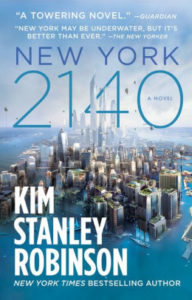
New York 2140, by Kim Stanley Robinson

Synopsis: A tour of New York in the year 2140.

Book Review: Kim Stanley Robinson is famous for his Mars trilogy, a Hard SF trilogy that explores how to realistically terraform Mars. He continues the ultra-realistic very-sciencey tradition with New York 2140. If you are into Hard SF, KSR is absolutely your man.

Robinson isn’t shy about his infodumps. He knows that the realistic portrayal of a physical world is why his readers are here. There is an entire chapter that is literally about the geological history of the New York bay area. I like learning stuff, and Robinson is a good writer with decades of experience, so I found this interesting. But it’s really slow.

In fact, being set in an existing city, and being so dedicated to realism, there were several times I forgot this was science fiction. It felt like Earth Fic – normal, contemporary narrative fiction without a speculative element. On the one hand, that is extremely impressive for a novel set over 100 years in the future in a flooded New York. On the other hand, I don’t really like Earth Fic, I read Speculative Fiction for a reason!

The characters are as rich and deep as the setting is. Everyone feels like a real person, with a real personality, and real motivation. Their problems all feel like real-world problems too. All of this makes for a gorgeous tapestry, that feels like a mix between biography, narrative non-fiction, and well-written textbook.

But it takes its time. It really, really takes its time. Last I heard, KSR is a Buddhist. And this novel feels very much like what a (western stereotype of a) Buddhist would write. It is sedate, taking every step deliberately and with consideration, and absolutely will not accept your sense of urgency in anything. It’s over 600 pages, and by the time I hit page 200 I still didn’t know what it was about, which is why my synopsis doesn’t mention any sort of plot. The last book-club book I read was Collapsing Empire, which covered a rollicking adventure and several life-shattering (and world-changing) events in the course of 240 pages. In the time that Scalzi managed to tell an entire story, KSR still hasn’t finished his exposition, and I’m not sure we’re actually going anywhere.

I was assured by those in my book club who did finish NY2140 that it does actually have a plot. It’s peaceful to read, interesting, and well-written. If I had all the time in the world, I would read this this novel. But sadly, I do not. I have to prioritize my reading, and I can’t wait this long for something to get started. I can see why Hard SF buff love this novel. But in my case – Not Recommended.

Book Club Review: Woooooah momma! I was pleasantly surprised by just how much conversation this sparked! Just how realistic is the portrayal of future New York? Why would people still live there, and is New Orleans/Detroit or Venice a better reference class for comparison? Are the infodumps an embrace of SF tradition, or self-indulgent showing-off of research at the reader’s expense? Are the dialog-chapters between Jeff and Mutt cool and experimental, or obnoxious? Was this a morally-accusatory work scolding the present for making the future so awful, or was this a demonstration that things will be mostly fine, life goes on, and people adapt and live full lives even after water levels rise? Is this a relaxed, accepting view of the future, or a rant that’s 10 years too late? And where the heck did KSR’s vaulted dedication to realism go when he had a human lifted from the ground by trash bags full of helium?

We went on about all sorts of things, back and forth, for a long time. The debate was lively, and you didn’t even have to read the whole book to join in! In fact, half our group had also finished less than half the novel by the time of our meeting (seriously, so long and slow!), and yet participated fully. Given that one doesn’t need to read the whole thing, and the discussion was so good – Recommended!

Jun 152018
 

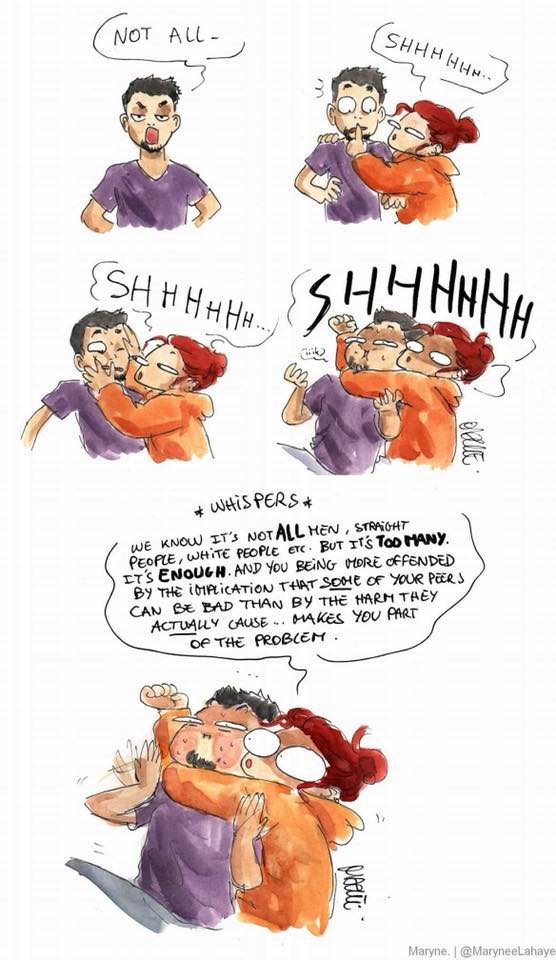
Here’s a popular but shitty entry in the culture wars. It’s a defense of bigotry, dressed up as humor.


First, let’s cover why some people like it. All the following was said by friends or friends-of-friends. I cannot take credit for the words, which is why they are well spoken. They are slightly snipped and paraphrased here and there for brevity.

[Critics of the comic] appear to believe that the girl in the comic, and those she represents, is a bigot who speaks in “all X are awful” generalizations for any group, from white people to men to heterosexuals. This is missing the point. [“Not all X”] statements are meant to derail. I see them ALL the TIME in response to people NOT saying “all.” You want her to defend herself from an unfair accusation instead of explaining her rationale by insisting that her not adopting the language of the accuser is proof of guilt. I’m pretty sure the artist didn’t have her specifically say those words because it’s so obvious to them that the accused don’t say all in most of these cases that pointing it out is redundant to the actual message being conveyed.

To get nitpicky for a moment, the word “all” itself isn’t even what really matters. “All police departments need to crack down on prejudice among their officers” still doesn’t justify “not all cops are racist.” The argument is still being shifted away from a system of cover-ups of abuse of power, and toward a new topic of the prevalence of racism among individual police themselves… Which the original speaker now has to address, or else be accused of being prejudiced against all cops.

One of the major problems is that liberals so often speak of institutions and systems, and those who aren’t on the same page take it personally. This is why the “it’s just a few bad apples” defense is so frustrating. The quote is “a few bad apples spoil the batch” NOT because some racist cops make all cops racists, but because the institutions that allow that rot to continue ruins even the non-rotten apples. Entire populations in this country don’t trust police anymore because the bad actors have been protected too often and for too long. Hell, it’s often not even about racism really, or even sexism or prejudice, it’s about power imbalances and lack of accountability. But the most vulnerable in society are always going to be the first to speak out.

The same goes for other institutions or establishments that don’t enforce equality. It’s not that men are never raped or harmed by sexism, but institutionally, men run the military, men run the government, men run the majority of major corporations, men run the police departments, etc. The harm of “patriarchy” is systemic, and insofar as it harms men too, the sentiment that it is men who need to help solve the problem should not be taken as an accusation that they are inherently part of it.

The gal in the comic here doesn’t actually represent someone who is saying “All men are <bad thing>” or even “X proportion of men are <bad thing>.” She’s supposed to represent the view that “long-running institutional norms in our society empower or permit men to do <bad thing>.”

This isn’t about men. It’s about our society. That’s why “not all men” is a bad response. It’s not that the statement is wrong, it’s that it’s a diversion from something crucial.

The problem with #NotAllMen is that it pulls the conversation away from one about culture and social awareness to one about being personally offended at being accused of something you were never really accused of.


And here’s why I disagree.

I used to call myself a feminist, and I basically still am, though I don’t identify with the group anymore. [This comic] is one of the reasons why. I know people who are genuinely good people. Who want justice and happiness for all. Love a number of men. Only hate those who are awful and deserve it. They would regularly post about gross violations of personhood or other awful injustices, and head it with something like “Men are trash!” Not because they are man-hating nazis. But because that’s just the culture. It’s not seen as a bad thing to do, and gets you lots of cheers. Everyone knows they only mean the bad ones, right? Call them out. End the brutality and patriarchy and oppression. Fight back!

I did it too

And eventually when I realized I basically hate my gender and wish I wasn’t a part of it, and stopped participating, and started asking these kind and caring people to not use that sort of language anymore, I got backlash. Because of course we don’t mean ALL men, just the trash ones. Stop being such a Meninist. Stop distracting and giving cover for your peers (my peers????) who really are doing awful stuff.

And seriously, I just want to stop feeling like I’m trash because of what other people who look like me have done.

So yeah. I assume the percent who hate men is 0%, or close enough to it that it’s a rounding error. The problem is pervasive and systematic and has nothing to do with actually hating men. It has to do with creating a culture/environment that casually destroys a class of people and holds their only acceptable moral condition is one of self-loathing. It’s the daily denigration that wears away at one’s psyche. And it doesn’t have to be “serious”–the people I know who routinely say this are kind people who have male friends, relatives, and sometimes lovers, all of whom they really like. For comparison, how many times can one joke about “black men can’t hold down jobs” before “I’m obv not serious, I’m married to a black guy myself” stops mattering?


(in reply to) “the sentiment that it is men who need to help solve the problem should not be taken as an accusation that they are inherently part of it.”

Thing is, lots of men are working to solve the problem. We’re not omnipotent, despite being born with a penis, so there’s not a whole lot most of us can do. But goddammit, we are trying. And we *still* get subjected to the “all men are trash” rhetoric. In fact, we get it far more than anyone else, because we’re the ones that are friends with the people saying it, and see it come up often. The assholes who perpetuate oppression almost never see this sort of thing. So as good as it may feel to say that men are trash, it’s hurting the people who are trying to help, and not doing anything to fix the actual problem. And pointing that out? That gets you lumped in with the misogynistic assholes.

Also, there’s far better ways of expressing the sentiment that men need to help solve the problem than repeatedly stating how awful all men are.

The problem is that the gal in the comic sometimes says just what you’re saying, and in those cases she’s in the right, and the comic is entirely correct. But other times she’s just saying “all men are trash” and everyone’s cheering about it, and in those cases she’s doing harm and the comic is supporting bigotry. The problem with the weaponization of “Lol, another #notallmen meninist” is that it is used to conflate the second situation with the first situation, and is used by bad people to harm others and make everything toxic.


And of course none of the above really matters. Because here’s the thing.

Most people, and certainly the ones who share this comic approvingly, are still in “there are only two sides” thinking. It’s the message the overwhelming majority of their social environment is pushing onto them, so I don’t entirely blame them. What they’re doing is posting a thing which in their mind is the equivalent of waving the “Heeeeey, I’m on the Left side! wooooo!” flag. It feels good. It fights oppression. It shows support and caring for their hurting friends.

And so anyone saying “Hey, that’s not cool, and here’s why” is, in the poster’s mind, an attack on their side from the other side. Because they’ve been told no one on their side would say such a thing, and there’s only two sides, so obviously the person being harmed by the comic are from the Right side and are here to start shit.

I hope my words, and the words of others like me that are trying to speak up gently, with understanding, but with the message that “You are hurting us because it feels good to you and maybe that’s not so great” will help to carve out a third side. A side that has spent the entirety of their lives learning and fighting for those who are oppressed and ground down by the system, and who hate that system themselves. But who also don’t want to be ripped apart in the process. Who are not content to have to choose between that or becoming the perpetrators of further mass harm. A side that believes there’s actual mutual forward progress possible, rather than just two sides and a war over which side gets to rule.

We can do better.

Jun 132018
 

I hope this isn’t TMI, but it’s relevant.

I think people look sexier with clothes on. I mean, it depends on the clothes, of course. But in a good outfit, everyone looks hotter than they do naked. I would prefer to have sex with my partner clothed in most cases, if it wasn’t such a pain.

Of course the social consensus is that peak sexiness is at the level of complete nudity. Which is why the “swimsuit” competition is the sexiest one. And why Baywatch was the sexiest show. They’re ramping up the sexy by reducing the amount of clothing!

I find burlesque boring for this reason too. The enjoyment is from… watching people get more naked? Everyone else loves it sooooo much though, I must be weird.

I had a bunch of narratives about what had caused me to deviate from the norm this way. I read tons of comic books growing up, and anime in my teens/twenties. I came to identify the ideal visual as sleek, clean lines (as drawn by a pen), and solid, uniform colors (as filled in by an inker or computer). Naked humans have all sorts of imperfections in their lines, and subtle shading and texturing in their skin color. But you put some nice clothes on that, and they sculpt the lines into smoothness, and replace variable skin with a single solid color. Etc etc.

I know a bunch of people tho, and many of them are less than vanilla in taste, and I was curious how many other people like me might exist in the fringes of humanity. So I tossed up a quick poll on Facebook.

Do people look sexier with clothes on? Or nekkid?

And a stunning 80% of respondents said they prefer their partners with clothes on!! 80%!! That’s insane! I realize it’s a self-selected sample, and my bubble of friends isn’t representative, etc. But even so… 80%??

I’m pretty damn sure now that the majority of the human race thinks fully-naked people are less sexy than people with a hot outfit on… and yet (almost?) everyone believes that the consensus position of everyone else is that nakedness is peak sexiness. Nothing else really drives home just how bad humans are at making knowledge public.

Jun 012018
 

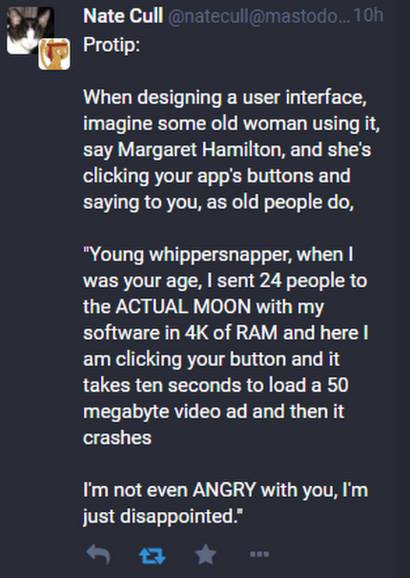
Every time any update is pushed to anything, I just wait to see what it’ll screw up next ><

A tweet storm about the reintroduction of slavery in Louisiana. :( Unfortunately just the FB images, since I don’t do twitter.


Alonzo Fyfe’s reply to the old canard that you can’t derive an Ought from an Is. If these Is statements are true (which in our world they are) than that Ought statement (we ought to promote an aversion to causing pain) is also true. As an objective fact, dependent on other objective facts.


There is one thing the Jehovah’s Witnesses got right…


Every Culture Appropriates. A great piece that chronicles the history of the cheongsam. Ends with

“To the extent that the cultural-appropriation police are urging their targets to respect others who are different, they are saying something that everyone needs to hear. But beyond that, they can plunge into doomed tangles. American popular culture is a mishmash of influences: British Isles, Eastern European, West African, and who knows what else. Cole Porter committed no wrong by borrowing from Jewish music; Elvis Presley enriched the world when he fused country-and-western with rhythm-and-blues.

How to draw the line between that and America’s ugly tradition of minstrelsy, in which subordinated peoples are both mimicked and mocked—as Al Jolson mimicked and mocked black music in his notorious blackface career? There is no clear rule, but there is an open way: the values of respect and tolerance that draw precisely on the rationalist Enlightenment traditions both rejected and relied upon by the cultural-appropriation police. Those traditions are the spiritual core of American culture at its highest. And those values we should all hope to see appropriated by all this planet’s peoples and cultures.”


“Philip Cross” has not had one single day off from editing Wikipedia in almost five years. “He” has edited every single day from 29 August 2013 to 14 May 2018. Including five Christmas Days. That’s 1,721 consecutive days of editing.

…The operation runs like clockwork, seven days a week, every waking hour, without significant variation.

…the purpose of the “Philip Cross” operation is systematically to attack and undermine the reputations of those who are prominent in challenging the dominant corporate and state media narrative. particularly in foreign affairs.

…This matters because, an ordinary reader who comes across an article questioning (say) the official narrative on the Skripals, is very likely to turn to Wikipedia to get information on the author of the article. Simply put, the purpose of the “Philip Cross” operation is to make certain that if that reader looks up an anti-war person such as John Pilger, they will conclude they are thoroughly unreliable and untrustworthy, whereas if they look up a right wing MSM journalist, they will conclude they are a paragon of virtue and entirely to be trusted.

…What is particularly interesting is that “Philip Cross”‘s views happen to be precisely the same political views as those of Jimmy Wales, the founder of Wikipedia. Jimmy Wales has been on twitter the last three days being actively rude and unpleasant to anybody questioning the activities of Philip Cross. His commitment to Cross’s freedom to operate on Wikipedia would be rather more impressive if the Cross operation were not promoting Wales’ own opinions.”


Make No Law. Popehat has a legal podcast, at long last!  Specifically about the First Amendment and relevant historic cases!


Anti-SLAPP (Strategic Lawsuit Against Public Participation) laws are designed to stop malicious litigants from silencing people by suing them for protected speech. While the defendant can prevail in court, to do so costs tens of thousands of dollars (because this is the US), and will either ruin most people or silence them. Anti-SLAPP laws stop these lawsuits, force the plaintiff to pay the defendants costs, AND impose an additional penalty (assuming that the lawsuit was indeed frivolous and an attempt at harassment/silencing)

Colorado has very weak anti-SLAPP laws. The PPP is is an organization working to strengthen these laws. You can sign their petition here, as well as donate money to the cause. I did so, and I think it’s a great idea for anyone who has ever posted anything on the internet.


Sounds like Bill & Ted 3 is actually happening

“The story springs from the ending of Excellent Adventure, in which futuristic mentor Rufus (George Carlin) predicted the duo would write music that would turn the world into a utopia. (This has not happened yet.)

“You’re told you’re gonna save the world,” Matheson told Entertainment Weekly in March during a reunion interview with Solomon, Reeves and Winter. “And now you’re 50 and you haven’t done it. Now they’re married, and it affects their marriages, and it affects their relationships with their kids, and it affects their everything.”

The original is one of my favorite movies. This spin on it sounds awesome. Sounds a lot like the end of The Last Temptation of Christ, in fact. God I hope it’s good.


Torturers can smile too. Our society is so broken that not only do these people walk the streets freely, there’s a chance they could be promoted to the highest levels of government. Take note if your rep votes to confirm this monster.