May 242013
 

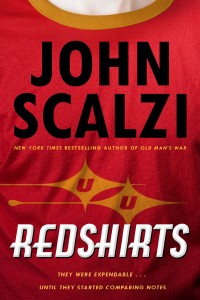
Redshirts_800Redshirts, by John Scalzi

Synopsis: A comedic Star Trek fanfic that goes meta, followed by three essays on existentialism.

Brief Book Review: If you’ve ever been a fan of Star Trek you’ll like this book. The fanfic portion is hilarious. Scalzi excels at writing witty banter and snappy comebacks, and placing characters in believably ridonkulous situations. His pacing is admirable, you’re always being propelled directly into the next exciting event even as the previous one is wrapping up. There’s no hang ups, no chance for your mind to wander, yet it’s never dizzying. It’s hard to put it down, and it’s not too long, making this a very fast read. And while the main show is supposedly the novella, the real meat is in the Codas. The writing slows down and a number of rather serious concerns about existential angst are explored by characters struggling to find meaning in their lives (and yes, this helped fuel my last series of posts). As fun as the fanfic was, these essays really made the book for me, and for everyone who discussed this at our book club. Recommended!

Book Club Review: This is a tough one. It “suffers” from a common problem among good books vis-a-vis book clubs – there is little to disagree over. Recounting your favorite moments of hilarity is fun, but it only gets you so far. There are minor quibbles people will bring up, but nothing major, and it’s unlikely to spark much discussion. The Codas are admirable, but again there’s not too much to say about existentialism aside from “Yeah, I know that feel. It sucks.” Unless people are willing to open up about their own recent existential crises, but it always seems like whining to complain about that sort of thing in public when we’ve Beaten The Game. Not to say that this is a desolate wasteland for conversation – there’s a fair bit to talk about and to enjoy together. But there isn’t much grist to fuel analysis and discussion. I don’t want to say it’s not recommended, because it was such an enjoyable book. So how about – if your book club has gone through a run of dark or harrowing books and needs a bit of levity to raise everyone’s spirits while retaining thoughtfulness, this is a perfect book! Save it for such an occasion, everyone will be grateful. :)

May 232013
 

better ourselvesI said yesterday that a basic income guarantee should be considered in light of rising productivity. The most common argument against this is that living requires the consumption of resources, and as long as humans are producing as much or more than they consume than everything is fine, but guaranteeing everyone enough income to live on even if they produce nothing is a recipe for creating a society where no one creates anything at all and the entire system collapses.

I don’t think this would happen, and I think this because Existential Angst exists. People feel awful when they do nothing. And they feel great when they create. When they do things that make a difference in the world. Forging a knife, or composing a song, or organizing a con. People do these sorts of things simply to do them.

Scalzi’s Redshirts (review tomorrow!) explores existential angst. One character without any purpose gets in a motorcycle accident and is left brain dead. A plot event restores him to life just days before his family was poised to pull the life-support plug. Later he looks at himself and wonders if he would have been more useful to the world as an organ donor than he is as a person. This is the essence of existential angst, and the fact that so many people experience it is a great sign! Yes it’s painful, but it’s like a doctor telling you that it’s good you can still feel intense pain in your legs after a car accident because it means you aren’t paralyzed. The pain is a sign that things haven’t fallen below a much worse threshold.

That angst is what reassures me that a society with basic income will not devolve into humans mindlessly playing games, drinking, and fucking. We have a need to do something which will keep us producing, exploring, and refining long after we don’t have to anymore.

(although yes, this can’t be fully implemented until we get to the point were literally all menial labor is automated. We still need fifty pounds of nails bynext Tuesday after all)

May 222013
 

15163 - artist john_joseco Calamity Fallout Littlepip original_character Velvet_RemedyKindle Worlds lets you get paid for fanfic. Yay? No.

John Scalzi summarizes the legal jargon, go read it. You’ll get paid for what you write, but then Amazon and the Licensors have full copyright ownership of everything you created. If you want to protect your rights you’ll have to change all the names, like Scalzi did with Redshirts.

This is nothing new, of course. Anyone who writes fanfic never had any legal claim on their work. That was a large part of the appeal. You are making something and gifting it to everyone for free, and in return they do the same. Eliezer wrote HPMoR, I used that to podcast it, Sam used the podcast to animate it. I get many of my FX from freesound, where other people upload their sounds for free for everyone to use. I upload my sounds in return (at least one of which has been used in a product) and the community as a whole financially supports the site. No one particularly minded, as there was no money to be made anyway. At best the original author gets extra sales from people who become interested in the world due to the fanfic (I only bought the original Harry Potter series because HPMoR was so good and I wanted my background. I never actually finished reading it, because frankly it wasn’t as good). At worst it’s just a bunch of people telling stories to each other and it doesn’t affect the author or publishers. Fanfic has been largely untouched by hostile hands due to this no-profit agreement.

Now Amazon is licensing fanfic for profit. At first blush this sounds good for the fanfic authors, but I have extreme reservations. Because now there is money to be made. Which means that if you’re writing fanfic and you AREN’T charging for it and giving the copyright holder a portion of the profits, there are lawyers that will make the case that you are stealing. Lawyers with a LOT of funding behind them.

I’m not saying this will happen, but now it could. And I don’t trust Amazon to not be evil. Hell, I don’t trust humans to not be evil, and they have preferences other than Maximize Profit! Give this tool to a Profit-Maximizing Optimization Process (which is what corporations basically are) and you will likely have to fight it to prevent a scouring of free fanfic.

Some people may not have a problem with this. The best fanfic writers will get some supplemental income and maybe make a name for themselves in the publishing world, and the rest will finally die off. But a lot of people first cut their teeth on fanfic. Every writer started out writing fanfic, most of them just had it in their elementary school notepads where they don’t have to admit to it. Imitation is always the first step in learning. Even people who don’t plan to write professionally often write fanfic sheerly for the pleasure of writing it. Soon they might be prosecuted if they don’t wish to turn over fiction written in licensed worlds to Amazon.

And some people have other agendas entirely. Harry Potter and the Methods of Rationality is explicitly a teaching tool. It isn’t just there to tell a story, it’s there to promote rational thought in readers. To help raise the sanity waterline of the reading public, just a wee bit. That’s why it was written. That’s why I do the podcast. I am not seeking financial gain, I am trying to make the world slightly better, and slightly more like me. This is a purpose important to us, too important to limit it behind paywalls. The work is given away free not just out of necessity, but also to disseminate it as widely as possible. If we do not wish to charge for it, will Amazon be able to take us to court and force us to charge or remove it?

I’m betting we’ll find out sooner or later.

May 222013
 

Robot FactoryYesterday I claimed that due to our ever-climbing productivity, we need far fewer factory workers than we are producing. That we need to retool our schools to produce creative, innovative, entrepreneurial people. I am not that sort of person. But I have, recently, gotten a taste of what it’s like to be that sort of person. The most intriguing thing I’ve found is that doing things feels good.

I’ve actually said that “being productive feels better than fun.” If I want to procrastinate I will often clean, because at least that’s a sort of productivity. I’d rather be cleaning than playing most games I can think of. Reading for my book club is more fun than reading for myself, due to the added element of getting something done. It’s been said that what the body experiences as “fun” is the Process Of Learning – which is why games cease to be fun once they’ve been mastered. The closest word I’ve heard to what the body experiences when in the Process Of Doing is “flow”. It’s a decent enough word I suppose, but most people don’t associate it with feeling great. I suspect many people never feel it at all. It’s hard to feel flow when you’re working a bolt-tightening station on a conveyor belt 8 hours a day. And the excitement of starting a brand new project that may fail dramatically? That’s something most people probably try to avoid.

However I don’t think simply teaching those sorts of skills is enough. There is a huge barrier in that right now society ties a person’s worth directly to their economic output. Their very right to exist is dependent on having a job. I am exaggerating a bit, no one (sane) in the US actually starves to death, or dies of exposure. But the implication is always there, and it’s going to become a major problem as machines continue to get smarter and better at working with fewer human handlers needed. Already we can run the essential parts of our economy with a fraction of the labor force. What do we do when a hundred thousand people can run the whole show? What does the mass of humanity do?

Yes, create things and services that those other people are willing to pay for, sure. But with so many people vying for the surplus of so few, exceptionally low prices can be demanded by those buyers. Robin Hanson asserts that child labor laws, the 40-hour work week, and minimum wages are all efforts to restrict the labor pool so those who remain can bid up their wages. These all appear to be good partial solutions, but they leave those who’ve been cut out without a means of support. They also seem to be beating around the bush of the “prevent exploitation of the starving by those with money” problem rather than cutting to the root of the matter.

It’s been mentioned by many people for decades, but a basic income guarantee seems like a very plausible solution. A combination of a small unconditional transfer (like that tried in India recently) along with universal healthcare may give people enough grounding to actually be able to try new ideas and make new products, without fear that if it doesn’t work they’ll be left destitute.

Maybe we’re not quite there yet. Maybe right now we can get by on the old system, if we just alter our education system to produce more innovators and entrepreneurs. But eventually human labor will be unnecessary. Right now we’re getting a small preview of that day, and we’re being given the chance to start planning for it.

May 212013
 

classroomsBack when we were in the process of Beating The Game the education system was exactly what we needed. A base of farmers to keep us in calories, a large pool of industrial workers to keep society growing and upgrading, and an elite corps of intellectuals – as administrators and to make new progress in understanding how reality works and exploiting that knowledge. Robin Hanson has argued that schools are very important for teaching humans how to efficiently work in factories – to accept domination and hierarchical rankings. The brightest kids could be routed through colleges, where they would gain additional skills for the rarer intellectual jobs.

The climate has changed since those days.

Here in America we can feed our entire population using just 2% of the workforce. All of our manufacturing and industry uses another 20%. But we’re still running our education system like we need tons of industrial labor. This leaves us with a lot of people who are very fit for industrial work, but no jobs for them to do – both the newest generation and the working adults who need to retrain as their old jobs disappear. They see the college track that has been laid down, and they think “Ah ha! Here’s the next step! I will make my labor more valuable!” Which is exactly what society has been telling all of us for decades.

This creates the education bubble we’re now experiencing. The college track was designed for a small percentage of students, not all of them. The demand for higher education rockets upward and the supply cannot be increased quickly enough to meet it, so prices go through the roof. Everyone is willing to pay those prices because the loans are freely available, subsidized by a government that had evolved in a period of relative intellectual-labor scarcity. It’s the same thing that happens to us when we’re exposed to unlimited high-sugar high-fat foods.

Now we face a glut of highly-skilled individuals with a bare handful of jobs to employ them. It’s gotten bad enough that people have paid $13,000 at auction for the privilege of getting an unpaid internship.

A large number of otherwise very smart people have been saying something I find rather surprising. That these highly-skilled and generally intelligent people should create new jobs. Just like all the innovators and entrepreneurs of the past, they should help to enrich society by applying their intellect in creative new endeavors. This would indeed be a great solution, if it wasn’t for one major hurdle.

We have stripped that ability from these people. We spent 12-16 years and tens of thousands of dollars per person doing that. Intentionally removing initiative and daring, in order to get cooperation and stability. To such a degree that many people can’t muster the initiative to keep themselves alive without a compelling outside reason to do so. Nowadays we get our cooperation and stability from machines, and we haven’t yet retooled our schools to keep up with changing demands. It doesn’t look like the government is making any effort to do so either, at least not in the US. Most politicians seem to be pushing the “do what we’ve always done, just do it more and better!” idea. Education needs to fundamentally change its focus.

In addition, we need to stop threatening people with death for showing initiative… which I’ll get into tomorrow, as this post is already long enough.

May 202013
 

no fate but what we makeSo, assuming that the Final Boss is Learned Helplessness. What can be done? I’m going to outline a strategy for an attempt. Seeking feedback, if anyone has any to give.

First, cut out a lot of media. Anything that you can’t change can be safely jettisoned. Stop watching the news and reading the paper. Eventually comedy and satire may be ok. Regular news can be phased back in once you learn to quickly shut-off any triggers.

Second, it may be important to accept that there are some things you cannot care about, and learn how to care about them less. This is closely tied to the first point. Yes there’s people dying in India. You can’t do anything about it directly, so don’t watch that exposé on corruption in the Indian government.

Third, and most importantly, do something that alters your future. Don’t do anything grand. This is not the time for grandiose gestures! In my case, I had just lost 20 lbs due to outside circumstances and I decided I wanted to keep it off. Simply not going back to my previous weight was my goal. You can build from there. Decide to lose a few extra pounds maybe. Join a book club (even if you have to take two shots of vodka before you walk in the door). Anything at all. Just do something that’ll have some small impact on the future around you.

Don’t worry about the rest of the world. It’s too big for one person to change it all. Can you lift one person that fell into a ditch? Sure. But you can’t lift ten. You lift the person next to you, and you trust that he will lift the person next to him, and so on. You can’t do everything by yourself, you can only be the type of person that would cooperate with themselves.

I already know the problem with #3 though. The problem is that when nothing matters, you cannot motivate yourself to do something. You can’t motivate yourself to do anything. There is no point. I have no idea how to overcome this problem, and I’ve been racking my brain and googling for days* . All I can say is that “finding your passion” and “searching for your meaning” is bullshit. Don’t bother trying to find something you are passionate about, it’ll only lead to greater disappointment when you realize there’s nothing to be passionate about. Just say “Yes” the next time someone on Facebook asks for a favor. Start small.


*btw, a common answer is “get professional therapy”. I strongly support that, but 1. it’s probably not enough, and 2. a lot of people can’t afford it

May 172013
 

pinnochio teYeah, the Expansion is Existential Angst.

As far as I can tell, untold volumes have been written about Existential Angst, and no one is any closer to beating it. Are there any things we can say we’ve learned so far?


1. It’s not a fear of death. Indeed, some people seek out death as a release.

2. The most commonly expressed sentiment is that nothing seems to matter.

3. Thinking makes it worse. The common coping methods all seem to be ways to inhibit thinking and reducing opportunities for idle thought.

4. Particularly well-informed and intelligent people tend to do worse.

5. You can’t reason/motivate/will-power your way out of it.

6. Doing something makes it better, temporarily.


Let’s expand on #6. People often report that while they are actively doing something they feel temporary relief. Generally this has to be something engaging that requires effort. The greatest relief is felt when these activities are perceived to have a lasting effect on the world. Games and socialization wear off very quickly – eventually failing to elicit any relief at all. Cleaning a room will have minor effects. Painting a room or building a shelf (or writing a blog post) achieve more relief and for longer periods. Large projects (helping co-ordinate a convention) over long time periods (losing weight steadily for months) have great impacts. In short, the greater the impact upon the future, the more permanent the change – the stronger the effect.

Considering again #4… A greater appreciation of the world and the events that shape it leads to worse outcomes. We are taught that all sentient beings should be in our circle of concern, but then can do nothing to affect the overwhelming majority of them. Shit happens and what I do doesn’t matter.

I’m starting to suspect that the Final Boss is Learned Helplessness. And… it looks like I’m not the first person to think so. Unfortunately as far as I can tell there has been jack-all written about what tactics to use to beat him.

May 162013
 

metroid_ending_screenFor most of the human race’s existence, we’ve been playing a game called Survival. The rules are mind-bogglingly complex, change all the damn time, and are not fair. But humans managed to hold on long enough try many different ways to win, and had the previously unheard-of ability to record their attempts and pass on what they learned to the next generation. Eventually humans discovered a system for figuring out what the rules are – The Scientific Method. Knowing enough rules meant you could game the system, and humans became the first Reality Munchkins. Combined with new methods of coordinating action (capitalism) they actually managed an unprecedented feat – they Beat The Game.

In the developed world, Survival is a solved problem. Starvation has been neutralized. Untreatable fatal diseases are rare. Violent death is rare. Most people can expect to live with minimal discomfort into their 70s or 80s without existential risk.

People don’t take enough time to acknowledge that we’ve Beat The Game. We should do so more often.

Of course, you don’t stop playing just because the game has been won. That’s why there is an Expansion. Unfortunately, we seem to be awful at the Expansion.

It’s disheartening how many of my friends have linked Depression Part Two with “YES! THIS!!” I was there myself for a time. Almost everyone I know (including myself) treated the symptoms of this with an unholy desperation, mainly consisting of drugs and distraction. Now that we’ve solved Survival, what else is there to do? We used to do things to survive. Now why do anything at all? Will it make any difference to our survival?

Not that any of us thought of it that way. But over and over, what I hear and what I remember is a despair at the purposeless and meaninglessness of life. “I don’t know why I bother.”

This changed for me once I had a goal. Something to strive for. It wasn’t even a very lofty goal, it was simply something I wanted, and was willing to work toward. My life changed completely, and very rapidly. It seems that this is what the Expansion to life consists of – Find A Goal. Not even achieving it… simply finding one. And unless my sampling is extremely skewed, it seems that the vast majority of middle America really sucks at this new game. We were taught all our lives how to win at Surviving, and that’s the game we expected to play. Being thrown into the middle of this new challenge without a compass, a map, or even eyes to see the terrain with is more than scary – it is dangerous. Most people I know have been suicidal at some point. Many still get occasional pangs. Some have made attempts. We solved Survival just to be shut down at the next level.

We need to figure out the rules to the Expansion. I’ll try to narrow the search a bit over the next few posts, but I don’t know of any methodology of doing so systematically yet.

May 152013
 

Google Wallet

The internet just gained a level. HUZZAH!


Why Star Trek is great

An absolutely awesome article for all the Trek fans.


Dredd is actually a really good action movie.


The evil engineer’s guide to patents

Software patent law is broken. Exploit it for personal gain – be a munchkin IRL


Don’t make fun of renowned Dan Brown

“The critics said his writing was clumsy, ungrammatical, repetitive and repetitive”


Scientists Invent Oxygen Particle That If Injected, Allows You To Live Without Breathing

Article title is, as always, greatly exaggerated. You’d need to keep getting injections every 30 min, and carbon dioxide would eventually build up in your blood to lethal levels. Still – 30 min without needing to breath? Yes pls.


Depression Part Two

 It’s a bit disheartening how many of my friends have shared this with words akin to “YES! THIS!!” Reminds me of what Hideaki Anno (reportedly) said when interviewed about the popularity of Evangelion. “I think it’s the most terrible thing I’ve ever heard. That so many other people feel like I do? It is awful.” (paraphrased, hearsay, and clouded by over a decade of memory, so take the quotation marks with a grain of salt)

MILLENIALS AREN’T LAZY: THEY’RE FUCKED

As our tech gets better, we need less and less people to work in order to keep society running. What do we do with those people in a work = right-to-live society?


Imagine A Flying Pig: How Words Take Shape In The Brain

An extremely brief summary. Words are mind-control magic.


Why Isn’t Gatsby in the Public Domain?

It should be. But as we already know – because the copyright laws have been gamed.


Government Assault on the Chinatown Bus Industry Fueled By Bogus Federal Study

/sigh


I won’t give Zach Braff one dime

Reserve Kickstarter for those who don’t already have the attention of powerful producers/funders?


Keanu Reeves is awesome


May 132013
 

CyberPunk RPG Gear ChapterRobert Heinlein said you never truly own any more than you can carry in two hands at a dead run. In my book club we just read two books in succession about people being controlled by an outside force via threats to what they love.

Growing up, I learned that caring about things is dangerous. If you care about something and other people know this, it can be used to control you. “Do what I demand or this thing will be taken from you. Or destroyed.” There are no limits to this, there is no true security. As such, I’ve tried to limit what I own, and what I care about. I drive the most bland, boring car I can, so I don’t overly care if it’s damaged. Until recently I didn’t own a home – I loved renting. Renting is great because not only can you move whenever you need to change locations, you aren’t invested in a conspicuous immobile thing. If you have to abandon it to flee the city, or if an enemy burns it to the ground, it doesn’t matter. It’s deliciously liberating.

Not caring about people is harder in some ways, easier in others. Easier in that it comes somewhat naturally to me now. I had a lot of experience earlier in life in having my feelings for other people used by those people as weapons. (Surprisingly, it was never an outside force that threatened my loved ones, it was the loved ones themselves who threatened to withdraw. That didn’t occur to me until as I was typing this.) As such I’ve already developed a reflex for not caring too deeply about anyone without even meaning to. It’s important to be able to walk away from any relationship if it comes to that point. It’s harder in that we’re instinctively social animals, and too much isolation becomes painful. This used to be an extreme problem for me, but I managed to get over it a couple years ago, which will have to wait for a future post.

Stereotypically, not long after I finally became comfortable with myself – fulfilled and happy living alone – I met my girlfriend (now fiancé), so I didn’t have very long to enjoy it. I’ve heard that’s a common thing – once you finally stop wanting a relationship you somehow fall into one soon after. Perhaps relationships are like guns or positions of power – you aren’t responsible enough to have one until you don’t want it, and there’s only one (long and painful) way to get to not wanting it.

There are still things I care about deeply. My girlfriend. Eliminating death. Creating things. But I’ve come to accept that letting go is a vital skill, and not knowing how to let go of people/things is as bad as not knowing how to read*. You aren’t fully human without it.


*by “read” I mean “be able to communicate an idea to people who aren’t present via durable symbols”.

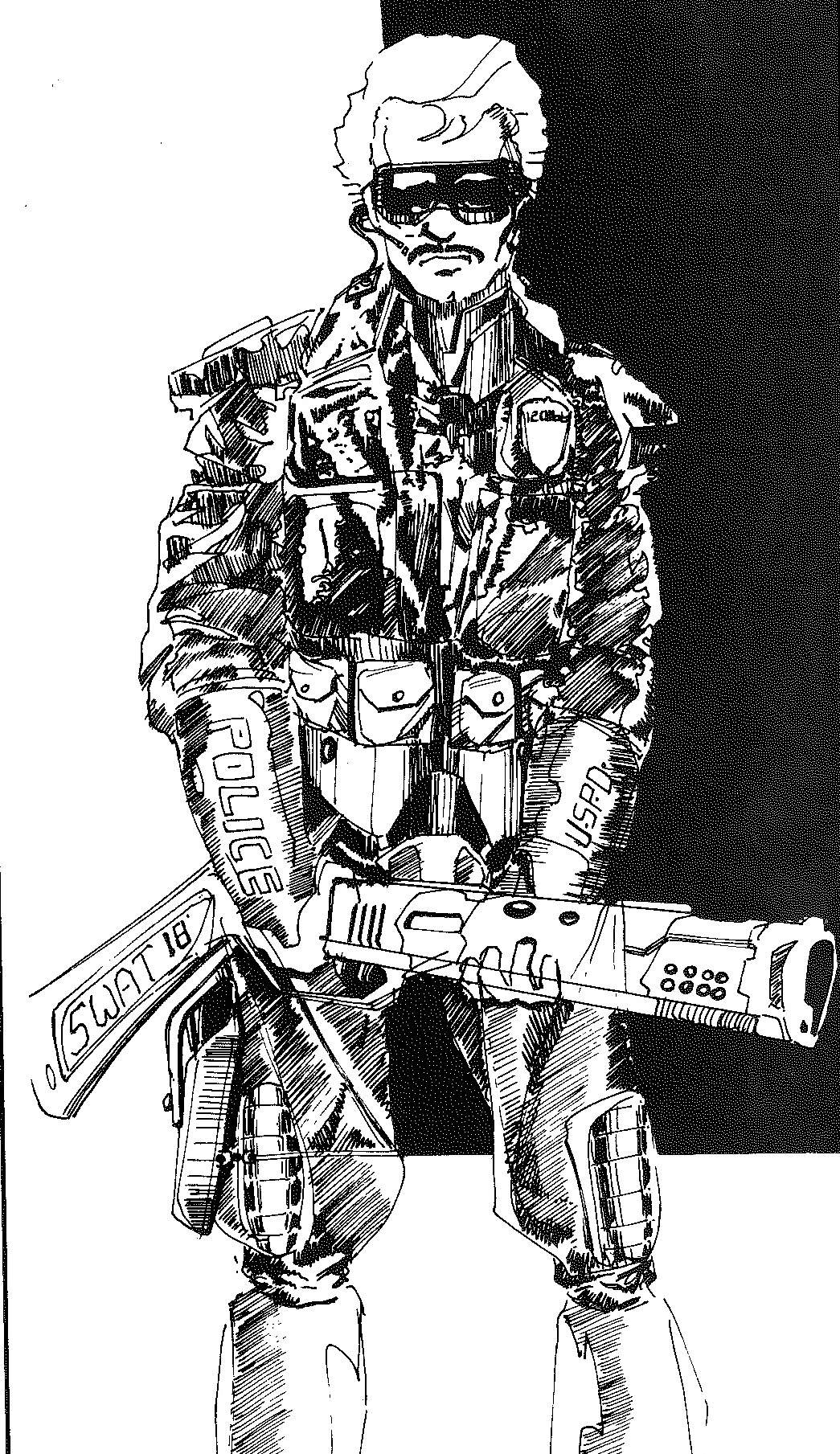
**the pic accompanying this post comes from the CyberPunk 2020 RPG soucebook, from the chapter on equipment. It comes with a caption of “Your Outfit – your worldly possessions stuffed in a 2×4 carry bag.” It was my pre-teen self’s first exposure to the concept of a life unencumbered by stuff.