Aug 112016
 

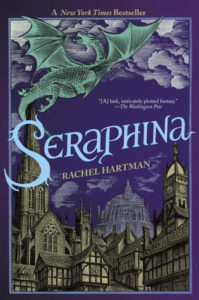
Seraphina, by Rachel Hartman16085483

Synopsis: A half-dragon teenage living secretly as a human in a country that despises dragons must foil a plot to plunge the two races into renewed warfare.

Book Review: I have a well-known prejudice against YA, so I was initially extremely surprised when I showed up for book club and everyone referred to this as a YA novel. Because I loved it. After thinking on it for about five seconds I realized that yes, this is totally YA. But it is awesome!

The heart of this book is its characters. They pop in bold colors, and feel like real people. Interesting, expressive, often admirable, and always real. I fell in love with all of them.

Particularly interesting to people like me are the dragons, who are basically extremely-thoughtful, Aspergers-ish, geeks. They love math and applied game theory, and have trouble understanding emotions, and give off a bit of a Spock vibe. Seeing a society of such creatures, and the way they are hated by humans, warms my heart. Even moreso when Seraphina (the titular protagonist) starts to discover her own dragon-like tendencies. When she first enters a pub for dragonkind and finds other humans like her, who love to talk about math and are terrible at flirting and other social things, she finally feels like she’s found a home. She’s finding her geek family!! It’s YA for people like us! Sadly, this doesn’t get as much attention as maybe it should. The story focuses more on the Prince and Princess of the kingdom (well, queendom technically), who are very much the Popular Kid crowd. Yet I still related very strongly with the geekiness of Seraphina, and it was kinda gratifying seeing her find acceptance among the cool crowd too.

(Seriously tho, one of the dragons is investigating love, which has been striking some of his comrades, so that he can better understand and combat this malady that has been infesting some of their brightest minds! And he’s willing to face lobotomy as a consequence, to help his people overcome this scourge. How can you not love that?)

It has some fantastic humor based off of this geeky stuff too. When one particular musical instrument is played FAR too loudly near her, Seraphina says “my appreciation increased with the square of the distance separating us”. :D

I also love that much of the conflict is informed by her constant need to lie to everyone about herself. The world of lies she wraps herself in feels very close to home for me. I never feel like I’m being honest with the world, everything is a dance performed so I am not shunned, and Seraphina has the same problem. Her fear of being found out comes with far worse consequences than mine, and that made the story all the more compelling.

Finally, while it ends in a traditional “love triangle” situation, the reader ends up loving all three of the people within it, and more importantly – all three of those people care deeply for each other, and are very close friends! I strongly suspect that this is setting up for a polyamorous triad situation, which would just be the best coup ever for a NYT Best-selling YA series! Yes!! Make it so!

The one downside of this book is that the ending goes on forever. The denouement is 2-3 times longer than a good denouement should be. The final three chapters should NOT have been in this book – they should have been the first three chapters of the sequel. Or just hinted at. It felt very much like the sequel was started at the end of this book, and that’s just clumsy. Yes, we know there are lots of complications that arise due to the events in this book, and much will still happen in this world. We understand not ever thread can be tied up when there’s so much left to do. Don’t go starting the NEXT story within this book! Just finish up the one you have, and start the next story at the beginning of the next novel.

Still, that’s a small drawback to a delightful novel. Recommended!

Book Club Review: In general, I think YA has less to say that can really get adults talking. That was borne out again. While we did talk quite a bit about the things we liked, there wasn’t any deeper conversation that was sparked. Nevertheless, just seeing a YA book that is aimed directly at the growing-up-geeky demographic was so refreshing that I have a hard time saying one shouldn’t read this. I’m glad I read it, and so was everyone else at the book club, it got very high ratings from all. If you’re willing to have a meeting that’s less about theme and more just chatting about a fun book with lots of heart, this is a good one. Recommended in that case, but otherwise the most warm-feeling Not Recommended I can give.

Aug 082016
 

13895232_1363555407006280_7036367322075833613_n15 Stats That Show Americans Are Drowning in ‘Stuff’ “Over the course of our lifetime, we will spend a total of 3,680 hours or 153 days searching for misplaced items”
!! Based on survey results finding average of 10 min a day looking for misplaced items. Seems unreasonably high to me, likely people are overestimating how long they spend looking for stuff on a daily basis, cuz it’s so frustrating it seems like a long time. I can’t imagine anyone would blow 10 min a day looking for things for more than a week or two before altering their lifestyle to fix that!
Still, this article confirms my personal prejudices, so I choose to share it!

Donald Trump quotes make a lot more sense when you imagine Zapp Brannigan saying them…

Two more things about The Great Wall:

First, MovieBob puts into words pretty much all my thoughts. As ususal, he is a voice of sanity. :)

Second, a few days later the Chinese director of this Chinese movie said it’s not racist. I dunno tho, that’s exactly what you’d *expect* a racist to say.

Y’all saw that Trump asked, three times in one hour, why we don’t just use nukes, since we have them, right?

UNNECESSARIAT:
“In 2011, economist Guy Standing coined the term “precariat” to refer to workers whose jobs were insecure, underpaid, and mobile, who had to engage in substantial “work for labor” to remain employed, whose survival could, at any time, be compromised by employers (who, for instance held their visas) and who therefore could do nothing to improve their lot.
… from where I live, the world has drifted away. We aren’t precarious, we’re unnecessary. The money has gone to the top. The wages have gone to the top. The recovery has gone to the top. And what’s worst of all, everybody who matters seems basically pretty okay with that.
…The bottom line, repeated just below the surface of every speech, is this: those people are in the way, and its all their fault. The world of self-driving cars and global outsourcing doesn’t want or need them. Someday it won’t want you either. They can either self-rescue with unicorns and rainbows or they can sell us their land and wait for death in an apartment somewhere. You’ll get there too.”

What This Feminist Sees in Harley Quinn
“I’ll come out and say it, she is my favorite female comic book character. Not because I admire her, but because I understand her.
She’s every negative female stereotype you can think of and then some. But there’s more to good storytelling than characters who are good role models.
She wants to live for fun and mischief and sex without responsibilities. She wants to screw a charismatic badboy (literally) without getting screwed by him (figuratively), and she refuses to accept that life doesn’t work that way.
No one’s halfheartedly dressing up the things she does for Joker as some kind of progressive, liberated forwardness like Catwoman’s ill-advised flirtations. She’s a comic book version of someone we’ve all met, of self-destructive feelings we’re all capable of. Her weaknesses and lunacy aren’t implanted in her to make her conveniently rescueable and compliant with a nonsensical plot. They’re lifelike. Human.
And that is what is missing from the majority of women in today’s fiction, far more than strength, intelligence, and independence:
Honesty. Thought. Depth.
That is how we will know when we’ve achieved equality in fiction. Not only by the number of female characters or even by what they do but by why they do it.”

Western civilization is taking over the globe. … Given a choice, young people choose Western consumerism, gender norms, and entertainment. Anti-Western governments from Beijing to Tehran know this this to be true: Without draconian censorship and social regulation, “Westoxification” will win.
A big part of the West’s strength, I hasten to add, is its openness to awesomeness. When it encounters competing cultures, it gleefully identifies competitors’ best traits – then adopts them as its own. By the time Western culture commands the globe, it will have appropriated the best features of Asian and Islamic culture. Even its nominal detractors will be Westernized in all but name. Picture how contemporary Christian fundamentalists’ consumerism and gender roles would have horrified Luther or Calvin. Western civ is a good winner. It doesn’t demand total surrender. It doesn’t make fans of competing cultures formally recant their errors. It just tempts them in a hundred different ways until they tacitly convert.

Scott Alexander rebuts withboth Chinese people and traditional Americans assimilating into universal culture in order to share a common ground – with this being invisible to people who are already assimilated into universal culture, to whom it just looks “normal”. […] the incorrect model of “foreign cultures being Westernized” casts Western culture as the aggressor, whereas the model of “every culture is being universalized” finds Western culture to be as much a victim as anywhere else.

My friends are quite talented. :) “Pokemon Go Yellow”: A Coldplay Parody by JessoLaurus Rex

Photographer Visits Famous Landmarks, Faces The Wrong Direction. Great pics!

Huh. The Green Party supports Homeopathy as an official plank of their platform(!). And they have a sizable enough anti-vax wing that Jill Stein felt she had to pander to them with circuitous hemming about the “medical-industrial establishment” when asked about vaccines, even though she has a doctorate from Harvard Medical!

“like Friedrich Nietzsche said: “He who fights with monsters should look to it that he himself does not start trying to capture monsters.” (Or something like that.)” – AV. Club

Oof. Right in the gut. :( I Am A Transwoman. I Am In The Closet. I Am Not Coming Out.
“I am a girl who has been through a lot of shit and who has grown into symbiosis with her boy suit. But what else I know is that my point is my fucking point. Do I even want to convince someone who will only listen to me when they find out I’m a girl?
Do I have to out myself to be treated like a person worth listening to? To stop my cis classmates laughing at someone who’s reckoned with the boundaries and the dimensions of masculinity and femininity in ways they never had to? Do I need their permission to speak?

I hate that the only effective response I can give to “boys are shit” is “well I’m not a boy.” I feel like I am selling out the boy in baseball pajamas that sat with me on the bed while I tried to figure out which one I was supposed to be, and the boys who I have met and loved from inside my boy suit—who believed they were talking to a boy. I feel like I am burning the history of the naked body that sits on the floor of my shower. ”

My basic problem with Trolley Problems. Sacred Values Are How Ethical Injunctions Feel From The Inside
“A perfectly rational being, of course, would have no need for ethical injunctions. But we’re monkeys with pretensions. We’re self-interested and prone to rationalization. If we say “it’s okay to torture people in very extreme cases that are never going to happen”, then you can talk yourself into thinking that this is a very extreme case, even though the actual reason you want to torture the guy is that he’s a horrible person and you want to see him suffer, and next thing you know you’re the U S Government.”

We built voice modulation to mask gender in technical interviews. Here’s what happened. (quoting FoF) – I hate clickbaity titles, but in this case the fact that the title describes an experiment but not its result is an opportunity to try predicting the outcome before reading about it.
also, fun lines from article: “programming is like sex — one mistake and you have to support it for the rest of your life.”
“you might want to do what any reasonable person would do in the face of an existential or moral quandary, i.e. fit the data to a curve.”

Fight the power! Chatbot lawyer overturns 160,000 parking tickets in London and New York

Holy crap, this deleted scene in ZooTopia would have been *amazing*!!

“the Hall of Presidents … as a representation of how America understands itself and its history, is absolutely correct. … the national mythos rests in the hands of a publicly traded corporation.
[…] We live in the capitalpunk AU.”
(also: “They say American copyright terms keep getting extended under pressure from Disney who wants to keep hold of all their founding properties, I almost wonder if it wouldn’t be less of a corruption of the civic system to just carve out special protections for Disney in recognition of their distinct role in America.”)

Powerful stuff.
“9. When I turned twenty-one, I could go to the clubs. Get dressed up, wear a coat to hide the outfit, pile into a car with friends, roll down the windows in the summer, sure, blare the music, sing along, roll the windows up when a car or truck pulled up alongside and shouted threats, hope they don’t follow, drive to the club, look around before parking to make sure no-one is staking out the street or parking lot, hide anything valuable in the car, lock it, walk to the club. Wait in the line to get in, all laughter and flirting and nervous grins and nervous shuffling and happy nervous everything, be grateful for the door-minder who was watching the sidewalk, pay, walk in.
Walk in.
Walk, strut, ease on in, breathe, breathe deep and happy and smell the smoke and beer and sweat and none of that matters because here, here no-one waits to catch you in the act of being gay.
Put vigilance down.
Put vigilance down, and dance.
[…]
14. The shooter went to a place of refuge, of joy, of celebration. He went to a place where queers go when we are told we are too queer to be seen anywhere else. He went to the place where all the shoving and flaunting of queer would have been hidden away from him.
[…]
I cannot stop anyone from murdering anyone else. I don’t have that power. But I am … done. I am done with letting the jokes and remarks slide by. I cannot continue to passively agree that I am a punchline, a threat, a bogeyman, a cautionary tale. I just, … I am done.
I can’t stop the Orlando murders, or any other murders of queers.
But I am done being complicit.”
(and yes, I dislike the use of the term “microaggression” here, but whatevs, it’s just a word and this essay is awesome)

Spoilery: The Quicksilver scene from X-men:Apocalypse. It is awesome! And only available on Facebook, for some reason?

On Taste. “it is a good idea not to develop taste in anything where developing taste will cost you more money. For instance, I would strongly advise against developing taste in chocolate. […] You should absolutely not develop taste about anything that is necessary for your life.”

I half suspect this is the most epic trolling of all time. “In line with our expectations, P [for “Psychoticism”] (positively related to tough-mindedness and authoritarianism) is associated with social conservatism and conservative military attitudes.”
You know where this is going, right? Spoilers below, I’d read the article if I were you cuz it’s short and sweet, but if you’d rather just get to the monkey:
“The authors regret that there is an error in the published version […]The interpretation of the coding of the political attitude items in the descriptive and preliminary analyses portion of the manuscript was exactly reversed.”

13327557_10153569326205965_2804770090938365614_n

Fandom is Broken. “Back in high school I had a great religion teacher. He used to have us bring in quotes from pop culture that could be applied to religion because he wanted us to understand how pervasive religion was to people a thousand years ago, as pervasive as music or movies are to us today. He believed that the future would see people no longer killing each other over interpretations of God but over bands…
I think he was on the right track when it comes to the way pop culture has replaced other things that used to give us meaning, but I don’t think he could have ever guessed it would be comic book characters and Ghostbusters that would motivate the 21st century’s holy popcult warriors.”

Aug 042016
 

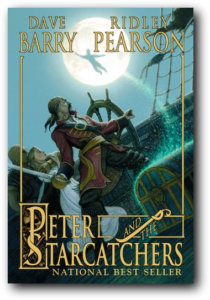
cover_peter-and-the-starcatchersPeter and the Starcatchers, by Dave Barry and Ridley Pearson

Synopsis: A Peter Pan origin story.

Book Review: This is straight-up very good fanfic. I guess not technically fanfic, since fanfic is fiction that you can’t legally sell, and Peter Pan is in the public domain now. But any reader of fanfic will recognize this in a heartbeat!

It’s a good story. It’s fun, it updates the story for modern audiences (ie: makes Peter Pan relatable, and removes the racism), and it creates a cool magic system that gives a neat alternate explanation for all the stuff we saw in the Disney animated movie. It’s full of witty humor and action. In fact, the entire second half of the book is basically one long, running, climax.

It’s also a very good portrayal of a newly-teenaged boy, if my memory of being 12-13 can be believed. I normally dislike YA, but this was well done. My only real complaint was that the introduction of Tinkerbell felt tacked on, like the authors didn’t want anything to do with her, but felt obligated to have her in there. She should have been left out if she wasn’t going to do anything (she literally just appeared for the span of a few paragraphs to be included in the origin story), and maybe introduced in some future novel where she’d have some reason to exist.

This book was a very quick, light read. That being said, it was a light read because there wasn’t anything of substance here. I had fun reading it, and I’ll probably never think of it again. Very good as a palette cleanser, or if you want to take a break after slogging through something overly-long and tiresome. But nothing to write home about. Not Recommended.

Book Club Review: As mentioned above, this is very light. Normally I wouldn’t care for this sort of thing, but it really had impeccable timing for us, having come on the heels of SevenEves. We all needed a break, and this story was delightful and refreshing. It was nice to enjoy a simple thing together, and have a chat. I wouldn’t want to do this sort of thing often, but it’s good to do now and then. So, overall, Not Recommended, but consider Keeping It In Reserve for when your book club needs something like this to recharge. :)

Aug 012016
 

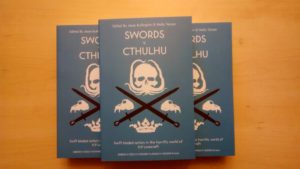
IMG_20160731_152605860I have been published again, this time in an anthology! My story “Of All Possible Worlds” appears in the Swords v Cthulhu anthology which is available now. You can get it from Amazon, or the publishers website (which has it in electronic version as well as paperback), and likely many other book sellers. I am very proud of this story, so I will talk about it a bit below. But first – what other people have said (both about the anthology, and about my contribution)


Aksel Dadswell said: “One of the best Lovecraftian anthologies out there, and one of the best anthologies this year in general” & “The truth is, there are a lot of Lovecraft-inspired anthologies oozing out of the woodwork every year, and it’s just a matter of statistics that not all of them are going to be as original or scary or fun as they could be. Some of them, though, exceed all expectations, and Swords v Cthulhu is one of them.”

He does mention my story specifically at one point, noting “Just as the protagonist walks through the world as if in a dream, so the story feels like a waking haze. Dreams ooze into reality and back again with sickening ease. At one point the narrator proclaims that “every nerve had been frayed down to its raw, bleeding quick,” and I certainly felt that way, vicariously experiencing the horror myself. There’s a pleasing kind of bloody circularity to the story that gives it that little bit of extra weight, too.”


Teodor Reljic reviewed every single story in the anthology here!  I think that means he liked it. In the review of “Of All Possible Worlds” he says “A story with grit and teeth, told by a surrealist street performer who would just as soon slit your throat for all your cash rather than simply accepting your busking tips.” :) I take that as praise! To dispel any doubt he mentioned on twitter “Loved this Ancient Roman mindfuck”, so there’s that.


This is the teaser from my story that the editors posted on Facebook:

“Darkness flickered at the edge of my vision. A shadow swooped through the air, movement where there should be none. I strained to look at it but there was nothing to focus on. An inexplicable presence descended to the savage’s side, and as it touched the sand, it finally resolved into a discrete thing with surfaces and heft.

Its body was that of an ox-sized crow, but bare of any feathers. Black skin stuck tightly to jutting bones. A jagged beak took up the entire face, its upper mandible curving down from the top of the skull. The wings consisted of long arms webbed to the body in the manner of bats. Cricket-like legs folded beneath it.

The Colosseum grew still. Even the gladiators gaped at this intruder. With a shout of glee, the barbarian wizard hopped on the monster’s back, throwing his arms around its neck. It leapt upward with a beating of its wings, a deafening squawk piercing the sky.”


Alright, so about writing the story itself. I’ll make this brief and spoiler-free.

The primary plot driver is my fear and loathing of dreams. Not just nightmares—all dreams. Every dream is an epistemic nightmare to me, because they implant events into my memories that NEVER ACTUALLY HAPPENED. This is extremely disturbing to me. My memories are me. They are the most personal record I have of what I am, and I’m already well aware that they are a shitty, corruptible record. I’ve always had a poor episodic memory. I can’t recall names well. I often embarrass myself in conversation by re-asking things that people have already told me which were fairly important events to them. I’m pretty sure I will lose everything I am via Alzheimer’s some day. So the absolute last thing I want is to start generating random, non-real events on the fly and sneakily implanting them into my self-archive. You know that fear transhumanists have of an outside entity hacking into your brain and rewriting your memories to alter you? It was nicely portrayed in the opening scenes of Ghost In The Shell, to use a well-known example. I have that, all the time, and the outside entity is my own fucking brain!

Sometimes the dreams are so unrealistic I’m able to brush them off as obvious forgeries (one of them is retold almost exactly as it happened within the story). But many are realistic, and I only discover them out of luck. I don’t know how many of my memories are like this. I assume/hope only a very small percentage. But that fear is always there. How much of my life is a lie?

I tried to demonstrate that fear in the story, and maybe make the reader feel a little bit of it as well.

Influencing this fear is also the common transhumanist “What if this is all a simulation?” fear,  which I consider very related. “Wake up, Neo.”

Finally, if this is all a simulation, why is it such an awful one? Why is violence the final arbiter of all things? God could have made a world where humans were physically unable to harm each other, and he didn’t. That was just one more thing in a long litany of things that led me to doubt the God hypothesis in the first place. But if there was a God… the fact that the world is as it is says a lot about Him/Her/It.


My copies just arrived, so I haven’t read any of the other stories within yet, but a lot of them sound awesome, and I plan to over the next month or two! That being said, I’m kinda side-eyeing our publisher. The book seems to have had two different release dates (July 12 for Amazon, Aug 1 for all other wholesalers? Was that intentional?), and there still aren’t electronic versions available at Amazon or B&N. /shrug. Hopefully an oversight that will be resolved soon.

Jul 282016
 

It’s time for another round of Liberal America’s favorite game:

Is It Racist?

I just learned of The Great Wall. It’s a Chinese movie, with a Chinese director, a largely Chinese cast, set in ancient China. It’s the most expensive Chinese movie of all time (to date). But the script was written by American screen writers, and perhaps most important – this movie about the building of the Great Wall of China stars Matt Damon. (all info taken from the linked article)

I’m sure y’all remember the Scarlet-Johanson-as-Major-Kusanagi kerfuffle. It was interesting that as much as this was a big deal in the US, people in Japan didn’t understand why it was controversial. Now we have a Chinese movie, casting a white guy in its lead role.

If this was an American movie, with an American director, etc, there would be outcry about this whitewashing/appropriation. Perhaps with good reason? Regardless, I’m pretty sure we won’t be hearing anything like that regarding The Great Wall, since it’s a Chinese movie, and it’s not acceptable to call a non-white group Racist for making a movie the way they want to make it instead of the way we would like it to be made. The closest I’ve seen so far is the weak-sauce admission that it’s “an unfortunate look” at io9.

I plan on asking people “Is It Racist?” about The Great Wall a lot. Maybe it can move the conversation on cultural exchange/appropriation onto more sane grounds.

For what it’s worth, whenever I get questions like this, I always try to identify who is harmed. I’m not sure I know enough about the situation yet to have strong opinions on that.

EDIT: Well, I was crazy wrong about that, it only took a few hours for the calling-out to begin. Perhaps I should have expected that, based on having seen black rappers called racist when creating ganster-rap. I’m updating in the direction of “it’s become OK to call anyone racist.”

Jul 272016
 

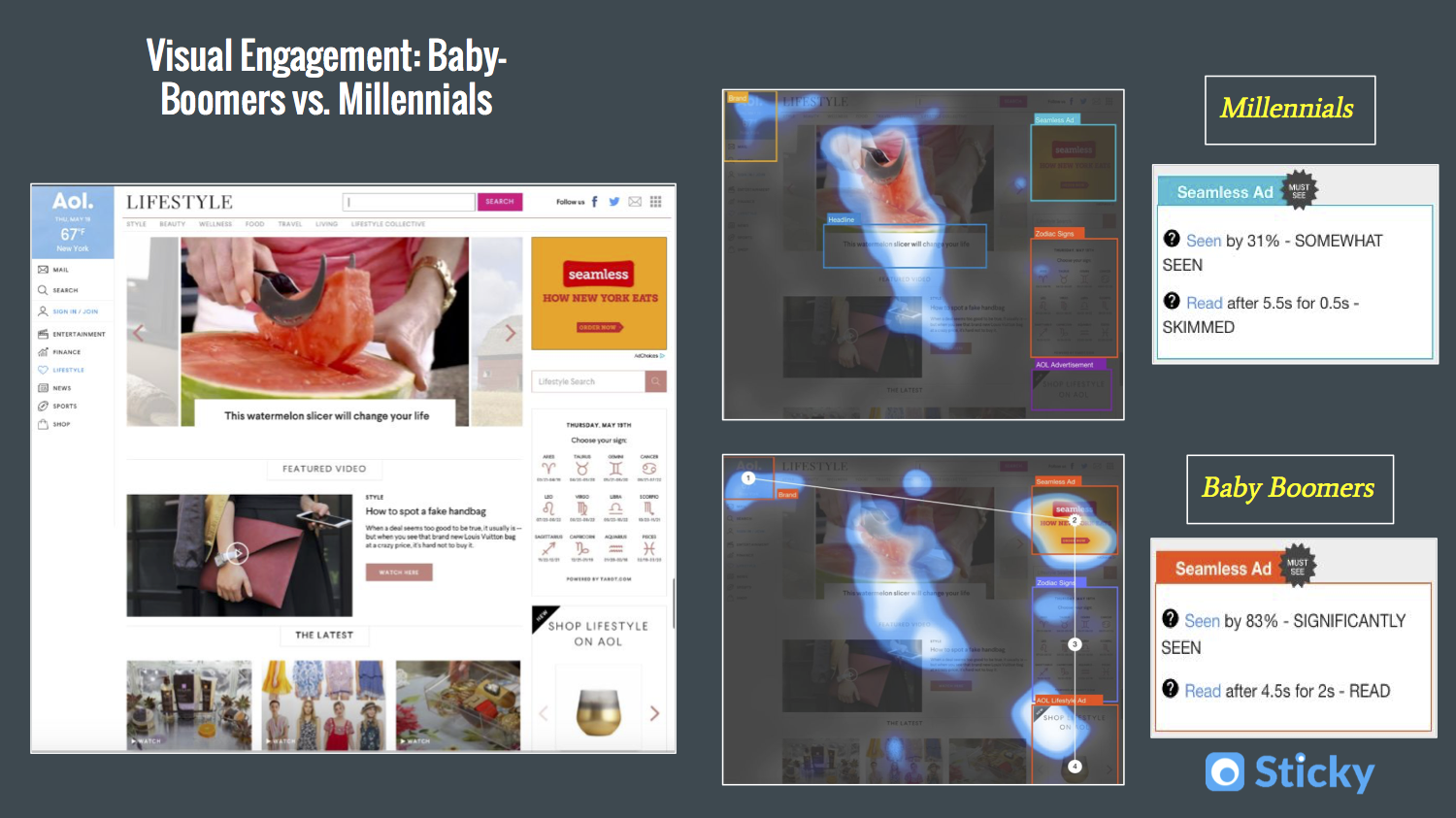
This graphic is both interesting and saddening. Take a look at the webpage on the left side first, then look over to the right for breakdown.

page viewing

It’s interesting that Baby Boomers (or at least those in the study) have not yet adapted their internet-looking behavior to disregard common places for ads. This brings up the question of whether this is because it becomes harder to adapt as one ages (which would be sad and scary), or because older people simply don’t spend as much time reading online, and therefore haven’t had enough stimuli to form the avoidance behavior yet.

It’s sad because it points out another cost of advertising that I hadn’t consciously thought of before – reduced screen real-estate. Despite my screens continuing to get larger over time, the screen-space keep feeling smaller! This is likely one reason why – I never look to the side-bars anymore.

Which can be really annoying sometimes. On more than one occasion on reddit I was told the answer to my question was “in the sidebar”. And I was like “WTF? What sidebar? I looked all over the… ooooooohhh… right, THAT thing!” The sidebar had disappeared from my attention so thoroughly that I forgot it was a place I could look to if I was looking for information on-screen.

This is a damned tragedy. If I could pay $10-$15/month to a micro-transaction service that split that among all the websites I visited, and get that screen real-estate back, I’d gladly do so. Unfortunately the only way to make that work is if everyone else online also does so, and that’s a coordination problem we can’t tackle (yet?). /sigh. You win this round, Moloch!

Jul 262016
 

gb-logoI haven’t seen the new Ghostbusters yet (I do plan to), but I already know I’ll like it more than the original. Because I hate the original Ghostbusters.
Which is a damn shame. It’s an awesome concept. It is the triumph of science over religion. Our tech is better than your magic, and by the power of knowledge we will make this world safe for us. And any man can pick up a proton pack and fight the mystical, so it’s also the victory of the common man over the chosen elite – gods and priests. Great stuff!

And they ruin it all right away by focusing on Peter Venkman. The reason I hate Ghostbusters is because I hate Peter Venkman. Right in the opening scene he is shown to be a fraud. He’s supposedly a scientist, and he presents himself as such, but he doesn’t give a damn about the quest for knowledge. He fucks up his own experiment to hit on a girl. He’s on the leading edge of paranormal research – an untapped frontier that will radically change everything we thought we knew was true!! And yet when his male subject displays possible psychic powers (correctly getting “wavy lines” after a series of motivating electric shocks) he completely ignores this. He keeps telling the female subject she’s correct (she’s not), which not only means he’s canceled his experiment on a whim, but which will also likely bring disrepute on his field of research when the lady will inevitably go out and claim she’s been scientifically proven to have psychic powers when that’s clearly not the case!

I have a very deep respect for the scientific process, and the power it’s given us. And I have an emotional attachment to the Quest For Truth. I tend to view science with downright reverence. To see a supposed scientist crap all over science like this pisses me off to no end. I feel an actual religious-style outrage. It’s like I’m a religious person seeing a priest in a movie intentionally desecrating the rituals of my faith. Fuck Venkman!

The hero of the movie should have been Egon. He is the true scientist – he does the research, he created the proton packs. He is the interesting character. (He was also my favorite character in the cartoon.) Instead we spend the entire movie focused on a creepy, quasi-sexist asshole. And we’re supposed to like him??

I actually hate Bill Murray in everything he does. Maybe as a person he’s great, but as an actor he always plays this exact same character. The asshole who doesn’t care about anything. Generally, if I see a movie has Murray in it, I know I won’t like it, and I don’t bother to see it. The only exception is Groundhog Day, both because it’s one of the best scripts ever written, and because in that movie Murray’s character gets his comeuppance for all his assholery, and after hundreds of years finally manages to be beaten into a likeable person! It is nice to see redemption stories sometimes.

In summary – science good, Murray bad.

Jul 212016
 

300x300xhugo-awards.jpg.pagespeed.ic.AsqaLzncTzMost years we read all the Hugo-nominated short stories and novelettes in our book club, as generally all (or nearly all) of them are available free online. This year, that is not the case. :( (yes, I blame Vox Day). So we were unable to read them as a group. However I still read them myself for voting reasons, and my impressions are below.
This is the last of the Hugo works I’ll be reviewing. If you have a Hugo membership and you haven’t voted yet, you should do so very soon, there’s less than two weeks left! And they warn that their serves often get hammered on the last day.


Best Novelette

And You Shall Know Her by the Trail of Dead” by Brooke Bolander (Lightspeed, Feb 2015)

I don’t really understand the love for this piece. It’s cyberpunk, and I grew up in cyberpunk. It is my home genre, I love everything about it. But “You Shall Know Her” doesn’t do anything new. This story has been covered a dozen times, from Ghost In The Shell to the starter adventure given in the CyberPunk 2020 Rulebook!

Nor does it fit quite right. It feels a little off, like someone trying to emulate a style that doesn’t come naturally to them, and they can’t exactly pull it off. It goes over the top in an attempt to imitate a form, and ends up feeling like a good B-movie. Those can be tons of fun, but they aren’t really award winning.


“Flashpoint: Titan” by CHEAH Kai Wai (There Will Be War Volume X, Castalia House)

This is a perfect example of “making the action scenes boring”, and it’s nothing but actions scenes. We see a bunch of stuff blowing up, but we don’t care who wins, because we were never given a reason to. There aren’t any characters or stakes we care about. And even the fights are yawn-inducing, because it’s a bunch of technobabble that doesn’t mean anything without a world built up around it to give it context.


Folding Beijing” by Hao Jingfang, trans. Ken Liu (Uncanny Magazine, Jan-Feb 2015)

In this story, the Chinese government found a way to double (or triple?) the population density of Beijing by folding it up. This lets a lot more people live there, but in exchange they have to sleep a lot more. Instead of losing 1/3rd of your life to sleep, you have to lose (depending on how rich you are) either 1/2, 2/3rds, or 5/6ths. However this is apparently still a good deal, because millions of people jump at the chance, and compete for the opportunity.

This story also got a lot of positive attention, and I’m even MORE confused as to why. It’s an interesting premise, but it certainly isn’t ground-breaking. It’s message is dirt-simple: being poor sucks. Um, ok. Can you say something more about that? Or just make us feel it?

Because, worst of all, this story is poorly written. I’m just gonna come right out and say it. I don’t care if it’s a translation issue or a cultural variance or something. By every standard that I apply to prose, this is just plain bad writing. It is flat and emotionless. It tells rather than shows. It paints in broad, flat sweeps, rather than poignant details. The sentence structure is clunky. The POV jumps around at random, sometimes even within paragraphs. Even if this was an AMAZING new concept with message that made you go “Ohhhhhh… shit!!!” those would still be extreme sins. They’d have to be truly fantastic to make up for prose this crappy. But it doesn’t have any of those. It’s just plain “meh” in all respects, and crappy in writing. Heck, this is on the same level as last year’s “On A Spiritual Plain”. I have no idea how this made it on any award lists.


“Obits” by Stephen King (The Bazaar of Bad Dreams, Scribner)

Steven King takes the premise of Death Note, but doesn’t do anything with it. I suspect this is one of those nominations given out because when the author published his truly fantastic genre-defining work(s), he was somehow overlooked, and this is to make up for that. Fair enough, I guess? I see those sorts of nominations every now and then. Still, it feels like a disservice to whoever should have been in this slot instead.

It did get me to wondering how old this idea is. Obviously Death Note is the work that took the idea to its fullest/best exploration. But the concept of “being able to anonymously kill anyone in the world, instantly and unstoppably, without being a trace” has got to go a looooong way back, right? I bet there’s ancient myths using this idea.


“What Price Humanity?” by David VanDyke (There Will Be War Volume X, Castalia House)

This one was actually pretty decent! It has the same basic premise as Vinge’s “The Cookie Monster,” but applied to a military setting.

As far as re-using mindwiped soldiers goes, this was done better in “The Immaculate Conception of Private Ritter,” but that’s a high bar to clear, not everyone can be Seth Dickinson. It did pretty well for itself.

All in all, I enjoyed myself. It did seem to try to force some angst in the end in a way that was completely unwarranted (“Isn’t it terrible that these people get to relive the most awesome two weeks of their lives endlessly, all just so they can save the human race?”). But, eh, I can let that slide.


In the end, I don’t think a single one of the Novelettes is actually award-worthy. VanDyke came closest, and I can see him making the grade fairly some day! :)


Best Short Story 

“Asymmetrical Warfare” by S. R. Algernon (Nature, Mar 2015)

Cute, and fun! Not award-material, but it’s clever. :)


Cat Pictures Please” by Naomi Kritzer (Clarkesworld, January 2015)

Also cute, and also fun! This story has some neat ideas, and explores them in a fun way! I don’t really know comedy, so I don’t know if it’s good. But the writing is well done, and it’s certainly the best of this year’s lot. In a normal year this would probably be near the bottom of my list, and I am saddened that I can’t see the stories it would have legitimately competed against. That being said, at least there’s something worth voting for in Short Story this year!


“If You Were an Award, My Love” by Juan Tabo and S. Harris (voxday.blogspot.com, Jun 2015)

This is not a short story, it’s a shit someone took on the internet, which Vox has splattered on the Hugo list to show his disdain. Disdain of the same award he’s trying so hard to win. Oh Vox.


“Seven Kill Tiger” by Charles Shao (There Will Be War Volume X, Castalia House)

Hm. There’s… not really much story here? It’s basically “all humans are horrible, awful people, and we’d be better without them.” It’s literally just barbarity upon genocide upon cowardice. This is the sort of gloomfic that normally stays in high school notebooks. I really like grimdark, but this wasn’t even grimdark. It would do very nicely as the prologue of a post-apocalyptic novel, but it doesn’t work as a story in itself. The only good part is when it quotes a 400 year old poem, and you’re really better off just reading that poem instead.


Space Raptor Butt Invasion by Chuck Tingle (Amazon Digital Services)

I loved it. See my previous comments here. :)


Don’t forget to vote!

Jul 142016
 

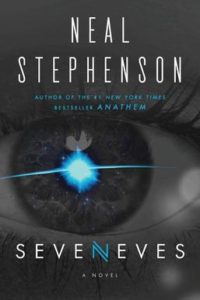
Seveneves_Book_CoverSevenEves, by Neal Stephenson

Synopsis: Present-day humanity has two years to evacuate as many people as possible before the Earth is destroyed.

Book Review: This isn’t really a story, insomuch as it is the fragmented pieces of a story buried within mounds of engineering. You will hear more about how chains and whips work in zero-gravity than you ever cared to. Unless you are of a very specific audience, you will skip over dozens of pages multiple times searching for some interesting event. Reading this book is like doing archeology – you have to spend a lot of time clearing away dirt and debris to get to the valuable stuff.

The frustrating part is, most of the good stuff really is good! When Stephenson bothers with plot or dialog, the story is interesting. But it’s so fragmented that you can’t even pull an entire story out of it. The archeology metaphor applies further in that it seems a lot of the valuable stuff has been lost over time, and you can guess at the pieces that are missing, but unfortunately they just aren’t there.

The only reason I got to the end of this book is because Stephenson has written really amazing things in the past, and he had a lot of my goodwill to ride on. This determination led me to see things I wouldn’t have if I’d just abandoned the book, which now I kinda wish I hadn’t seen.

Stephenson doesn’t seem to care about portraying other people realistically anymore. The characters that are engineers & scientists feel very similar (can you tell Dinah and Ivy apart? I can’t), and I suspect they have a lot in common with Stephenson himself. Everyone else is a monkey. The contempt for all non-engineers displayed in the book is surprising. Politicians are power-hunger moustache-twirlers happy to damn the human race to extinction if they can rule for a few years. The common people are blind sheep, easily falling for the most asinine and bald-faced lies, which only the engineers are impervious to. The entire book reeks of “You all deserve to be wiped out, because you were too damn stupid to put us engineers in charge!” As a fan of Atlas Shrugged, I recognize this bile. And sure, I’m a bit of an elitist jerk myself. But I at least do my best to understand why intelligent people could reasonably disagree with me, rather than portraying them all as fuckwits deserving of the fate they’ve brought upon themselves with their stupidity.

Also, Stephenson seems to have gotten very, very lazy. He tells us (via a character talking to the protagonist) that what we’re going to see is possibly the saddest thing we have ever seen. He then describes a scene which is, at best, a mild downer. Later on he tries to make us feel moral outrage by having every relatable character react with outrage and horror over an event… but the event itself is no big deal at all. Dude, you can’t just tell us we’re supposed to feel a certain way and call your job done. You must actually make us feel it!

He even gets lazy with technical aspects. At one point it looks like he decided to have a character up on the Space Station whom he previously hadn’t intended to have there. So he inserts the line “[he] had been sent up to Izzy a month before” with a one-line excuse for why, and then continues. Anyone with respect for their art would have taken the time to go back and write a scene in a previous timeframe where this actually happens. Simply deciding “oh, he should be here” and dropping him in with an excuse in the middle of the action is not how one does good writing.

SevenEves honestly just feels like someone trying to cash in on the success of The Martian, but without having any understanding of what made The Martian so amazing. Not Recommended.

2nd Book Review: There is another book included with SevenEves. It’s passed off as part of the novel, so it doesn’t have its own title or anything. SevenEves just continues with “Five Thousand Years Later.” However, it is a new book, with a different feel, new characters, etc. Again I think this is a case of Stephenson being lazy – he didn’t want to establish setting and introduce characters again. Which is unfortunate, because it means we get several hundred pages of text without characters we care about.

In fact, the second book doesn’t even have a plot. I wouldn’t even call it a book. It is a bunch of awesome concepts, that are in desperate want of characters and story to drive them somewhere.

Don’t get me wrong, the concepts really are amazing! I would have loved to read this if it had a storyline. The second book is of FAR more interest to me than the first book, because it’s actual science fiction! It has awesome speculative elements, strange cultural and social constructs, semi-alien characters. In contrast, the first book was basically EarthFic with a lot of techno-fetishism. It was barely SF, IMHO. Sadly, the second book isn’t a novel – it’s a RPG source book. Lots of cool setting ideas and concepts, no story. Again, Not Recommended.

An Aside: Does anyone else think it’s a terrible idea to name the book “SevenEves” and have a huge eye on the cover? It’s almost impossible not to see “SevenEyes” when you look at it.

Book Club Review: If you stick to just the first book, and don’t bother with “Five Thousand Years Later”, it’s actually not bad for a Book Club book. After the first couple technology wanks it becomes pretty easy to flip pages rapidly until things start happening again. The plot (when it’s present) proceeds quickly enough that one can skip over the simmering misanthropy without taking too much note of it. In the final pages of the book it does raise some interesting questions about how we should improve the human race, if it were possible to do so (but sadly, it doesn’t bother trying to address them, it just ends.)

In our meeting, a bit of time was spent discussing Stephenson’s views of humanity, and how radically unrealistic they felt. Speculation of that sort (“what would happen if everyone only had 2 years to live?”) is kinda interesting. But you don’t need to slog through a door-stopper of a book to ask them, and you can find unrealistic portrayals of humans in all sorts of novels.

If your book club isn’t specifically SF-focused, please avoid this. This is the sort of book that I hope people who don’t read SF never pick up. It plays directly to the stereotype of “Science fiction is just technology fetishists drooling over made-up tech, without care for characters, plot, or writing craft.”

If your book club is SF-focused… well… I still think you could do better. Get one of Stephenson’s earlier works, those are very good! Anathem was great (although, again, long). Snow Crash was fun as hell. I’ve heard great things about Cryptonomicon, and it’s on my list. But SevenEves… Not Recommended.

Jul 112016
 

sidewise logohome2007Hey, you know the short story I wrote last year, “Red Legacy”? It’s a finalist for the 2015 Sidewise Award for Alternative History!!!

It’s interesting… I didn’t originally intend for this to be an alternative history story. I was just going for supervillain origin story. But I’d long been enraptured with Lamarckian evolution. It is the perfect evolutionary theory for communism, because it’s so damn optimistic! Darwinian evolution is a horror, as I expound on in the story. You get born with random genes, and then you find out if they’re good enough by being killed by nature (or, if you’re lucky, avoiding that). The selection process is needlessly cruel, and the determination of your worth (fitness of genes) is capricious and beyond your control. It’s a lot like Calvinism. You’re already saved or damned before you’re born, which one is the case is entirely beyond your control, and you have to go through this entire painful BS “life” thing just to find out which one you were fated to. :(

Lamarckian evolution, OTOH, is quasi-fair! If you work hard, you are rewarded. It closes its eyes to the cruel nature of reality, and embraces a comforting fantasy, because that fantasy is the way the world SHOULD work. Which, IMHO, is exactly the same thing communism does. And both failed for the same reason. Reality doesn’t care about what you think is fair.

Anyway, I wrote before about how much I love that Ted Chiang takes apart the world, changes one thing, and then puts it back together to see how it would run with that one thing changed. I don’t think I did quite that, I cannot aspire to Chiang-levels of writing. But I tried. If Lamarckian evolution is true, that’s a big change. It affects a lot more than just my one scientist in her laboratory, it alters how everything on earth works. I can’t get into all of them in a short story, but how does the world look different in ways that are relevant to the plot? If societal structures stayed similar to what we’re familiar with, what effect would that have? If the world looks like how the Soviets of the 50s envisioned it, how could that be explained in Lamarckian terms?

And so you get things like Europe’s aristocratic killer-elite. :)

Anyway, I am thrilled and honored to have been selected as a finalist for this award, and I look forward to meeting my fellow nominees at WorldCon next month!