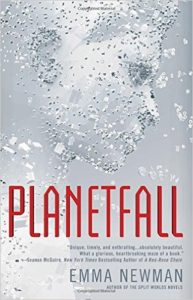
Synopsis: In a post-scarcity utopia, a woman struggles with decades of guilt by running away from everything.
Book Review: The majority of this book is kinda mediocre.
It can be hard to create meaningful conflict in a utopia, because what is there to fight about? This leaves most things feeling very low-stakes. The author also has an immensely irritating way of constantly bringing up this Dark Act in the protagonist’s past, and then pointedly not telling us anything about it. Every few dozen pages it’s “but I couldn’t do anything about it, because of the Dark Act in my past,” which is exactly how to NOT do this sort of thing. You’re supposed to hint about it, and drop clues in the protagonists actions and speech patterns. Chasm City did this thing wonderfully. Planetfall hacks at it clumsily. Plus from page 1 we all want to scream at the book “YES, WE KNOW SHE KILLED A BUNCH OF PEOPLE AND THEN COVERED IT UP FOR THE GOOD OF THE COLONY, GET ON WITH IT ALREADY!”
The book does do some cool things with mental illness, I think. The revelation of the protagonists compulsive hoarding, and how much it rules her life, is interesting. Our book clubs pysch major didn’t like it, said it was a superficial handling, but I found it one of the neat things here. Unfortunately that’s not really enough to hang a whole book on.
The colonists are remarkably incurious for a religious cult living in the literal shadow of their giant god, but I dunno, I’ve seen enough crazy shit in real-life religions to let that go. Their attitude of “eh, whatever” is a good summary of how I felt reading this book. It was easy enough to read and it didn’t hurt or anything, but I wouldn’t write home about it.
Until the end. Oh dear lord.
There are three different climaxes. The only one that is related to the rest of the novel, thematically, is the rest of the colony discovering our protagonist is a hoarder and tearing apart her house in schadenfreude. It fits the story, but it’s not particularly well done. A good handling could make this sort of thing feel like the end of the world. Instead it was just sad. But that climax is quickly abandoned for RANDOM ATTACK BY SAVAGES!
Which is completely unforeshadowned and basically bullshit because it comes out of nowhere. Also, we’re supposed to believe seven savages with knives are able to overwhelm a modern colony of 1,000 space-faring peoples? And where they hell did the savages get explosives? After a quick raid they kill a dozen people and kidnap ten more and flee back into the wilderness, which makes me wonder – what the hell was their end-game? They aren’t worried about the fact that they pissed off 975 people with the ability to print guns and vehicles on demand, with orbital cameras? (Yes, the savages know this, one lived with the colonists for some time!)
But without a doubt the worst, most infuriating thing is the third climax. Protagonist enters god/god’s building and walks through what is basically the worlds easiest puzzle game. It’s laid out exactly like a video game, except the puzzles are aimed at the 5-8 year old demographic. Not ONE other colonist in the past 20 years bothered to sneak into this building to try this?
Our protagonist makes it to the end of the video game, discovers that progenitor aliens seeded the galaxy with humanoid life, and basically kills herself. I mean, technically she transcends physical existence and is now at peace and one with everything, but that’s functionally indistinguishable from suicide. And this is while A. The rest of her colony is being ravaged by savages with knives, and B. there is still a religious taboo against entering god’s building, so this secret will die with her.
In theory I guess anyone else could walk through the puzzle rooms as easily as she did, but that is some serious bullshit. Your people need you, you have the secret of god or whatever, and you’re just gonna say “eh, fuck those losers” and kill yourself? SCREW YOU.
Not Recommended.
Personal Musing: It’s books like this that make me wonder why I bother with reading unknown authors. I feel like I wasted many hours of my life on this, and I look back on Obelisk Gate and think “I should just stick with known quantities. If I already know someone is good, or a book is getting a lot of buzz, I read that, and don’t waste my time on the rest.” It’s seriously disheartening to run into a climax that makes me want to hurl a book across the room.
But then I think… if it wasn’t for picking up random books, I would’ve never read Perdido Street Station. OK, that’s not entirely true, I would’ve heard about how great it is eventually. But it took a bunch of people willing to pick up a random first book by an unknown author to get to that point. And more to the point – I actually never would have read Vellum, as most people don’t like it and I’ve never heard about from anyone but myself. And it’s the best thing I’ve ever read.
So I guess I’m willing to take shots in the dark from time to time, for the possibility of landing a hit like that. At least I get a blog post out of it! :)
Book Club Review: There are a few interesting things to talk about. It seems the author is asserting that creating a post-scarcity utopia on Earth is impossible, due to the legacy issues we have, and our population load. But setting up a new colony on an untouched planet with a thousand people and tech only a few decades further along than our own could be viable utopia. That is both hopeful (we’re so close!) and really depressing (we can only do it if almost everyone else is gone!).
The juxtaposition of the post-scarcity society and the literally hunter-gathering savage society is fascinating and heartbreaking. It really hit home for me when the savage boy asks “Do you live here because that’s where the food is?” Ouch.
That being said, all this was overshadowed by the truly awful ending, and the way nothing really held together. Not Recommended.
Haven’t posted one of these in a while, hope it’s not too overwhelming.
Also, this one will be Trump-heavy, for obvious reasons.
This Is How Your Hyperpartisan Political News Gets Made. You gotta give it to capitalism – it can be pretty damn efficient.
“both sites whipped up a post … The resulting stories read like bizarro-world versions of each other — two articles with nearly identical words and tweets optimized for opposing filter bubbles … These for-the-cause sites that appeal to hardcore partisans are in fact owned by the same Florida company”
“In Japanese, “E” means image and “Moji” means character.” The Oral History Of The Poop Emoji (Or, How Google Brought Poop To America)
I thought that Emoji was etymologically related to “emoticon”. Waddaya know.
Story itself is pretty interesting, includes a lot of cultural history that I found fascinating. And this:
“the most common use is probably “that’s unfortunate, and I would like to punctuate my comment with a reiteration that I am displeased at what has just been expressed.” It’s the anti-like.”
“The year is 1910. Adolf Hitler, a struggling artist, has fought off dozens of assasination attemps by well meaning time travelers, but this one is different. This traveller doesn’t want to kill Hitler, he wants to teach him to paint. He pulls off his hood to reveal the frizzy afro of Bob Ross.”
The writing prompt itself is good but the true value of this link is that it introduced me to the ol’ Reddit switcheroo, a few comments down. AWESOME.
WHY PURITY CULTURE DOESN’T TEACH CONSENT. Also some talk about the implications (which can probably be imagined)
“They don’t teach consent because teaching consent would undermine one of their basic assumptions about people. Namely, the assumption that every single last person– most especially men, but also women– are basically nymphos who are straining at their leashes every single second of every single day and if you let that sex-crazed beast out for even just a moment then BAM it’s all over and you’re not a virgin anymore and that’s horrible because now you’re a half-eaten candybar or a cup full of spit.”
I Helped Create the Milo Trolling Playbook. You Should Stop Playing Right Into It.
“I wrote the book as an explicit warning about how broken our media system was and why it needed to be fixed.
…
Someone like Milo or Mike Cernovich doesn’t care that you hate them—they like it. It’s proof to their followers that they are doing something subversive and meaningful. It gives their followers something to talk about. It imbues the whole movement with a sense of urgency and action—it creates purpose and meaning.
…
the most effective retorts against the alt-right were when Trevor Noah had Tomi Lahren on his show and when Elle Reeve profiled Richard Spencer for Vice. Both came off looking mostly like jokes. Tomi Lahren showed her age. Richard Spencer revealed his movement to be mostly a collection of a few thousand sad dorks.”
NOTES FROM THE ASILOMAR CONFERENCE ON BENEFICIAL AI
A fascinating peek into a conference of people that will (IMO) literally shape the entire future of our species (or lack thereof).
“The technical people at the conference seemed to think this idea of uncertainty about reward was technically possible, but would require a ground-up reimagining of reinforcement learning. If true, it would be a perfect example of what Nick Bostrom et al have been trying to convince people of since forever: there are good ideas to mitigate AI risk, but they have to be studied early so that they can be incorporated into the field early on.”
I NEVER expected someone to munchkin their way into a spot on America’s secret assassination agency by simply slipping the president a piece of paper to sign that he doesn’t read. That is *cartoonish* plotting.
Suddenly it seems like giving the executive branch the ability to kill anyone without trial or oversight or even a record of the decision was a bad idea… I guess screwball comedy + real life = kafkaesque absurd horror.
(fairness note: that may not be what 45 is actually angry about, so this is partly speculation. But I couldn’t resist the image of Road Runner slipping Wile E Coyote an executive order he doesn’t read)
“But for the moment, Mr. Bannon remains the president’s dominant adviser, despite Mr. Trump’s anger that he was not fully briefed on details of the executive order he signed giving his chief strategist a seat on the National Security Council, a greater source of frustration to the president than the fallout from the travel ban.”
From a friend:
“I am the very model of a fair, aspiring rationalist
I’ll analyze my priors and modify, unabashed, a miss.
I know logical fallacies, and though I try my very best
I know I still make errors when the stakes are at their… hairy-est :)
For his scientific knowledge, though he’s curious, and reads a lot
He cannot speak in detail what the specialists have truly wrought
But still in matters logical and liberal-transhumanist
He is the very model of a fair, aspiring rationalist!”
What really worries me is 45’s purging of government bureaucrats and installing loyalists in their place. Especially his doing so in the agency that is literally in charge of secret assassinations.
“Third, popular attention must focus less on whether we agree with what the government is doing, and more on whether the system of checks and balances we have in place is working. It is a much bigger deal that the DHS felt they could ignore a federal court than that Trump signed an EO blocking green card holders in the first place. It is a much bigger deal that Trump removed a permanent military presence from the NSC than that he issued a temporary stay on immigration. The immigration ban may be more viscerally upsetting, but the other moves are potentially far more dangerous.”
(I know, I know, the first mistake was creating an agency of secret assassinations. But that boat has kinda sailed)
I think I have more respect for Uber now. They turned off surge pricing, like they generally do for disasters and emergencies, so they don’t appear to be profiting off disaster. They didn’t impose their politics onto their drivers. And they are financially supporting those drivers affected by 45’s ban. I wish more people would do some research before tweeting & hashtagging… What’s not to like?
“thousands of drivers who use Uber and come from the listed countries, many of whom take long breaks to go back home to see their extended family. These drivers currently outside of the U.S. will not be able to get back into the country for 90 days. That means they will not be able to earn a living and support their families—and of course they will be separated from their loved ones during that time.
We are working out a process to identify these drivers and compensate them pro bono during the next three months to help mitigate some of the financial stress and complications with supporting their families and putting food on the table.”
All those times I railed against the pledge’s desecration, and blacked out “under god” on our money, and I was told “It’s no big deal” and “Stop being a dick, you’re the Angry Atheist stereotype.” … This is why!
“”I feel that if a Muslim woman wants to move into this country, she needs to leave her towel home. Because the reason this country is here and safe today is because of Jesus Christ,” Bill says. “We were one nation under God.” […] A lot of Americans think one of the great things about this nation is that you can worship whatever god you want. Bill shook his head at that notion.
“That is something I believe that has come along with political correctness and all this other garbage,” he said, insisting that America is a fundamentally Christian nation.”
“I’ve done human rights work that had me working in proximity to the U.S. military, so at a professional meeting a Lefty called me a Nazi.
So if you tell me that I’m a Nazi… and tell me you’re in favor of going out and beating up Nazis, guess what? I am suddenly very interested in the physical safety of Nazis.
And I’m *Jewish*”
(post is crazy long, but that’s the most relevant part IMHO)
Oh how I hate the media. Are they TRYING to help Trump? This article leads with DeVos’s Gun vs Bears comment. It’s also the highlight line under the picture when you share on Facebook: “She wouldn’t say guns don’t belong in schools–and cited a school’s need to protect itself from “potential grizzlies.” Bears, that is.”
That just means she’s really shitty at social posturing. We all know the correct PR answer is “Guns never belong in schools!” and then to demure and say “of course some exceptions can be made in extreme situations, such as to protect our children from rampaging bears.” The fact that she was honest and led with “Well sometimes guns are necessary” shouldn’t be a strike against her. I prefer honesty over political double-talk.
In fact, this makes me sympathize with her very much, because I hate bullshit. So when the rest of the article goes on to point out how absolutely clueless and incompetent she is, I’m now asking myself “How much of this is true, and how much is it the source doing it’s best to smear her?”
Obama commutes bulk of Chelsea Mannings sentence. I seriously did not expect that to happen. I have to update in the direction of being less cynical? Or, I guess if I’m the correct amount of cynical I should be surprised-in-a-good-way about as often as I’m surprised-in-a-bad-way. I should start tracking how often each happens, but the fact that this stood out so much might mean I’m still not cynical enough. Bleh.
3 disease resistant GMOs could address climate change and save farmers billions
“For example Simplot, the makers of the Innate potato estimate farmers will need to annually apply 25-45 percent less fungicide to its GM potatoes. Furthermore, widespread adoption of these potatoes could reduce annual CO2 emissions by 146 million pounds (the equivalent of taking 14,000 cars off the road).”
That Vow To Defund Planned Parenthood: Easy To Say, Hard To Do
“75 percent of that government support comes from the Medicaid program to pay for direct medical services provided to low-income patients, including contraception, cancer screenings and sexually transmitted disease testing and treatment. The remaining quarter comes from other sources, primarily the Title X federal family planning program. The Congressional Budget Office estimated last year that the group gets approximately $390 million annually from Medicaid and $60 million from Title X.
… taking away Planned Parenthood’s access to Medicaid funding would require a change in the federal law that guarantees most Medicaid patients with a choice to use any qualified provider.”
Sometimes I wonder if one can be too charitable to one’s opposition. The Rude Pundit seems to think so, and I enjoy this moxy. :) He ends with some claims I’m not fond of, but does make good points. (snips for length)
“I have more respect for these dumbass motherfuckers than any of the wannabe Jane Goodalls observing the ways of the chimps. Because I don’t treat them like fucking children. We’re talking about fucking grown-ups who make fucking grown-up decisions, and I’m gonna treat them like grown-ups.
“To rural Americans, sometimes it seems our taxes mostly go to making city residents live better. We recognize that the truth is more complex, particularly when it comes to social programs, but it’s the perception that matters — certainly to the way most people vote.”
And there you have the reason why liberals are called “elitist.” We actually know that most of our taxes go to the Republican-run states. We aren’t fucking hypocrites who condemn government, elect people who want to shrink government, and then are pissed off when the government doesn’t offer enough services.
What you’re calling “elitism” is just simply not being ignorant. We don’t have our heads shoved up Jesus’s ass. And when the left gets angry because of how fucking dumb some of the shit coming out of rural and red mouths is, we’re told we need to understand what they believe. No, we’re just gonna say that stupid is stupid.”
Everyday Authoritarianism is Boring and Tolerable
“Most Americans conceptualize a hypothetical end of American democracy in Apocalyptic terms. But actually, you usually learn that you are no longer living in a democracy not because The Government Is Taking Away Your Rights, or passing laws that you oppose, or because there is a coup or a quisling. You know that you are no longer living in a democracy because the elections in which you are participating no longer can yield political change.”
Oh god yes!! A judge “slapped a half-million-dollar bill on the lawyers and said that they were personally responsible for paying it, not their client.
This unusual decision could make lawyers hesitate to take patent trolls as clients” A potentially fatal blow against patent trolls
GO TEAM HUMANS!!!!! :D
10 Japanese Travel Tips for Visiting America – showcases both how awesome the new Google Translate is, and how interesting being seen by people outside your culture is. (From 1. THERE IS A THING CALLED “DINNER PLATES.” AND WHAT GOES ON THEM IS A MIGHTY DISAPPOINTMENT, through 10. BUT DARN IT ALL, THEY’RE SO WEIRDLY OPTIMISTIC YOU JUST CAN’T STAY IRRITATED AT THEM.)
This excerpt is so long it could be a post by itself, and it’s only a fraction of the original post. :) But so worth reading! Is is by the Ada Palmer who wrote Too Like The Lightning, who I interviewed a few months ago. On Progress and Historical Change
“In the early seventeenth century, Francis Bacon invented progress.
Medieval Europe came to the realization that God had a moral message to relate through its progression. God planned the Crucifixion and wanted His Son to be lawfully executed by all humanity, so the sin and guilt and salvation would be universal, so He created the Roman Empire in order to have there be one government large enough to rule and represent the whole world. The empire didn’t develop, it was crafted for God’s purposes, Act II scene iii the Roman Empire Rises, scene v it fulfills its purpose, scene vi it falls. Applause.
Francis Bacon invented progress. If we work together — said he — if we observe the world around us, we can base new inventions on our new knowledge which will, in small ways, little by little, make human life just a little easier, just a little better
It really took two hundred years for Bacon’s academy to develop anything useful. There was a lot of dissecting animals, and exploding metal spheres, and refracting light, and describing gravity, and it was very, very exciting, and a lot of it was correct, but–as the eloquent James Hankins put it–it was actually the nineteenth century that finally paid Francis Bacon’s I.O.U., his promise that, if you channel an unfathomable research budget, and feed the smartest youths of your society into science, someday we’ll be able to do things we can’t do now, like refrigerate chickens, or cure rabies, or anesthetize. There were a few useful advances (better navigational instruments, Franklin’s lightning rod) but for two hundred years most of science’s fruits were devices with no function beyond demonstrating scientific principles. Two hundred years is a long time for a vastly-complex society-wide project to keep getting support and enthusiasm, fed by nothing but pure confidence that these discoveries streaming out of the Royal Society papers will eventually someday actually do something. I just think… I just think that keeping it up for two hundred years before it paid off, that’s… that’s really cool.
As “progress” broadened to include unsystematic progress as well as the modern project of progress, that was the moment we acquired the questions “Is progress natural?” and “Is progress inevitable?” Am I powerless? Can I personally do anything to change this? Do individuals have any power to shape history? Are we just swept along by the vast tides of social forces?
Every year in my Italian Renaissance class, here at the University of Chicago, I run a simulation of a Renaissance papal election, circa 1490-1500. when I tell people about this election, and they ask me “Does it always have the same outcome?” the answer is yes and no. Because the Great Forces always push the same way. The strong factions are strong. Money is power. Blood is thicker than promises. Virtue is manipulable. In the end, a bad man will be pope. And he will do bad things. The war is coming, and the land — some land somewhere — will burn. But the details are always different.
The Great Forces were real, and were unstoppable. The dam was about to break. No one could stop it. But the human agents — even the tiniest junior clerk who does the paperwork — the human agents shaped what happened, and every action had its consequences, imperfect, entwined, but real. The dam was about to break, but every person there got to dig a channel to try to direct the waters once they flowed, and that is what determined the real shape of the flood, its path, its damage. No one controlled what happened, and no one could predict what happened, but those who worked hard and dug their channels, most of them succeeded in diverting most of the damage, achieving many of their goals, preventing the worst. Not all, but most.
There are Great Forces. Economics, class, wealth gaps, prosperity, stagnation, these Great Forces make particular historical moments ripe for change, ripe for war, ripe for wealth, ripe for crisis, ripe for healing, ripe for peace. But individuals also have real agency, and our actions determine the actual consequences of these Great Forces as they reshape our world. We have to understand both, and study both, and act on the world now remembering that both are real.
So, can human beings control progress? Yes and no. The system is more complex than it seems. A change which achieves its intended purpose also throws out-of-whack vital forces you did not realize were connected to it.
“Has social progress has failed?” or “Has liberalism failed?” or “Has the Civil Rights Movement failed?” they have also done what all movements do in a dynamic historical system: they have had large, complicated consequences. They have added something to the fish tank. Because the same Enlightenment impulse to make a better, more rational world, where everyone would have education and equal political empowerment BOTH caused the brutalities of the Belgian Congo AND gave me the vote.
I gradually got better at understanding the fish tank. the doctors gradually figured out how the eye really does function. some of our civil rights have come by blood and war, and others have come through negotiation and agreement. we as humans are gradually learning more about how our world is interconnected, and how we can take action within that interconnected system.
we really have achieve some of what Francis Bacon and his followers waited for through those long centuries: we have made the next generation’s experience on this Earth a little better than our own.”
TRUMP AND THE BATMAN EFFECT “Trump has put a lot of effort into crafting his image as a person who repays favors – you think businesspeople aren’t going to notice that kind of thing?
… we are in for four years of sham Trump victories… Every one of these victories will actively make the world worse, in the sense that these big companies will get taxpayer subsidies or favors they can call in later to distort government priorities, but nobody’s going to notice”
:(
Do Women Date Assholes? A Study.
“With the exception of narcissism, all measures of assholery appear to be either uncorrelated with or weakly negatively correlated with romantic success. The p-values are high enough and correlation coefficients low enough for most measures of assholery that I am comfortable saying that assholery is just uncorrelated with romantic success. That is, an attractive asshole has no more and no fewer partners than an attractive nice guy.”
Another bit of a surprise to note for my cynicalness-judging metric.
So I’ve been buying cage-free for the past five years in an attempt to make chicken lives less miserable, and it turns out it doesn’t matter at all, and may in fact be worse. :( Fuckin’ fucks. Score one for not-cynical-enough.
(trimmed for brevity. cw: descriptions of unpleasant animal deaths)
“…cage-free reforms likely harm laying hens. The most comprehensive study to date was conducted by the Coalition for a Sustainable Egg Supply (CSES). The most important and informative figure is the mortality rate. The study found significantly higher mortality in aviary(cage-free) systems, with 11.7% of birds in the such systems dying before the end of the production cycle.
Many of the excess deaths in the aviary systems were due to cannibalism and vent-pecking, wherein a hen’s cloaca is pecked out until she dies. Additionally, far more of the hens necropsied in the aviary systems were found to be emaciated. Ammonia levels were also higher, because the birds live in their own feces and kick them into the air. A much larger number of hens in the aviary systems were found to be “dirty.”
The study also found that it takes more hens to produce the same number of eggs in an aviary system, evidently because more of them are dead.”
Rick and Morty Theory: Why Rick is so Depressed. I didn’t realize it was possible for me to like this show even more. The video starts actually being interesting at 1:25, so skip to there.
“In February, the U.S. Embassy in Baghdad issued a warning of the consequences of a breach in the dam. For a statement written by diplomats, it is extraordinarily blunt. “Mosul Dam faces a serious and unprecedented risk of catastrophic failure with little warning,” it said. Soon afterward, the United Nations released its own warning, predicting that “hundreds of thousands of people could be killed” if the dam failed. Iraq’s leaders, apparently fearful of public reaction, have refused to acknowledge the extent of the danger. But Alwash told me that nearly everyone outside the Iraqi government who has examined the dam believes that time is running out: in the spring, snowmelt flows into the Tigris, putting immense pressure on the retaining wall.
If the dam ruptured, it would likely cause a catastrophe of Biblical proportions, loosing a wave as high as a hundred feet that would roll down the Tigris, swallowing everything in its path for more than a hundred miles. Large parts of Mosul would be submerged in less than three hours. Along the riverbanks, towns and cities containing the heart of Iraq’s population would be flooded; in four days, a wave as high as sixteen feet would crash into Baghdad, a city of six million people. “If there is a breach in the dam, there will be no warning,” Alwash said. “It’s a nuclear bomb with an unpredictable fuse.”
So uh… I think Michigan is soon gonna have a economic boom similar to the one Colorado had three years ago when we fully legalized pot. Well, maybe not as sudden and steep of a boom. But probably longer-lasting. Michigan lets self-driving cars on roads without human drivers.
“Our ancestors survived deprivation and lethal weather during this season, every year, for millennia. We can recreate these conditions in the modern day by turning off the WiFi.” – A Friend (paraphrased)
Is Twitter a dystopian technology?
“Each person, in order to feel emotionally safe from the constant attacks that he feels like he’s getting on Twitter, might be pushed to join an ideological group – like a prison gang, for protection.
Ideological polarization creates few costs for the user. It really doesn’t make my online experience much worse to join the BernieBros, or the Alt-Right, or the Social Justice Warriors, or GamerGate, or the Libertarians, or whoever. I sacrifice a little bit of opportunity to say maverick, unorthodox things, and in return I get a whole bunch of people who have my back and are willing to beat off waves of attackers on a daily basis.
But ideological polarization might be very costly for society.”
Herein I continue my tradition of pointing at stories that I think are really good, and will be getting my Hugo Nominations this year. Remember, you only have until March 17th to nominate, so don’t tarry too long!
Sadly, I only have so much time to read, and I know there are tons of things I haven’t read yet, many of which I would very likely enjoy quite a bit. This has been proven to me every year so far, and I don’t doubt this year will be the same. So these are the things I liked most out of what I read this year, which is a limited pool.
Novelettes:
This year I didn’t read enough novelettes to feel like I can make any sort of recommendations. :/
Short Stories:
Mika Model, by Paolo Bacigalupi– I’ve loved Paolo’s work for a long time, and he delivers again with this fantastic story about Super Stimulus, and rights for Turing-Passing Beings who aren’t provably sapient. It does a fantastic job of really making both sides in the conflict emotionally and intellectually compelling, so at the end you don’t know which side you want to win. This is a thing I really love in the fiction I consume, and one of the things that I like most about RatFic. Plus, you know, sexbots, who doesn’t like those?
What You Need, by Van Aaron Hughes– A fairy-tale/fable about scrupulosity, which I don’t see written about very often. More importantly, it’s written well, and tells a fantastic little story. Very tidy, and short enough that I believe it qualifies as flash fiction. It’s one of those fast, high-impact tales that just comes out of nowhere and lands a great blow.
Fall To Her, by Alexis A. Hunter – Another Super Stimulus story, because I apparently really like those. And I suppose this reveals what stimulus I find most interesting IRL as well? In 2015 I couldn’t stop telling everyone I knew about how great Kenneth: A User’s Manual was, so I suppose this has been a thing for a while. Anyway, gorgeous story, with good Other-Minds for aliens, and just soooo pretty to read. Also pretty darn short!
Daughter of the Drifting, by Jason Heller (not available online) – This story appeared in Swords v. Cthulhu with me, and I think it was my favorite from that collection (although I admit I haven’t finished reading it all yet, cuz I suck). You know how Lovecraftian Gods are supposed to be incomprehensible, in a universe that if one were to try to actually understand it would drive one insane? Yeah, Heller actually did that, and it’s fantastic. His universe is incomprehensible, and you shouldn’t try to make sense of it, because you will only fail. Our heroine serves as a living sheath for a sword, and is yanked back and forth through time-space whenever the Elder God who owns the sword needs to draw it and use it, which must be sorta a metaphor because what the fuck, but only partly, because you get the sense there’s actual cutting involved on some multi-dimensional quasi-physical time-rending level. Anyway, as the poor damned human stuck as a tool of a god beyond reckoning, our heroine’s understanding is neither needed nor bothered with. It is one of the first times I’ve truly felt a sense of Lovecraftian Otherness and Alien Incomprehensibility that I think Lovecraft himself was often shooting for but never really (for me) achieved. I believe this story will be my standard for Unknowable Nihilistic Universe for a long time.
Everyone Is Todd, by Marmoulman– Because I can’t go a year without a shout out to RatFic of some kind. :) A great little piece about slightly-imperfect alignment leading to a missed utopia. Probably should come with a content warning about legit existential horror. However not so bad that I couldn’t read it.
Novels:
I won’t go into these in depth here, because I’ve already talked about them at some length in my reviews. But I’ll be nom’ing:
And despite how much I love the Broken Earth trilogy, I’m really on the fence about nominated Obelisk Gate. Not because it isn’t great (it is!), but because I’m not sure I should be going around nominating every book in a trilogy, and honestly, it’d probably be best to stick with nom’ing the ground-breaking first book, and (if it deserves it) the holy-shit-that-was-awesome last book, and leaving any Middle Books out of the process entirely.
My Eligibility
As one does, I’ll also mention my eligibility this year.
This is just me collecting a few thoughts about the Grimdark genre for myself in one spot, taken from recent posts and a comment. Like any other genre Grimdark is as much about the flavor as anything else, and flavor is something that’s difficult to put into words, but these are some of my current opinions.
I. Bad Choices
In response to “Alasdair Stuart said: you find yourself in a position when you can do the right thing or the thing that means you will survive for another day and they are most definitely not the same thing.”
For me the important part is “being forced into terrible choices” more than “lack of power.” The lack of power often leads to the being forced part, of course.
Really good grimdark will confront a protagonist with a choice between two very important but conflicting goals. This is most apparent when it’s something like “Don’t betray your lover” vs “Continue to live.” But it doesn’t have to be. It can be between something like “Protect your hated ethnic minority” vs “Don’t become a murderous monster.” The key is that both are integral to the character, so in picking one and sacrificing the other, the character is carving out and destroying a piece of their own soul. Willfully. It’s the psychological self-mutilation that I find endlessly fascinating.
In a non-grimdark story, there are ways around this. If you pursue the righteous path, you will be rewarded in the end. In grimdark you will fail, and sometimes that failure is lethal.
It’s also fascinating to watch characters reach the breaking point where they refuse to sink any lower, and observe the consequences of that as well.
II. Means Can Be Justified By Ends
In heroic fantasy, there are some things you simply don’t do. In the end, this will be for the best. Even if it costs you your life, the greater good has been served. Grimdark never assumes that things will end well, and so the characters within it are often willing to employ ugly means, if they think the ends are important enough.
It should be noted that sometimes they will fail anyway. Doing bad is not a way to achieve your goals. The real question is about what ends up being effective, not what is good or bad. Sometimes bad works, sometimes it doesn’t, and the uncertainty just makes the whole world even worse. But every now and then, every one of us has a certain thing we’d be willing to mutilate ourselves to achieve, because it’s simply that important.
III. Power Precedes Morality
When characters come into conflict, they don’t win due to their virtue. They succeed or fail purely on their ability to impose their will on others. We want our heroes to win because they are better people. But the REASON they win is because they are better at violence then their opposition. It can be tricky to demonstrate the difference between the two, because in both cases the heroes are better people than the antagonists, and in both cases they win by prevailing in a violent conflict. But in one case the moral goodness of the goal/person is the narrative reason for their victory, and in the other it is entirely orthogonal.
Of course there’s plenty of bad grimdark out there, just as there’s plenty of bad everything. And this is certainly not to everyone’s taste. But I like it, and these are some of the reasons why.
This post is FULL of spoilers. Go read The Obelisk Gate first if you were planning on it, and come back later.
.
..
I. Fantasy v SciFi
For the second half of Fifth Season and first half of Obelisk Gate I really enjoyed the tension that this might technically be Science Fiction rather than Fantasy. That’s always a very contentious issue when Fantasy is set in a future far enough out of that we may have crossed Clarke’s Line of “sufficiently advanced technology is indistinguishable from magic.” I tend to agree with those who say the best way to distinguish Fantasy from SF is via the furniture, and in that case this is certainly Fantasy. But still, the edge-case-exploration part of my mind was very titillated and happy.
So I was a little sad when this finally tipped into full Fantasy for me. That happened when it was revealed that the Earth itself really is a Sentient Being that we’ve enslaved (via coretap) and whose child we’ve taken from it. A member of my book club tried to say “Hey, maybe it still is SF. It could be that a sufficiently advanced AI has taken responsibility for the planet, such as the EarthMinds of various SF series.” I don’t buy it though. It seems implied that the Earth has been sentient since long before humans came around, and that it feels pain and emotions.
On the plus side, holy shit, we are in a war against a freakin’ Elder God that we LIVE ON! And based on the first two books, this really does look like a truly Alien mind. So much so that we and it weren’t even aware of each other’s existence for most of our history, because we’re so different and incomprehensible to each other. It’s still almost impossible to comprehend, and negotiation certainly seems unlikely. Have I mentioned how much I love books with legit Gods in them? I’m always happy to find good Lovecraft unexpectedly in what I’m reading. :)
Also, I love that the tables are somewhat flipped. The Roggas are the exploited minority throughout the first two books, and their enslavement is a major driving force for Essun’s character. Then near the end of Book 2 it turns out that her existence (and the existence of her minority) is dependent upon the enslavement and exploitation of a vast, non-human being. What Now, Punk? :) (and to top it all off, it had it’s child ripped away from it by its enslavers, the same way Essun has had her children ripped away from her. d’oh!)
II. Grimdark v Noblebright
The “grimdark” scene I mentioned in my review is the one where the community is voting on whether or not to expel their Rogga minority to prevent war with the intolerant much-greater force besieging them. Essun destroys the ballot box without counting it, and says that the Roggas stay because human rights are non-negotiable and she’ll kill anyone that opposes her on this, because she can kill every last motherfucker in this com and she will.
This is absolutely fucking awesome, because first of all, that is some BURNING PASSION IDEALISM that even Rorschach would be happy with. Superior force offers us a choice between betraying our ideals or complete annihilation? Take annihilation. Every single fucking time. And take down as many of those bastards with you as you can. It’s probably not the correct answer, but it’s the one that fills me with joy. Never compromise. Even in the face of Armageddon. Not about something this important.
In a noblebright fantasy, this would have been resolved differently. The hero would convince enough of their fellow villagers to stick with their ideals, and they’d unite voluntarily. Or a Rogga would sacrifice themselves in a noble display, reminding everyone how worthy of respect they are. Or a Rogga/Still Romeo & Juliette situation would unify the community. But it would be achieved via good means, that we approve of. Because in noblebright, there is never a conflict between Means and Ends. The Ends never justify the Means, because as long as you uphold pure Means, you will eventually achieve good Ends.
Grimdark doesn’t take that as a given. And so every now and then a character is presented with an End they feel is so important, they say “fuck it” and resort to violent, even “evil” Means. Like threatening to murder everyone in your community, and being ready to carry it out.
I think I like this in my fiction so much specifically because its such a terrible idea IRL. The whole point of fiction is to live out things that are terrible ideas in real life because they usually get you killed, or destroy civil society, or something. Any real-life Rorschach is a murderous psychopathic hobo. The Watchmen Rorschach is the last shining beacon of decency in a world compromised into complete corruption. Or, in Essun’s case, defending her minority, but then going on to wipe out an entire city-state and taking their stuff, not because it’s right but because it’s convenient.
I’m pretty sure Essun can’t live through this trilogy, her crimes are too great at this point. I predict Redemptive Death.
III. Rage v Nihilism
I’ve mentioned before I like Angry Fiction. I loved the absolute simmering rage that underlay every single sentence of The Fifth Season. I would have been OK with more of that, but Obelisk Gate changed up the emotional theme, going with Nihilism instead. Which, for a world in the midst of an apocalypse, works just fine. :) It was well-executed and it drew me in. I mainly note it because I enjoyed it, and because it leads to my one major bone of contention…
IV. Essun v Nassun
IMHO, Jemisin mixed up Essun’s and Nassun’s roles.
I wrote in my spoilery post-Fifth Season post that The Fifth Season guides the reader on a journey to understanding why a person would want to destroy the world. Really desire it, as a moral good. It does that by following Essun. By the end of the novel we are all saying “Yes. Fuck them all. Burn it all down!” (if we’re me). But by the end of Obelisk Gate it’s obvious that Nassun will be the one trying to destroy the world, while Essun will be trying to save it.
To me this feels like it completely negates the point of the first book. Fifth Gate brought us to the realization why the world must be destroyed. Why would the person who took us on that journey now be thrust into the role of its savior? It feels very out of character.
Furthermore, Nassun is set up very nicely for a character arc where she struggles from nihilism into realizing there is something worth saving the world for, and fighting against her mother to preserve some scrap of humanity. That breakthrough of “There is some good in the world, and it is us” would be beautiful, fighting against her mother’s constant (and VERY in-character and relate-able) disgust and hatred of all the evil works wrought by man.
Using Essun as the savior means that a different destroyer has to be built up over the course of Book 2, which is dumb, since we already have Essun! We spent all of Book 1 getting Essun, and we only have maybe half of Book 2 to create a new Destroyer. This leads to Nassun being forced to do randomly evil things without believable motivations. She realizes that the Fulcrum is where her mother learned to break her hand and her response is… to murder everyone inside the Fulcrum? Mass murder feels like an over-reation to a broken hand. Especially since the only people there now are fellow victims.
Also, she just doesn’t have enough life experience to be realistically motivated to destroy the world. Essun had a LIFETIME of abuse, degradation, enslavement, and self-hatred. She’s experienced and/or witnessed horrific atrocities. She killed her own child. She had another child beaten to death by her husband. Nassun is 12 years old. Almost all of it has been with a doting father (who later tries to murder her) and a cold and fearsome mother. This is absolutely believable motivation for adopting Nihilism. It’s not enough for random acts of mass murder. And certainly not enough to become Destroy Of Mankind.
I suspect that Essun will likewise be forced into out-of-character actions in Book 3, to wedge her into the Savior role. Which is a damned shame. I think I’ll still love Book 3, but man, it coulda been so much better if the protagonist and antagonists hadn’t gotten mixed up in Book 2. :(
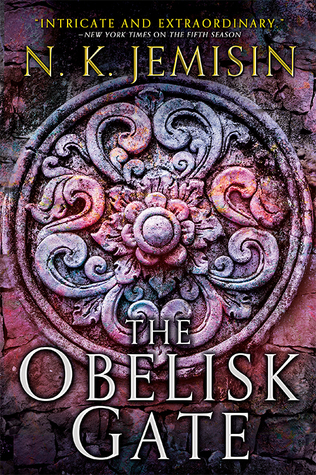
Synopsis: In the second book in the Broken Earth trilogy, Essun and her daughter Nassun explore and grow into the fullness of their powers, while surviving in a currently-unfolding apocalypse.
Book Review: Last year when I read the start of this trilogy, The Fifth Season (review, discussion), I was blown away. Easily one of the best books of 2015, and plenty of readers agreed with me, as it won the Hugo Award for Best Novel.
Jemisin returns in strong from in this continuation, which picks up literally minutes after the first novel ended. It is a good companion, for a number of reasons.
First, it has a rational flavor. I would not call it RatFic, per se. But one of the major components of Rational Fiction is characters who explore the underlying rules of the world they are in, in order to munchkin their way into power. A lot of the focus of Obelisk Gate is the exploring and uncovering of how this magic system works, and exploiting it, and that really reminded me of RatFic. :)
The opposing sides continue to be relate-able, Jemisin puts a fair bit of work into making you understand how the various factions came to the place they are in and sympathizing with them.
It also stays in “grim” territory, which I really enjoy. There’s one scene in particular, which should make everyone cheer when it happens, and which strikes a blow against our ideals, that will stay with me a long time. This scene helped to cement in my mind the difference between “grimdark” and “traditional” fantasy. I think that in most fantasy, the heroes win because of their virtue. They are better people, and because of that they succeed. In grimdark people succeed or fail purely on their ability to impose their will on others. We want the heroes to win because they are better people. But the REASON they win is because they are better at violence then their opposition. It can be tricky to demonstrate the difference between the two if you are an author, because in both cases the heroes are better people than the antagonists, and in both cases they win by prevailing in a violent conflict. Jemisin performs this feat spectacularly, and still wins our hearts even when it’s clear our hero is simply better at killing and willing to use that to further her own goals.
Obelisk Gate does have the problem of being a middle book. (I continue to hold that authors should simply stop writing the middle book in a trilogy!) Which means it seems to tread water a lot, and much of the action within doesn’t feel that important. Middle books always feel like a long diversion that give you more info and some development without impacting anything of major significance.
This is significantly offset by the Nassun storyline. Nassun was briefly mentioned in The Fifth Season, but in The Obelisk Gate she becomes a secondary protagonist and we’re in her POV for aprox half the pages as we’re taken through her story. This means the book is one-half a “middle book” focusing on Essun, and one-half a “first book” for Nassun. This REALLY does a lot to make it a better novel! Having a first book folded into the middle book is a great idea, and if you’re going to write a middle book, this is one way to do it much better.
Another way is to be N.K. Jemisin. She is easily one of the best fantasy authors of our time, and it shows. There is one thing that bugged me personally, but it’s very spoilerific so I’ll save that for a future post. Despite this mystery complaint, the craft is beautiful, the characters are compelling, and the world that is slowly revealed to us as the book progresses is enthralling.
Highly Recommended.
Book Club Review: This novel produced TONS of discussion. There’s simply so much in here! I don’t want to go over everything, as that would simply take too long. The themes of human rights vs existential risk from the first book are still very present. Since they’re in the middle of an apocalypse there’s a bit of lifeboat ethics that comes up, but more interesting is the idea of who gets to decide how they’re implemented. And the themes of abuse are much stronger than they were in the first book, which sparked a lot of discussion about conditional vs unconditional love, and the biological realities of how you feel about children/parents, regardless of how they have treated you. To say it was interesting would be a hell of an understatement.
All this is because Jemisin obviously has a lot to say. Her society is brimming with rich concepts that must be on her mind often. Someone who doesn’t submerge themselves in these sorts of musings (and I’m assuming conversations/arguments) frequently simply wouldn’t have a world with such deep roots. They are as irremovable from the author’s work as they are from the author’s mind. And this works exceptionally well because Jemisin hasn’t set out to preach a message. The world and the stories within it are full and complex because these things are vital to the author. Having Something To Say but using it as fuel for driving your writing, rather than as material to make a soapbox out of, makes for stories that give people a LOT to talk about, in a thoughtful way.
We were at it for a long time, and it was great. Highly Recommended.
The founder of my writer’s group (and 2x Nebula winner) Ed Bryant passed away in his sleep last night. I’d seen him for several hours every month for coming on three years now.
This is the first time anyone I’ve known personally in my life has died. I’m not sure what to make of it yet.
This picture is basically the Ed I knew, expect the shirt is wrong. He never wore anything but Hawaiian shirts. I don’t know how they got him into something this formal.
I owe Ed a lot. As I said, he started the Northern Colorado Writer’s Workshop. I learned more about my craft, in a shorter period of time, in that group than I could imagine was possible. It was a rocket burn of learning.
He attended every single meeting. We’re supposed to keep our comments to a reasonable length, to keep the meeting moving, but exceptions were made for our elder statesman. :) He would go on at length about all sorts of topics, sometimes not all that related to what we were doing, but generally interesting. He imparted insight into the world of professional writing, and kept us very much informed of his personal goings on. It was like having a grandpa, I imagine. I don’t know, I’ve never known my grandparents, they’re in Poland.
Sometimes he went on a bit too long, but no one ever complained, because come on… he’s Ed. He deserves to go on as long as he likes. And he’s just so damn accepting and caring. He smiled all the time. His laugh was a huff that came up from the belly, and sparkled from his eyes.
Almost every meeting he would doze off at some point. Just a thing that comes with age, right? It was endearing. He’d look up bleary-eyed when it would come his turn to offer a critique on a work, take a breath, and jump right in.
He has read almost everything I’ve ever written. And commented on all of it. He read every single word of the first draft of the novel I just finished. He called it “Bravara Writing.” :) I didn’t keep most of the manuscripts I got back, because who can keep 3000+ pages of printouts with notes scrawled over them? When I get home today I’m going to go digging. I hope I kept one or two with his handwriting. It just… didn’t occur to me that he’d be gone.
Even when his kidneys failed last year, and he had to start dialysis. Even when he had a bad turn last month, and missed an NCWW meeting for the first time in as long as I’d been coming. I just thought “Well, he’ll be better by next month. Ed is always there. Good ol’ Ed.” I sent him a get-well card. Maybe I should have gone to visit too.
People often say “I won’t ever see X again,” but that doesn’t seem to apply anymore. There’s photos, there’s video. And I’m not that visual. What weirds me out is I won’t hear his voice again. He had a very deep voice, like an old bear. A little scratchy and rumbly in his old age. He spoke slowly, deliberately, which was frustrating at times, but it was distinctive. It was him.
As far as I know, he wasn’t signed up for cryo. He’s just… gone.
When I worked for The Man, I often had long periods of enforced idleness. Accounting is cyclical by nature. We’re busy at month-end, and very busy at quarter-end and year-end, but 8 months out of the year there’s a couple weeks were the work volume is just very low. But due how employment laws and norms work in the US, I still had to be in the office 40 hours a week, even during those weeks when there was only 15 hours of work to be done.
I thought this was stupid as shit. To be honest, from a business perspective I still think it’s stupid as shit. You’re literally paying your employees to burn away hours of their life on nothing. As long as their work gets done, I think they should be free to leave the office on slower weeks. But hey, some places have it worse. I hear in Japan you’re expected to put in 12+ hour days every day and often work weekends, which results in office workers who literally sit at their desks doing nothing at all for more than half their time in the office. And everyone knows it, and everyone still does it anyway, cuz expectations.
I’ve come to miss that Enforced Idleness. Because it’s not like I literally did NOTHING during that time. I spent a lot of time reading–specifically, surfing the web. This idle time is how I discovered Overcoming Bias. It’s how I got most of my econ knowledge (seriously, the two classes I took at college level ended up just being review. They were only 100-level classes, of course. But it’s cool that anyone with the interest can get an entry-level college education from dedicated reading of economist blogs). It’s how I gained most of my history knowledge, and kept up on advances in tech fields and some sciences. I read the entirety of the Less Wrong sequences, and SSC, and so many other things. If it wasn’t for this enforced idleness, I likely would never have read the Transdimensional Justice Monster post, which was a major inspiration for Of All Possible Worlds. I’ve greatly deepened my knowledge, and broadened my horizons, becoming a better and more thoughtful person. Because I was being paid to waste time.
Now that I’ve been “working” for myself for a number of months, I have much less idle time. I chisel it out for the stuff I find really important (like SSC). But I can’t stand to have hours every day where I’m merely reading interesting things about the world, because those are hours that I am not being paid anything, and not producing anything that will maybe help me pay my rent some day in the future. I don’t feel I can afford idleness, for the most part. I don’t follow many of the blogs I used to follow, nor podcasts. I’m worried I’m missing a lot, and it’ll come back to bite me, and some day I’ll just be an old man yelling at a cloud because the world has left me behind.
So I guess what I’m saying is, maybe that Enforced Idleness was a much better thing than I’d given it credit for at the time. It basically forced me into boredom regularly, and we all know how productive boredom can be. Maybe Enforced Idleness will be the future of work, once the robots have taken everything else.
I know everyone says that, but it’s one of the nice things about human psychology that we can know it’s not true but still believe it on a gut level, because we like where we are so much. I live in the South Denver Metro area, in an area called “DTC” (the “Denver Tech Center”). It’s my favorite combination of density and nature.
As I’ve said many times before, I hate the suburbs. They sprawl and they’re ugly and inefficient. Dense living, such as multi-story apartments, are far more efficient both for energy- and land-use. And by not sprawling across miles and miles, we reserve that land for ACTUAL natural wilderness, rather than the aesthetic horror that is lawns.
And just on an aesthetic level, I love large, imposing buildings. Sided in glass and given a decent architect to make them structurally interesting, it feels like living among giant cut diamond artifacts, gleaming in the sun.
The problem is that in many cities, the space between these soaring buildings is ugly. It’s cracked concrete and sooty asphalt. It’s chainlink fences and deteriorating lampposts. This dirty sterility drives me away from many highly-dense urban settings.
Fortunately, there is DTC. It contains towering glass structures, surrounded by corporately-maintained strips of well-mimicked wilderness. It’s like someone took the best parts of our neon post-cyberpunk future, and blended them artfully with tolkeinesque elven forests. Here’s a few pictures taken between my apartment complex and the Starbucks I walk to most days.
As one can see, even the deer were fooled into thinking they were in a pretty nature place. :) This is not a common occurrence, but man was it cool. I’ve posted a video below that shows how close they let humans get to them, they’re mostly unconcerned with us. I could probably have touched one if I wanted to, but I think that’s probably a bad idea. Plus, the three bucks with very pointly antlers made me cautious of scaring them.
Synopsis: The ladies of a wild west brothel have to save their town from an evil mayor.
Book Review: This is a solidly mediocre book that feels like the literary equivalent of going to eat at Olive Garden. The food will be acceptable and you won’t leave hungry, but this certainly isn’t where people go to follow their passion.
The story starts out strong. Bear obviously had a really cool idea and decided to try it out. The first several chapters are engaging and interesting. The women of the brothel form a tight-knit community that feels very much like a family, and the protagonist has a unique and enjoyable voice. I like the sort of high-agency protagonist that Karen Memory starts with.
But it feels like Bear wasn’t sure where to go with this idea, and decided to just keep typing until she reached her word count goal. Some of the worst writing advice I’ve ever seen widely repeated is “if you’re stuck, just write ‘A man enters with a gun’ and go from there.” This feels like that sort of book, and it results in a story with a very slapped-together feel. There are a ridiculous number of elements that are sort of dropped in and don’t really DO anything.
*There’s a mind-control machine that’s used to insert some random chaos when things get boring, it’s then destroyed, and it looks to have no impact on anything in specific.
*There’s a ridiculous cholera plot that doesn’t make the least bit of sense. It’s told to our heroines for no reason before they are to be killed in a “Before I Kill You Mr Bond” way, but of course they escape easily right after.
*Whenever Bear doesn’t want to bother with the specifics of how a certain bit of action resolves her heroine is conveniently knocked unconscious, or chloroformed, or faints, and we skip right to the next scene without explanation.
*A romance subplot is dropped in, has no real effect on anything, or any emotional impact, and is neatly resolved with “yup, I love you too! ^^”
On top of all this, there’s no reason for this to have been steampunk, nor does it add anything to the story. It feels tacked-on. Almost everything feels tacked on, to be honest.
Perhaps this is an artifact of the fact that after the initial brothel set up, the story really shifts to be the story of the Marshal who rides into town on the heels of a serial killer. But Bear doesn’t realize this and sticks doggedly with Karen, and it brings down the whole novel? I don’t know.
In the end, I like my fiction to be “thinky.” This doesn’t just mean that characters think a lot in it (although it does mean that), or that I like for it to make me think (altho it does mean that as well)… it also means I expect the author to spend a good deal of time really thinking through the world, and the plot, and all the characters. This feels like it was dashed off without pausing for breath or any real care as to how it holds together. Not Recommended.
Book Club Review: Eh. The book isn’t bad, but doesn’t have much to recommend it. There’s a bit of chatting that can be done, trying to suss out what went wrong, or talking about the enjoyable parts. More than that, the group can speculate as to why the novel got as much attention as it did when it came out, but that ends up feeling kinda icky pretty quickly. People can enjoy things for any reason they want, and I don’t like to judge. But in terms of leaving the group with lots of interesting things to talk about, or a memorable experience – Not Recommended.
Personal Note: I almost threw the book across the room when the first dead hooker showed up. I am absolutely sick to fucking death of that trope. It’s lazy and it degrades an entire category of human into a cheap plot device. I once knew a sex worker, and it would be painful to watch things with her and see how often this bullshit showed up. Try sitting next to a friend while watching a comedy that jokes about how funny violence against your friend’s group is, because they’re dirty subhumans. I thought I’d be safe from it in a story with an ensemble of brothel workers, but NOPE! Our protagonists are the good kind of prostitutes–the high-class ones with a nice building and a strict-but-fair madam–and the street-walkers are still disposable bodies used to show how evil the villain is.
I’m sorry. I know I sound like a crazy person. But I was really looking forward to seeing this group finally portrayed as real humans in a fun book, and I got hit with that again. Ugh.