May 312013
 

TOOL_albumArt_001In high school I knew someone who was afraid to cross bridges. Once I saw her unable to cross a 4-foot walkway over a creek that one could hop over. This was bizarre and unbelievable to me, partly because there was no way the bridge could have collapsed, and partly because even if it did the worst possible result would be a sprained ankle.
I have developed a bit of an unreasonable fear of my own though. Last week the podcast website and this blog went down for a bit less than a day. The terror that this sparked in me is hard to describe. It’s like an icy clawed hand gripping inside your chest. Not at my heart, because it’s in the center of my chest rather than a bit to the left, but it feels like where the heart should be. It becomes harder to breathe, and the only thing I can think about is getting the site back up. Turns out it was a glitch with a new feature the host was rolling out, and was reversed quickly. Disaster averted.

When I was an awkward teen geek, for a couple years my entire social life was online. Nearly everyone I cared about could only be reached via modem. There was a point, after I’d settled into this life, that my ISP had a major catastrophe of some sort and was down for two days. Instantly I was cut off from everything that gave me comfort, and there was nothing I could do about it. There was nothing I could have done to prevent it. Some piece of circuitry in some distant place had failed and amputated my connection to the world and I was completely helpless to do anything about it. It was the helplessness that was the worst part.

Yes, I realize this was all greatly exaggerated due to being a dramatic teenager in the midst of hormonal pandemonium. But the horror stuck with me. I know it’s irrational, and I try to downplay it and not think about it. It’s still there, and it rears its hideous head when things like unexpected/unexplained server crashes occur. I’m getting twinges of that feeling just recalling it. Bleh.

I dropped out of my Comp Sci courses in college mainly due to this. I couldn’t face a career where I would be feeling this ALL THE TIME. Worst idea for a college major ever.

May 162013
 

metroid_ending_screenFor most of the human race’s existence, we’ve been playing a game called Survival. The rules are mind-bogglingly complex, change all the damn time, and are not fair. But humans managed to hold on long enough try many different ways to win, and had the previously unheard-of ability to record their attempts and pass on what they learned to the next generation. Eventually humans discovered a system for figuring out what the rules are – The Scientific Method. Knowing enough rules meant you could game the system, and humans became the first Reality Munchkins. Combined with new methods of coordinating action (capitalism) they actually managed an unprecedented feat – they Beat The Game.

In the developed world, Survival is a solved problem. Starvation has been neutralized. Untreatable fatal diseases are rare. Violent death is rare. Most people can expect to live with minimal discomfort into their 70s or 80s without existential risk.

People don’t take enough time to acknowledge that we’ve Beat The Game. We should do so more often.

Of course, you don’t stop playing just because the game has been won. That’s why there is an Expansion. Unfortunately, we seem to be awful at the Expansion.

It’s disheartening how many of my friends have linked Depression Part Two with “YES! THIS!!” I was there myself for a time. Almost everyone I know (including myself) treated the symptoms of this with an unholy desperation, mainly consisting of drugs and distraction. Now that we’ve solved Survival, what else is there to do? We used to do things to survive. Now why do anything at all? Will it make any difference to our survival?

Not that any of us thought of it that way. But over and over, what I hear and what I remember is a despair at the purposeless and meaninglessness of life. “I don’t know why I bother.”

This changed for me once I had a goal. Something to strive for. It wasn’t even a very lofty goal, it was simply something I wanted, and was willing to work toward. My life changed completely, and very rapidly. It seems that this is what the Expansion to life consists of – Find A Goal. Not even achieving it… simply finding one. And unless my sampling is extremely skewed, it seems that the vast majority of middle America really sucks at this new game. We were taught all our lives how to win at Surviving, and that’s the game we expected to play. Being thrown into the middle of this new challenge without a compass, a map, or even eyes to see the terrain with is more than scary – it is dangerous. Most people I know have been suicidal at some point. Many still get occasional pangs. Some have made attempts. We solved Survival just to be shut down at the next level.

We need to figure out the rules to the Expansion. I’ll try to narrow the search a bit over the next few posts, but I don’t know of any methodology of doing so systematically yet.

May 132013
 

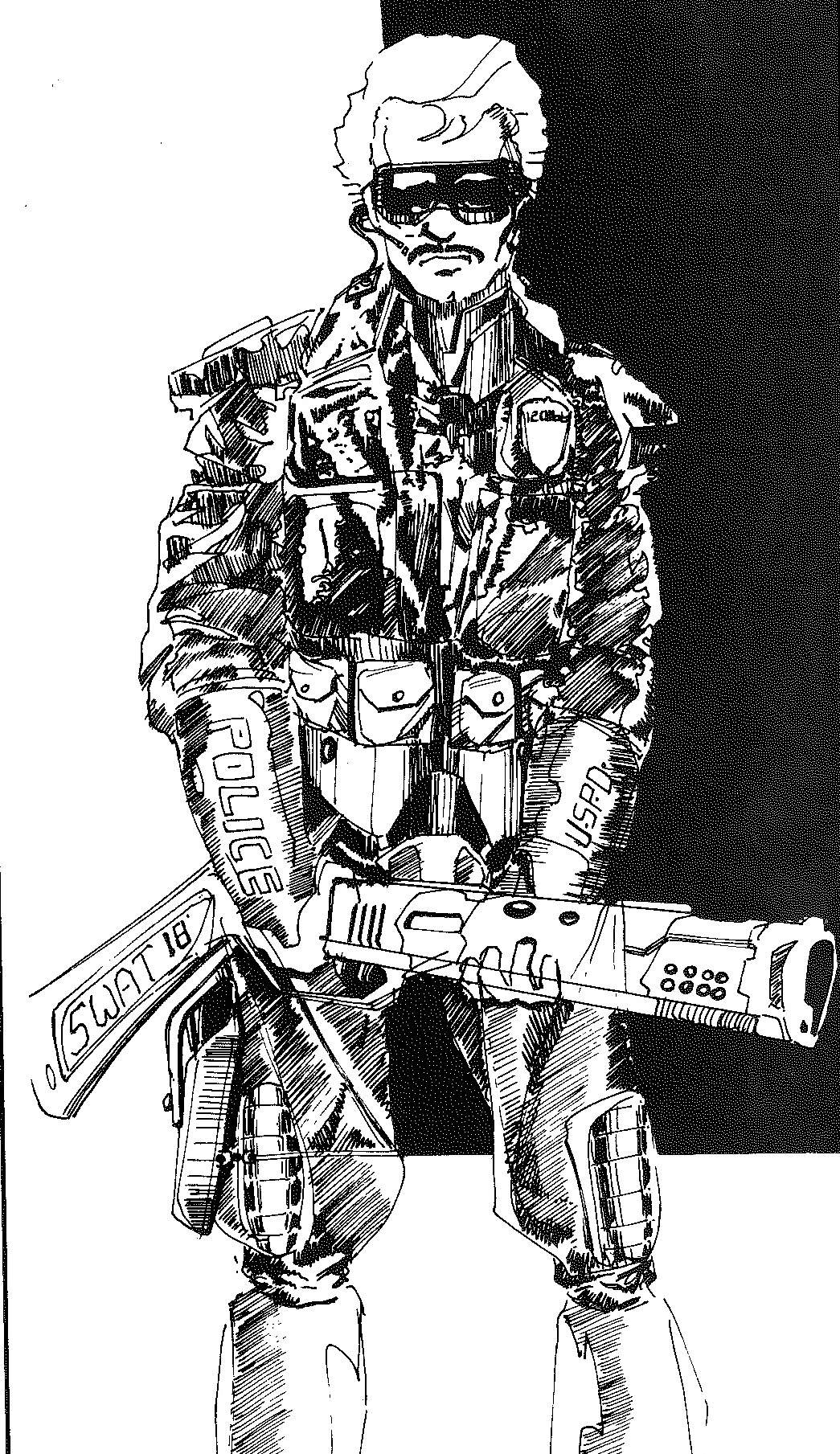
CyberPunk RPG Gear ChapterRobert Heinlein said you never truly own any more than you can carry in two hands at a dead run. In my book club we just read two books in succession about people being controlled by an outside force via threats to what they love.

Growing up, I learned that caring about things is dangerous. If you care about something and other people know this, it can be used to control you. “Do what I demand or this thing will be taken from you. Or destroyed.” There are no limits to this, there is no true security. As such, I’ve tried to limit what I own, and what I care about. I drive the most bland, boring car I can, so I don’t overly care if it’s damaged. Until recently I didn’t own a home – I loved renting. Renting is great because not only can you move whenever you need to change locations, you aren’t invested in a conspicuous immobile thing. If you have to abandon it to flee the city, or if an enemy burns it to the ground, it doesn’t matter. It’s deliciously liberating.

Not caring about people is harder in some ways, easier in others. Easier in that it comes somewhat naturally to me now. I had a lot of experience earlier in life in having my feelings for other people used by those people as weapons. (Surprisingly, it was never an outside force that threatened my loved ones, it was the loved ones themselves who threatened to withdraw. That didn’t occur to me until as I was typing this.) As such I’ve already developed a reflex for not caring too deeply about anyone without even meaning to. It’s important to be able to walk away from any relationship if it comes to that point. It’s harder in that we’re instinctively social animals, and too much isolation becomes painful. This used to be an extreme problem for me, but I managed to get over it a couple years ago, which will have to wait for a future post.

Stereotypically, not long after I finally became comfortable with myself – fulfilled and happy living alone – I met my girlfriend (now fiancé), so I didn’t have very long to enjoy it. I’ve heard that’s a common thing – once you finally stop wanting a relationship you somehow fall into one soon after. Perhaps relationships are like guns or positions of power – you aren’t responsible enough to have one until you don’t want it, and there’s only one (long and painful) way to get to not wanting it.

There are still things I care about deeply. My girlfriend. Eliminating death. Creating things. But I’ve come to accept that letting go is a vital skill, and not knowing how to let go of people/things is as bad as not knowing how to read*. You aren’t fully human without it.


*by “read” I mean “be able to communicate an idea to people who aren’t present via durable symbols”.

**the pic accompanying this post comes from the CyberPunk 2020 RPG soucebook, from the chapter on equipment. It comes with a caption of “Your Outfit – your worldly possessions stuffed in a 2×4 carry bag.” It was my pre-teen self’s first exposure to the concept of a life unencumbered by stuff.

May 022013
 

atlas-shrugged-book-coverI mentioned in my podcast’s production notes that I was raised with a moral code meant for gods, which breaks mere men. I see my younger brother now struggling with the same problem and I want to help him. I was at a loss when trying to figure out how to do this though. I had to spend a lot of time searching through my past before I came to what I think was the major turning point that finally put me on the road to recovery – reading Atlas Shrugged.

Let me assure you that I’m no longer a Randian (that lasted less than a year) and I will not be extolling the virtues of Objectivism! I’m not even Libertarian. But there was a time when I was suicidal, and when I would have likely pressed a “Destroy The World” button if it was given to me – and believed it was the best thing to do. With the right (ie: wrong) mental wiring and moral teachings, not being able to be God can lead you to such places. It can make you sympathize with people who want to watch the world burn.

Being a Randian Objectivist is also bad, but it’s very much less bad. Objectivists may be complete assholes who view human worth as a function of an individual’s economic output, but at least they consider the human species worthy of continuing. They can generally function in society. They may espouse a cartoonishly villainous Virtue of Selfishness, but they’ll hold down a job and live by the laws of the land. They can still harm many people by passing bad laws and ignoring suffering wholesale, and should be held in check by saner and more compassionate forces. But it’s better than slowly going insane.

As I mentioned yesterday, I am easily taken in by certain types of claims. And Atlas Shrugged is famous for its ability to sucker in a certain type of young male reader. It’s almost a joke that every college freshman becomes an Objectivist for several months after first being introduced to Rand. So a charismatic, passionate, and seemingly iron-clad reason-based argument for how You Can Save The World By Being Selfish, and everyone who ever said that you are responsible for righting every wrong you encounter was (either through ignorance or evil) trying to Loot Society And Destroy Civilization… is a startling revelation. But not just that – it is a HUGE RELIEF. An indescribably welcome one. Suddenly, I am finally not responsible for all the evil in the world. I can finally stop trying to be God, and just be a man. It’s nearly impossible to describe the sense of relief and the thankfulness that comes with that, with finally being unburdened from this crushing, soul-tearing responsibility. It’s like being able to breathe again after years of suffocation.

This is why I compare Rand to Malaria. Before antibiotics were discovered, it was found that the high fever caused by Malaria would kill the Syphilis virus. It turned a 100% lethal disease that drove you insane, into a 5% chance of dying which could afterward be treated with quinine. Rand is like Malaria – really bad, and awful for any healthy person. But useful for those with a certain condition. With a little luck they’ll pull through and can be treated of Objectivism over time.

However I have only a single data point. Will this work for my brother as well? He seems to have a worse case than I do, it’s been exasperated by his recent environment. Even if it could work, how does one get someone else to read a freakin’ doorstop like Atlas Shrugged? He’s not into fiction. And I can’t just point him to this post, that may inoculate him against its curative properties.

/sigh

May 022013
 

whitemagicRecently I was accused of “not believing in anything” because I was skeptical of certain claimed medical advances. This is not an uncommon occurrence. I’m often called “robotic” by people who know me. I find this both interesting and frustrating, because IMHO what people are seeing is a self-defense mechanism. My actually problem is that I believe far too readily in far too much.

I’m quick to identify with groups and worship heroes (I would post a link to my encounter with Vernor Vinge if Facebook had any value at all as an archive. /fume ). I get passionate about abstract concepts quickly. I’m easily misled (I despise April Fools Day). I was a Randian for 9 months after reading Atlas Shrugged, simply due to having read Atlas Shrugged (yes, I’ve very embarrassed to admit that. Both parts of it.) I have frequent and sincere existential worries that I’m living in a simulation that has been designed around me specifically, and wonder about how to react to that knowledge. When something new and cool comes around I jump on it with a speed that’s simply stupid, and get FAR too excited about it. Most recently this happened with Soylent, which after learning about I was literally unable to stay still for the rest of the day and stayed on a happy-high for four days. I had to be brought down to earth by the Skeptics Guide to The Universe pointing out that this was nothing new and had been around as Ensure for decades. Crushing sadness. :(

So it seems I have a neuro architecture that is very strongly suited to believing things strongly with little or no evidence. I have what is sometimes called a Mystical Mindset. I recognized this as a problem, and I had to look for workarounds. I haven’t found a fully generalizable mind-hack, but I have found some useful techniques. As I mentioned, one of them is simply acknowledging that my brain is crazy and that statistically it’s far more likely that I’m crazy than that Thing X is true, so I should ignore it and calm down. This often works, but it also requires noticing that I’m being crazy in the first place.

A very handy heuristic is to accept what is settled science and take a very skeptical view towards outliers. Science is imperfect and slow, but it has a mechanism to separate truth from falsehood, and an internal error-checking procedure, so it keeps getting closer to reality. Faith has no such checks, so its correspondence to reality is largely coincidental (and often non-existent). If I haven’t heard of something before, my default position now is to be strongly suspicious until I’ve read about it in more detail. Not because I don’t believe anything, but precisely because my nature is to believe everything, and I have to control that. This is a basic self-defense mechanism, where what I’m protecting myself against is my own mental deficiencies. It is literally “self” defense in that I’m defending myself against my self.

I’m glad that these sorts of defenses are available nowadays. Had I not learned how to defend myself it’s entirely possible I would have ended up a priest or something.

Apr 302013
 

there-but-for-the-grace-of-god-go-iMy fiancée has taken to growing edible things (as mentioned in the previous post). When we killed most of our lettuce through overwatering, at first I was elated. Then I realized that my continued existence depends on these sorts of plants being grown to maturity, and that they are fragile little bastards. We’ve had more luck with some and less with others, but overall we really suck at making food.

It is extraordinarily easy to imagine being dependent on only what you can grow. And it’s terrifying to think that if these crops don’t come in, I will die. In large part because you have so little control over them growing! There is nothing I can do if nothing sprouts up after I’ve planted the seeds. There’s no way for me to prevent extreme weather conditions from drowning or freezing my crops. When a blight comes in and starts to rot the plants where they stand, I cannot take a sword or gun and hunt down the infection and kill it off. All I can do is watch as my life withers before me.

I’m used to a world where I have some modicum of control. I used to fear giving others ways to control me (a topic for another post), but I always assumed that if I needed to eat I could find a store and purchase some food. Life might suck, but I’d never be completely helpless in the face of starvation. How long had the human race lived with this sort of fear? I’m uneasy even thinking about it!

No wonder people developed superstitions, in the face of such helplessness. Being unable to do anything at all is insanity-inducing. Wave a cat at your fields under a full moon? Well shit, if someone says it works, I’ll damn well do it! Watch as day over day, the green shoots rise from the earth and fill out. How does this happen? Who makes it grow? I plant and I water, but only God can make it grow. Praise be unto him, and let’s make sure he stays happy with us.

It’s been observed that the safer and stabler a society is, the lower the incidence of religiosity among its population. I am immensely grateful to the humans who’ve come before me who have discovered how to make crops grow efficiently and consistently. To the point where no one fears starvation, and just 2-3% of the population grows enough food to feed the whole country. That is why I so often use pictures of industrial agriculture in this blog. Not only do they make life possible, and secure, they have saved me from the fate of the superstitious. I see the mind-numbingly devout and I think “There, but for the grace of men like Norman Borlaug, go I.”

Apr 292013
 

903316_10101339385033572_172541308_oThis is a picture of a pot of lettuces first sprouting a few days after my girlfriend fiancée planted them (that girlfriend/fiancée thing is going to take some getting used to). I had never kept living things in my home before. They bring dirt and harbor insects and require maintenance. But she enjoys growing things, so I’ve learned to cope. I was amazed by how quickly they took over their environment. In just a few days they had gone from seeds nearly too small to see to this invasive colony of growing organisms.

Honestly, I was borderline horrified. These were non-conscious replication machines that drew material from the world around them and broke it down into raw materials simply to make more copies of themselves. It was a mindless consuming horde, a green Grey Goo with no notion of what it was destroying. It was a virus. Extrapolating their rate of growth from what had already been observed, in no more than a few years the entire world would be taken over by ravenous greenery.

All this flashed through my mind in maybe a second before I realized that this isn’t just a viral phenomenon – this is what all life is. I’m getting my knickers in a twist over nothing. I can look outside to see that this green has already taken over the world, and it ain’t so bad. But it was still a very eerie feeling, and left me uncomfortable for several days. Then something happened…

My fiancée overwatered them, and more than 90% of them died. Huge relief! These bastards aren’t so tough, we can wipe them out just by accidentally giving them too much of what they need! BWA HAHAHAHA! Come at me, lettuce-bro! I am human, and I own this planet for a reason! You get out of control and we will put you down!

That joy lasted for only a day before I realized the even-more-terrifying implications…

(continued in the next post)


Editted: Original picture found and added!

Apr 082013
 

408138_630276420319487_1975656987_nI’m going to get married.


I am happy. :) But I was against marriage for a long time, and I still am. I dislike marriage for two major reasons.


1. I don’t need any outside group telling me my relationship is legitimate.

I don’t need anyone’s approval to be with the person(s) I love. I don’t particularly care what anyone else thinks about my choice of mate(s), whether they approve of their race, gender, temperament, or anything else. Therefore I don’t feel any need to get a piece of paper telling me that my choice has been approved by the government. Big fucking deal, you can take that paper and shove it up your ass. It will not change the nature of my relationship, I will not love my mate any less or any more because I have it. We’ll stay together as long as we both want to be together. Which leads me to…


2. I don’t want any outside group telling me my break-up is illegitimate.

I’ve gone through a divorce before, and the amount of legal hold your partner has over you is terrifying. Basically, either person can hold their ex-partner’s life hostage for months and force tens of thousands of dollars in lawyer’s fees upon them, simply in retribution. Fortunately this didn’t happen, it was an amicable divorce. But if my ex wasn’t a civil person it easily could have, because she still wanted a relationship and I did not.


Let me clarify a few things here.

I don’t believe men should be able to take-and-dump women. I realize that some women’s life path is to marry a nice guy with a good job and spend her life making the home and raising the children. (Actually that can work for both genders, but traditionally it’s more common among women) It is arguable that a woman’s highest-potential years for achieving this are in her twenties, and thus a man who marries a woman in her twenties and then leaves her in her forties is literally robbing her of her greatest producing years. Marriage (in its current incarnation) is designed as a contract to protect the homemaker in these sorts of arrangements. If one party has given up their careers – decades of income, and decades of gathering job skills and professional contacts – with the implicit assumption that they will be economically secure in their old age due to this sacrifice, it is both Right and Just that s/he be assured that security through legal means if their partner reneges.

I’ve never had that sort of relationship. I do not want that sort of relationship. I consider it distasteful and exploitative. I like my women independent and self-fulfilled. Aside from brief periods of unemployment (on both sides) everyone I’ve ever been in a relationship with has had their own ambitions and career and made roughly the same amount I do. House work is shared. There are no children. The marriage contract does not apply to our relationship. No one is being exploited. No one needs to be legally bound to uphold their side of “the deal” which marriage represents. We don’t have or want that deal. This is what I realized during my first divorce – the social good which marriages protect does not apply to my relationship. It does no good at all, and only serves to encumber us, and give us hostage rights over each other. We should never have entered into a marriage in the first place.

Until such a time as I decide to be party to a marriage of the traditional sort (1 wage-earner, 1 home-maker) there is no good reason to enter into a marriage, and several good reasons to avoid doing so. And as someone who hopes to live for at least thousands of years, I have to accept that it is likely that both I and my partner will value-drift in ways that do not match, and in time we will no longer be ideal for each other, and at that time we should separate. I don’t want to go through the whole terrifying divorce ordeal again once that happens.


There are a few things which have persuaded me to actually get married, despite these reservations.

*The most obvious, but least important, is the various legal benefits that society grants to couples that have that piece of paper. It’s ridiculous, but there are all sorts of rights that it conveys – some of them non-trivial.

*Far more important is that my mate values being married as a terminal goal by itself. As she’s my SO, my utility function contains a term for the fulfillment of her utility function. I was worried, however, that she wasn’t including the terror I felt at being legally bound in her utility calculations. This was allayed by:

*She has agreed to divorce me after five years. After that we’ll remarry after five years, and repeat. Obviously with no change in lifestyle (unless we desire), merely in legal standing. This, more than anything, convinced me that she understands my worries, and she’s willing to share the burden of living in sub-optimal marital states for 5 year periods with me (though of course the periods we consider sub-optimal are transposed). And that… that is what true love is. :) I feel I can trust someone who’s willing to be so fair and honest with me, and I’m happy to make concessions to her, as she’s willing to make them for me.

Plus we’re crazy happy together. <3

Apr 022013
 

mouseI live in a townhome, and share a wall with an unoccupied unit. This puts us at greater risk of pests, and sure enough, a couple weeks ago we heard a mouse in the walls. We have since solved this problem by catching it with a live trap and letting it free in a field a few dozen miles away. This was not my preferred solution, and I feel it was not the most moral one. It was the one that would keep my girlfriend from hating me, which is very important to me, so I went with it. It also made me feel much better than the true moral solution, so it was hard to resist. However the moral solution would have been to use to death trap and/or simply kill it.

In case you aren’t familiar with The Prisoner’s Dilemma, here’s a short summary. Or here is one in comic-strip form.

It’s fairly easy to get people to do things that are to their advantage, and to not do things that harm them. On the other hand, it’s harder to get people to take actions that would lead to better results overall when it harms them personally. I’ve felt for a long time that the primary purpose of morality is to get people to cooperate in Prisoner’s Dilemma-type situations. It’s a big job that requires a multi-pronged approach. We add rewards to cooperating, and we add punishments to defecting. We attempt to instill a desire to cooperate in our fellow humans, so that there will be self-inflicted rewards and punishments for cooperating/defecting (as appropriate). And still we have a hard time even getting basic cooperation on simple issues, like pest-control.

You’d think the warm-fuzzy feelings I get for releasing a furry little mouse wouldn’t compare to the huge disadvantages of living in a city overrun with vermin. It’s nice having walls that aren’t eaten away in the night. I like not having to lock up all my food in glass or metal containers to prevent it from being stolen and soiled. And most importantly, I like not living in a city ravaged by plagues and diseases, constantly worrying for my own health and likely often falling sick.

But I don’t have to bear any of these costs, because I can avoid the cost of feeling bad for killing a mouse simply by shifting that burden on to my neighbor (or in this case, a neighbor of a few dozen miles away). Someone else will be inconvenienced by this mouse, and then they’ll kill it for me. This is an immoral action. In an ideal world I would have someone living with me that would help me keep watch over my immoral impulses and remind me of the right thing to do. Two people together are much stronger than one. But that was not the case this time.

I’m not sure there’s a point to this post. I guess I’m mainly feeling guilty, and I’m confessing to the internet. So I guess morality wasn’t completely impotent, just not effectual enough. /sigh

Mar 132013
 

super pillowLike many people, I’ve long had problems falling asleep. Sleep has always felt like such a terrible waste of time, a third of my life lost. Imagine what I could have done living an extra ten years of life up to this point! But curtailing sleep was an unmitigated disaster, the loss of performance and quality of life was so bad that I might as well not have bothered at all. For those extra 2-3 hours I lost an entire day. So when I did go to bed, I wanted to lay down and get on with it.

That was always a ludicrous aspiration. Simply lying down does not shut off one’s mind. Now that I didn’t have other things to distract me, my brain could start going over every little thing that happened to me that day. Analyzing it, dissecting it, suggesting alternatives (too late) and estimating how it affected other’s opinions of me. And I would start contemplating what I would do the next day, sometimes elaborate plans. Or I’d start forming opinions of things I’d watched or read or witnessed. Then I’d realize what I was doing and get annoyed at myself for not falling asleep. And on and on like this for hours. The only way to avoid this was to first get so exhausted I’d just collapse into sleep when I went to bed, which required staying up way too late and suffering the next day. During my alcoholic phase I discovered that drinking a lot would also work, but that’s hardly an ideal solution.

This had been a blight upon my life since at least my early teens. Basically as far as I can remember I’ve been tortured by my inability to sleep. And I hear this is very common.

So when I discovered an easy and extremely reliable way to fall asleep in almost no time every single night, I was in awe for weeks. It was like I had developed a freakin’ super power. In fact, I’m still sorta in awe of it, although familiarity has dulled the shine a bit – I’m sure Superman isn’t constantly amazed that he can fly either. Seriously though, this is one of the most useful abilities I’ve ever developed in my life. It is such an amazing relief.

In the interest of spreading all superpowers to as many people as possible, I present:


 How To Fall Asleep (in 2 steps)


1. Get some Melatonin and take 1-2mg just before you go to bed.

I generally don’t trust supplements, but this one came recommended by Gwern, who’s done a full write-up on it. It convinced me to try it, and it works. In short, Melatonin is a hormone your body makes to regulate your sleep cycle. Check out Gwern’s article for all sorts of details in an easy-to-read well-written format, which includes citations.


2. Lay down, close your eyes, and do some light meditation.

Meditation is also something I don’t trust, because it’s been associated with some much New-Age Woo that even hearing the word generally makes me roll my eyes. Which is too bad, because when you remove the mysticism it apparently actually helps to train you in various mental skills (such as focus and concentration). Anyway, the level of meditation required to fall asleep is absurdly light, you can almost just call it “relaxing”, but it is a focused and regimented relaxing that will GET YOU ASLEEP. Here’s the process (which I first lifted from Less Wrong)  –

* focus entirely on your breath. Not on the process of breathing, just let that come naturally. Simply observe the air flowing into your nostrils, filling your lungs, and then leaving again. Nothing else, just that.

* this will work for about 3 seconds. Then your brain will randomly generate some thought. You won’t notice at first, but eventually you’ll realize “Oh hell, I’m thinking about what I want to do tomorrow instead of my breath!” Stop thinking about that and re-focus on your breath.

This is the tricky part, so there are many tricks on how to do this. My personal favorite is label the thought under a category – give it a tag like “plans” or “memory”. If there’s a song running your head tag it “music”, if you’re listening to a dripping sound, label it “sensory input”. If these very instructions on how to do it are running through your mind, label them “process.” If you’re annoyed that you’re thinking about thinking, label it “meta”. Then picture yourself throwing the label aside. I often make a mental wrist-flick as though tossing it in the trash. Don’t get upset, just refocus on your breath.

Early on this will happen constantly, you’ll be amazed how wasteful your brain processes are. As you get better you’ll be able to refocus more quickly, and be distracted less often.


You’ll fall asleep quickly once you’ve put your mind to bed. At first this can take 20+ minutes (still better than the hour+ it often took me to fall asleep). In 3-5 days (seriously, the learning curve is that quick) you’ll be able to do it in 5 minutes, maybe 10 on bad days.


That’s it. You can still lay in bed and contemplate projects or stories or whatever, when you want to. But now you can fall asleep when you want/need to as well. Congratulations on your new power, and you’re welcome. :)