May 172013
 

pinnochio teYeah, the Expansion is Existential Angst.

As far as I can tell, untold volumes have been written about Existential Angst, and no one is any closer to beating it. Are there any things we can say we’ve learned so far?


1. It’s not a fear of death. Indeed, some people seek out death as a release.

2. The most commonly expressed sentiment is that nothing seems to matter.

3. Thinking makes it worse. The common coping methods all seem to be ways to inhibit thinking and reducing opportunities for idle thought.

4. Particularly well-informed and intelligent people tend to do worse.

5. You can’t reason/motivate/will-power your way out of it.

6. Doing something makes it better, temporarily.


Let’s expand on #6. People often report that while they are actively doing something they feel temporary relief. Generally this has to be something engaging that requires effort. The greatest relief is felt when these activities are perceived to have a lasting effect on the world. Games and socialization wear off very quickly – eventually failing to elicit any relief at all. Cleaning a room will have minor effects. Painting a room or building a shelf (or writing a blog post) achieve more relief and for longer periods. Large projects (helping co-ordinate a convention) over long time periods (losing weight steadily for months) have great impacts. In short, the greater the impact upon the future, the more permanent the change – the stronger the effect.

Considering again #4… A greater appreciation of the world and the events that shape it leads to worse outcomes. We are taught that all sentient beings should be in our circle of concern, but then can do nothing to affect the overwhelming majority of them. Shit happens and what I do doesn’t matter.

I’m starting to suspect that the Final Boss is Learned Helplessness. And… it looks like I’m not the first person to think so. Unfortunately as far as I can tell there has been jack-all written about what tactics to use to beat him.


May 072013
 

Ritual MagicThere’s two primary types of magic in fantasy novels. The personal kind, in which a wizard casts a spell himself, usually completing it within a few seconds of starting. It can have stunning effects, but it’s rarely very complex. Then there’s ritual magic, which involves a group of wizards combining their efforts, casting for a long time (usually at least minutes, sometimes hours or days), and often involving significant material components or sacrifices. The results can be almost anything, and are usually game changing.

Industry seems to me to be ritual magic that we humans can actually do. A few extremely knowledgeable wizards develop the ritual aspects of the spell – what actions must be taken, what order they must be taken in, how often they must be repeated. They determine what material components will be needed to invoke the powers of the beyond, and how they are to be manipulated by the casting wizards. Then they invest a great deal of time, money, and energy into bringing all the required elements to a single place. After this they train support wizards in the casting of the spell, assigning a role to each, and watch as the world is altered to match their will.

This level of magic is extremely powerful. One such ritual can create a large device – big enough for a man to sit in with plenty of room left for carrying physical goods. It can move this man, as well as many hundreds of pounds of material, for hundreds of miles at speeds faster than the swiftest horse. It does so without tiring, needing only occasional stops to refuel. It protects the man in a cage of steel, keeps the air at a comfortable temperature around him, and plays music for him to keep him entertained. There is not a single wizard of those who cast the ritual that could have made this device on his own in even a year’s time. Yet when combined with others to multiply their magic, they can produce one such device per wizard every three days! They can produce them so reliably and affordably that nearly every family owns one of their own. Many own several.

Imagine what could be done in a world where everyone was a wizard, and the majority of the population spent ~40 hours a week casting ritual magic. They would never need starve. They could see nearly anywhere, and speak with nearly anyone, at any time. They could travel to other worlds.

Joseph Campbell (allegedly) said “The priests used to say that faith can move mountains, and nobody believed them. Today the scientists say that they can level mountains, and nobody doubts them.”

Apr 302013
 

there-but-for-the-grace-of-god-go-iMy fiancée has taken to growing edible things (as mentioned in the previous post). When we killed most of our lettuce through overwatering, at first I was elated. Then I realized that my continued existence depends on these sorts of plants being grown to maturity, and that they are fragile little bastards. We’ve had more luck with some and less with others, but overall we really suck at making food.

It is extraordinarily easy to imagine being dependent on only what you can grow. And it’s terrifying to think that if these crops don’t come in, I will die. In large part because you have so little control over them growing! There is nothing I can do if nothing sprouts up after I’ve planted the seeds. There’s no way for me to prevent extreme weather conditions from drowning or freezing my crops. When a blight comes in and starts to rot the plants where they stand, I cannot take a sword or gun and hunt down the infection and kill it off. All I can do is watch as my life withers before me.

I’m used to a world where I have some modicum of control. I used to fear giving others ways to control me (a topic for another post), but I always assumed that if I needed to eat I could find a store and purchase some food. Life might suck, but I’d never be completely helpless in the face of starvation. How long had the human race lived with this sort of fear? I’m uneasy even thinking about it!

No wonder people developed superstitions, in the face of such helplessness. Being unable to do anything at all is insanity-inducing. Wave a cat at your fields under a full moon? Well shit, if someone says it works, I’ll damn well do it! Watch as day over day, the green shoots rise from the earth and fill out. How does this happen? Who makes it grow? I plant and I water, but only God can make it grow. Praise be unto him, and let’s make sure he stays happy with us.

It’s been observed that the safer and stabler a society is, the lower the incidence of religiosity among its population. I am immensely grateful to the humans who’ve come before me who have discovered how to make crops grow efficiently and consistently. To the point where no one fears starvation, and just 2-3% of the population grows enough food to feed the whole country. That is why I so often use pictures of industrial agriculture in this blog. Not only do they make life possible, and secure, they have saved me from the fate of the superstitious. I see the mind-numbingly devout and I think “There, but for the grace of men like Norman Borlaug, go I.”

Apr 242013
 

drmDRM is, of course, the stupidest thing ever. It only hurts the people who pay for a legitimate product, it never stops the actual pirates.

There are two books we’ll be reading next in my book club that are only partially available in e-formats. I resisted e-readers for a long time, and once I finally got one I realized that had been a very stupid stance, because these things are the best things ever! They’re small, light, and incredibly convenient. You can read places you could never read before. I do almost all my reading on my e-reader now. But there is a problem.

The e-format of these two books is exclusive to Kindle. I have no problems with Amazon, per se. I’m happy to give them my money, and I’d buy ebooks from them. But their ebooks are all encumbered with DRM to make them readable on a Kindle only, and my e-reader is not a Kindle. “Excuse me”, I say. “If I’m buying this media, you can get fucked if you think you’ll be telling me what brand of media-player I have to use to read/listen/watch it.” Fortunately it’s extremely easy to crack the files and import them into a non-Kindle e-reader, so I go about doing that. Then I realize this will take 20 minutes of my life from me, and there are DOZENS of “pirate” sites out there which have done the work for me already. In a few seconds I can “illegally” access the works I have legally purchased and save myself that time.

Furthermore, if I do that, I’ll be rewarding Amazon for putting DRM on their ebooks. Why they hell am I giving them money to continue this detestable practice? This is a textbook example of a perverse incentive.

I want to support the author I’m reading, I can’t in good conscience steal his work just because Amazon is vile. I used to think I should pay the author directly for their works, but Charles Stross has pointed out that a lot of work is done by the publishing company, and giving him money directly would be stealing from them (which is why he doesn’t have a Tip Jar on his site). His advice? Buy a paper copy!

So I do that. But now I have an e-copy I will actually read… and a paper copy which I don’t know what to do with. I don’t want to simply throw it away unopened, that seems wasteful. What did I kill that tree for? At first I figure I’ll donate it to a library, but then I realize that doing so will simply replace the copy of the book that the library would have bought! I might as well simply have not bought a book at all and just pirated one, it would’ve had the same net effect! How is it that a damnable online bookseller can make doing the right thing so damned hard?

Initially I had decided to give the book to someone who I knew wouldn’t have bought it, and thus not displaced any sales. However before posting this I figured getting expert advice on the situation couldn’t hurt, so I asked Paolo Bacigalupi what he thought. He’s of the opinion that if you’ve purchased a legal copy, then donating it to a public library is not only acceptable, but commendable. If no one needs the spare copy to read, I’ll be doing that instead. I’m happy with the final decision, but I gotta say, the whole situation is a bit ridiculous.

Apr 222013
 

agricultureAs long as I’m talking about things I’ve changed my mind about

I used to be of the opinion that there should be no tax breaks for having children. This seemed like an incentive for humans to have more children, which I was told was bad. Children are a drain on society, and they’ll grow up demanding more food, products, and energy – creating waste and pollution. If anything, people should be taxed for burdening us with more kids!

Naturally I eventually realized that this meant the best way to end waste, pollution, and all bad things was to eliminate the human race entirely. During my most depressive period I thought this was an ideal solution. I have since changed my mind, but there are others who still willingly bite that bullet.

Nowadays I’ve come to realize that all value come from beings that can value stuff, and that on net, every human produces more than they consume. This should have been obvious without anyone pointing it out to me, and yet somehow I missed it. Every group must produce at least as much as it consumes, or it will starve. For millennia we’ve been producing more than we need for survival, allowing some people to work at non-food-production tasks. World GDP (or just GP, I guess?) continues to go up at a rate faster than population growth, we keep getting more productive per-person. Each additional human makes all of us richer on net.

(yes, this is in aggregate; and yes, this assumes we have not reached the carrying capacity of the planet)

This turns the problem on its head. Raising a human is very expensive, $235k per child just up to the age of 17. Parents are shouldering these costs primarily on their own, in addition to the vast restriction on freedom and loss of free time they experience. They generally do not recoup these costs later. And the childless, like myself, reap the benefits of a growing society of people who produce far more than they consume without paying into it by raising children of my own. This is becoming enough of a problem that we may reach a peak population of ~10B this century, and start losing population after that!   Many developed countries are already experiencing below-replacement-level reproduction rates.

As someone who wants to make the world more like me, I have to ask if I can live with myself – literally. It appears that in this regard, I cannot. So I’ve come to the conclusion that not only should people receive benefits for having children, but that currently we are giving them far too few. I am obviously going to have to start voting for higher taxes on myself in order to subsidize the altruistic among us who are willing to make the sacrifices to raise the next generation.

Apr 192013
 

Sister_PrayingI used to hate the phrase “I’ll keep you in my prayers.” It’s a meaningless sentence muttered so that people can feel like they’re helping without actually doing a thing. As the saying goes, “Two hands working accomplishes more than a thousand clasped in prayer.” I’d much rather that someone offered to help in some way.

My thinking has started to change on this, however, due to the cynicism/realism of bloggers like Robin Hanson. As Robin would say – religion isn’t about God. I’ve started to simply disregard any explanation that a believer makes that involves God or the supernatural as a lie (even if they don’t realize that it is), and started to look for the real answer. When a believer says they’ll pray for you, they’ll tell you it’s because their recitations will invoke a magical entity to alter the laws of physics in your favor. But what’s really happening?

A lot of the time when someone is suffering (say, they’ve been in a car accident) and they are visited by a friend, there is nothing that the friend can do at that exact moment. The injured does not have a doctor’s bill in their lap. They don’t need anything fetched from the shelf they can’t reach, and they aren’t particularly hungry. Maybe they’re in a lot of pain, but there’s nothing the friend can do about that. The injured will need help later, when it’s less convenient and no one is around.

By “keeping someone in their prayers”, what the divine-petitioner is actually doing is reminding themselves every day that this friend of theirs is still in need of help. Not only does this keep the memory of the injured fresh in their mind, it also may convey a slight sense of obligation. By praying for the injured’s welfare, they are emotionally pre-committing to aid that has not yet even been asked for. In theory, this would make them more likely to check-up on the injured party, and quicker to respond to any requests for help, be it physical or financial.

Studies seem to be mixed. Sometimes there appear to be correlations between surgery recovery times and religiosity, and sometimes no such link is found. It used to be the case (in America) that mainly only the very independent would shirk religion – even nonbelievers would remain in a church community for the social aspects. As non-belief becomes more common and communities form around other things, I imagine that this correlation will continue to decrease. I’ve always been a bit of a loner, so regardless of how communities function in the future, I’ll be unlikely to ever fully participate in them and get these advantages. Which is ok with me.

But now – when people say “I’ll keep you in my prayers” – instead of tasting indignation, I remind myself that they are simply trying to say “I’ll try to remember to help you when you need it.” Which makes for much better social interaction. :)

Apr 172013
 

Runners continue to run towards the finish line as an explosion erupts at the finish line of the Boston Marathon


This was just a comment on Facebook in reply to someone’s flailing calls for action. I didn’t think it was very noteworthy, and I’ve said similar things before, but someone else asked for permission to repost it, so I guess it’s good enough to put up on a blog.


I think the psychological hurdle is that people want to do something right now! And there’s very little that can be done right now! If you want to help catch the guy, you need to have joined the FBI already, which means many years of schooling and related experience. If you want to help those who are injured directly, you need to already be working in the medical profession, which means many years of schooling and experience. And even then – the entire country can’t JUST be law enforcement and medical professionals. They need a whole infrastructure of builders, farmers, factory workers, inventors, store-keepers, truck-drivers, (and yes even accountants) to support them and keep society running. So in the long run, the best thing you can do is to be useful to society in some way.

But that doesn’t feel very fulfilling. The best that can be done immediately and directly by 99.9% of everyone is to give blood, and donate money to responder organizations.

Apr 152013
 

T-800.4A gun is a tool like any other. But its function is specifically to kill, which makes it a tool we’ve got good reason to be wary of and maybe place some restriction on (an obvious no-brainer is the magazine capacity limit). Some people find the registration of guns controversial. I don’t think it should be.

Of course one cannot blame a tool for how its used, one can only blame the user. For this reason we have restrictions on who can use guns – we don’t give them to children, or the insane, or people who are likely to use them for criminal purposes. And yet somehow these people still often get their hands on guns, guns which they do not legally own. This is because some gun owners do not treat the ownership of guns as a responsibility. If you have created or purchased a tool who’s purpose is to dispense death, you have some responsibility in ensuring it isn’t used for evil.

My support for registration comes from my opinion that the legal owner of a gun should be held at least partially liable whenever a gun is used illegally. Which means that a gun must have a legally registered owner from the point of manufacture, through transportation, resale, and final ownership. Any time a gun is reported stolen, lost, or missing, there would be a hefty fine on the owner, reflecting the cost to society for having a death-machine unaccounted for on the loose. I assume this may lead to gun insurance, with lower rates for more responsible owners.

Yes, people will complain when their guns are used by criminals against their consent to do things they would never endorse, so why should they be held partially responsible? My reply is that they should think about the consequences of owning a death-machine when they purchase one. It’s fucking pathetic that someone would need a law to make them feel responsible about what a gun they’ve made/sold/purchased was used for, but it looks like many people lack a sense of basic responsibility. Anyone who would complain about this doesn’t have the maturity to own a gun in the first place.

If you own a dog you may be held liable if it maims someone. Especially if it has a history of aggression, and doubly so if you are a negligent owner who allows it to roam the neighborhood without supervision. The standard should be at least as high for the ownership of firearms. The primary purpose of a gun is to kill. That is why they are made, that is what they are designed to do most efficiently. They are literally death-machines. Yes, sometimes we need death-machines, that’s why they were invented in the first place. I’m not saying they are inherently bad. I am saying that if you buy a device who’s purpose is to spit death, you need to treat that ownership like the responsibility it is. Which means accepting the consequences when your death machine is taken to hurt or kill someone.

Apr 092013
 

diamondsAs almost everyone who’s bought a diamond knows – along with most people who haven’t – diamonds are only valuable because de Beers wants them to be. Through strict monopoly practices and careful marketing they can sell cheap, abundant shiny rocks at a huge markup. Some people say this is bullshit, and that we should overturn the system. I think they’re doing us a favor.

Consider: what is the primary function of a diamond? It certainly isn’t to look pretty – plenty of things look just as pretty at much more reasonable prices. Cubic Zirconium and polished glass give you functionally identical beauty at a fraction of the cost. What is the first thing you think when you see a really big, sparkly diamond on someone’s finger? “Damn, that must’ve cost a ton.” The function of a diamond is simply to be expensive in a way that everyone recognizes.

Other substances aren’t as useful for this purpose. There are a wide variety of precious gems and very few people have a working knowledge of how much they cost, and how stable that price may be. Thanks to de Beers throttling of supply (to make the price high and stable) and extensive advertising (to ensure everyone knows how high the price is) everyone knows just how expensive that diamond is. Metals can be tricky (Can you easily tell silver from white gold from platinum?) and can be impractical – to give a woman a $10,000 gold ring you’d have to make it a 6 ounce ring. Diamonds are a much more compact package.

There are other gems which are also very valuable, but they suffer from the same recognizability problems – most people aren’t able to quickly tell they are expensive. A celebrity can get away with an exotic gem, as the tabloid media will inform everyone how much it costs. But the average guy needs something that is already well-known.

In additional, gem diamonds aren’t very useful for other applications. If people couldn’t use diamonds as their social wealth-barometer they may turn to substitutes that actually are rare. If those substitutes have alternative uses we may be bidding away material that is providing us with a real benefit simply for our signaling games. (And yes, industrial diamond would be a bit cheaper if it wasn’t for 20% of it going to gems, but it’s not in short supply).

So sure, de Beers is extracting huge profits. But as long as we’re going around comparing what we make by glancing at the hand of the other person’s spouse, someone will be making those profits. It might as well be the organization that’s putting in the effort of limiting the supply of a cheap product, and stabilizing and advertising its price, all while preventing us from using up useful minerals. Cheers to de Beers!

Apr 032013
 

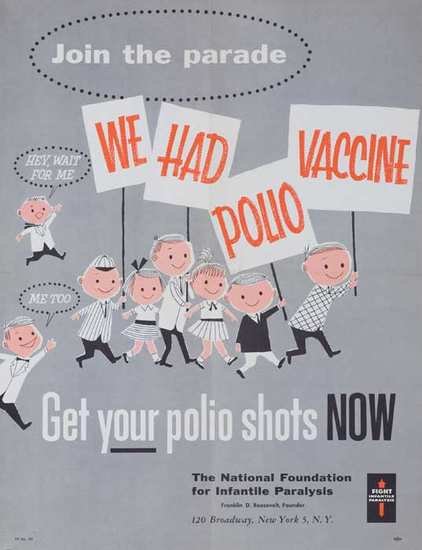
polio posterThe Tragedy of the Commons is a broader application of the Prisoner’s Dilemma (brief summary at Wikipedia). I wouldn’t call the Prisoner’s Dilemma the Root of Morality if it wasn’t for the fact that the Tragedy of the Commons is interchangeable with it, since the TotC is more common and a bigger problem.

Most laws are attempts to avert the Tragedy of the Commons. Take theft. Everyone is better off if theft is illegal. When property rights are stable people have incentive to make things, and society grows. In a world where everyone can take anything at will and there are no property rights it is nearly impossible to go beyond simple hunter-gatherer economics. Everyone is much better off. (as Paul Graham says: “the Europeans rode on the crest of a powerful new idea: allowing those who made a lot of money to keep it. Once you’re allowed to do that, people who want to get rich can do it by generating wealth instead of stealing it.”) But if a single person can avoid the restriction on taking things that “belong” to other people he gains immense personal advantage over everyone else, while still living in a rich and vibrant society! Thus it is in everyone’s personal interest to steal, while simultaneously demanding that no one else do so. The Tragedy is that if everyone does what is individually best for them, society crumbles (the Commons are destroyed) and everyone is much worse off, including the cheaters.

This is why the anti-vaxxers (people who refuse to have their children vaccinated) are morally evil. They are defecting in a TotC/Prisoner’s Dilemma situation. There are some miniscule risks to getting vaccinated. (Let me say right now that Autism is not one of them. Autism has been conclusively proven to not be linked to vaccination in any way, and the single study that claimed otherwise has been demonstrated to be maliciously fraudulent.) They are extremely rare, and as a compassionate society we’ve even set up a program to compensate and help people who are thusly injured. The fact that we can coordinate in such a manner makes me extremely happy, I didn’t realize we’d once had such a well-functioning government! Even if this program didn’t exist, the tiny risk of complications is worth the benefits. Small pox used to ravage populations, with a 20-50% mortality rate, usually leaving permanent scars, and sometimes causing blindness. Polio would kill and paralyze thousands per year just 60 years ago – people hid indoors during the summer months in fear of catching it. These have both been wiped out in the US, and other major childhood killers are held at bay, by a successful public vaccination program.

Anti-vaxxers take advantage of the fact that everyone else vaccinates their children. They live in areas with such a high vaccination rate that their children run no risk of catching the disease – it has been functionally wiped out. By doing so they avoid the risk of vaccination complications, and transfer that cost onto their neighbors. This is the very definition of an evil act. They are weakening herd immunity in their area for personal gain. They are no different from the thief who takes other’s property but expects society to continue to function as if property rights exist. If the community followed their example we would return to the Dark Ages in terms of infant mortality and public health. These people must be found and punished no less than the thief or the fraudster.

I’m not sure how long it took society to develop such strong taboos and counter-measures against theft and violence. But I hope we develop a strong defense against subtler TotC defectors much quicker than it took us to figure out slavery was bad.