Mar 132015
 

The_Martian_2014The Martian, by Andy Weir

Synopsis: An astronaut is stranded on Mars and must survive until NASA can send a rescue mission months later.

Book Review: I went in wanting to like this book, because I love narratives of the new economy triumphing over Old Media. I was not disappointed. :)

The best thing about this book is Andy Weir’s voice. He writes in an extremely personable style – you feel as if you are having a conversation with him right there in the room, and he’s an awesome guy to have a conversation with! He’s witty, and extremely funny, and energetic, and very friendly. This is a guy you want to know, and you get to know him for hundreds of pages. It is ridiculous amounts of fun. His humor isn’t the stilted humor you often find in books – it’s the way people today actually joke amongst themselves, and there were several times I literally laughed out loud.

The second best thing about this book is the problem-solving with real science & engineering. If you liked Apollo 13, there’s a damn good chance you’ll like this book too. It uses the same sort of solutions that combine the esoteric and extremely specialized equipment you have around you with a huge knowledge base to produce brilliant engineering hacks.

The third best thing about this book is that it is written clearly and doesn’t talk down to you. It realizes most people aren’t NASA scientists, so it explains everything to the lay person in common language. And Weir’s character is so friendly and likable that he always does it in a way that makes you feel like you’re a co-conspirator working with him, not a kid he’s lecturing to.

The book does have a few problems. First is that it’s written far too linearly. There is a problem, and then it is solved. Then a new problem is introduced. Then it is solved. Repeat until the end. This killed the tension after every solution, and eventually became predictable and therefore a tad boring. I read a disaster-recovery novel many years ago entitled “A Signal Shattered” which had a similar concept, but new problems were introduced before old ones were solved, sometimes putting the previous problem on hold with something more urgent, sometimes having to be resolved at the same time. Sometimes the solution to an old problem from several chapters back would provide a tool for solving a new problem, or vica versa. Othertimes solving one problem would simply lead to two new ones. The point was, the tension never died away altogether. That would have been a good thing to do.

Secondly, when it comes to the technical aspects of writing, Weir isn’t good at that yet. Whenever he stays with the blog-post-style (most of the novel) it’s fantastic, you love reading the words. But in the few places he switches to a traditional third-person narrative you can tell he’s a first-time writer, the words feel flat and the action feels clunky. There are things you can say in personal conversation which are perfect for conversation, but which do not fly in prose narrative. That’s why people don’t talk like books, and why books don’t sound like people talking. I’m sure Weir will learn over time how to write sharp narrative prose, but it was apparent that it’s not his strong suit.

That being said, all the fun and strong parts of the book really outshine its flaws. Recommended.

Book Club Review: This novel is perfect for book clubs. It reads quickly, several members finished it in a couple days. It makes you want to keep coming back for more, and you can read it in small pieces if you need to. It gives you quite a few things to talk about, both in its strengths and its flaws. One of our members used to work for NASA, and we were regaled with tales of how strict and uptight NASA culture was, and how no one who acted like any of the characters in the novel would have a job for more than five minutes at NASA. :) Another member pointed out that the protagonist is almost a non-character. He has no history, never mentions his past, and never hints at feelings deeper than super-smart class-clown. And yet everyone still loved this book. You can’t not love it, and that makes you want to talk about it a lot, both to discuss the joys of it, and to pick over the flaws. It even touched on a few interesting questions about humanity (how many tens of millions of dollars will we spend to save one well-known man, when we’re unwilling to use that same money to save hundreds of thousands of unknown peasants?) without ever being heavy handed or taking away from the fun of the story. I don’t know if I’ve ever read a better book for book clubs. Strongly Recommended.
Mar 052015
 

300x300xhugo-awards.jpg.pagespeed.ic.AsqaLzncTzThe deadline for the 2014 Hugo Nominations is almost upon us. I really should get to this a little earlier one of these years. Anyway, as is tradition, here are my noms.

Short Stories

Economies of Force, by Seth Dickinson.
I wrote an entire blog post about why this story is amazing and pushing the cutting edge of SF forward, so this is obviously my favorite. How do we react when we become the component parts of a super-human agent?

Kumara, by Seth Dickinson.
I really like Seth Dickinson. A beautiful post-singularity transhumanist story. And murderous too.

Kenneth: A User’s Manual, by Sam J. Miller
A heart-tearing story of desire and super-stimulus. “When it comes to beauty, we are insatiable. Art does not make us feel better. Love songs and Virtual Kenneths and Rembrandts only feed the fire that consumes us.”

Never the Same, by Polenth Blake
Strange Horizons does a great job with fiction starring non-neuro-typicals, IMO. Last year’s Difference of Opinion (by Meda Kahn) with an autistic protagonist was fantastic, I posted about it then. This year’s Never the Same has extremely good characterization of what are commonly termed “psychopaths” (or “sociopaths”). The storyline itself isn’t as good as Difference, but the characterization is just so strong and delightful to read I have to include it. It’s about morality and hypocrisy.
“Empathy wasn’t as simple as a mango. That’s why I needed my rules. I should have hugged her, not tried to reason with her. But the therapists wouldn’t accept that I was never going to understand. It wasn’t enough to follow the rules. They wouldn’t be happy until I could feel the rules.”

Jackalope Wives, by Ursula Vernon
I’m not sure what exactly to say here. The stories of shape-shifter-animal brides… what would they be a metaphor for, if you thought about for a while? Yeah. Ursula Vernon thought about it for a while, and then wrote a story that is about strength of character in a broken world, rather than the simple moralizing it could have been. Powerful.

EDIT: I originally hadn’t included the following, as it wasn’t publically available – it was a bonus story given for those who’d contributed to the Women Destroy SF Kickstarter. I was just informed that Lightspeed did make it available to all in December! So now I add:

They Tell Me There Will Be No Pain, by Rachel Acks
As story of warfare in the future, where killing is done at a distance with layers of drones between you and your target. I want to say foremost that this is a very strong story, with good exploration of drone warfare and its cultural impacts. It’s also hit a very personal note for me, because my brother came back from Afghanistan with very bad PTSD, and I saw him in every word and action of this story’s protagonist. It hurt to read.

Unfortunately that makes six stories, and I only get five nominations. I’ll have to think on who to cut. :(

I first heard Thirty-Six Interrogatories Propounded by the Human-Powered Plasma Bomb in the Moments Before Her Imminent Detonation on Toasted Cake in 2014, but it looks like it was published in 2013, so I guess I can’t nominate it. That makes me sad.

Novelettes

The Study of Anglophysics, by Scott Alexander
An amazing story of scientific discovery in a universe that runs on different physics. Also of obsession and arrogance. And anagrams. Lovecraftian overtones, but with a ton of humor. Seriously, this story has everything! :)

The Colonel, by Peter Watts
It is Peter Watts’s brilliance compressed into short form. If you liked Echopraxia and/or Blindsight, you’ll likely like this. Awesome exploration of neat ideas, as the human race stumbles towards making itself obsolete.

Novels

The Metropolitan Man, by Alexander Wales
A story of Superman, as it would be written by someone who took Superman’s powers and ethics seriously, and wanted Lex Luthor to actually be a viable threat. Told from the POV of Lex Luthor. I love good villain stories, and this is a particularly good one. I eagerly anticipate Alexander Wales first original-universe work, which I hear he’s working on now!

Echopraxia, by Peter Watts
The book HP Lovecraft would write if he was writing today. I loved it so much I posted about it twice. It is horror, so be warned, but it’s not gory. And it is extremely intelligent.

No Lasting Burial, by Stant Litore
Again, I had to write a full post about it. A retelling of the gospel story of the calling of Simon Peter, James, and John; with zombies. It’s good. If my childhood church had half of Litore’s understanding of the forgiveness message of Jesus, and even a fraction of his ability to convey it, maybe I would still be some flavor of Christian today.

BTW, if you’re interested in Rationalist Fiction, please note that my first selection in each of these categories would count as Rationalist IMHO.

Dramatic Presentation (Short Form)

The Study of Anglophysics, by Scott Alexander
It’s available in audio! :)

MLP – Pinkie Apple Pie. My Little Pony seriously needs a Hugo nod already, I can’t believe it hasn’t gotten one yet. While this may not have been the best episode of 2014, it holds a special place in my heart because it was so damn heart-warming, and a ton of fun. Good times, adventure, humor, and friendship. Everything I want in an episode. Plus a lot of Pinkie Pie! :)

Welcome to Night Vale – A Story About Them. I can’t imagine this show won’t get Hugo recognition this year, it seems to have gained enough critical mass to finally come into everyone’s awareness. A Story About Them was my favorite from last year. I’m a sucker for good structure-play. :) And the story well exceeded WtNV’s quota of weird, and creepy. Great times.

The Undertaker v Brock Lesnar at Wrestlemania XXX. As the Hack The Hugos post points out – better TV than Dr. Who! Let’s do it.

EDIT: I completely forgot about graphic novels! I’m nominating Rat Queens Vol 1, which is a delightful romp; and Pretty Deadly Vol 1, which I haven’t actually finished reading yet but which so far has blown me away with it’s density, and the story it is promising.

Feb 192015
 

Technicolor_Alien_Brain_by_ClaireJonesFrom Echopraxia (note that “Bicamerals” are humans that have self-modified to network their brains and thus reach post-human levels of intelligence) –

“You could look into the eyes of any cat or dog and see a connection there, a legacy of common subroutines and shared emotions. The Bicamerals had cut away all that kinship in the name of something their stunted progenitors called Truth

Those lines hit me right in the awe-sense. Yes. YES! I admire the HELL out of those people! That is true dedication to overcoming biases and gaining a correct model of reality. That is what a true love of Truth looks like. It is inspiring. It is amazing.

It is also scary, because it means cutting out parts of what makes us human. It is Peter Watts’ contention (if I read his book right) that it is even worse, akin to killing oneself, as you’d no longer be recognizable afterwards. If our species were to go down this path, it would be genocide, replacement by alien beings.

But it also seems to be his argument that such creatures would make humans obsolete. Never again would we be players on the stage of reality. We would become no better than pets, or chess pieces. The real players would be incomprehensible and unopposable. And that’s the true horror, for anyone who thinks such self-modification is inevitable. If you want to matter, you must leave behind your humanity. If you believe the change is radical enough to destroy your very self for all significant purposes, it means your choices are literally either meaninglessness or suicide.

On the one hand, I want to say “bring it on.” I’m very different from who I was ten years ago, and unrecognizably different from who I was twenty-five years ago. Evolution already killed (almost) all of us once, at puberty. It can do it again. I might as well beat it to the punch, and reincarnate in a form of my choosing.

On the other hand, I value myself a lot. The thought of killing myself, replacing myself with something not-me in order to affect the future, is fucking terrifying. Every practical concern in my body says “No. No. NO. NO!”

But… then that lure of the Truth comes out. Human brains can only know so much. These brains are better. All the hard-edged fiction I’ve ever read asks me “How much are you willing to sacrifice for your [loved one/planet/goal]?” I was raised to value the truth above all else, and to some extent I do. So when the heavens open up and the Lord asks me “How much does the Truth matter to you? How much are you willing to sacrifice for the Truth?” my lips reply “ALL OF IT.” and my soul cries “Yes, Yes, Yes!”

I don’t know if I’d make that decision IRL. And Peter Watts certainly is against it. But the emotions it stirs are awesome, and I hope the Noosphere deems  this work to be worthy of remembrance.

Feb 172015
 

echopraxiaEchopraxia, by Peter Watts

Synopsis: A biologist joins a crew to retrieve a sample of an alien life form, and becomes embroiled in the machinations of competing post-human intelligences.

Book Review: The novel follows a baseline (non-upgraded) human, in a world that contains post-human intelligence (groups of humans that have self-modified and networked their brains, as well as a new species of human with vastly superior cognitive abilities). The first half of the book seemed to go extremely slowly. Not because things weren’t happening – there was a lot of action. But the protagonist’s actions didn’t seem to affect anything. They didn’t drive the story forward. It was slow even though the plot and pacing were fast. If you keep reading, you eventually realize why this is.

Because the post-humans in this novel are the equivalents of Lovecraft’s Gods.

Lovecraft is very popular nowadays, especially among people who’ve never read him. Cthulhu has huge name recognition, yet most people know him as a gothed-up Godzilla. Maybe that’s because if you do read Lovecraft now, he’s not that scary anymore. But you can still get the idea of what he was going for. Various sources (as well as my reading) postulate that the essence of Lovecraft is to make humanity brutally insignificant, through the use of opponents so powerful they can’t be opposed, and so alien they are incomprehensible. It doesn’t work in Lovecraft’s writings that well (anymore) because the unknown areas he was exploiting are less unknown now. We’ve been off this planet a few times, space is less mysterious. The deep ocean isn’t as murky. Psychic powers have been shown to not be real. Etc.

It’s been said that a good translator doesn’t translate a work directly on a line-by-line basis. A good translator writes the book that the author would have written if the author spoke the language natively.

This is the book HP Lovecraft would write if he was writing today.

The reason the protagonists actions don’t seem to affect anything is because he is a pawn, and the real players are post-humans. Every action he is contemplating has already been taken into account and incorporated. His decisions are as determined and integral to the real player’s strategy as the falling of a domino, and he has as much ability to alter his fate as that critical domino piece. But it is impossible for him to really know that, he can only determine it after the fact when it looks like everything he did appears to have been exactly what was planned for. So he has to keep believing that he can affect his own life, that his decisions are his to make, as an article of faith. Because maybe they really DIDN’T foresee the next thing he’s doing! The book is a relentless, non-stop campaign of seeing that faith crushed again and again and again. At every turn humanity is utterly powerless, their efforts are futility. Greater forces are now the true players. It is a bleak hellscape of hopelessness.

What’s worse is that we can’t even comprehend what the post-human minds are up to. We are literally incapable of grasping it all, which is why it is never explained. You can catch some hints of the plot of the book if you look hard, but always only in retrospect, and it never fully makes sense. The only way to write a story of a post-human conflict for human readers is to leave them as lost and confounded as the protagonist, because any plot a human could understand wouldn’t be post-human, would it?

And the mood of the writing constantly reinforces the murkiness. Not only are all the sets stark, and too dim or too bright, and rotating, and off-kilter; not only are all the ambient sounds clicking and scratching and buzzing; not only is everyone always holding something back and slightly out of touch… oh no. Watts even goes so far as to make the world require a lot of cognitive effort to understand. He doesn’t say something like “They crashed into an aircraft carrier,” and then proceeds to describe the crashing. He will describe the sensation of being thrown about, and screeching metal sounds, and then take you outside and describe the metal surfaces you are viewing, without ever saying the words “crashed” or “aircraft carrier”, so you have to figure that out for yourself. I don’t know if that was intentional, but it is fatiguing and it makes the world harder to understand, so reinforces the theme of “you are too small to grasp this”.

The isolation in this book doesn’t come from something quaint like being far away from people. It comes from humans slowly enfolding themselves in their own private groups and sub-groups more and more, wrapping themselves up in technological filter bubbles, until all that’s left is themselves. The insanity doesn’t come from looking at something eldritch, it comes from deliberate psychological and physical manipulation spread over a long period to drive you to a desired mental state that is not your own. And the horror of corruption isn’t just something ugly growing in your body, it is the twisting of your own mental processes until gradually you are no longer you… and you know it, but can’t stop it.

This is a horror novel, IMHO. I generally don’t find horror scary. This scared the living shit out of me. For the couple weeks I was reading it my IRL mood took a very dark turn, my life was unpleasant, and things sucked. This is a powerful and amazing book, and it should come with a memetic warning. If you can weather a temporary mood disruption, read this book. If this is not a good time in your life, or you’re worried about downward spiral effects, avoid it like the plague.

This is easily my favorite book of the past year, and I will not forget it for a long time.

Highly Recommended, given the previous warning.


Book Club Review: It feels like Watts is writing to a very specific audience. Readers of SF Horror who are familiar with the transhumanist scene and are somewhat smarter than me. And he doesn’t care if anyone not in that audience understands a single word of what he’s saying. I admire this, but it also makes the book less appealing to a wider audience.

If you can get to the message of the book, you have a lot to talk about. How should we proceed as we inevitably start leveling-up humans? Is it worth pursuing, given the costs? Is it, when you get down to it, basically a new form of genocide?

We got hung up on “What is the plot? Can we figure it out? Can we fill in the holes in our knowledge?” IMHO the answer is “Maybe a little, but not to a degree that matters, and look that’s really not what we should be focusing on. The whole point was that it’s incomprehensible. Let’s focus on the message Watts is pushing.” But the temptation was too great. The discussion was not as satisfying as it could/should have been, nor as in-depth. I’m not sure if this can be blamed on the writing style of the book, but it’s possible. If the emotion of a piece is so strong that it drowns out the message, that’s a flaw.

Still, we had things to talk about, it certainly wasn’t a boring evening, and the novel is great. Give everyone the memetic warning beforehand, ask if they want to expose themselves to a temporary vector of despair like this. If everyone consents – Recommended.

Feb 092015
 

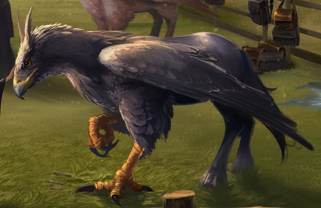
HippogriffI love the Sad Puppies Saga. It’s making the SF Lit scene fun again!

Brief summary for those not in the know: the Hugo Awards are considered very prestigious awards for SF literature. They are awarded by SF Fandom at large – anyone can vote. There’s a group of conservative authors (led by Larry Correia) who feel that the awards are too liberal and intellectual nowadays, and are leaving out the SF base of fun, action-y novels (a lot like the written-word equivalent of Marvel movies). They’re pushing their fans to register for the Hugos in large numbers and nominate and vote for more conservative and/or old-school works.

I don’t know how many people still bother watching The Grammys or The Oscars. No one I know has bothered with that for well over a decade, because it’s self-congratulatory crap, and you already know which movie is going to win – and it’s never actually a good movie. Crap like Forrest Gump is called Oscar Bait for a reason.  Same reason you never see a ground-breaking work winning the Grammys.

I was worried the Hugos could fall into the same rut. Then along comes Larry and shakes the whole thing up. :D

Here’s the thing about the Sad Puppies Saga – both sides are very sympathetic.

Side Sad Puppies: Larry points out that most of the authors he’s pushing are incredibly successful and wildly popular. It very much gives the feeling of a large populist base being ignored by a snobby elite. It makes you want to root for them to win. He’s charismatic, his fiction is fun to read, and all around he just seems like a super fun guy to hang around with. It makes you want to see him win. And he’s involving you directly, reaching out to us personally, so we will be involved in this win as well. Just good normal folk vs the out-of-touch intelligencia. Hell yeah I’m on board! Let’s do this!

Side Happy Hippogryphs: Have you seen most of the shit that Hollywood spews out? Remember Transformers? Despite being awful, they make hundreds of millions of dollars, and they keep getting made! You know when I knew I wouldn’t see the new TMNT? When I heard that they put April O’Neal on a trampoline. They put motherfucking bad-ass April O’Neal on a goddamn motherfucking TRAMPOLINE! Fuck EVERYONE involved with that movie. (yeah, sore spot for me. Venting is over now.) Anyway, a lot of the stuff being pushed by Sad Puppies isn’t much better. A lot of it is fun, and popular, but… it isn’t something you’ll remember ten years from now as a game changer. Unlike, say Pulp Fiction. Which, you’ll note, did NOT win Best Picture. Happy Hippogryphs are here to prevent the equivalent tragedy from taking place in SF. They aren’t always on the ball – Perdido Street Station didn’t win its year (though Mieville did get one later as a mea culpa). But at least we don’t give out awards to our Transformers. Yes, Jim Butcher is great! He’s popular for a damn good reason, and should be rightly proud of his work. But it’s not really revolutionary, ya know? So the Sad Puppies barging in, demanding awards for their rewrites of old-school action novels that were cutting edge back in Heinlein’s day, is like watching Michael Bay demanding that Kubrick and Scorsese acknowledge how great he is.
(all this is acknowledging that awful stuff does get nominated, but it is fortunately winnowed out in the awarding process)


It’s easy to identify with either side, and you want them both to win. This makes for the BEST sort of conflict. Different types of good against each other. Good vs Good is soooo much better than boring ol’ Good vs Evil conflicts. And the battlefield for this isn’t some dumb slug-it-out match, it involves politics, manipulation of rules, riling up the emotions of the base… in short: social manipulation. Those are the most fun sorts of conflicts to watch! Good v Good in social manipulation struggles? It’s like I’m INSIDE my favorite books, except I don’t have to worry about the world ending if the wrong side wins. :) Everything about The Sad Puppies Wars makes me excited to see what will happen next. The speculation even seems to be spreading beyond the typical SF bounds, which means that even the wider non-SF world is finding our awards interesting! This is fun, and I’m glad it’s happening while I was around to see it and take part.

Jan 272015
 

tim_powers_last_call_coverLast Call, by Tim Powers

Synopsis: A dark Gaiman-esque retelling of The Fischer King legend, mixed with Tarot mysticism and gambling, set in the early 1990s.

Book Review: An interesting tale. It kept my attention and moved quickly. It is filled with a delightful plethora of psychotics who are all demented in new and interesting ways, and you cheer when they finally meet their well-deserved doom. The creepiness of the story reminded me strongly of Stephen King, although I’ll admit I have actually read very little Stephen King, so that’s more of an impression than a statement of authority. I liked the treatment of alcoholism as well. Powers pulls in many aspects of many myths, creating a very rich mythical stew that is savory to read.

However, something about it felt lacking. I can’t quite put my finger on it. Maybe because I’ve always thought gambling is dumb? Or because the particular myths Powers chose for this book don’t inform my upbringing, and so didn’t mean anything to me on an emotional level. Perhaps because I couldn’t figure out why the hell anyone would want to be the King in the first place. It comes with a truckload of shit, and not a single discernable benefit. Why no, I don’t care to needlessly complicate and endanger my life for no reward. The ending also fell flat, which was a bit disappointing with such a strong foundation. It builds and builds but doesn’t go anywhere. It’s a fine book, but I didn’t get anything out of it, so… Not Recommended.

Book Club Review: A pretty good book for book clubs. It reads fast and there’s a lot to like. Due to the previously-mentioned deep mythological roots there will be a lot to discuss if one or more people in the group are well-versed in those myths, or English Lit generally. We kept talking for quite a while, and went over time. Certainly no one disliked it. If you have other options I’d suggest keeping this one at the back of the list, but you could do a lot worse. Mildly Recommended.

Jan 072015
 

Asimovs Feb 2015Asimov’s Science Fiction has purchased one of my stories!!! This is the first thing I’ve written to be published. I’m very proud. :)

Edit: So excited I forgot to say: It is “Red Legacy”, on page 48.

I’m not sure one can call it Rationalist Fiction, but it is at least rational. It follows a Soviet mad scientist during the Cold War era.

It appears in the February 2015 issue of Asimov’swhich is actually out right now. It is pictured in this post. You can find it in any fine bookstore. [edit 08/04/15: you can now read it online free, at my Fiction page. Or buy it almost anywhere that eBooks are sold.]

Since writers are an egotistical bunch and love talking about their work like parents love talking about their kids, I’ll be posting a few more times over the next week about writing this piece. Sorry about that, but at least I’m warning you in advance. :)

Dec 022014
 

steerswomanThe Steerswoman, by Rosemary Kirstein

Synopsis: A rationalist monk investigates why the wizards of her world want to destroy her order

Book Review: I’d heard this was a rationalist novel. I was not disappointed. Much of the meat of this book is in applying the tools of thought and observation to puzzle out what is happening, or to evaluate options and choose between them. Clues are fed to the reader constantly, some just before the puzzle’s solution is presented, others far in advance, and several things are left unknown to the protagonist at the end of the story which we as the reader have figured out (though we do have a massive advantage which I won’t get into due to major spoilage). A lot of the remaining action is in the domain of subterfuge and misleading your opponents, while attempting to see through their subterfuges. Unfortunately the writing of actual physical action (there are a few fight scenes) is kinda clunky. It doesn’t feel exciting, and it’s hampered by over-analysis, which takes the urgency out. That’s ok, I’m not here for the fight scenes, but it does detract from the book a little.

It endeavors to teach the reader a usable skill as well. I was pleasantly surprised to see the protagonist say (not literally, but close enough) “I notice I am confused” and go on to explain that there is no confusion in reality, and therefore something she thought she knew about the world is incorrect, and now she must find what it is. Written almost 20 years before Yudkowsky’s Sequences, and yet the similarities were astounding. Rationality is timeless. :)

The humanist/transhumanist ideals are there as well, from the protagonist’s deep-seated emotional aversion to spreading untruths, to the statement at the end that while the villains can kill individual rationalists, they can never defeat human progress, and thus as long as it’s possible for humans to grow in knowledge the villain will ultimately be defeated. It’s good stuff!

And the primary conflict is between value systems rather than good-vs-evil, which again fits the rationalist motif.

But is it a good story, you ask?

Yes. It is. The writing is solid (although there is an epidemic of people laughing their dialog that felt unrealistic). The plot keeps moving at a strong pace, and the characters are likable and relatable. So much so that I was angry at one of the characters when she did something reprehensible, and I was sad when one of the villain’s lieutenants was killed. There’s one really gripping scene near the beginning that gut-punched me with its unexpected tragedy – a prime example of no one being evil but the system being broken – that I won’t forget for some time. It has some rough patches, and a few errors I could do without, but overall it’s a good book, and I’m glad there’s another rationalist novel I can point to proudly. Recommended.

Book Club Review: If you’re not a rationalist, the novel isn’t quite as enthralling. As I said, it’s a good story, but it’s not stellar. I was told that the rough parts stick out more when you aren’t enamored with it. And it turns out that if you aren’t reading with some attention it’s possible to miss the puzzle altogether.

Also of interest – a couple readers couldn’t figure out the Steerswoman’s motivation, so the entire thing felt kinda rambling and unfocussed to them. At first I was confused. “What do you mean there’s no motivation? There’s an existential threat against their entire way of life!” It turns out that for people who don’t already deeply identify with a philosophy of pursuing truth and growing the knowledge base of all mankind, if an outside force threatens to both curtail all explorations of certain phenomena and permanently hobble the scientific spirit… that’s not really a big deal. I know, that sounds crazy to me too! But I guess not everyone places as much importance on those ideals, so they don’t see why others would risk their lives to defend them.

There are some great things for rationalists to talk about if they read this. There are a couple instances of the Steerswoman failing at rationality, which make for good topics. More importantly, there are a couple of systemic flaws in her order’s approach to rationality that really seem very glaring in my opinion. The merits of these are arguable, and one can speculate as to whether this was intentional on the author’s part and will be addressed in later books, or was oversight.

There were plot points that non-rationalists can discuss as well, in particular a couple moral decisions/shirkings that happen near the end which spark a fair bit of emotion. But in the end all I can say is that, as an aspiring rationalist, I am completely unable to say whether or not this book is a good recommendation for book clubs in an objective way. I liked it, and I am excited about it. If you are an aspiring rationalist as well, and you want to expose your book club to rational fiction, and they’ve already read Blindsight, this is a good book to go with.  With the caveat that my judgment is colored – Recommended.

Oct 302014
 

The very first illustration of Frankenstein and his creature, by Theodor von Holst, published in 183Frankenstein, by Mary Shelley

Synopsis: The original 1818 Frankenstein.

Book Review: Ugh. Frankenstein has been called the first work of science fiction. But the person who called it that defines science fiction as “hubris clobbered by nemesis,” (at least if I’m to believe Neil Gaiman) which really should have been my first clue. But I was really excited to get to my roots, so I wasn’t paying much attention. And it started out great. All gothic and dramatic and Lovecrafty (yes, I know it predates Lovecraft by a century). The language is extremely pretty, as is the case for most things written around this time.

Unfortunately it seems that writing technique hadn’t yet been well developed. I’ve said before that this isn’t really the author’s fault. We can’t fault pre-Renaissance painters for not knowing of perspective and proportion, those techniques just hadn’t been invented yet. But it’s still painful to read. Do we need to have the same piece of “The maid is guilty!” “No, actually she’s innocent!” dialog repeated THREE TIMES IN A ROW by six different characters? The second and third repetition added nothing. Furthermore, the past seemed to not know that Showing is preferable to Telling. I can’t count how many times Shelley basically wrote “I was really really really upset” rather than showing us the emotion in some way we could feel it ourselves. And speaking of superlatives – good god, she went through the entire list and started again from the top, twice. Frankenstein’s monster was never really described – I still don’t have a very good idea of what it was supposed to look like, aside from being eight feet tall. What we got instead was line after line after line of “Very, extremely terribly, indescribably, superbly, ultra-extra-mega-UBER UGLY!!” Which helps me not at all.

Getting away from technique though, Miss Shelley also fails to deliver a believable world. It seems the universal human reaction to seeing a really ugly super-tall guy is to IMMEDIATELY ATTACK HIM MERCILESSLY AND BEAT HIM WITH STICKS UNTIL HE RUNS AWAY. Without any good reason, and without exception, regardless of how gently the monster tries to approach them. I may not know a lot about 19th century Europe, but I’m pretty sure there were at least a few ugly motherfuckers walking around, and I believe most of them managed to exist in society somehow. As far as I can tell, “evilness” and “goodness” in Shelley’s world are native characteristics you get at birth that are unalterable, and are immediately obvious to others at a glance. It’s very much a Disney-esque “pretty is good, ugly is bad” philosophy. It’s reinforced multiple times across multiple characters, and is most striking when our lame-ass and objectively vile protagonist is repeated described as one of the “greatest examples of humanity, that all strive to emulate” by everyone in the novel, including the monster he treated like shit.

But let’s set aside nit-picks and get to what really sucks about this book.

I’ve mentioned on a few occasions that I can’t stand plots that only exist because the protagonist is completely idiotic or pathetic. If your story is about someone lamenting how awful it is to be starving to death who is inside a room full of food but is too lame and pathetic to reach out and put some in his mouth, I have nothing but disdain for your inability to write an interesting story. There are amazing stories about people doing their best to get calories by any means necessary and STILL nearly starving to death! Write something like that! Don’t waste my time because you’re too lazy to figure out how to put non-idiotic/pathetic people in tough circumstances.

Victor Frankenstein is the worst kind of pathetic. His every action is whining and shirking responsibility. I would not trust him with a pet rock. Seriously, every pregnant teenager you’ve ever seen on Jerry Springer has orders of magnitude more responsibility and self-control than this wanker. He goes about bringing a new sapient life into this world, and upon awakening it he realizes that it’s really very-super-ultra-ugly. So he abandons it. That’s right – a few minutes after it wakes up in a confusing and hostile world, without any experience or knowledge or ability to talk – he walks out on it and leaves it to die, because it was ugly. This would’ve been a simple story of infanticide if Victor hadn’t been unlucky enough to create an 8-foot tall infant that managed to feed itself on nuts and berries. And he doesn’t even think twice about it. A few hours later Victor runs into a friend and they return to his apartment. The monster has left by then and Victor says “Whew! He’s gone. Guess I dodged that bullet!” and never once feels any sense of remorse or worry, either for his monster or for his neighbors who now have an 8-foot-tall unsocialized infant unleashed upon them! Good thing that’s not Victor’s problem anymore!

This continues throughout the book. Later, when Victor finds out his monster is killing people, he resolves not to tell anyone about it, because… reasons. And when an innocent girl is accused and convicted of the murder, instead of standing up and saying “Look, she didn’t do it. I know exactly who did it, why he did it, and what he looks like. Release this poor innocent girl!” he decides to just shut up and let her go to her death because, look, being a decent human being with a smidgen of responsibility just isn’t the sort of thing Victor does! He’d much rather let various other family members and friends of his be killed instead, including his new bride.

Also, here’s Victor Frankenstein’s reaction to first re-encountering his monster after it had killed his brother:

“Devil! do you dare approach me? and do not you fear the fierce vengeance of my arm wreaked on your miserable head? Begone, vile insect! or rather stay, that I may trample you to dust!”

That’s the extent of his action. Bluster, and contradictory bluster at that. W.T.F??

Seriously, the monster should be the protagonist of this piece. It survives without any guidance, teaches itself language, and pursues its goals successfully across multiple countries and several years.

One good thing did come from reading this. If anyone ever again says that Frankenstein is about the dangers of scientists “playing God” I will immediately know that they’ve never read the book and have no idea what they’re talking about. Victor’s scientific achievement is creating a new human life. The same “playing god” that nearly every post-pubescent woman since the dawn of history has been able to do, and which most of them do actually do. This isn’t a story about playing god; this is a simple story about a negligent parent abandoning his child, with an SF twist, and the wrong protagonist.

Needless to say, Not Recommended.

Book Club Review: Everyone else seemed to enjoy it a fair bit, and there was a decent amount of discussion. Plus it’s historic, and you’ll get to say you read it. And it’s short and very skimmable. If you can stomach child-abandonment stories that try to make the abandoner the hero, you may want to check it out. Very Mildly And With Great Hesitation Recommended.

Oct 102014
 

Golem and Jinni
The Golem and the Jinni, by Helene Wecker

Synopsis: An unlikely love story in turn-of-the-century New York.

Book Review: This is a solid story about two fish-out-water characters who come to rely on each other in a strange world. It hooks you early with a fairy-tale style, then builds slowly, establishing all the major characters firmly before it brings them together. The more you read this book the more you want to keep reading it, but it never feels unbearably urgent. It is an altogether pleasant read, it wraps up everything well, and it features strong characterization and an interesting plot. While all this is good, it’s not entirely enthralling either. If this was all there was to the book I’m not sure I’d recommend it. I don’t have a ton of free reading time, and simply being good isn’t quite enough IMHO.

Fortunately, there is more. The Jinni is a fire elemental, with exactly the personality to match (passionate, flighty, irresponsible); whereas the Golem is an earth elemental with the matching characteristics as well (solid, dependable, conservative). At first one thinks this is simply good writing, but the more I read the more I became convinced that these two characters represent the male and female genders and the book is about gender relations and the chains of biology in a pre-reproductive-control society. The men can be reckless, they do not have to suffer the consequences of their actions. This allows them freedom to pursue their whims and passions. The Jinni does what he wishes, often carelessly destroying lives without knowing he’s doing it, without a care in the world. He is unconcerned with the trouble he could bring to his immigrant community, he doesn’t understand concepts like limiting yourself out of concern for the unfair ways the world may punish others. He behaves as if the world is fair, because he’s never the brunt of any injustice. The women, OTOH, must bear the fallout of men’s bad choices. They are expected to be always restraining the men, and always policing their own actions, because it’s their lives that are ruined by a mutual decision. And society reinforces this, doubling down on the pressure put on women and freeing the men, in a sick game of piling-on.

It’s a very effective metaphor in multiple ways. The Golem starts out the property of a man. Her father-figure tries to find a kind, new master for her when the first man dies. Her destiny is always to be bound to a man. Interestingly, she even desires this – when she’s free she’s uncomfortable. And even while she’s free she’s always serving others, and always tailoring her actions to comfort and appease those around her. Both out of desire and out of fear. The claustrophobic feeling of being a woman in an institutionally sexist society is palpable.

It isn’t all roses for the Jinni either. When he’s wounded and his fellow Jinni arrive he’s very concerned about hiding his weakness, which is an aspect of male culture you don’t see engaged very often – the constant fear of showing any weakness and always having to project a strong front can be very isolating. Particularly when you actually need help.

This aspect of the book increases my enjoyment of it a good deal, so yes, Recommended.

Book Club Review: Not surprisingly, this book makes for some fairly good talking. In addition to the gender themes there is some commentary on both religion and free-will/determinism which allows for further discussion. Plus portrayal of immigrant culture and ghettos in the early 1900s. Combined with the book’s natural charms and a very comfortable length, it is likely this will get a good percentage read-completion and involvement from everyone attending. Again, Recommended.