Oct 292015
 

water knifeThe Water Knife, by Paolo Bacigalupi

Synopsis: Grimdark near future where the American Southwest collapses into low-level civil war over water.

Book Review: Bacigalupi is known for his post-environmental-collapse dystopias, and this is another fantastic entry in that style. Many of Paolo’s works carry a theme of ‘We are living in an absurdly wealthy period, where we can afford things like compassion and charity. When the easy resources dry up and we are left fighting over the remaining scraps, those who try to retain their compassion and humanity will be torn to pieces by the people willing to do what is necessary for survival. People are always exactly as good as circumstances allow them to be.’ Moreover, we’re currently able to believe any old crazy thing for that reason, but in the near future people will be forced to see reality only as it is, or die. It’s a very Hansonian view.

He differs from Hanson in that Hanson says this isn’t as bad as we think it is, and “poor people still smile”, whereas I think Bacigalupi’s message is “So let’s work hard to make sure THIS NEVER HAPPENS.” And he shows you vividly what the This is, and how it could happen. Don’t expect an uplifting story.

Bacigalupi’s writing is strong, the story never falters or lets up, and you feel like you are in a crumbling metropolis. The city itself feels like a character, with large events taking place in the background that both make for great flavor and inform and constrain the human protagonist’s actions. You realize that these people are just one small part of a large world. The human protagonists themselves are fantastically portrayed. Even when they are doing awful things you are rooting for them, because they’ve won you over with their ideals, or their fears, or simply their desperation to not be ground down and abused every single day. I sympathized deeply with every character, and in each case for a different reason.

In short, this is a very good book. Strongly Recommended.

Book Club Review: Also a fantastic book for book clubs! There is SO MUCH to talk about here! And I don’t just mean the message portion, because frankly all of us in the book club are already very much onboard with Bacigalupi’s message, so we didn’t talk about that part at all. Rather, the portrayal of humanity and what happens to us when the shit REALLY hits the fan lead to a lot of discussion over the nature of humanity, and whether Bacigalupi is a cynical misanthrope and we’re better than that, or if he’s just a realist who isn’t afraid to view the world with open eyes. (You can probably guess my position by the phrasing of that sentence). The fact that this is very near-future really drove home that this story is about us, and made a lot of people challenge his assumptions. There was a lot of talk of idealism vs circumstance, and whether we are uniquely situated to fail in situations our ancestors wouldn’t, because we are so socially isolated and insulated that the institutions of community have broken down and all we’re left with is this fragile individualism that isn’t actually worth shit in any non-modern/non-super-wealthy situation.

Plus lots of discussion about character arcs and plot elements. One of the major contributors to the discussion is that this is NOT a perfect book. It has flaws, and those imperfections add to the conversational grist as well. The discussion was so rich and interesting that we ran right up to closing time without realizing it.

One caveat – two of our members had very negative reactions to the grimness of the book, one in particular is in a bad stretch of life right now and declared she wouldn’t be reading any other works by Bacigalupi. I can’t blame her. It’s not the worst thing ever, it’s certainly not slasher horror or anything, but it may be a bit too much for some readers. With that warning – Strongly Recommended.

Cultural Appropriation Watch! The protagonists in this work are American Hispanic female, white female, and Mexican male. Bacigalupi is none of those. A couple of our bookclub members (who don’t read my blog) expressed appreciation for the diversity of the cast. It was very well done, and definitely increased the quality of the storytelling! The Appropriation Police would have us whitewash this book so it only contained white male characters (bleh) or simply not allow it to be published at all (bastards!!!). They shame their ancestors, let us hope they repent their ways quickly.

Oct 162015
 

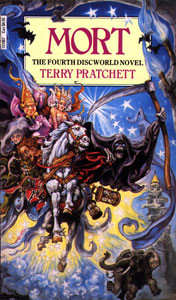
Mort-coverMort, by Terry Pratchett

Synopsis: Death wants to take a holiday, so he takes on an apprentice to cover for him, and things go as well as you might expect.

Book Review: If you’re one of those people who hasn’t read Pratchett before and wants to know what the big deal is, here’s half of the big deal:

His writing is stellar. He creates a world that is charming and extremely fun. It shows a fondness for the tropes of sword-and-sorcery fantasy and mocks them affectionately while simultaneously using them to tell a good story. His characters have a joy-in-life but aren’t naïve. They are, in fact, generally very smart, and react the way an intelligent reader would react, rather than the way a stereotypical “hero” might.

Pratchett is genuinely funny, and often made me laugh. His turns of phrase are delightful. And he breaks the fourth wall frequently in his books, talking directly to the reader, so it isn’t a traditional narrative insomuch as it is a favorite uncle regaling your with a tall tale. In all of this his love of writing really shines through, you can feel the passion this man has for this craft.

That being said, this is only half of what makes him good, and isn’t enough to hold my interest on its own. The other half of what makes Pratchett great (with a caveat I’ll get to soon) is that he has something to say. He cares about our world, he cares about his fellow man, and he’s pissed off about the ways society sometimes fails us all. He will let you know what is wrong, and what can be done about it, in no uncertain terms. He’s assertive and has the strength of his convictions. In a word – he writes excellent message fiction.

The first book of his I read was Going Postal, one of his later ones, about why certain social services (in this particular case, the Postal System) are damned important, and a really good thing, and efforts to privatize it can go suck an egg. It is amazing. I fell in love right away. (The Truth is similar, for journalism)

So that caveat – Mort isn’t like this. It’s one of his early books, and he hadn’t come into his own yet. Maybe he was worried about offending people? You can still see hints of that passion poking through here and there, but it feels like he’s pulling every punch that he takes, and not even swinging at all most of the time. It ends up being a humorous little tale that doesn’t go much of anywhere or say much of anything. And it’s OK, I guess. But his later work is SO MUCH BETTER! Including his books focusing on Death. Although I haven’t read it yet, I hear The Hogfather is truly excellent, has things to say, and it will make you stop and really think about our society… while still being extremely funny and a great story to boot.

If you are reading your way through all the Discoworld books… well, in that case you don’t really need this review. But if you don’t have time to read even half the things you’d really like to, don’t spend that time on Mort. You’d be FAR better served reading some of Pratchett’s later works. Not Recommended.

Book Club Review: Basically all the things I said above apply here as well. It’s kinda fun to compare everyone’s favorite scene/joke/gag, but in the end the book just doesn’t have much to say, and so there isn’t much to say about it. It reads fast and it’s funny, so it’s not a let down, but it certainly didn’t spark anything either. Not Recommended.

Sep 252015
 

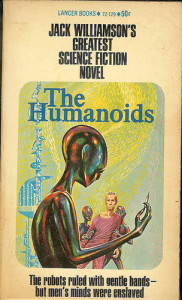
humanoidsThe Humanoids, by Jack Williamson

Synopsis: Failed Utopia: Benevolent AI is too paternalistic, doesn’t allow humans to do anything, humans rebel.

Book Review: Atompunk isn’t a term I’m terribly comfortable with, because I think the practice of adding the –punk suffix to everything is reaching the point of risibility. But for those unfamiliar, it’s a sub-genre that takes place in the future as it was imagined in the 50s. The best popular example is the Fallout series of games, in which the pre-apocalytic world is basically atompunk – 1950s Leave It To Beaver wholesomeness with chrome and spandex everywhere, and EVERYTHING runs on atomic power, from your car to your teapot. This feels like an atompunk book, for the most interesting reason – it was published in 1949. This is atompunk the same way that Pride and Prejudice is steampunk. Which makes it really interesting to read.

Stylistically, it’s quite a throwback. At times it’s charming, such as this line near the beginning: “For Starmont was not on Earth, nor Jane Carter’s language English; even her name is here translated from less familiar syllables.” I can’t even read that with a straight face, it’s so damn adorable! Other times it’s just tedious, with lots of narrative assertions and truckloads of tacked on adverbs.

But what about the content, you ask? Well. This novel is a one-trick-pony. It’s basically a straight helplessness-horror story, with a twist at the end. When it does that trick, it does it very well. The frustration and rage I felt at the machines taking away everything made me grind my teeth as I was reading. The constant paranoid fear of having to always present as super-happy in every moment of your life or risk being permanently drugged up with stupefying euphorics was terrifying. This was hell, and death would be better, if not for the glimmer of hope that perhaps the monsters can be overthrown. But unfortunately the trick doesn’t take a novel-length work to play out. It would be extremely effective as a short story or novelette (and indeed Williamson did originally write this as a novelette, which I hear is outstanding), but when it’s stretched out into a novel there’s many many pages that add nothing and seem to be just the protagonist spinning his wheels. It was kinda annoying.

The thing that kept me coming back was the ambivalence in the novel. It’s hinted that maybe the machines aren’t so bad. Our protagonist is certainly an asshole, and destructive both to himself and those around him, so you can’t say for certain that the machines are wrong in not giving him full freedom. You suspect he might not be a reliable narrator, and you keep going to see if there is a twist at the ending.

And there kinda is, but kinda not. Is it worth suffering through the middle for the reveal at the end? If this was shorter, I would say definitely. At it’s actually length…. Eh. Ultimately, I’m glad I read it. I would recommend skimming through the whole middle part of the book, but the strength of its horror-front and twist-back push it into Recommended.

Book Club Review: There will be spoilers in this section, so if you don’t want to read them I’ll simply say right now – for Book Clubs, I STRONGLY Recommended this. Discussion why below. It includes spoilers, so turn away now if you don’t want them.

.

.

.

.

Last chance.

.

.

OK, so. The ending to this is basically a mirror of the ending to A Clockwork Orange. It turns out that the machines gladly give humans the freedom to do whatever they want, including self-harming behavior, once they are mentally and emotionally mature enough to evaluate the risks and choose to take those risks from an informed position. It’s a lot like how we don’t allow children to buy alcohol or tobacco or refuse chemotherapy, but we do allow adults to do those things. Not only that, the machines actively repair damaged humans so they are raised to that level of maturity and can make those decisions – they are uplifting the species, in a sense. In this respect they remind me very much of the humans in Three Worlds Collide who repaired the Confessor’s Fetal Alcohol Syndrome and gave him therapy and whatever.

But the thing is, the author didn’t intend to portray this in a positive way. You can tell he meant for this to be horrific, in part because of the implicit claim that 99+% of humanity needs this upgrading before the machines will give them freedom, including our “normal” protagonist. He just did a shitty job of presenting it as horrific (IMHO). This led to a very interesting split in our reading group, between those who read it as it was intended, and those who read it the same way I did.

Since it’s obvious that the author wanted this to be horrifying, it’s easy to go along with that. It was argued that it’s evil that they forced this uplift on people who didn’t want it. It was argued that making everyone conform to one vision of “normal” destroys all the variation that makes life worth living. It was argued that the life of the super-happys is not worth living, we must be free to feel pain and disappointment and boredom. It was argued that without the ability to hurt and grow as people we are impoverished and we would lose not only our humanity, but also the art that lifts us up and glorifies life. You can’t have 10,000 Days without a suffering artist.

And first of all, this makes for some AMAZING discussion!! Both the arguing of the actual points raised (for there are counter arguments… shouldn’t we help this homeless person (trigger warning: extremely depressing) if we could? Is it right to make others suffer so we can consume amazing art? etc), which was stimulating and passionate! But also because ultimately I do agree with ALL those points! But the problem was that this isn’t the world portrayed in the book! The world portrayed in the book is one where the AI actually does a good job of balancing freedom and responsibility, where the machines fix people to make them more human, more the people we want to become! Williamson wanted to write the ending of 1984, where it is clear that people are being destroyed and mind-raped into loving the system that controls them. But he didn’t even get A Clockwork Orange, where reasonable people can say “The method is flawed, so even though the results are good now, we should be wary that this could be used on normal people instead of murder-rapist psychopaths.” Williamson went all the way into “How is this not actually a utopia?” territory. And I think the interplay between readers who are willing to say “Fuck you, even if they’ll thank you for it afterwards it’s still brainwashing and turns them into different people!” and those who say “Sometimes who we are could use upgrading” makes for really fascinating dynamics.

I’m still not even sure I’m on the right side, to be honest.

So yes, this sparked some of the best conversation we’ve had in months. STRONGLY Recommended.

Sep 112015
 

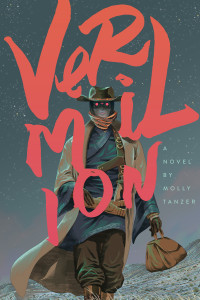
vermilion_cov_smVermilion, by Molly Tanzer

Synopsis: A weird western following a half-Chinese exorcist as she tracks down an evil force in the Colorado Rockies that’s killing her countrymen and turning them into undead.

Book Review: Boy am I conflicted about this book. It has all the trappings of something really great, but then it falls short of the mark in really frustrating ways. Let’s start with the good stuff.

The book is fun! It’s imaginative and well written, and the dialog pops! Tanzer has a fantastic way of bringing people to life through their words, letting them reveal their own character. It’s been said that Joss Whedon is an accidental feminist, because his strength is writing amazing dialog, and you can’t write amazing dialog with people who aren’t real to you. Tanzer has a similar strength, and no, this won’t be the last time I compare her to Whedon.

The writing is very modern and casual, in a the-narrator-and-reader-being-real-and-talking-with-each-other way. You feel like you’re a close friend of the narrator, and she’s just laying out her life for you. Lines like “[The couple] looked at Lou as if she’d strutted up and farted right in their mouths,” get you to love the narrator. The novel is full of this frankness and humor that is delightful to read.

It also starts out fairly light and wise-crack/adventure-ish, but keeps displaying flashes of darkness, and near the end takes a hard left turn into Quite Dark territory, with gore and torture and such. Again, very Whedon-esque, where he starts out with a wise-cracking cheerleader type and can take you into something like the Miss Calendar or Dark Willow episodes with stomach-dropping rapidity.

And, of course, the villains are just as real as the protagonists are. The villain and his wife (when not slipping into the abuser/battered-wife dynamic they sometimes have) are ABSOLUTELY ADORABLE! I loved them! The fact that you can relate to them, but still really hate the fucker and want to see him die a horrible death is fantastic.

And the cast of supporting characters is quirky, strong, and interesting. You see all the reasons to love it, right?

I do feel there to be two major flaws though, one which hindered my enjoyment, and one which hindered everyone’s enjoyment.

On the personal level, it never went very deep. It started to, several times! When a vampire-sympathizer brings up the protagonists hypocrisy because she eats the flesh of mammals and doesn’t think twice about it, I thought we were really going somewhere! Especially when she considered for a while, and conceded that maybe it was so bad, as long as they were otherwise good people and stuck to hospices for the dying to “feed on the weak and sick, like any other honest predator” she might have no beef with them. Unfortunately this is never explored again. It’s just left there, and we never have to worry about it because it turns out our villain is quite evil. Likewise, when the vampire-sympathizer points out that the undead are hunted simply for existing, our exorcist protagonist flirts with a crisis of conscience. She thinks maybe the undead are people too, and instead of forcibly expelling them from our existence – basically re-killing them – maybe they have some right to un-life like real people do. Then she never again worries about anything like that, and keeps doing her job of killing ghosts and zombies and vampires. It’s super-disappointing to have something that potent brought up, and then just dropped and staying instead with surface-level action and unrequited-love stuff. :/

A more general complaint is that the stakes are never very high for the protagonist. One might say they’re almost non-existent. She doesn’t seem to care about anything very passionately. We never get the feeling that if she loses it’ll matter. There’s no one she’s fighting for, no fate of the world at stake, etc. Even when her own life is in danger it doesn’t feel like that big a deal, because she’s so cool and jaded about everything. As readers we never have an emotion stake in her winning, aside from the “well, she’s the protagonist” thing. This left me (and the other people in my book club) feeling very unsatisfied by the novel. The trip was fun, but in the end it didn’t seem to matter much and it was hard to figure out why.

Which leaves me at an uncomfortable place – I am honestly not sure if I would recommend this book to past-me or not. I like things with substance to them, and this novel felt like it had great style and flair but lacked heft. I guess I’ll have to put it down as “Recommended if you’re looking for reading material, but don’t bump it to the front of your reading list.”

Book Club Review: Due to a confluence of unrelated factors, our turnout was pretty low this week, so I’m not sure I can judge how well this works for book clubs in general. However even with just three of us there ended up being quite a bit to talk about, as we tried to figure out why it was that we seemed to both like this and not like it at the same time. And, to be fair, some people liked it quite a bit, while others were far less happy with it. Having a wide spread of opinions like that is also quite conducive to good conversation, leading us to compare notes and argue points. That fact that it was enjoyable on a page-to-page level helps too. Though I’m not as confident as normal, I would say that for book club purposes, this is Recommended.

Sep 022015
 

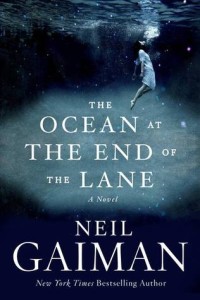
Ocean_at_the_End_of_the_Lane_US_CoverThe Ocean at the End of the Lane, by Neil Gaiman

Synopsis: A seven-year-old boy’s life is turned upside down when an Eldritch Monstrosity moves into his house disguised as a nanny.

Book Review: Anyone familiar with the SF/F scene doesn’t need me to tell them this, but I’ll reiterate it – Neil Gaiman is a hell of a storyteller, and a damn fine wordsmith. This story is told as a retrospective by a middle-aged man in the current day, recalling a childhood incident in 70s Britain. It manages to be touching and insightful, combining the wisdom of an older man with the innocence of a young child in the same narrative. That sounds sappy when I write it out, but Gaiman makes it work with his charming style. The magic is fantastical and blurry, and all the characters feel like they’ve come straight out of your favorite fables – vibrantly colored and larger than life.

There are a number of great things about this book, but the biggest success is in portraying how helpless children are, how completely at the mercy of adults, and how terrifying that is. Your world is so small, and everything in it so much bigger than you, and you have no recourse if it turns against you.

The biggest flaw in the book is that the boy gets an over-powered ally, which ends all meaningful conflict once he makes it into her protective sphere about 2/3rds of the way through the book. After that he is (almost literally) under the protection of god. All the conflicts are resolved by the goddesses, mostly offstage, and always with very little the boy can do to have any effect. Don’t get me wrong – the climax is heart-pounding and incredible! The boy is running from the eldritch monstrosity, lost in the fields, being taunted by her, unsure of where he is and if he can get to safety and how he can save himself. But once the climax is over, the story just keeps going and going as the goddesses do other things. Those things are played off as part of the storyline, but they aren’t really… the story was resolved when the boy escaped from the monster/nanny. If the goddesses had only been less omnipotent, and the boy had something he could do to help them, this wouldn’t have been a problem. But alas.

Finally, the supposed sacrifice at the end felt weak. If a godlike being has existed from the beginning of creation, and will last until the heat-death of the universe, but is forced to step away from Earth for a century or two… that’s not really a big deal. I don’t consider that “giving up my life.” The goddess didn’t sacrifice herself to save the boy, she was temporarily inconvenienced. Sure, the boy won’t ever see her again, but… eh. It makes the action not very meaningful, IMHO.

I’m not sure if I would recommend this or not. It is great where it is great, but it’s disappointing where it isn’t. Maybe I wouldn’t be as harsh on it if it was written by someone less talented and famous that Gaiman? I dunno. Howabout we agree to stop at the point where the boy finally escapes from the nanny, and call it The End. In that case – Strongly Recommended.

Book Club Review: There’s a number of things to talk about here, such as the nature of sacrifice, and parent-child relationships. This book may get people to open up about their own childhoods (it did in our group just a touch), which I find to be a very strong point for it. Isn’t learning about each other why we’re all here? It’s pleasurable to read, and it is very short (even if you read it all the way to the end!). I’m not sure it would technically qualify as a novel, come to think of it. All these things combined to make it a high turn-out meeting for us, with some fine discussion. Recommended.

Aug 182015
 

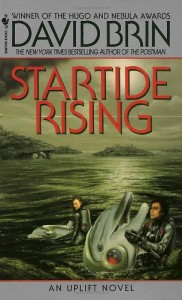
Startide RisingStartide Rising, by David Brin

Synopsis: Disaster recovery after a starship crashes on an abandoned planet, while a space battle takes place overhead. With sapient dolphins!

Book Review: This is a fun adventure tale, featuring lots of problem solving, which puts it right up my alley. The book starts off with a bang, dropping us right into the middle of a raging battle, and it is never dull for its full duration. There is always something going on, very often multiple somethings, and they’re all intriguing.

The uplifted dolphins are a huge part of the charm of this book, they’re mischievous and witty, and strike me as very smart and energetic pre-teens. They’re a delight to read. Brin also gets to have a lot of fun with the concept of uplift, because it means alien species don’t have to make sense evolutionarily. Intelligent trees? Sure, a creator race genetically engineered them, so why not?

The world feels rich, with a lot of depth that is hinted at but never explored, because the main action is too important for diversions. You come away from this book feeling like there are volumes that could be written within it, and this was but one small corner that we had the opportunity to visit. I would refer to it as a very fanfic-fertile environment. :)

There are quite a lot of POV characters though, so many that some start to blur together after a while. And it makes liberal use of psi powers, which threw me at first. It’s an artifact of the times when it was written and psi wasn’t quite disproven yet, but it feels damn bizarre to have fantasy sticking it’s nose into my sci-fi! Fortunately the things that the psi is used for turn out being so damn cool that all is forgiven, and you come to accept it over the course of a few chapters.

When you’re done with it, the book leaves you optimistic, exhilarated, and wanting more. Recommended.

Book Club Review: While there’s a lot of action to be had, the book still manages to make some commentary here and there. It decries traditional colonialism, while also making a case for the importance of helping emerging species. It strikes me as a demonstration of how The White Man’s Burden can be a positive thing (where “White Man’s” would be replaced with “Human’s” or perhaps “Uplifter Race’s”). I wish it had been explored in more detail, but it was a start.

The interesting concepts and adventurous tone makes this a good choice for almost any group, it’ll leave everyone entertained. It is a little dated, but that doesn’t hurt it much. While not amazing, it is good, so I’d Recommend it.

Aug 012015
 

THIS+IS+FINEI just read “Three Bodies At Mitanni” by Seth Dickinson.

Oh my god.

At first you think it’s about Hanson-style Ems. Then you think it’s about p-zombies. Then you think it’s about pathological altruism. Then you make the connection to Meditations on Moloch. Then you realize it’s the story-fication of the picture to the left. And then, in the end, you realize it isn’t about any of those things. Or rather, it isn’t *just* about those things. It is about you.

This is Rational Fiction by a Rationalist that is a Cautionary Tale About Rationalism. And it’s really fucking good. Seth Dickinson continues to be one of the most important writers of our generation.

I only wish it was available in a format that people in my generation could ACTUALLY READ. Right now you can only get it by tracking down a June 2015 dead-tree copy of Analogy Science Fiction (the special 1000th issue!).

But if you get a chance, I highly recommend it. Hopefully Seth will make it available online someday.


[EDIT 8/23/22] – This is now available online in epub form, from Forever magazine, issue 67. Still gotta pay for it, but at least it’s super easy! Thank you Ross Presser!

I also created an audio version with Seth’s permission

Jul 242015
 

300x300xhugo-awards.jpg.pagespeed.ic.AsqaLzncTzThese reviews got long, so I’m breaking them into two parts. Novelettes yesterday, Short Stories today, as that’s the same order we discussed them in my bookclub.

Overall Puppy Note (preemptive!): It’s impossible not to talk about the Puppies heavily when reviewing these stories, since the Puppies vandalized the Hugos this year. As such, many of my reviews address them directly. Based on the readings of the Sad/Rabid Puppy nominations, there are two things I think can be definitively said about the Puppies. The first is that they don’t much care about thinking through the implications of their worlds or spending mental effort to make them make sense.

The second is that (to quote an esteemed bookclub member) they are heavily invested in their own moral superiority. In retrospect, the second should have been obvious simply by taking their own rhetoric at face value, but I guess sometimes the obvious eludes me unless I really have it hammered home by reading the same moral over and over in a group’s fiction. Perhaps I was fooled by their claims of “Hating Message Fiction” and “wanting to nominate works that aren’t message fic.” As a reminder, the Puppy leadership complained about Message Fiction by saying:


These days, you can’t be sure.

The book has a spaceship on the cover, but is it really going to be a story about space exploration and pioneering derring-do? Or is the story merely about racial prejudice and exploitation, with interplanetary or interstellar trappings?

There’s a sword-swinger on the cover, but is it really about knights battling dragons? Or are the dragons suddenly the good guys, and the sword-swingers are the oppressive colonizers of Dragon Land?

A planet, framed by a galactic backdrop. Could it be an actual bona fide space opera? Heroes and princesses and laser blasters? No, wait. It’s about sexism and the oppression of women.

Finally, a book with a painting of a person wearing a mechanized suit of armor! Holding a rifle! War story ahoy! Nope, wait. It’s actually about gay and transgender issues.


But let’s let the works speak for themselves…


Short Stories


On A Spiritual Plain”, Lou Antonelli

Much like yesterday’s Ashes to Ashes, this is an bland tale with mediocre prose. At first I was intrigued by the premise – a planet whose physical properties demonstrate that souls exist! After someone dies their consciousness remains localized near their point of death, due to (ahem) the planet’s magnetic field. It is a fully functional person, able to think, feel, learn, communicate, and weakly interact with the world!! Holy shit guys, the afterlife is real, and it’s on this planet! Immediately I was snapped into Awesome Transhumanism mode. This is obviously where all humans will rush to now, when they are close to death, so they need not be annihilated by the destruction of their body! How will society change when Death has finally been defeated, at least locally? How long before our scientists can create a device that mimics the (ahem) magnetic field of the planet in other places, allowing us to achieve immortality anywhere in the universe? THIS IS GREAT!

Oh wait, no. It turns out that the moral of the story is that DEATH IS GOOD. And by not dying all the way, the poor bastard is being denied the awesomeness of death. The goal of the rest of the story becomes to kill him again, because it didn’t take the first time. You did not die enough! Die more! The kindly chaplain has no qualms about resorting to trickery to achieve this, but fortunately(?) his victim is cool with dying, so when he finds out what’s happening he doesn’t put up a fight. Apparently “he would rather be nothing, than a ghost on a strange wold.” Cuz fuck strange worlds man. Death is so much better than novelty! Arrrrrgh.

If you like poorly-written BLATENT Deathist propaganda, this is the story for you. I find it morally repugnant.

Puppy Note: Wow. The novelettes hinted at this trope with Ashes to Ashes (“Death is the solution to all your woes!”), but it’s really hammered home here. The Puppies embrace Death, and seem to want their fiction to demonstrate the moral superiority of Deathism. Every character’s goodness and/or wisdom is proportional to how gracefully they accept their own voluntary extinction. A purposeless extinction at that. And they call themselves the culture of life. O.o

Anyway, this is obviously Message Fiction. The Puppies actually love Message Fiction, as long as it’s their message.


The Parliament of Beasts and Birds”, John C. Wright

Wright intended this as a Sunday School sermon, and that’s basically what it is. You can read it as it’s intended – another way of presenting Catholic Dogma to the laity – and roll your eyes. Yes, as written this should never have been accepted into the Hugo’s because it isn’t Sci-Fi or Fantasy or Horror or anything, it’s just straight-up religious indoctrination. But here’s the wonderful thing about really old religions – they are horrific. The most effective tool for conversion to atheism is (IMHO) simply taking off the blinders and reading the Old Testament as it is written, taking it all at face value. It is the story of a Lovecraftian Eldritch Horror which men have been worshipping to gain advantage over others on Earth. Wright’s story, by staying true to the source material, tapped directly into that. If you ignore his intentions and just read it as a straight horror story, you’ll find an excellent piece of existential horror that will leave you terrified. See my full post about it for more on why, if you’re interested.  It is easily my favorite story on this ballot, and I’ll be voting for it to win. I’m with you Fox! We must kill God!

Puppy Note: Sermons are the original Message Fiction. This story is literally nothing but a very thin veneer over what is 99% message. There is almost nothing here EXCEPT the Message. Any Puppy who ever claims that they’re against Message Fiction again will be exposing him/herself as a liar. You can interpret it as a pro-God message (boring) or a death-to-God message (Yeah!!) but either way, it’s Message Fiction. I personally don’t have any problem with Message Fiction. I think Message Fiction is the best kind of fiction (because if you aren’t trying to say something, why are you bothering to write?), as long as it’s done well. I thought this was well done, so I enjoyed this a lot. :) But the Puppy Hypocrisy is stunning.


A Single Samurai”, Steven Diamond

This is a Basic Story in the most basic sense of the word. It is literally “Warrior gives his life to save his people. Yay!” with nothing else. This isn’t bad, of course. Every one of us needs to read stories like this when we first start reading fiction. These sorts of stories are the bedrock on which our literary taste grows. All the nuance and subtle play of complex works depends on the reader already being familiar with the basic warrior ethos story. And this also has Kaiju in it, which we all need to experience for the first time at some point. You can’t fully appreciate Evangelion without knowledge of the Giant Robot genre. You can’t fully appreciate Magica Madoka without knowledge of the Magical Girl genre. You need to build up to great works by starting with the simple stuff.

And as a simple story, this works great. It’s competently written. Unlike the other pro-death stories, which are pro-death purely for the sake of being pro-death, in this story death is shown to be a bad thing, but one which it is noble to accept when it leads to the greater good. A warrior who sacrifices himself to save his people. That’s inspiring, it’s a good moral.

But it is undeniably Simple. It is a Basic story. We all read this story dozens of times when we were children. There is nothing new here for anyone over the age of ten. Why is another version of such a simple story on the Hugo ballot? There is absolutely nothing new to see here. I am absolutely flabbergasted.

Puppy Note: Do the Puppies simply not understand what awards are for? The rehashing of childhood tales is not an award-winning endeavor.

Message Fic – yup. It’s a good message: “Heroes will lay down their lives to save others, if they have to. Be heroic!” But it’s still message fic.


Totaled”, Kary English

I’m very torn on this story. It is easily the best written of the five, by far. The premise is great, and the story was interesting. But it focuses on the wrong story. I guess the author wanted to tell a touching story of a dying mother letting go of her children, and she completely missed the implications of what she’s writing.

When the worst people in our society do horrendous things, and we lock them up in the worst places we can create, and they keep doing terrible things to other prisoners and guards even within those prisons, how do we punish them further? We lock them up in solitary confinement. Because forced isolation is painful to humans. Painful enough that many jurisdictions consider long-term solitary confinement to be cruel and unusual punishment, equivalent to torture. So when I learned that the protagonist in this story is a brain in a jar, essentially someone suffering from Locked-In Syndrome I figured it was going to be somewhat horrific. But the author skims right over this, and never gives us any indication that the protagonist is on anything other than an extended no-phone vacation.

Worse than that, it quickly becomes apparent that her co-workers and boss at the brain-research facility are FULLY AWARE THAT SHE IS CONSCIOUS, and don’t give a damn! Instead they use her as slave-labor to advance their research. So we have a story of someone in constant isolation, unable to interact with the world aside from simple yes/no responses to one other person during regular working hours, being used for slave labor, with the understanding that she will die in six months and nothing can be done to alter that.

And somehow this isn’t a horror story??

I am horrified that the author was able to take those circumstance and try to write it out into a touching story of a dying mother saying her final goodbyes. I mean… it’s a good story. It’s well written and emotionally touching. But it seems like focusing on the story of a conflict with your in-laws when two blocks over there’s a genocide being carried out.

Puppy Note: I don’t quite know what to make of this. Again, it seems to be a story about accepting death, but at least this time death is portrayed as something to be sad about, rather than something to be welcomed. A surprisingly good entry, considering the Puppies’ track record so far.


Turncoat”, Steve Rzasa

Pure drek. The villain is one-dimensional, the hero is invincible, and tech-jargon is used as a replacement for anything that might be thought-provoking or compelling.

I said before I like Good Message Fic. This is the opposite of that. It is the worst kind of message fic. It is actually The Worst Argument In The World, put into story form. It is very simply “My ideological opponents are Hitler. If you agree with them, you are as bad as Hitler.” I’m not kidding. The author doesn’t use the name “Hitler”, but the antagonist is a genocidal, racist, megalomaniacal dictator.

There are interesting stories to be told of people trapped in situations where they have to behave horrendously or suffer terrible consequences (turning over the Jews in their attic or be killed themselves). These stories are full of tension and drama. Fortunately, our Turncoat protagonist doesn’t have to make any such hard decisions. The moral of the story seems to be “If you aren’t really onboard with literally committing genocide, and you can easily switch sides, turn the tide of battle, and not have to worry about taking any sort of risk to yourself… then heck, why not?” It’s not really inspiring.

Puppy Note: The most outrageous example of “heavily invested in their own moral superiority.” Message Fic with nothing to say. Seriously, you complained about the Hugo’s promoting “Message Fiction” because gay characters are portrayed positively, or a spacefaring society doesn’t make gender-distinctions and refers to everyone as “she”, but then you nominate a story whose sole purpose is yelling “my opponents are Hitler!” without even bothering to try to portray your own arguments sympathetically? What is wrong with you?


Book Club Note: As I said yesterday: I strongly encourage all book clubs to do something similar to this once a year. Reading shorts is a nice change of pace. Also, it provides immense reading-time-to-discussion value! Reading all the Hugo nominated Short Stories and Novelettes took half the time (or less) of reading a single novel, and with ten shorts there is SOOOO MUCH to talk about! We went significantly over time. A very favorable ratio, even compared to the best books.


Let’s hope there’s less Puppy Poo next year though.
Jul 232015
 

300x300xhugo-awards.jpg.pagespeed.ic.AsqaLzncTzThese reviews got long, so I’m breaking them into two parts. Novelettes today, Short Stories tomorrow, as that’s the same order we discussed them in my bookclub.


Overall Puppy Note (preemptive!): It’s impossible not to talk about the Puppies heavily when reviewing these stories, since the Puppies vandalized the Hugos this year. As such, many of my reviews address them directly. Based on the readings of the Sad/Rabid Puppy nominations, there are two things I think can be definitively said about the Puppies. The first is that they don’t much care about thinking through the implications of their worlds or spending mental effort to make them make sense. The second is less flattering, and so I’m putting it off until tomorrow’s post, where it is much more thoroughly supported (due to it being more strongly represented in the Short Stories).


Novelettes


Ashes to Ashes, Dust to Dust, Earth to Alluvium”, Gray Rinehart

A decent, if fairly unremarkable tale. An example of “didn’t bother to think through the world-building.” The basic premise is that a technologically- and militarily-dominant alien species is oppressing a human settlement on a planet they both colonized, and the humans chase them away by exploiting a simple superstition in their religious beliefs. “Drive Away Your Alien Overlords With This One Weird Trick!” They have a fear of bodies buried under the earth, and so are willing to give up military dominance of billions in infrastructure to get away from those scary buried corpses. If anyone bothered to think on this for more than ten seconds they’d realize any such belief system would have been weeded out of the memetic ecosystem aeons ago. No expansionary society can have a belief system so easily hacked. If one guy with a shovel can overthrow any size military occupation in a single night, your belief system will not propagate.

The story itself failed to strike much emotion. No one seemed particularly harmed by the alien “oppression”, as far as I could tell we were supposed to be cheering for the humans merely because they are human. That’s OK, I guess, but it’s not compelling.

Puppy Note: The story’s basic premise is remarkably stupid (but sadly not the stupidest thing the Puppies nominated). But it had to be stupid, to get across the moral of the story, which seemed to be “Your religion is stupid. Look how stupid it is, we can exploit it so easily! It’s important to have a non-stupid religion, like ours!” /sigh


Championship B’tok”, Edward M. Lerner

Oh dear lord. Remember how much I hated The Dark Between The Stars? THIS IS THAT BOOK, IN STORY FORM! Just apply everything I wrote in that review to this story. To recap: “as much emotion as reading a bad history textbook” and “there is not a single person in this book. There are a bunch of plot-advancing devices that have names. But they are empty husks, whose only purpose is to get us from Event A to Event B to Event C, and give us no reason to care about any event or any person.” Holy cow is it bad.

Puppy Note: Let’s get the obvious out of the way. This is not a short story. It’s a novel excerpt. For the Puppies to have nominated this is an insult to the Novelette award. There is no character building, plot arc, anything, because there can’t be! It’s one chapter out of a novel. This is like nominating a movie trailer for Best Short Film. This is a clear example that either the Puppies didn’t bother to read their slate before they voted on it, or that they have no idea what these awards are supposed to be recognizing. It took a Novelette nomination away from an actual novelette, which is a damned shame. That alone puts this below No Award. The awful quality is just the kicker.


The Day the World Turned Upside Down”, Thomas Olde Heuvelt, Lia Belt translator

A gorgeously written surrealist piece, with extremely evocative prose. While reading it I actually experienced vertigo, and felt like I was somehow reading upside-down, even though the words were still right-side up. The premise was fascinating, and the survivors’ struggle to simply exist without flying into the stratosphere was fantastic. I absolutely loved most of it.

But I hated the protagonist. He is an extremely creepy stalker, who spends the entire story hunting down the girlfriend who broke up with him because he refuses to accept her breakup. When he finally finds her at the end of the story, trapped with a broken leg in her house, he again confesses his undying love and complete stalker-tude. To her credit, she reiterates that they broke up and it’s over, even in her position! He refuses to accept her breakup (again!), then goes into her bedroom and discovers that she is totally over him and started dating someone else. So he goes into a slut-shaming tirade and leaves her to die.

I generally like damaged characters. And I love villains! Villain stories are among my favorites. But I really despise entitled misogynistic assholes who we’re supposed to sympathize with and consider the heroes. That is not a villain story. So this piece didn’t leave me with the delicious sense of evil and tragedy that a good villain story leaves you with, it just left me feeling slimy and gross. Ugh. I’m kinda torn on this work, as the wordcraft and world is so evocative. But ultimately I just can’t like a piece that reads like it’s glorifying something this ugly.

Puppy Note: The only non-Puppy work on this ballot!


The Journeyman: In the Stone House”, Michael F. Flynn

A very welcome surprise! This is a fantastic piece! The prose is superb and the voice is extremely strong! You cannot read this without immediately knowing just what the protagonist is going through, and feeling every single bit of it right along with him. And smiling the whole time. :) I especially love the banter between Teo (the protagonist) and Sammi (his travelling companion). Teo is a very old-school “honor and glory” type. He does what he does because it is awesome, and he is awesome, and he wants to be remembered down the ages and sung about, because we’re all going to die and that is true immortality, etc. It’s inspiring and exciting and swells the chest with pride. Sammi is a barbarian who speaks in broken English, but is obviously the smarter of the pair. He’s got a razor wit, always ready with a snarky quip, and always does the practical, smart thing in any situation, even if that would be seen as “cowardly” by the bards. He doesn’t give a crap about someone singing about how heroically he charged into the mouth of a dragon, he’d rather sneak up on the dragon, poison its food, and live to tell about it. Sammi is also incredibly admirable in this regard, and I would honestly consider him a Rationalist character. The interplay between the two of them really makes the story, and it was fantastic to read! Plus the storyline was pretty engaging too!
Oh! And did I mention the budding romance between Teo and the guy who’s been hunting him down? It is adorable, especially because it seems that right now Sammi is the only one who realizes what’s happening between the two of them… those two still think they hate each other! /squee!! It’s masterfully done, and I tip my hat to Mr. Flynn.

It is interesting to note that this appears to be an entry in a serial story (a previous story in the same storyline having been published in 2012, and the main storyline obviously not even close to resolution at the end of this novelette). However this isn’t just an excerpt, it really is a full story in the serial style – it has a beginning, middle, and end, and leaves you feeling satisfied. It’s much like a single episode in a season of Buffy – advancing the main arc of the season while still being a good self-contained narrative on its own. I’m happy to see serial works coming back in print form, I had assumed they were dead outside of cyberspace.

Puppy Note: Michael Flynn is an old hand in the Hugos, having six previous nominations. It’s a good thing the Puppies came along to right the injustice of him being shunned by the SJW circles and Hugo elitist conspirators, who had kept him from getting his due recognition…

Also, I get the feeling that the Puppies aren’t great at reading subtext, because I suspect that many of them would not have nominated a story with an budding gay romance. Either that or they didn’t bother to read their slate before nominating it *cough cough*.


The Triple Sun: A Golden Age Tale”, Rajnar Vajra

This started out strong, and I thought I was going to like it just as much as The Journeyman. The prose is good, and it’s written in that clever modern style that’s so fun to read. You know the one, you see it in most urban fantasy and some steampunk, very Whedon-esque. I was cruising along, having a good time, when we got to The Puzzle. I really like puzzles in my fiction! Some of my favorite works are basically very elaborate puzzles for the reader to figure out, with narrative and character, so I was excited. And this puzzle was introduced as something that a team of scientists had been working on for 30 years! And if they failed at it, they lost their home planet and had to move back to Earth! Wow, this is gonna be awesome. I am looking forward to some intense Insight Porn, because that’s half of what Rationalist Fiction is about, right?

While he’s describing the puzzle, halfway through the second paragraph the solution is obvious. He’s not even done setting it up yet and already I can tell what the answer is. Seriously a team of highly motivated scientists couldn’t figure that out after 30 years???? It’s not even a good puzzle!!! In fact it’s almost insulting to my intelligence how simple it is! I thought maybe I’d just been spoiled by the Insight Porn that is LessWrong and Cracked and SSC, until I got to the solution the author wrote…

Which was even stupider than I could have imagined, because I graduated middle school. I’m gonna spoil it for you, but don’t worry, you aren’t missing anything. The cows on their world, that have spent 30 years eating, reproducing, and doing nothing else, but are all wearing Apple Smart Watches? The Smart Watches were actually made by the symbiotes living on the cows, who have spent 30 years eating, reproducing, and doing nothing else. Oh, and did I mention this is a pre-industrialized world? Let me take that back… this is a pre-agricultural world.

That’s right. The symbiotes created those Smart Watches (using stone tools??) on a world without any industrial development at all. No factories, no refineries, nothing. I’m not the world’s smartest person. But I am aware that to build a Smart Phone/Watch takes literally centuries of industrial development, as we bootstrap up the tech ladder to produce the high-precision machinery needed to make such things. You don’t chisel one out of stone. It would take a society of hundreds of thousands of people (at least) all in extremely specialized careers to have the infrastructure needed to make this. That sort of society is impossible to hide, especially for thirty years! And it would collapse is suddenly everyone within it stopped acting like a modern society and instead hung out with cows, eating and reproducing and NOT GOING TO THEIR DAY JOBS IN THE FACTORY FOR 30 YEARS!!

I was personally insulted by this story’s lack of respect for my intelligence. It assumes I am a drooling idiot, and I’m willing to read whatever this author will shovel out on a whim without bothering for one second to think through the implications of the world he’s created. I actually hate this story. >:(

Puppy Note: Again, it seems the Puppies can’t be bothered to think through any of the implications of their world, or spend even two thoughts on world-building. Also, how did this get published in what is supposedly a Hard SF magazine? Doesn’t the “Hard” in “Hard SF/Hard Fantasy” mean “took time to think about what is being proposed so that it makes some damn sense”?? This story is not SF, because for the cow-parasites to have “made” the Smart Watches basically means they magic’ed them out of thin air. It is a fantasty story with conjuration magic, that is dressed up with techno-babble. Really? Adding techno-babble to your fantasy story is all it takes to be considered SF for Analog’s purposes? That is a low bar.


Book Club Note: As I do every year, I strongly encourage all book clubs to do something similar to this once a year. Reading shorts is a nice change of pace. Also, it provides immense reading-time-to-discussion value! Reading all the Hugo nominated Short Stories and Novelettes took half the time (or less) of reading a single novel, and with ten shorts there is SOOOO MUCH to talk about! We went significantly over time. A very favorable ratio, even compared to the best books.


Short Stories tomorrow!

Jul 102015
 

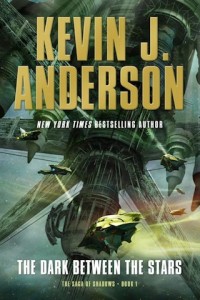
Dark_Between_the_Stars_2014_1st_edThe Dark Between The Stars, by Keven J. Anderson

Synopsis: A “space opera.” War among the stars, as humans are attacked by The Darkness (not the band).

Book Review: First, a minor quibble. This book isn’t SF, it’s Fantasy In Space. You will have to make a conscious effort to forget any physics you know to preserve the suspension of disbelief. It’s interesting that sometimes these things work and sometimes they don’t. I’m a fan of Star Wars and Warhammer 40K, and both of those are known to laugh at the idea of being constrained by basic common-physics-sense. But they have a flair, a certain bombast, that makes you eager to play along. This novel lacks that, and the result is groan-inducing.

But to get to the heart of the matter… Guys, I tried with this book. I really did. I felt the Puppies deserved a fair shake and I did absolutely everything I could to give them my fairest. After all, they have to their credit Warbound which was good in parts and wasn’t bad overall, and Parliament of Beasts and Birds which I quite liked. I can’t just denounce something without actually reading it. But after slogging through 220 pages of this abomination I could not read a single page further, and I was only about 1/3rd of the way through.

This is not a story. This is an outline of a story with a few physical descriptions fleshed out. You know those “Here’s a refresher of what happened last season” 5-minute clips that come out when a new season of a TV series begins nowadays? Imagine nothing but an entire book of that. Events are summarized, but no details are filled in. The result is a story with as much emotion as reading a bad history textbook. Allow me to demonstrate:

“Elisa was so furious and indignant she could barely think straight” is used to display anger. Can you feel the anger radiating off the page? Me neither. But it’s nothing compared to this next line, delivered after a mother witnesses her son die:

“That meant her son was dead! Anger warred with her grief.”

Let me be very clear – I’m not taking two sentences out of context of a greater tapestry. That is literally the entire effort that Anderson put into showing us the grief of a mother watching her child die before her. The paragraph before this was things blowing up, the paragraph after is exposition telling us things we already know (how her son got here), and the paragraph after that is descriptions of how damaged her ship is. The entire book is like this! The author does not give a single fuck about his writing, so why should I? Other examples:

“The survey ships orbited the small moon, and the readings were unusual enough that Keah decided they warranted a hands-on surface investigation. Adar Zan’nh agreed.”

“Sparks showered from control panels throughout the command nucleus, and the life-support systems shut down.”

Dry narrative that fails to evoke emotion, and the most-mocked cliché in Star Trek, at the same time!

“Sendra gave Garrison a gaze full of meanings, regrets, questions, and not-so-subtle flirtation.”

HOLY SHIT GUYS!! The only time I’ve read a line like this before is in fanfics that are parodies of bad fanfics!

But the complete lack of emotion and terrible writing aren’t the worst of it either. By far the worst part of all this is that there is not a single person in this book. There are a bunch of plot-advancing devices that have names. But they are empty husks, whose only purpose is to get us from Event A to Event B to Event C, and give us no reason to care about any event or any person. This book is empty. Not Recommended.

Also, in the glossary at the back there is an entry for “Black Robots: intelligent and evil beetlelike robots…” Yes, it says ‘evil’ in their description. Seriously, was this book written by-and-for eight-year-olds? I was surprised no one cast Magic Missile at The Darkness.

Book Club Review: Hahahahaahha! No. Not Recommended.

Puppy Note: Seriously guys, what the hell? Are you just trolling us? This is one of the worst books I’ve read in years. Apparently simply putting words on paper is enough to get a Sad Puppy Hugo nod. No wonder Brad had to go full post-modern, it’s the only refuge left to him now that he hitched his wagon to this turd.

On the plus side, it really puts into perspective the other books that were nominated. Skin Game and Three-Body Problem and Goblin Emperor all had their faults, and I can’t say any of them were really good. But now that I’ve been reminded what a BAD book looks like, I feel a lot better about those.