Jul 302020
 

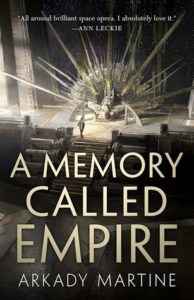
A Memory Called Empire, by Arkady Martine

Synopsis: A diplomat from a space station makes friends with high-level officials of a space empire.

Book Review: The book starts with a really interesting situation. The diplomat has the memories and personality of the previous diplomat uploaded into her head, and the two of them have to integrate into a new unified personality. She deals with foreign reflexes and intrusive emotions, and can speak with the old diplomat in her head to a fair extent. It was a delight to read, and I was looking forward to a great rollercoaster of interaction and personality conflicts. Which was good, because with the setting being a boring diplomacy gig in a safe embassy, the action outside her head was pretty dull.

And then a few chapters in the uploaded personality & memories are wiped out.

Most of the rest of the book is a slog to get through. The stakes are low, we don’t really care about the protagonist’s mission, and the political intruige is poorly done. The personal assistant that gets assigned to our protagonist seems to be fawningly in love with her and her home station, showing far more loyalty to this stranger than her own people. I assumed she was a very bad double-agent for being so unrealistically loyal, but it turns out she really does just exist to give the protagonist an unswerving ally.

Which is a good thing for our protag, because she’s a complete idiot. Early on she, her assistant, and a friend play a game of “Let’s build trust by telling each other secrets!” The assistant reveals a minor sexual fetish for foreigners. The friend reveals something equally innoculous. Our protag reveals the most sensitive state secret of her people. I /foreheaded. Turned out to be fine though, because her assistant is just so loyal!

I get the feeling this book was trying to be A Song of Ice and Fire In Space. There’s a great, inhuman threat descending from the North deep in the galaxy, which cannot be reasoned with or understood, and the small border state that knows it’s coming has to appeal to a larger empire to defend all of humanity, but gets caught up in the machinations of a power struggle within the empire. The problem is that the machinations of the power struggle have to be interesting. GRRM knew how to write political intruige. Martine does not. Ideas are easy, execution is hard, and the execution here left me alternately rolling my eyes and bored.

Deep into the book, a few chapters from the end, the action picks up and SOMETHING worth writing about finally happens in the story. We get quite a bit of fireworks, and it’s actually fun reading for a few chapters! Then the news of the approaching alien onslaught is delivered to the people who can do something about it and the book ends.

This book could have been titled “Space Opera: Prologue.” Because that’s what it is — a prologue that was spun out into a novel for no good story reason. It was done for a pretty good financial reason. As has been bemoaned on this blog before, everything has to be a series now to make any money, and so what should be a prologue within a novel is sold as a seperate novel… even if it has to be padded out with a hundred thousand words of filler. Bleh. A thousand curses upon this dumb trend. Not Recommended.

Book Club Review: There’s not much to talk about in a book of such thin substance. Not Recommended

Hugo Note: I’m being a bit harsher on this book than I would normally be. This is because I came in with high expectations. This is a perfectly servicable fluff book for times when people just want to kill time wandering through a space opera prologue. It is mediocre, but it’s a first novel, and most authors need several novels to get their writing legs under them. I wouldn’t recommend it, but I recognize there’s a place for these sorts of things. If I had come into this like any other book, I wouldn’t have expected something really good from the get go, and I would have been able to enjoy it a bit more.

But I didn’t come into it like any other book, because it has been nominated for a Hugo. A significant number of people put this forward as a book that may very well be one of the best SF books written in 2019, a book which may alter and redefine aspects of genre fiction, and a work that any other novelist should be proud to aspire to. So I came in with some expectations. Turns out those were ridiculous expectations and it really hurt the novel that I had them, because there is nothing exceptional about this. It’s…. fine. It’s fine. But it’s not good. It’s certainly not genre-defining or among the best things published that year. It’s just a space opera story being stretched out to meet publisher demands for a series. That is not inspired, and it’s not inspiring.

I know there’s at least one Hugo nominated novel that I just don’t get every year, but I don’t think anyone is doing Martine a favor by pretending they think her novel is a Hugo contender. I feel bad that this happened.

Jul 232020
 

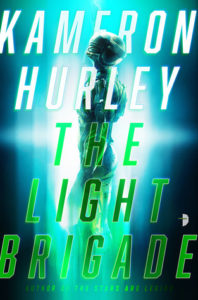
The Light Brigade, by Kameron Hurley

Synopsis: A fascist footsoldier becomes unstuck in time, realizes war is hell, and turns against the system that created her.

Book Review: First, an apology. I moved this month, and that process has drained away a lot of my time. I read this book well over a month ago, and this review is very late. Some of the details are already a little fuzzy.

I was impressed by Hurley’s decision to go with a protagonist that is a fascist in the current political environment. The novel doesn’t glorify fascism, quite the opposite in fact, it shows how evil a system it is. But such nuance can often be missed by people looking to get outraged, so it wasn’t the safest choice. It was a good one though. Portraying how a fascist system is destructive and abusive even to its own members is powerful, and was well executed. The Light Brigade isn’t some cartoon dystopia you find in YA fic, where the snobby elites kill kids for the lulz in a stable evil empire. This was a thoroughly real, crumbling dystopia in a war of all against all, reminiscent of original cyberpunk. It is gritty, and gritty is something Hurley does very well.

I also really enjoyed that the novel stays bitter and angry all the way through. There is no Conversion Moment where the protag joins the holy order and dedicates herself to righteousness and things improve locally. There is only deepening bitterness, and a refocus of anger from what her masters want her to kill, to what actually deserves destruction. This is my cup of tea, and I love it.

The theme is also exactly up my alley — a recognition that violence begets violence and is awful, but done in a way that allows us to see maximum violence along the way, because I get a visceral thrill out of the spectacle even as I abhor it IRL. Any book that gives me violence thrills while making me despise violence generally gets my support. :) This is message fiction done well!

The downside is, I didn’t get anything new here. The protag becomes unstuck in time, and so we get the distorted, chopped-up narrative common to other well-known anti-war books. It felt very reminiscent of both Catch-22 and Slaughterhouse Five. While I consider that high praise, I don’t think it cleared the bar the same way those works do, and so suffered in comparison to them. As I read I felt a number of times that this would be really cool if it was the first time I was experiencing it… but it’s not, I’ve read it before, and I don’t think it improved the recipe. I don’t want to diminish what Hurley has done, because this is better than a lot of things I’ve read in the past couple years, but it honestly felt like a remake that didn’t live up to the original.

I’m not sure how to go with the recommendation on this. Will this turn out to be something that I look back on years later and wonder why I didn’t love it at first? I don’t know. Maybe. If this sounds interesting to you, I don’t want to dissuade you from picking it up. But I would put other things on my reading list above it, so, though I may regret this later, I can’t quite recommend it.

Book Club Review:  This is pretty good for a book club book. The time-loop shenanigans are fun to puzzle over together. Most of the book club found the protagonist to be rather unlikable, which I had to admit is a fair cop, and gave us further things to discuss. I don’t think other readers liked it as much as I did, but the discussion went well, which is a big part of what makes a good book club book. One reader did point out that this is another book that unfortunately trivalizes torture and its effect on the victim, so there’s that. But nonetheless, I think the meeting we had tips it just over into Cautiously Recommended for book clubs. (Cautiously because there is a lot of violence and despair, some book clubs may want to avoid it for that reason… but of course those book clubs would want to avoid any realistic war novels as well.)

Jul 212020
 

Sorry for the long delay, I guess sometimes “tomorrow” means “in over a week”!

I.

Anyhow, yes, Emergency Skin is meant to be funny. I don’t think this should be controversial. I mean, there’s a dick joke in the first paragraph. Not only does the poor protag obviously not know what is desirable in a human body (long thighs?), but he’s being sold a long penis when we all know a long, thin penis is no one’s friend.

Most of the humor in the story is of this style – we see a naive protagonist being lied to by a narrator that is taking advantage of him. It’s a sort of comedy of errors, as we see a couple of complete idiots bumbling about in a Three Stooges-style fiasco, getting more and more wrapped up their buffoonery. Like, how can you not laugh at a society that thinks they’re The Best Evar but apparently hated women so much they replaced them all with “pleasurer robots?” Their entire society is so mentally and culturally deficient that it’s pretty clear that they were politely given the tech to leave by a humanity that really wanted them to move away, and they’ve lied to all their descendants claiming that they were so very smart that they found a way to leave the planet when no one else could. As if they’d had the capability to do cutting edge research, or accumulate vast wealth, with the three brain cells they had left. :D

Anyway, this would just be a straight-up farce if it was simply a depiction of this society of charicatures, but it turns into a satire when we see one of these flunkies coming back to Earth to interact with normal people. At that point, Emergency Skin reads very much like a take down of bad message fiction. It’s holding up a mirror to writers of bad message fic and saying “See, this is what you look like when you don’t do this well.” Writing good message fiction is a skill, and takes a lot of work. When it’s bad, it’s really bad. Satire can point this out via demonstration, and make us laugh along the way.

The really cool part of Emergency Skin is that you actually feel sympathy for the protag here, because he’s so niave and doesn’t know any better. He’s being used by the narator, and so we cheer when he sees through their lies and decides to go back and help his fellow citizens. There’s an actual good character arc, which is pretty unusual for a short satire piece.

II.

Poe’s Law is an artifact from the atheism wars on the early internet, which states that it is impossible to create a parody of extreme views so obviously exaggerated that it cannot be mistaken by some readers for a sincere expression of the views being parodied. No matter how ridiculous of a religious claim you made, someone would think it was serious, because why not? Religions are already looney toons. Religious people would often get upset about this, saying that it was plain freakin’ insulting that someone would say they couldn’t tell the difference between an absurd parody and a real religious claim. This sometimes resulted in hilarious own-goals, when it was discovered the original claimant was in fact a religious person expressing a sincere belief that the objecting theist had claimed was so ridiculous that only a liar trying to Own The Opposition would pretend to be confused whether it was a joke or not.

(Related fun study – some conservatives thought The Colbert Report was a pro-conservative show. From a study: “conservatives were more likely to report that Colbert only pretends to be joking and genuinely meant what he said while liberals were more likely to report that Colbert used satire and was not serious when offering political statements.”)

Which is to say that the meta punchline is Emergency Skin is being Poe’d. At least a couple people in our book club assumed Jemisin was writing this as a serious piece of anti-something propaganda. I’m not entirely sure what the “something” in this case is, but I think some combination of Billionaires, Capitalists, Whites, and Men. And, sure, those are all popular targets of the illiberal woke-ists out there. But I don’t think an objective reading of the story can support this.

III.

The story, as a satire, is pretty obviously about idiots the rest of humanity didn’t want to have around. They are shown to be a dysfunctional society brought to the brink of extinction due to their own mental, moral, and cultural failures. They’re just barely keeping old tech functioning, having to scavenge repair parts from Old Earth regularly. They are a fascist slave-owning society with dogma and philosophy completely inimicable to scientific advancement or functional capitalist systems. There is no way they got off Earth on their own. They were basically kicked off, and teach their descendants blatent lies. They do their best to hide these lies from the scavenger scout, but the truth is so blindingly apparent, and the society is so inept at even something as basic as lying, that the figleaf of falsehoods is blasted away immediately upon arrival.

The story, as serious criticism, is…. let’s say “problematic.” It’s the story of a minority group of humans. This minority group has distinct physical features (skin color, facial structure, hair) that make it obviously different from the rest of humanity. This minority group is also mentally, morally, and culturally retarded. Yet despite being vastly inferior to the rest of humanity, they have somehow insideously taken control of major power structures on Earth. In addition, they’ve tricked, defrauded, or outright stolen vast amounts of wealth from those who created it and should rightfully own it, and horde it for themselves. When the rest of humanity was in its most desperate situation, they stabbed humanity in the back and abandoned us, taking all their stolen wealth with them.

Basically, they’re 1930s Jews in Nazi propaganda.

What’s more, it turns out that once they were left to themselves, their true nature of theiving untermensch is revealed, and their new world collapses. Meanwhile, now that Earth is freed of their insidious leeching, Earth flourishes, and ushers in a New Golden Age where everyone has plenty and there is no more strife. By extension, the reader is left to wonder that if only… IF ONLY this vile minority of sub-humans could somehow be removed from the planet everything would be sunshine and roses.

So, yeah. I know this is combining Poe’s Law with Godwin’s Law, but reading this as a serious work of modern cultural criticism, one would be forced to say that Jemisin basically recreated the worst kind of exterminationist Nazi propaganda. And, to be quite honest, I don’t think that’s remotely plausible. It’s as silly as saying Colbert is a secret Republican, or Obama is a secret Muslim, or Scott Alexander is a secret Nazi.

And come on! This is a story that includes lines like “Beautiful? That’s… You’re only saying that beacuse they have skin.” Or “They want everything for everyone and look at where it’s gotten them! Half of them aren’t even men.” These are jokes, and pretty good ones!

Also, would an author that seriously embraced that sort of ideology be one of only two (of the twelve short work authors) who didn’t make the story available freely to all? And be the only author who made the story available ONLY at Amazon, so people are forced to give their money to the boogeyman of the leftists? I had to install a Kindle app to read this, I don’t think anti-capitalism is a driving value here. :)

Jul 102020
 

Hugo AwardBy long tradition, we read the Hugo nominated shorts in our book club. Spoilers for all stories below. I’d encourage people to read all of them, they’re short, but if you’d like to know which ones I think are the best so you can read just those before getting spoilers, they are: “For He Can Creep”; “As the Last I May Know”; “Do Not Look Back, My Lion”; Emergency Skin, by N.K. Jemisin (not available online)

Best Novelette

“The Archronology of Love”, by Caroline M. Yoachim

A story about loss and longing. I didn’t find it particularly interesting, but this may be because I have a cold, dead heart. ;) Several people in our book club really loved it, and found it bittersweet and poingnant. I honestly can’t even remember much of it after less than two weeks since I read it. It wasn’t bad, just nothing here for me.

“Away With the Wolves”, by Sarah Gailey 

A pretty good werewolf story. It deals with disability and chronic pain in a way that I really wanted to connect with, as someone who is now a sufferer of daily chronic pain and kinda-sorta-techincally-mildly-disabled-I-guess. But for some reason it just didn’t click. It feels unfair to say that, because I can’t point to anything in specific. It just… didn’t connect for me. This was a feeling shared by everyone in my book club, so I don’t think it’s just me, and we all really wanted it to work. I don’t know what the secret sauce is, and it feels shitty to say that something is missing it. :( But, well, there we go. It ended with a nice message of acceptance and community togetherness which was pleasant enough. Just no fireworks.

“The Blur in the Corner of Your Eye”, by Sarah Pinsker

There’s nothing to this story. It’s a bit of cozy mystery fluff with an SF twist at the end. I want to make it perfectly clear that there’s nothing wrong with that. God knows I love a lot of fun, fluffy stuff that’s just pure enjoyment without heft to it. But I was surprised to find this on the Hugo short list. On a craft level, it’s great. Pinsker is an acomplished writer of astounding skill, and kept me reading the whole time. It’s entirely enjoyable too. But I get the feeling she was just having fun here, and I imagine she was as surprised as I was to find it as a nominee. Awards tend to favor works that will be viewed as “influential” on the broader art form by future generations, and it seems unlikely to me that a light bit of mystery fun fits that.

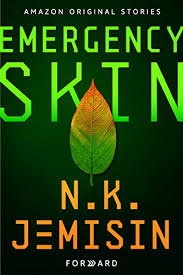
Emergency Skin, by N.K. Jemisin

This is a fantastic satire of terrible message fiction. I laughed several times, which is unusual when reading, for me. It’s not as full-on absurdist comedy as the other Hugo-nominated parody of my time, “The Shadow War of the Night Dragons”, but to make up for that it has an actual plot, with a full storyline and character arc that is more-or-less fulfilling. Being able to pull that off in a parody piece is really impressive. They tend not to lend themselves to that.

There was quite a bit of disagreement between me and the rest of my book club on this story, several people didn’t realize it was a comedy. Tomorrow I’ll be writing up a significantly longer treatment on this, because c’mon, that’s just crazy, one can’t let that go unexamined!

“For He Can Creep”, by Siobhan Carroll

Oh my god, this is the most perfect feel-good story and I love everyting about it. It’s about a cat that fights Satan in an insane asylum! And it’s even better than you’re already thinking! I checks just about every single box for things I like in feel-good ficiton. Adorable protagonists with snoots and whiskers and swishing tails, that don’t take crap from demons. The titular character has Harry James Potter-Evans-Verres levels of self-assurance and lack of patience for fools, and doesn’t try to pretend he isn’t awesome. His priorities are all screwed up, but perfect for a cat, and it’s a joy to watch him saunter right into disaster. And the story centers on a madman! AND THE DEVIL! They literally fight freakin’ Satan. Also there is a work of art so intense it can shatter the world. The prose is straight-up gorgeous; it’s lyrical throughout, with some flamboyant flourishes. The plot is engaging and very satisfying, and I literally want to read a dozen spin-off stories based on these charecters, but only if Carroll is the one to write them. If she doesn’t win this year’s Hugo then all love of art has fled from the world, because this is Art.

A thing of note – both “Blur in the Corner of your Eye” and “Away with the Wolves” are also feel-good stories. But “Wolves” lacks the joyful energy, and the intensly lovable characters. Neither “Wolves” nor “Blur”  innovate, and don’t have have beautiful, lyrical prose or experimental style. I believe this is what seperates a Hugo-contender from a “pretty good story.” “For He Can Creep” is impressive and memorable in addition to being a fantastic read.

“Omphalos”, by Ted Chiang

A return to old-school Chiang, where he examines what the world would look like if a belief people claim to hold was actually true. In this case, young earth creationism. I didn’t find it as engaging and pround as some of his other examinations, though. Maybe because this was never a belief I’d held? Perhaps the Chiang stories people most enjoy are the ones that tackle subjects most dear to their own upbringings/beliefs. However it is expertly executed, as all his stories are, and obviously there are enough people with a background of young earth creationism that it had the numbers to make it as a nominee. Mad props to Mr Chiang, as always.


Best Short Story

“And Now His Lordship Is Laughing”, by Shiv Ramdas 

A great revenge story set in colonial-era India. An atrocity is visited upon our heroine, and when she recovers enough to exact revenge, it is graphic and brutal. Some of our book club didn’t particularly enjoy that. I loved it, because I like bloody revenge stories. There is a part of me that wants to see such horrors avenged, to see their perpetrators die screaming, and everyone around them who was complicit can die screaming too. Giving such feelings a safe outlet is what fiction is for. If you like the bloody-revenge part of Tarantino movies, you’ll probably like this. I sure did.

“As the Last I May Know”, by S.L. Huang

Oh damn! Someone took the Roger Fisher proposal that the nuclear launch codes be kept inside an aide so the president would have to cut them out (thus killing a man with his own hands) before starting armageddon, and made a story out of it, and it’s soooo good. It’s set in a different world, so national sympathies don’t get in the way of telling the story. Instead we simply live with the child(!) chosen to be the bearer of the code, as her nation falls closer and closer to nuclear war and the president who’s come to love her has to decide if he can kill her to save his entire nation. Not only is it a great take on a great thought experiment, it’s really brought home by the defection of the girl’s adoptive father/mentor at the end. Despite being a pacifist priest, in the end he breaks, and tries to provide the nuclear codes to the president WITHOUT requiring the sacrafice of the child, because he can’t live with the death of the daughter, but he can’t live with the destruction and slaughter of his country either. It’s brutal.

And the fact that it ends without us knowing if the girl is going to live or die is perfect. The reader is left trying to figure out which ending would I prefer? and thus has to answer for themselves which situation is worse? Is this worth the cost in my own opinion? Is this justice?

While most of my bookclub thought this was an anti-nuclear-weapons story, I pointed out that it seems very much like a Tragedy of Good Intentions. The purpose of the policy is to prevent nuclear armageddon unless it is absolutely vital. But the country that invades our protagonist’s country doesn’t have nukes themselves. They ravage the interior, thousands are killed in the fighting on both sides, and tens of thousands of civilians are killed in bombings, many times more displaced and starved, and cities ruined. Because the invading country figured our president wouldn’t kill this child to launch nukes. The intention behind the policy was good and pure, but there wouldn’t have been an invasion at all if the nukes didn’t require a child sacrafice. Because the invaders would have worried that if they invaded, nukes would have been launched in retaliation and the aggressor nation devestated. Without a war there would have been thousands of soldiers lives saved on both sides, and possibly hundreds of thousands of civilians. As a cautionary tale, the message is obvious — don’t give anyone a reason to think you won’t use the nukes, and you end up preventing wars and saving many lives.

Except, of course, without some deterant on their use, it’s much easier to get world wide armageddon. And shouldn’t someone willing to kill millions of people have to kill at least one person first? If you can’t kill one person, how can you kill so many, so indiscrimently?

And in the end, the nukes might get launched anyway. Damn, man. Really, a very good story.

“Blood Is Another Word for Hunger”, by Rivers Solomon

Another revenge story. This one is more elaborate, and grows to encompass an entire society. As in “everyone in this society supported this atrocity by their acceptance of slavery, burn it all down.” Again, I like revenge stories, so I liked this. It focuses less on the revenge itself, and far more on how getting your revenge isn’t enough, because afterwards the world is still broken and you are still empty. The protagonist grows over the course of the story, learning to find acceptance and belonging with her friends/surrogate family. In the end revenge stops being the goal, and instead becomes the means towards the true goal, which is family and togetherness. It’s actually a really positive message among all the slaughter. :)

“A Catalog of Storms”, by Fran Wilde

I gotta admit, I didn’t particularly get this story. It’s written in a surreal, dreamlike way, never fully explaining what’s happening, but giving you enough to figure out the broad strokes. Yet, despite figuring out more or less what’s happening, I never really felt a connection. It all felt too unmoored in anything. I dunno… it’s been a while and it still bugs me. I think I’m missing something, and if I reread it a few times perhaps whatever I’m missing will click and I’ll have a revelatory moment. I was hoping someone in my book club would have insights on this, but they all felt basically the same way, which makes me suspect maybe it’s not us, it’s the story. Googling has found only people that say basically the same thing — a cool mood piece, but there’s not much that happens to anyone. I guess all I can say is it wasn’t to my taste. Good imagery, though.

“Do Not Look Back, My Lion”, by Alix E. Harrow

A very strong piece about being an outsider in your own society. A woman of peace is tolerated in a warrior culture because her wife is the best warrior in the land, but everyone else shuns her, even her own children. The one child that takes after her is pressed into the military anyway, and as more and more of everything she loves is taken from her and forced into the war machine, she rebels. Unlike the other stories this year, this rebellion isn’t a bloody revenge. She flees, and prevails upon the love of her wife to protect her. The two both do what is right in their own way, despite their methods being antithetical at a first glance. It’s a love story of the type you don’t see often – one about the love of a dedicated relationship after many years together, rather than the passion of new love in youth. I really liked this.

Also of note, since I’m on a world-building kick — absolutely stellar worldbuilding. It was published in Beneath Ceaseless Skies, and good worldbuilding is basically The BCS Thing, and it’s nice to see they are still holding strong to that. :)

“Ten Excerpts from an Annotated Bibliography on the Cannibal Women of Ratnabar Island”, by Nibedita Sen

This was a bit of a nothing-burger for me. An infant is taken by the British from an island of cannibal women and raised in a boarding school. She makes a friend who develops a crush on her. The friend then cuts off pieces of herself and secretly feeds them to their mutual friends over dinner. Everyone is very disturbed by this. That could make a good story, but what I just told you is basically the entirety of what you get. It’s told in ten snippets from news or scholarly articles about the event, so you get the story in pieces and have to put it together yourself. I really like this sort of structure play, my Favorite Book Ever does the same thing. Except Vellum has an amazing story with God and angels and alternate universes and fantastic character development. When I put together the pieces of “Ten Excerpts” there wasn’t anything there. Just… hey, here’s a thing that happened, kinda gross right? Cool structure play on it’s own isn’t enough, you still need a good story at the heart of it. For a fantastic example of structure play, I generally refer people to this owner’s manual which is secretly about superstimulus, the crushing power of beauty, and loneliness.

OTOH, one member of our book club REALLY loved it. The story does give you a lot of pieces, and if they really strike your fancy you can certainly arrange them into a larger structure.

Highly Recommended: “For He Can Creep”, by Siobhan Carroll; “As the Last I May Know”, by S.L. Huang

Recommended: “Do Not Look Back, My Lion”, by Alix E. Harrow; Emergency Skin, by N.K. Jemisin
Jul 072020
 

I was recently brought to my attention by my cohost at The Mind Killer podcast that HBO is run by simpering cowards. They will not make available the five South Park episodes that have Muhammad in them.

Two of these episodes, Cartoon Wars part 1 and part 2, are still available to the South Park Comedy Central website (linked).

The other three: Super Best Friends (alt); 200, and 201 (combined), are available at various torrent sites around the internet. I can’t vouch for any of these links, I didn’t download them myself.

The episodes also are likely available on the DVD versions. Super Best Friends is in season 5 and 200 & 201 are in Season 14. Again, I have not bought these, so I can’t verify they are on the DVDs.

And here’s my drawing of Muhammad from way back in the day. Remember the cartoonists massacred in Paris. HBO has spit on their memory.