Apr 232020
 

Hugo AwardThe Hugo Nominees are out. As always, I link all the short works that are available free online on my blog, for easy reference for my book club. If you have a book club, taking one meeting to read all these and discuss them is a great use of a meeting!

Best Novelette


Best Short Story


Apr 212020
 

Machines Like Me, by Ian McEwan

Synopsis: A privileged, insufferable idiot has a bad relationship with this girlfriend and whines a lot.

Book Review: This is straight-up LitFic. Some ponce literary author wanted to write “SF” without having ever bothered to read any, and you get crap like this. The protagonist comes into possession of one of the first androids ever created. By the time I got to page 50, he still HAD NOT TURNED IT ON. He was too busy whining about the ennui of being an english major in a university and having a girlfriend that just doesn’t understand him.

By the time we do get to the android being turned on, we do almost nothing with it. It’s just a thing for the protag to be angsty about, and occasionally act like an autistic nephew. This isn’t SF. This is what someone who’s only exposure to SF was seeing an episode of the 60’s Star Trek out of the corner of his eye while someone else was watching it across the room. “Oh man, if I put an android in my novel, it’ll blow people’s minds! He’ll be all… analytic and not understanding of human emotions!”

The “alternate history” parts are occasional exposition dumps inserted in the most boring way possible without impacting anything in the story. Both the “SF” and the “alternate history” parts of this novel could be removed without changing anything of substance.

I don’t think LitFic authors should write SF if they aren’t read in it. The fact that they think they can shows how much contempt they hold for any form of art other than their own. I spit on them.

I’m on record as hating most LitFic, and this is no exception. MFA programs seem designed to ruin art. They give talentless hacks the idea that they can write because they learn how to string words together without actually creating anything of substance, while also denigrating most good art society produces. You know how you get awful crap like Star Trek: Picard? By hiring MFAs who have been taught to disdain what makes SF good and don’t care to do anything right aside from what they were taught makes “good dialog.”

Most MFAs also teach people to only “write what they know,” which is why you get stories of disaffected, insufferable intellectuals whining about their bad relationships. What else has an upper-middle-class kid pursuing an MFA degree done in his/her life?

I would consider this a typical LitFic book in that it doesn’t bother to think about anything of substance, has no higher goal or message, and is just griping about personal relationships with no stakes. To be fair, a couple people in our book club like LitFic and read some occasionally, and they both said that this is an exceptionally bad example of LitFic. To the point that focusing on how it fails as SF is besides the point, since it already fails really hard as LitFic. They assured me there really is some good LitFic out there, and some day I’ll read some of it and be wowed. I’m sure they’re right, but that day is not today.

Vehemently Not Recommended.

Book Club Review: Most people gave up long before the end. Everyone hated it, even the LF readers. There’s nothing of substance here, so mostly we complained about how bad it was. Not Recommended.

Apr 182020
 

This is about Banks’s The Culture series, but doesn’t really contain spoilers.

Within The Culture it is established that biological humans are nigh-immortal, but that nearly all humans eventually choose suicide after several centuries of life. When I first heard this I thought it was just typical Deathist BS. The same “Ho ho, living forever is terrible, no one would want to do it unless they’re an evil villain” crap we usually get. I failed in properly giving Banks the benefit of the doubt. (In my defense, I didn’t know anything about him yet, knowing only how immortality is portrayed by mainstream media).

Upon reading The Player of Games, I understood why humans in that society choose death. The Culture is explicitly post-human. Anything of actual importance that needs to be done on a galactic scale is done by the Minds. For humans to feel important, their only option is to be important to each other. Unfortunately, that’s also not really an option, because no one needs anything.

At first, this seems like a blessing. That’s the whole point of getting post-scarcity. To truly need something is to be in peril. If you need something and can’t make/grow it yourself, you’re at the mercy of someone who can. Your best option is to find something they want or need and trade it to them for what you need. But ideally, you want to need as few things as possible.

In The Culture, no one needs anything. Everyone is given all the food, health, entertainment, and resources they could possibly want. No one relies on anyone else for anything. No one requires someone else to get any need or want met. And while it’s nice to finally have the safety and security to know that “no matter what happens, I’ll be fine,” it also means that no person is needed by any other. I don’t want to need anyone. But for me to not be needed by anyone feels… empty.

The Player of Games does a great job of portraying that lack of connection to any other humans. All the relationships that the protagonist has are superficial, trivial things. There are no stakes to anything he does in his life, aside from the one mission he is sent on that we read about. Everything before that was killing time. Everything after that was trivial as well. Nothing really matters, it’s all just games he plays. When no one needs you and there are no stakes, you’re just killing time. Eventually you realize you aren’t killing time for any purpose. Maybe just skip to the end already.

Which makes me feel really weird, because deprivation and insecurity SUCK. We’re trying to build this glorious post-human future because we’re tired of the suckiness of life, and we want to fix it. I am now somewhat worried about creating a future were no one is needed for anything anymore, though. Not enough to stop striving for it. But… going full The Culture seems like another Failed Utopia.

Apr 122020
 

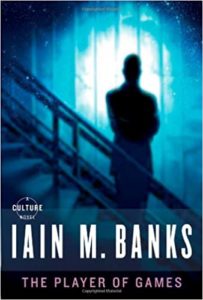
The Player of Games, by Iain M Banks

Synopsis: The post-scarcity Culture recruits their best game player to destabilize an expanding civilization that selects its rulers via an incredibly complex board/card/tabletop-war game.

Book Review: Banks is best known in the SF community for his creation of The Culture, an incredibly advanced post-scarcity civilization, and the series of books that take place within it. Player of Games isn’t the first book in the series, but it is the one that is considered the best entry point into the series. This book feels like it was written specifically to introduce people to The Culture. First we’re introduced to a typical citizen, and we get a typical day-in-the-life narrative to show us how these people live. World details and tech levels are displayed, and then this citizen is recruited to become the representative of the entire Culture to an alien civilization. Much of the conflict comes from the culture clash of this outsider navigating among strange people with strange ideas and customs, and every time there is a conflict not only do we learn how the alien civilization is structured, we also learn how The Culture is different in contrast. It’s pretty darn ingenious.

If this was just a tour of The Culture I’m not sure it would make an interesting book… you do need some story to get me excited. Fortunately, it is a lot more than just that. Yes, the novel does start out very slowly. The first few chapters drag on far longer than their word count would lead you to believe. Perhaps this was intentional, to get the reader to relate to the boredom and ennui of the titular protagonist, but it’s still a slog. It is, however, worth it. Once the central plot is engaged, the story really picks up, and it just keeps getting faster and better as it goes. Plots thicken, stakes are raised, and eventually hell is raised, bullets are flying, and everything is on fire.

More than that, though, this book reminded me that speculative fiction is the genre of Big Ideas. SF/F should be about something. Lots of times, it’s not. It’s just cool stories of interesting people doing exciting things. The Player of Games has a central thesis. I didn’t even realize that I had been starved of stories with a Big Idea until this novel gave me one and reawakened that thirst. It was wonderful, and I hope to not forget this again for a long time.

Dan Carlin often mentions the adage that civilizations ascend wearing wooden clogs, and descend wearing silk slippers. Meaning that only when life is hard and miserable do people struggle to make things better, and once a civilization is rich and secure it becomes weak, its people become lazy, and it declines. This is probably a perpetual fear of anyone living in a rich empire, but it’s hard not to take it seriously. One wonders, is it only by cruel strength, and the hard-bitten willingness to sacrifice the weak that people can advance? Is any great liberal society doomed to be out-competed and replaced by something leaner, meaner, and ruthless? The Player of Games asks exactly that question, pitting a rich, liberal society against a hungry, brutal one. And more to the point, it doesn’t do this by putting them in violent conflict, which would only resolve which civilization is better able to wage ware. It pits the ideals of the two societies against each other directly by abstracting those ideals into a high-stakes game that winnows out the weak and breaks the unworthy.

Highly Recommended.

Book Club Review: For the reason stated in the previous paragraph, this is a very good book club book. There was a lot to talk about, much of it being very thought-provoking. Even outside of the central thesis, The Culture itself makes a fascinating topic of conversation (one of the reasons these books have become so popular, after all), and that along can keep a group going for quite a while. And while the beginning is slow, we didn’t lose any readers to it, because the kind of people that go to SF book clubs tend to also be the kind of people that have been gamers for ages, and so the promise of a book about an Uber-Game kept everyone engaged until things go going. :) Recommended.

Podcast Note: A friend of mine has a reaction-style podcast where he and a friend are reading through the entire Culture series together. He’s read it before, the friend has not. The three Player of Games episodes are 1, 2, 3. And the whole series can be followed at the Discord, or the RSS.