Nov 262018
 

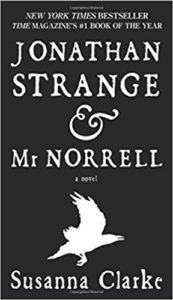
Jonathan Strange & Mr Norrell, by Susanna Clarke

Synopsis: Two landed British gentlemen of the Napoleonic era flounce about being prissy, ineffectual twits. Also there are fairies.

Lately I’ve finally been picking up books that I’ve heard great things about for a long time, to great success! To continue this trend, I moved on to “Jonathan Strange & Mr Norrell” next. I’ve heard from many sources that it’s an astounding novel.

Holy crap were those sources wrong. This is the most tedious, plodding, overhyped exercise in fiction I’ve come across in a while. I began to dread returning to it.

The basic conceit is that the landed gentry of Britain don’t have much to do, and so spend all of their time in frivolous pursuits like reading about old magics, and talking about old magics, and holding sessions about magics and writing great essays about the history of magic, but never actually doing any magic themselves. Until Mr Norrell comes in and changes all that by, I dunno, actually doing some of things they all read and discuss at length. But Norrell is just as ineffectual as everyone else, and the focus of all the action is not about the magic, or the Napoleonic wars, or the machinations of the fairies, or anything of the slightest bit of actual INTEREST. Rather, it focuses on how prissy and shallow and pompous everyone is.

I get that this is supposed to be a comedy. It’s just a type of comedy I find boring to the highest degree. A bunch of befuddled idiots faffing about because they’ve got way too much time and money? I realize this is a popular British thing, a sort of Comedy of Manners or something, and I’ve always found it stupid. This was just like all those. The only thing it did was convince me that all landed gentry need to be rounded up and executed for extracting the wealth of the working class to chase their own worthless follies. We (in the US) didn’t revolt hard enough, dammit. There’s still nobles left!

I read for several hundred pages. Nothing happened. In a book with fairies and the Napoleonic wars! And I didn’t even get halfway through this brick.

The worst part was the teasing. The novel is always right on the edge of interesting. I was always sure that on the next page, or maybe just in the next chapter, something really cool was going to happen. All these neat things are shown just enough to get our attention, and then quickly buried under more tomfoolery with manners and courtesies and being stymied by someone’s utter lack of proper decorum! Until eventually I lost all hope, I realized nothing would ever be fulfilled and I was just being strung along, and I gave up in disgust.

I realize some people find this sort of thing delightful. Some insane reviewer said ‘How can a book of over 800 pages still be too short?’ (paraphrased), because I guess if you love nothing happening it can very well keep not happening forever. But I’m not one of those people. Yeesh.

Nov 212018
 

A few years back, Rainbow Rowell wrote a post titled “Learn to Read, Kid, But Don’t Fall In Love.” Sadly, it’s been taken down, but it can still be found in pdf format around the web, because it was important to many people. Myself included.

It compared the love of reading to addiction. It pointed out that reading is an escape from reality. “Sometimes I worry that I’m not really living. That I’m spending as much time in secondhand lives than I am in the real thing.” Give it a read, it’s short.

I feel I’ve pretty much overcome this addiction. But I worry about the lasting effects.

I often feel detached from the world. I find myself unable to fully trust anyone, to get fully attached to any person or group of people. I don’t trust anything to last, and I live my life so that anything can be dropped if needed, and nothing and no one can be used against me as a weapon.

I suspect one of the reasons for this is that fictional worlds are fraught with peril. If they weren’t, they wouldn’t be fun. In these worlds, people you care about die. Hundreds of people across dozens of lives. Everything is stripped from you, again and again, to put you through an arch of struggle which you can grow from as a character and leave you with a satisfying resolution. You begin to question the wisdom of growing close to anything, knowing it’ll be taken away.

And in the end, regardless of how pleasant the story and the fact that no one died and it was a wonderful fairy-tale ending… in the end, all your friends leave you anyway. Because you reached the last page, and that world ceased to exist. Every single book you pick up is another chance to grow connected, and then to have those people leave you and never return. Even a 20-novel series eventually has to end. Everyone dies.

It gets to the point where you have a hard time remembering people’s names in real life, or remember many personal details about them. Because in all the lives you’ve lived, the emotional lesson you’ve learned is that people are disposable. They will be with you for a time, and then they will leave, and you will pick up another book and replace them with someone else. If everyone is interchangeable, how do the little details matter?

Of course, this could all just be a way for me to excuse my rude treatment of others. I certainly don’t have trouble remembering the names of authors I like. It could be a way of avoiding going to therapy and dealing with a childhood of isolation. Maybe I should just consider that I might be depressed. Or maybe there are real effects to running many high-fidelity emotional-trauma simulations in your mind every year. Despite the title of this post, I think it’s not possible for human brains to not update on fictional evidence, at least to some degree. The more engaging and gripping stories are–the “better” they are–the harder it is for the emotional core of the brain not to update on them. After all, the whole point is to “be moved” emotionally in a way beyond one’s control.

That being said, the first chapters of my novel are now available, and more are coming each week. These things are self-perpetuating.

Nov 162018
 

This is the spoiler post for Circe, which talks about everything, but specifically the ending.

If you don’t want spoilers, don’t continue.


.

.

.

.

.


As I said in my review, I viewed the gods within Circe as a metaphor for The Patriarchy. Circe explores just about every method a woman can use to deal with a Patriarchal society.

She starts out fawning and eager to please. Seeking approval from her father, as if this would provide some sort of protection and security. She sees first hand that this does nothing. A powerless person has nothing to offer and nothing to bargain with. Scylla, the beloved, is mocked with delight by her family when she’s turned into a monster. Circe’s mother is cast aside without a thought when her coupling with Helios proves politically troublesome. Being someone’s pet is terribly insecure, and pretty shitty anyhow.

She tries to be the good wife for her fisherman. She makes him happy, supports him, and eventually elevates him to godhood. And the instant he doesn’t need her anymore, she’s tossed aside as well. Without even the recognition that she’s done anything.

She tries to check out of the system entirely. Exile to an isolated island, just leave her alone. Nope, no can do. The system comes for you, and it will use you how it sees fit.

Then we have a wonderful dialog with her cruel half-sister. The sister points out that she makes poisons and monsters because if she didn’t she would be kept in a cage and bred to death. The system wants to use her up and discard her, and the only way she can live a decent life is to take power. To bend the world to her will through force and cruelty. It’s a wonderful revelation, and it shows just how shitty the Patriarchy is for everyone, even those on top.

We have a similar revelation about Odysseus much later. Where we see first his charming, warm side. And later the cold, violent side, which he was shaped into via this shit-ass system. But I’m getting ahead of myself.

For a while she rages against men, and it’s very emotionally satisfying for the reader, but it leaves her bitter and unhappy with life. Then she finds Odysseus, one of the few good ones, and for a year she’s happy. But eventually the gods catch up with her and ruin that, too. (Also, he wasn’t that great after all… just better than most). She goes into full defensive mode, putting up a wall between herself and the rest of society. And that actually works, for quite a while! But it’s constant effort, and it drains her strength year after year, and if she ever slips for even a second it’ll all come crashing down. This is not sustainable.

So she decides this has to end. She has the most powerful magic in the world on her side. She’s smart as fuck, and she’s had more than enough of this shit. She calls her father down and has the most epic verbal show down with him. She dares him to test her power. She states she would rather ignite a war between the gods and see the world burn than be at their mercy any longer. She renounces her heritage, thinks of gods as “them” rather than “us”, declares that “I’m finished here, one way or another.”

The novel’s inciting incident was the chaining & torture of Prometheus. His rebellion against the gods and compassion for the downtrodden have been a recurring element during the narration. Now, in the final chapters, Circe is armed with a weapon even the gods fear, and she goes on a quest to retrieve the most powerful magical components in existence. I am so fucking happy at this time, because we are about to see some amazing shit. The world will be sundered, and the gods cast down. The Patriarchy will be smashed, and it sounds like Circe may very well die in the process, but fuck them all, it’ll be worth it! The heavens themselves will shake!

To step back just a bit, I didn’t actually expect all that to happen. It was pretty clear that the system is just too big for one person to destroy, even with the world’s most powerful magic. Much like the Patriarchy can’t actually be smashed. But there were hints throughout, hints that the world could be split somehow, and Circe could leave this world behind and enter a better one.

It turns out, Circe does leave this world behind. By committing suicide.

After all that, all her rage and learning and growth and fighting, she ultimately decides to just give up and kill herself.

WHAT. THE. EVER. LIVING. FUCK.

After all the compassion she’s shown for humans (or “everyone else trapped in the Patriarchy” if we’re extending the metaphor), after all her admiration of Prometheus for sacrificing himself so completely to make their lives less awful, she decides everyone else can fend for their fucking selves and she’s just going to nope the fuck out. After all her words about how she won’t put up with the gods’ abuse anymore, she surrenders so utterly that she kills herself for them so they don’t even have to inconvenience themselves with the effort. When she said “I’m finished here, one way or another,” I thought she meant that either this system would end, or she would die fighting it, not that she was abandoning everything. How are we supposed to sympathize with this? How is any of this OK?

To those saying that gods are inhumane because they are inhuman, and becoming humane means one must become human – bullshit. We have proof in the forms of both Prometheus and Circe that one can be a god and be compassionate and humane. To those saying “becoming mortal isn’t suicide” – bullshit. For a god it’s as much suicide as a human deciding to drink themselves to death over the course of years. And in both cases it’s cowardly. And the flash-forward dream-sequence final chapter lingers quite a bit on her eventual death anyway, like that’s the best part of being human. It is a suicide, and it is cowardice. I would have preferred no final chapter at all, an abrupt ending would at least have let me continue believing Circe was a good, courageous person.

Bleh.
Nov 152018
 

Circe, by Madeline Miller

Synopsis: Like Wicked, except for the witch who turned Odysseus’s men into pigs.

Book Review: One of the best things I’ve read this year, right up until the final chapter, which face-plants so hard I couldn’t believe what I was seeing.

The novel starts out somewhat slow and a little clunky, IMO, so I wasn’t really sold at first. The story starts with a confused young geek with a good heart constantly being rebuffed and rejected by a world obsessed with superficiality and pettiness, which I’ve seen many times before. But Circe continues to try new and varied techniques to deal with her social situation and her world, growing with each one. So what starts out as a flat character blossoms before our eyes into someone ever more complicated and interesting. She gains knowledge, insight, and awesome magic powers, and yet constantly fails in new, increasingly awful ways. Her occasional victories are all the more sweet for it.

The scene with Odysseus himself is particularly delicious. The characters in conflict have meta-knowledge of each others’ knowledge and destructive powers which they can’t acknowledge, which results in a riveting verbal dance of wit and power dynamics that thrilled me. And far later in the book, when one comes to learn more of Odysseus and his motivations, everything is recast in a new light that still leaves one with admiration, but now tinged with a deep distaste that leaves a complex swirl of emotions in your mind.

What I’m saying is, this is a good book.

By the time we get to the end we have a deep world of screwed up incentives and abusive power structures. And somewhere along the way, I came to realize that the gods and their dynamics are basically a reflection on The Patriarchy. How it scars and abuses both men and women, and flattens all sexual relationships into ugly exchanges. Or at least, that was my take. And rising up through it all is Circe, the outcast, refusing to play that fucked-up game. Right up until the last chapter I was sure this was going to be the best and most memorable thing I’ve read in years.

And then the last chapter was such an unspeakable disappointment that I couldn’t stop thinking about it. How could something this good throw it all away in the end, and turn into such crap? I haven’t been this upset by squandered potential since the Phantom Menace.

Obviously I can’t get into details without massive spoilers. So later today or tomorrow I’ll post a spoiler post discussing why the ending failed so terribly.

But all that said… the entire journey up until the last chapter was worth it. Recommended!

Book Club Review: This book has a lot going for it. It’s relatively short, and quick to read. It’s a dang good book in its own right. And it is likely to spark quite a bit of discussion among a group. Conversation on the nature of gods and archetypes, and the interplay between the inhumane and becoming human. A member of my book club had a very different interpretation of what the gods represent, and what the overall arch of the story was, which led him to find the ending entirely acceptable. We got a lot out of this one, and there wasn’t a single person who didn’t find the novel immersive and enjoyable. Highly Recommended.