Oct 282016
 

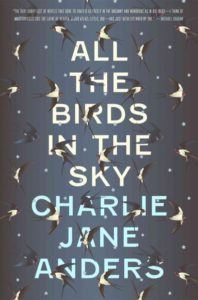
allbirdsskyAll The Birds In The Sky, by Charlie Jane Anders

Synopsis: A pair of outcasts meet as children and overcome social isolation and opposing ideologies to become friends and save the world.

Book Review (Rational Fiction version): This must be done in two parts, because first I must address the Rational Fiction flavor of this book! This is the most only novel I know (so far) that captures the style of Rational Fiction without being Rational Fiction itself. It’s hard to explain what I mean by this, so let’s start with the conflict.

A foundation of RatFic is that there aren’t “good” and “evil” sides (per se)–there are factions with conflicting values who are intellectually consistent and morally good to themselves, but who clash over their differences. All The Birds does this thing, as the two protagonists are from opposing ideologies and are each other’s antagonists, and whenever you are reading a chapter from the POV of one of them you identify with that character, and you realize how right and proper their actions are, and why of course they must fight the stupid/bad actions of their opposition. The next chapter switches to the other character, and you feel the exact same thing from the other side. I love that sort of thing.

Secondly, both protags are child prodigies who are socially isolated because of their gifts. This isn’t a defining feature of RatFic per se, but it is a common theme, and it’s very HPMoR-esque, which kicked off the whole RatFic genre in the first place.

Third, it is comfortable in the language/culture of transhumanism. It isn’t a treatise on the movement or anything, but the author is either familiar with the movement, or had a lot of input from people who are. This feels like it was written by someone in the scene, and it’s refreshing to read something that comes from my culture! You don’t realize how alien the overwhelming majority of the world is until you stumble across something that feels like it came from your home group, and you can love it for the comforting family tale it is. I get fuzzies just thinking about it.

Fourth, the humor is straight-up Yudkowskian. If you liked the humor of HPMoR, you’ll likely enjoy the humor here too! It is slightly absurdist, but in a way that is delightful, like the assassin’s guild that requires its members to perform pro bono hits from time to time to remain in good standing. The word play is top-notch. And there are a fair smattering of the geeky pop-culture references, done just right, that we all love (ala Forks +2).

That being said, this is explicitly NOT Rationalist Fiction! The male hero starts the novel by crafting a 2-second time machine which apparently anyone can make if they have internet access, but most people don’t, and which isn’t abused or munchkined at all. There’s a TON of these throw-away things in the novel which could potentially break the world if an enterprising hero were to munchkin them into abuse, but which are never exploited in that way, because this isn’t RatFic. It’s a story of friendship, and love, and growing up, and it focuses on THAT. As long as you don’t expect RatFic-style exploitation, and accept this as a surreal fantasy story where everyone has a blindspot as to the game-breaking-potential of all the magic/gadgets around them, you’ll enjoy the hell out of it. :)

Book Review (Traditional Version): This is a beautiful story. I don’t know if anyone read the works of Daniel Pinkwater as a kid, but this novel feels exactly like I remember those. It is surreal in a way that allows the author to focus on the parts of reality that really MATTER to the story, and seriously drill into those. The story does not give any fucks about “realism.” In Pinkwater’s Lizard Music, for example, there are talking lizards who play jazz music on public access television after midnight. In a world that otherwise makes sense. There is no explanation given, it’s just a brute fact of the story world. All The Birds In The Sky has many similar things, straight-up absurdities which are fun and which don’t need explanation (like the 2-second time machine). They are quirky and delightful, and put you in the frame of mind that this is a fantasy for precocious, imaginative people that are willing to revert to a more child-like play state for the duration of a novel.

This is important, because much of this novel is an exploration of how we move from being wonder-filled children to jaded adults. Sooooo much of it is a commentary on Adulting. On trying to stay true to yourself in a world filled with mundane madness, with a sanity waterline so low it drives you to exasperation… and maybe conformity? This is a paean to anyone who still uses Adulting as a verb to proudly describe things they sometimes do, rather than a noun describing what they are.

And oh god, the childhood of these characters. It is my childhood. It is angst and isolation, and thinking if maybe you can do this one glorious thing it will all be different… but it never is. The parents are absurdly extreme in a way no real humans are, but in a way that speaks to the emotional reality of what it is to be a child. It sacrifices literalism to get to the emotional core of a world dominated by overwhelmingly powerful beings who cannot relate to or fully understand you.

The teen years too! The sexual struggles of the male character are the most true-to-life of any novel I’ve read, and I think it says something that a surrealist YA novel has come so much closer to portraying realistic sexuality than anything trying to be Serious and Literary.

The prose itself is just fantastic too. After a love scene between the male protagonist and his then-girlfriend, the final paragraph ends with

“When Laurence got back to bed, Serafina had fallen into a cold sleep, and her elbow jutted into him.”

It just ends like that, flat. And it’s the most beautiful way to say “They do not fit together. This relationship is awkward and uncomfortable and doomed to failure.” Because instead of just telling us that, it shows us it in the most physically-literal way possible. In just one sentence, describing a single action. And yet everything is wrapped up in exactly that one line, and it hits you and lingers, because that one line is all it took, and it did it via demonstration. There’s a number of these literary feats sprinkled throughout this book, and it’s perfect every time.

Also, it is written exactly the way I would talk with my friends! For example, there’s even a part where the two characters try to speak at once, and the next sentence is literally:

Then they were both like “You first.”

Which is awesome. :)

The book has a few weaknesses. Patricia’s stay at the Magic School (and the resulting Siberia Incident) never felt very fleshed-out or compelling to me. And the ending was a bit weak. But the beauty and wonder made up for it, for me. I don’t want to over-hype this, because nothing can live up to too much praise, and then one is disappointed. But I certainly enjoyed it. Highly Recommended.

Book Club Review: This review has gone on for quite a while already, so I’ll try to make this short. Not everyone liked this book as much. A couple of our members just couldn’t swallow the absurdist aspects. However, as a commentary on what sort of world we have built for ourselves as we became adults, and how we changed to accommodate that, it did give a group a couple interesting lines of conversation to talk about. The way it portrays environmentalism vs humanism, and the recklessness of over-ambitious leaders, is also intriguing. The fact that it isn’t too long and is a pleasant read helped with completion and turn out as well. Overall, this is makes for good book club reading/discussion. Recommended.

Oct 262016
 

palace-of-solitudeFirst of all – thank you to everyone who replied to my last post. It helps. :)


Recently I received an email about my flash fiction piece, wherein a reader expressed appreciation for it. In addition to making me feel happy, it reminded me of something Seth Dickinson said the first time I wrote him, years ago now, about his piece “A Plant (Whose Name is Destroyed)“. He thanked me for writing, because no one ever engages with short fiction. I didn’t know what he meant by that at the time. But now I do.

It’s very hard to gauge reader reactions to stories that are published in more “traditional” venues. There normally aren’t comments/likes to give feedback, and even in venues that DO provide a comment section, the vast majority of people never post any comments at all.

The artists I know feed on validation. It could be a general artistic thing, or a general human thing, or maybe I’m just stuck in a very weird social bubble. /shrug. I almost wish I’d gone into one of the performance arts… When you act, or play music, or do stand-up comedy, you have immediate feedback from the audience. That doesn’t happen with the written word. Which means that those of us that feed on validation but don’t perform are starving.

There is some recourse. I go to WorldCon regularly now, and as Robin Hanson noted, it’s a long party to celebrate the authors we admire. But even there, interaction is a bit limited. If I had to guess, I would say this is exactly why serialized fiction has become so popular again. People actually leave feedback on serial fiction. Scott Alexander could publish Unsong as a single completed novel. But he’d never see more than the smallest fraction of the community interaction that comes from telling a story to a collective audience over time.

Fanfiction is the same, I previously quoted a friend who observed “I wrote one short little fic after I saw Thor: The Dark World and in the time since I put it online I have literally received more feedback on it than I have in total for every piece of original work I’ve ever published. It’s like pure black tar heroin for the sad little twitching addict that is a writer’s ego.”

I am also guilty of this. I’ve read stories that really moved me, and then never said a thing. Like, almost moved me to tears, and the author has no clue.

This is unfortunate, and I want to do my part to help change it. From now on, if a work takes my breath away, I will leave a comment on it, even if to say nothing more than that. If commenting isn’t an option, I’ll spend five minutes trying to find an email, website, or twitter of the author instead, and send them thanks. Reading something like that is rare, and it’s not fair for someone to not know they’re appreciated. In fact, I’m going to go back and do that right now, for several works I’ve read in the past year that I left uncommented. They deserve no less.


(That being said, this is not the thread to say good things about anything of mine that you’ve liked. If you agree with any of this, please find something you’ve loved by someone else, and comment/tell them instead! Spread it outward. :) Thanks!)

Oct 212016
 

shinjiGloomy mood today. I have to go watch some Steven Universe or something.


I.

I remember the first time I got lost/separated from my mother at a grocery store. I think I was seven or eight years old? The world switched in a heartbeat from safe and familiar to alien and hostile. I was alone in a confusing landscape. I had never been in this situation before, completely isolated and unable to find my way back to safety. For all I knew, recovery from this disaster was impossible. I would spend the rest of my life alone. And at the mercy of uncaring passing forces.

Fortunately, it turned out things weren’t quite that dire.


II.

The religion I was raised in (Jehovah’s Witnesses) is ideologically purist, and very insular. It is very important that Witnesses not have very many contacts with the outside world, as they will corrupt you. Ideally only those absolutely required to make a living. You should not have any friends who aren’t Witnesses, and limit your interaction with non-Witness family members. My extended family lived across the Atlantic, and I was a very shy and nerdy kid, so those were kinda my default anyway. I was lucky to have the one or two friends within the church that I did have. I was grateful to the church for forcing us together.

The religion also uses shunning as a control mechanism. It is frequently brought up in church meetings that anyone who is kicked out of the church must never have interaction with current members. Not even a phone call. Not even if they’re your son/daughter. This doesn’t actually happen very often in practice, because most people aren’t monsters, but I didn’t know that. I took ideas seriously, even as a child.

Every now and then at church we would be told of the Super Virtuous Mother who kicked her teenage kid out of the house and never even made eye-contact again, even when they were crying and begging outside windows of the family’s home. She, and other examples like her, were held up in glowing terms as shining examples of what we should all strive for, and everyone would nod and murmur in wonder at her great devotion, and clap in approval. Every now and then we would hear about how this family’s devotion would be rewarded by God, when the wayward child finally came back months or years later, humbly returning to the church with a renewed faith. A soul saved, a family reunited! Because they were strong, and never wavered in the exile.

This was horrifying, even as a believer. It got worse as I started to have doubts. It was the start of my tendencies to try to limit how much I care about others.  They can’t control you if you don’t care about their love, right?


III.

Dan Savage, sex-advice columnist, is often asked by young gay people how to deal with rabidly homophobic parents. The first step, of course, is to not be dependent on them. As long as they are in charge of whether you have protection from the elements and food to eat, they have a stranglehold on you. But the next step, the only step available for adult children who’ve already moved out, is to remove yourself from your parents’ life. To let them know that you are deserving of respect, and you WILL NOT sit idly by while they abuse you. You are under no obligation to sit there and take their hatred. You can simply leave. And you should.

Often, parents will eventually come around. Because generally, parents love their children, and miss them when they’re gone. They will moderate their views, and they will hold back their vile opinions when in your presence, because they know you won’t stand for it. Eventually, they often even change their minds entirely, and come to accept and love their children for who they are. As Dan says: As an adult, your only leverage over your parents is your presence in their lives.

This is wonderful advice. And it requires that you be more willing to cut someone out of your life than they are willing to cut you out of theirs. This sounds very familiar.


IV.

I dislike the way the world works. I dislike that we live in a gladiator universe, where the final arbiter is violence. I dislike that even if we were to eliminate physical violence, there is emotional violence that can still be inflicted. I don’t know how to compare the two, though I assume physical violence is far worse. But the shitty part about emotional violence is that, while physical violence can be used against anyone, emotional violence’s power is directly proportional to how much people care about you. The more someone loves you, the more you can hurt them.

The ultimate winning move is to weaponize your Self. Do whatever you can to get everyone to love you as much as possible. And simultaneously, you care for them as little as possible, so you are not vulnerable to their attacks. It’s gross. It feels like the subtext of every relationship one can have, though.

Maybe this is the result of having been raised to see love as a weapon, used to control those who love you… but I don’t want to have that sort of violent power over another person. Right now I’m hurting someone, and I hate it. I wish I could see some way to avoid this trap, because I don’t want to be alone either.

Oct 182016
 

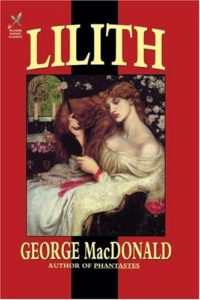
lilith1Lilith, by George MacDonald

Synopsis: A landed gentleman stumbles into a magical dreamland, which I guess is full of parables and symbolism?

Book Review: Written in 1895, this book reads like it was written a century earlier. It’s short, only 200ish pages, but I still gave up after 60. This thing is not worth reading.

First, there’s no reason to like the protagonist. He’s a bland young man of the landed gentry class, who inherited his wealth, and has no friends or anyone important in his life. I just don’t care about his aimless wanderings through a nonsense world.

Second, there’s no tension. In addition to not caring about the protag, there’s no reason to care about what’s happening. None. He just goes wandering.

Third, it’s poorly written. Something something different time period – whatever. MacDonald will often write extremely long sentences that, once you parse them, say literally nothing. Sometimes several in a row. And those are just the ones that intentionally say nothing. My biggest complaint is that:

Fourth – this book is nothing but a huge dump of Pretending To Be Wise. In fact, it’s worse than Pretending To Be Wise. At least if you’re Pretending To Be Wise, you’re actually making some claims with substance, even if they are shallow. Lilith contains innumerable passages with a bunch of fancy-sounding words which don’t actually say ANYTHING. There is no substance there at all! It is the 19th century equivalent of the Quantum Homeopathy Woman. It’s fancy gibberish that doesn’t have any referent!

Well OK, not *every* time. It’s pretty obvious that the little people vs giants section is a big ol’ sign to say “Greed is bad.” Thanks for that update George. It was extra-profound when you demonstrated Greed Is Bad by pointing out that it would be awesome if everyone lived in an Eden, in perfect health with unlimited food and no need for shelter. Totes applicable to my life.

Strongly Not Recommended.

Book Club Review: Yeah, there’s not much to talk about here. There’s no topic to discuss, because nothing has been said. I was going to chalk this up to “Writing technology has advanced a lot”, but our English Major pointed out that MacDonald doesn’t even have that excuse. This post-dates Charles Dickens. It post-dates “Alice in Wonderland”, which was an actual GOOD tale set in a magical dreamland. It’s only a couple decades removed from Hemingway.

The only person in our book club who enjoyed this novel was someone who misinterpreted it as an Absurdist Humor piece, and found it hilarious. Even she got tired of it after about halfway through though, and skipped to the end.

On the plus side, it’s in the public domain, so you can get it free. Or for under a buck at Amazon.

Not Recommended.

Oct 122016
 

space_planet_light_82977_2560x1080I love finding opinions that differ from mine in interesting ways. Here are two.

Re my distaste for Genghis Khan, a friend replied:

“Status: terminally monogamous. Ironically, it was my girlfriend that first showed me this song a few days ago. I honestly just tuned out the lyrics as silly when I heard the name Genghis Khan, but I just googled them. It’s sort of sad, and I’m totally going to be projecting now, because it’s a lot like what my first relationship was like (many moons ago before I’d ever heard the term “polyamorous”).

Anyway, the lyrics: the guy feels jealous and possessive and hates himself for it. And that pretty well describes how I saw myself during that first relationship. Now, I sort of bristle when I see situations where a philosophy that lives mostly in the frontal lobe is being given dominance over emotions that live all over our brains. For me, that philosophy was “love is not possession” and it’s a hard argument to beat (and really not one you’d want to beat). But you also can’t argue with emotions. The idea of my then-girlfriend being with -her- girlfriend hurt terribly. Was it “right”? No, love is not possession. Did my emotions care whether or not it was right to feel that? No, they didn’t. “And I don’t have the right / To ask where you go at night / But the waves hit my head / To think someone’s in your bed”

What should I have done in that situation? I should have left before we hurt each other more. But neither of us had scraped together enough self-esteem to end it until an ugly ending. The non-judgmental thing would have been, “I need this, but you can’t give it to me. That hurts, but we should part as friends.” So now having been forced to read the lyrics to this silly song… ( ;P ) It makes me a little sad for a guy that is beating himself up because he thinks he’s the “I’m a bad person” flavor of “wrong”. It reminds me that we’re all pretty fucked up in the head and a relationship is about finding somebody compatibly fucked up and working on making room for each other’s fuckedupitude. If one person is poly and the other person isn’t, nobody is wrong. There just isn’t room for a relationship there. Which isn’t what I think the song is saying. I think the guy is mad at himself for feeling the way he does.”


Re the poem “air and light and time and space“, which I loved, a different friend said:

“I’ve seen this poem several times, and honestly it’s always confused me why people see this as such a positive message. I’ve never seen it as something nice to hear, and I think I’m finally able to articulate why. I think most creators see this and see inspiration to not make excuses to get their ideas out. I read the hyperbole in the second half as a sort of “some people are creative, and some people just aren’t, no matter what sort of preparation they make for themselves.” This seems to discourage people who don’t see themselves as creative to try being creative, ’cause they just “don’t have it,” and I really, really dislike this attitude.

I feel like I went through my whole life thinking I wasn’t creative until a few years ago when I did exactly what the spirit of the first half of the poem was describing, in that I set aside some space, time, and money to do the thing I was interested in doing, and it ended up being a really great experience. I also doubt it would’ve been good had I not prepared at all, due to the scope of what I was trying to accomplish. This poem seems to doubt the ability of people who – like me – are only occasionally struck by the need to make something new and interesting, but that creative process is still meaningful to them.

At any rate, I think it’s cool if you draw inspiration from this, and I hope my rambling doesn’t rob you of that. I felt like I had some insight when seeing this for the 4th time or so, and I just needed to get it out. Maybe other people share this experience when reading this poem and might appreciate seeing their opinion corroborated on some level or something.”


Cheers guys!

Oct 112016
 

14444609_1023189497793238_8003052628749934835_o
Quoted directly from Eliezer Yudkowsky
“For so long as the voting system works the way it does, there will always be 2 parties in American democracy, no more, no less. For reasons that include e.g. the Median Voter Theorem, the votes will always drift back to around 50/50 for each party. The Republican Party *will* be back in 2020, and Hillary seems more likely than usual to be a one-term President.
So this would be a very good time to praise the #NotAllRepublicans who were first to say #NeverTrump. The Republicans who never compromised with visible evil from the start, not for the sake of power, nor party, nor fear of Hillary Clinton. The #NeverTrumpers deserve that praise, and you *will not like* what happens in 2020 if those honorable Republicans do *not* get to be the ones to rebuild the Republican Party.
A list of refusers, including time of first break, appears here.

Oh shit. No more excuses. Seriously, someone loved the poem enough to buy the domain and host just that poem, forever. That is awesome.

Twitter reveals How God Created Animals. It is hilarious.

California passes poorly-thought-out regulations which destroy small businesses? Who’da thunk it?
Forgers can’t sell Mark Hamil’s autograph easily anymore, but now *neither can Mark Hamil*. If you sell stuff at SDCC, don’t sign it anymore. Unless you bring along a stack of paperwork.
“The law requires that any autographed item sold for more than $5 must include a certificate of authenticity including information about the dealer, where and how the item was signed, and the name and address of any third party from whom it was purchased. The law was undoubtedly aimed at shutting down forgery mills, but it was written so broadly that it will make things a lot harder for anyone dealing in autographed goods.

second-hand booksellers, some of whom carry hundreds or thousands of autographed copies of books … must either create individual certificates of authenticity for each book, or else discard thousands of dollars in inventory that is no longer salable.”

“Whether we like it or not, we all need some kind of objective standard against which to measure our work. […] most of the great art the world has ever seen came about not through a single stroke of genius but by the continual effort of a community.”

A great short piece by Yudkowsky, from the writing prompt: “Write a romantic comedy. Difficulty: both lovers are emotionally mature and have excellent communication skills.” Here’s a small taste:
“WOMAN: Is this really… dating? I captured you. I now own you. You’re my harem slave, not a, a…
MAN: We’re seated at a nice marble table waiting for a chef to cook our food. I am reasonably sure this is a date.
The WOMAN covers her face in her hands.
WOMAN: It is, isn’t it. Oh, god, I’m on a date.”

25 years ago today (Sept 24th when I posted) Nevermind was released, and saved us all from CockRock. Very few albums can be said to have spearheaded a movement that significantly altered the music ecosphere, and this was one of them. HT to awesome music.

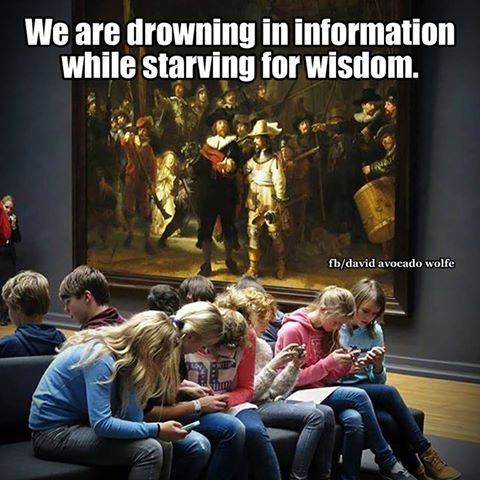
13754380_10153636581221512_4996851253414833391_nOh snap!! (also props for correct use of “ironic”)
“This image is really ironic, actually. Because it is meant to shame the young people looking at their phones and seemingly ignoring the beautiful Rembrandt painting titled, ‘The Night Watch’, which is on display at the Rijksmuseum in Amsterdam.
“In fact, the kids are using the museum’s fantastic free downloadable multimedia app to learn more about the artist and the painting. This photo was just one of a larger set of photos, most of which show the students engrossed in the art and its history.
“But the internet doesn’t care about the truth. Not even enough to do a small amount of searching before sharing something. It gets a small amount of information, a simple image, a snapshot in time, and it draws ridiculous conclusions, especially if it means they get to be superior and judgemental of others.
“How’s that for wisdom?”

Humans never cease to amuse. From Michael Blume:
“Snowden: Hey WaPo, I found out about this thing; you could tell people about it. Or not. Really, just do whatever you think is best.
WaPo: Hey everybody, Snowden just told us about this thing, we thought you should know.
WaPo: Hey, Pulitzer committee, remember when we told everybody about the thing? That was excellent reporting, and it served the public interest. You should give us a prize for it.
Pulitzer committee: Yeah, sure.


WaPo: Hey everybody, we really think Snowden ought to be prosecuted for telling people the thing, it was completely irresponsible of him, he should’ve kept it to himself.”

Another proposed name for those of us that spent our teens getting shoved into Gen X, are now tacked onto Millennials, and don’t really fit in either. I thought this was a good idea for 5 minutes, before I started seeing everyone claiming it, esp those outside the date-range, because they also liked Oregon Trail. /sigh. Back to the naming-board.
“Gen X individuals were already fully-formed teens or young adults when computers became mainstream, and Millennials can’t even remember a time before computers.”

VAGINAS ARE MYTHS, WHISPERED QUIETLY IN SECRET AMONG ONLY THE BRAVEST OF MEN

Companies Can’t Legally Void the Warranty for Jailbreaking or Rooting Your Phone. This is the opposite of what I thought was the case, and it makes me a little happier about the world.

Now this… this is an idea worth trying! Start splitting all Culture War movements into High and Low, to distinguish good actors from bad. (Rabid Puppies = Low as Fuuuuuuuuuck)
“The benefits of using low vs. high:
You get to be immune to fights over naxalt etc.; if someone says “feminists are doing evil things like erasing male rape victims” you just add “low feminists, yes, they do suck indeed” and judo their categorical attack to the ground. If they respond to this category-splitting dodge with “no, all feminists” the existence of a single counterexample is enough to pwn the pathetic attempt once things have been expliticized.
Similarly, you get to use this same phenomenon to whine about nasty people who have hurt you. If you say that low feminists do bad stuff, there’s nothing I can do about it because you’ve inb4′d the naxalt and according to the rules of the internets that means you win. But there’s nothing I need to do about it because yalxalt. It’s not about me, it’s not about you, it’s about them out there. Every ideology has its share of utterly repugnant assholes and everyone deserves a chance to whine about them without being naxalted, and everyone deserves to not have their ideas discredited by weakmanning superweapons to existence.
[…]
everyone (high) prefers everyone splitting, and by using this distinction we can force people who want to maintain credibility with us highs to split too. We can still disagree for all we want, and fight over shit, but we should be able to coordinate to try to enforce this one civilizing rule on everyone we interact with. We can now actually define something as kind of a geneva convention of culture wars in a way which should actually be win-win and in the participants’ incentives”

I have discovered a new website to take all my hours! Bad-ass Of The Week. Here’s one sample, courtesy of Charles Stross.
“Julie D’Aubigny was a 17th-century bisexual French opera singer and fencing master who killed or wounded at least ten men in life-or-death duels, performed nightly shows on the biggest and most highly-respected opera stage in the world, and once took the Holy Orders just so that she could sneak into a convent and bang a nun. If nothing in that sentence at least marginally interests you, I have no idea why you’re visiting this website.”

How Studying Mnemonics Changed the Way I Learn
“At this point, I have explained control systems to the parts of my brain (and yours!) that actually matter for real learning. [note: yup, she did!] … I have built inside my mind a structure that directly supports further understanding of anything and everything about control systems.
If it turns out that there’s something wrong with my understanding of control systems, I’ll be able to notice because my control system will fail to behave the way it’s supposed to, and then I’ll adjust the structure.”

Warner Brothers reports own site as illegal.
“A good approach would be to white-list non-infringing sources such as warnerbros.com and amazon.com”
No, a good approach would be to repeal this clusterfuck of a law, and jail/fine/flay everyone who’s despoiling the creative commons so wantonly. ><

This review of Star Trek Beyond is soooo much more than just a review. And it puts into words why I avoid nostalgia as much as possible. Not good for mental health!!
“These memories. They are just that. Memories. They are part of me, and what I’ve enjoyed. Part of what makes me who I am. They live inside me. I can’t relive them. Making new things won’t take away the pain that this ever ended.”

A two-year-old’s solution to the trolley problem.

“Being unconditionally polite, kind, and compassionate in a society that values and finds “deeper meaning” in aloofness and cynicism is subversive and thus punk”
hufflepunk
(seen on tumblr)

Julith VS Kerubim

We really are living in the CapitalPunk universe!
Legalist is a Silicon Valley startup […] offering “data-backed litigation financing” using algorithms to “analyze millions of court cases to source, vet, and finance commercial litigation.” It’s the latest in a series of companies that allow third parties to “invest” in the success of a lawsuit, by funding said lawsuit.”

A rationalist in the Zombie Apocalypse. Short, fun, and includes a great in-universe explanation. :)

This Is Why There Are So Many Ties In Swimming. The timing can’t be made more sensitive because then it would be more sensitive than the lane lengths are:
“In a 50 meter Olympic pool, at the current men’s world record 50m pace, a thousandth-of-a-second constitutes 2.39 millimeters of travel. FINA pool dimension regulations allow a tolerance of 3 centimeters in each lane, more than ten times that amount. Could you time swimmers to a thousandth-of-a-second? Sure, but you couldn’t guarantee the winning swimmer didn’t have a thousandth-of-a-second-shorter course to swim. (Attempting to construct a concrete pool to any tighter a tolerance is nearly impossible; the effective length of a pool can change depending on the ambient temperature, the water temperature, and even whether or not there are people in the pool itself.)”

This short story by Alexis Hunter is exactly my sort of thing!! /heartflutter

The most ridiculous patch notes from 10 years of Dwarf Fortress. :) Animal breeding is prevented if animals aren’t “willing to marry”.

Oct 032016
 

steel-beach Steel Beach, by John Varley

Synopsis: A tour of a transhumanist future on a lunar colony, where Humanity struggles against the ennui of irrelevance, and a sovereign Friendly AI struggles against value drift.

Book Review: It is really impressive how ahead-of-its-time this novel was. It was published in 1992, and for the most part I felt like it could have been published last month (with a few notable exceptions–the “we update our news sites every hour” must’ve seemed like a lot back then, nowadays we update in real time…)

I was wary at first, because the story starts with a journalist being told to write a series of articles about how life is different now than it was 200 years ago (due to the approaching bicentennial of humanity’s exit from Earth). That just felt like a very ham-handed way of saying “I, the author, shall now pontificate on my personal vision of what a cool future would be for hundreds of pages.” But I was pleasantly surprised. The world is indeed pretty cool, and its oddities and quirks kept me interested in the initial chapters. The plot, while it does flag in a few points, keeps things moving pretty well. Varley’s style totally steals the show though! He writes with a very strong voice that really brings his protagonists personality to the fore and lets it shine. I may not like everything about the protagonist, but I feel like I know who they are after spending this novel with them.

The big draw with this book is Varley’s dive into the meaning of life. Not in the pretentious “Let us ponder upon the meaning of life” way, but in a somewhat-more-intelligent-than-average character trying to figure out what exactly to do, and how to be meaningful, in a world that doesn’t really need humans anymore. Let me take that back – not just “try to figure out”, but actively churning his/her life experiences in multiple attempts to try stuff and find a thing! It’s cool to see someone actually make efforts and go through several feedback loops.

Hell, the protagonist even falls back on the old “revert to survivalism” and “have children” clichés, and fortunately doesn’t come to the conclusion “It turns out we all just need to go back to living like our ancestors.” :)

Most interestingly, the book doesn’t really give any answers. Varley certainly doesn’t have any method to push, aside from the usual “keep seeking, there’s gotta be meaning somewhere.” It’s more of an exploration of ennui than a refutation of it, and has a bittersweet taste throughout. If that thought turns you off, this is not the book for you. But I enjoyed it.

One big downside—most of the climax happened off-stage. That’s a storytelling sin, IMHO. But the book wasn’t really about that plot, so I’m more forgiving of it than usual.

This is not a book that I would give a hearty “You must read this as soon as you have free time!” endorsement of. However I’m glad I read it, and I would recommend to my past self to read through this at some point, when there’s a lot going on in my life and I need something to bring me some calm for a bit. So, a Mildly Recommended.

Book Club Review: Holy crap, there is so much in here to talk about! The entire novel is a comment on modern life and how we deal with it. There are so many hooks for conversation you may have to choose to focus just on the ones most interesting to your group. This will spark a lot of discussion about human nature, the coming age of automation, the banality of modern news media, the ethics of X and/or Y, and so forth. It is absolutely fantastic.

And it does so in a way where the focus is on the fiction, not where the fiction is just some thin excuse for the author to expound on how much Kids Suck These Days or whatever. It’s got a legit good story with good characters, who happen to be wrestling with those issues, but who were written for their own sake. Not to serve as mouthpieces.Quite well done.

One would be excused in thinking that this book was written specifically for book clubs that like read a neat story and then discuss cool things. Highly Recommended!