Nov 252015
 

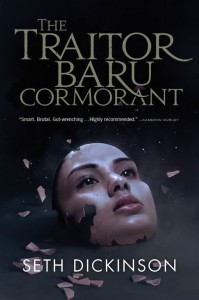
the-traitor-baru-cormorantThe Traitor Baru Cormorant, by Seth Dickinson

Synopsis: To overthrow the Empire that devastated her homeland, Baru infiltrates it to become one of its powerful bureaucrats and destroy it from within.

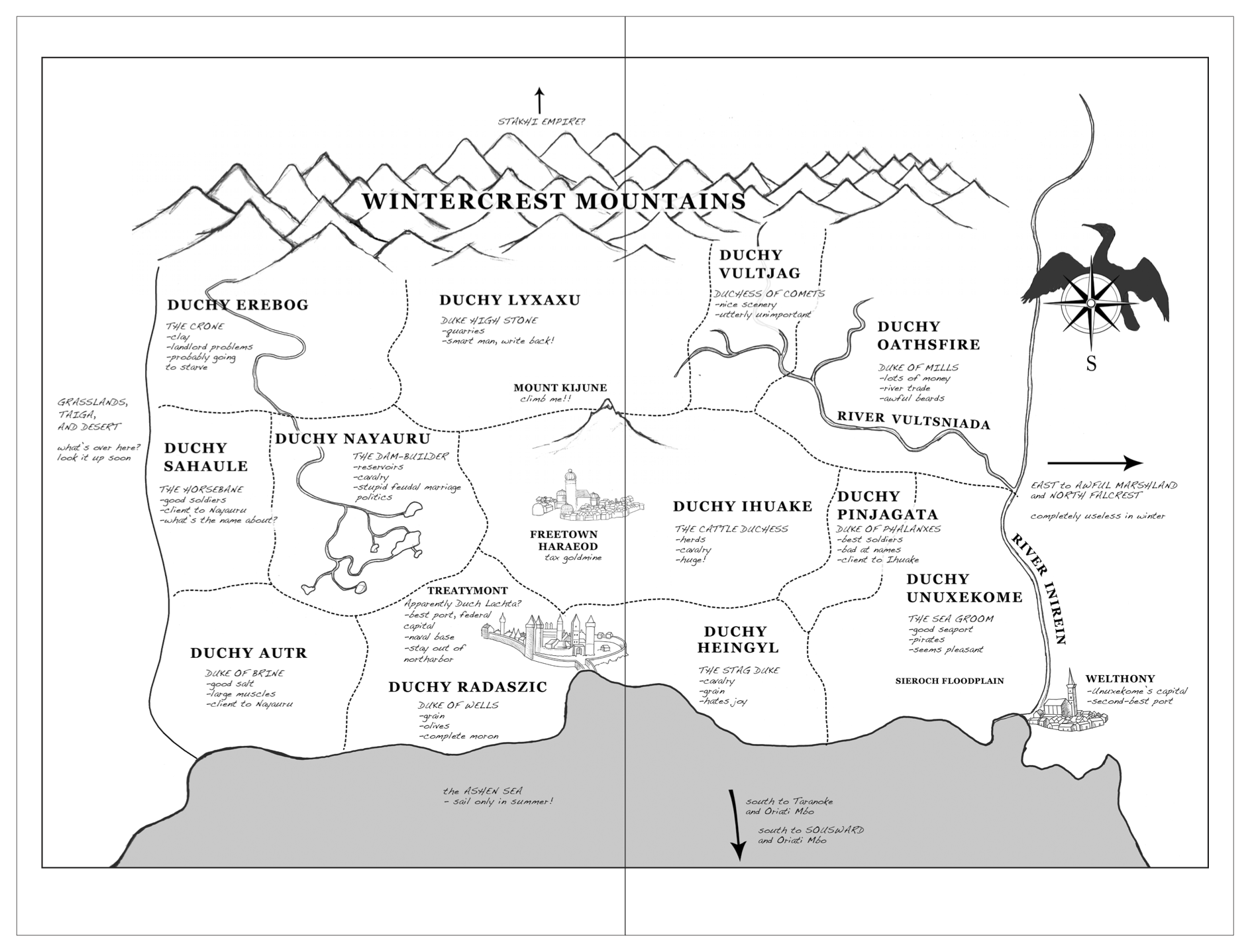
Book Review: The first thing you see in the book is the map (below). And right away the book lets you know this will be different from what you’re used to. Maps always show what is important to the mapmaker. In most fantasy books this is the territory of the journey. The hero’s hometown to the Stronghold of Evil. In between are national borders, the mountains that stop armies, the Dark Forest where the hero is tested. In Traitor Baru, the borders barely matter. They’re loosely roughed in. There are no major physical features, aside from the rivers that facilitate trade. What the map DOES show is political allegiances, economic ties, and resource dependence/abundance. Right away the book is telling you “This is not about wars and movement. This is about political influence, and economic power.” It’s a brilliant way to start a book. Or rather, to start THIS book.

If you like smart characters with smart opponents who manipulate their environments with whatever tools they have – tools which they often go to great lengths to make available to themselves – you will like this book. And by “environments” I do mean physical environment sometimes, but more often the social and political forces that can alter much more around you than you could alter by yourself. This is a book of out-thinking your enemy, and hard choices.

And really, the hard choices is what it all comes down to. I’ve written before about how much I love Seth Dickinson’s short fiction. One of his recurring themes (and certainly present in Traitor Baru) is “How much are you willing to sacrifice, to do the right thing?” How much will you give up to save the innocent from the corrupt? Forget silly things like your body or your life – how much of your soul will you give? Is your very humanity that important, when compared to the world you will be saving?

This theme runs a livewire through my psyche. I cannot get enough of it. Dickinson executes it well… although not quite as well as in his short stories. In his shorts he holds nothing back. The novel Traitor Baru is, surprisingly, very emotionally reserved. One fellow reader speculated that this is an effort to get us to sympathize with Baru’s life trapped in the closet. Not just about her sexuality, but about every single thing she cares about. Her world is lies upon masks upon lies, and she assumes that everyone around her lies just as much as she does. As a result she can never show true emotion, and expects that no one else does either. This makes sense as self-defense, but it hurts the emotional narrative. Another fellow reader speculated that this was necessary as a mercy to the reader, because, if we were too involved with Baru emotionally, most readers would not be able to endure the story (it is a very painful story), and especially not the gut-punch ending (seriously, the ending is fucking amazing). It’s hard enough to read even as emotionally-dampened as it is. Perhaps that’s true? But I want that pain in my fiction, I thrive on it. I was disappointed it wasn’t sharper. A final conjecture was that Baru is at least somewhat autistic, which… duh. Of course she is. That doesn’t mean the emotion needs to be held back from the reader, we’re inside her head.

Also, I really could have used some more visceral scenes of the Empire’s evil. Yes, I get it, colonialism is bad. Agreed. But “colonialism is bad” isn’t emotionally compelling, whereas “watching teeth fly and blood pool as someone kicks my father to death” is. There was a lot of the former and very little of the latter.

So, it’s not a perfect book. But it is still really good. Recommended.
6a00e54ed05fc2883301bb0889237d970d

Book Club Review: This book sparked one of the best discussions we’ve had. First, there’s simply so much to discuss. Not just about imperialism and sexuality and technological change either, but ranging across Baru’s choices, her view of the world as a puzzle, and the nature of our humanity. Is there anything that should be off-limits to sacrifice, if the rewards are great enough? At what point does certainty-of-outcomes breakdown enough that you should revert to deontology over utilitarianism? If you somehow exhaust that topic, there’s also stylistic choices that Dickinson made to be discussed–there’s plenty to say about his writing as well as about what was written. Even the people in our group who really disliked the book said this was an amazing discussion, they loved the book club meeting itself, and they were glad they read it and attended to discuss it. I’m not sure you can get a much greater endorsement when evaluating a book for book-club-suitability. HIGHLY Recommended!

Cultural Appropriation Watch! The protagonist is a dark-skinned, gay woman. Seth Dickinson is a white man. I dunno about his sexuality, cuz I don’t know him well enough for that to be any of my damn business. The Appropriation Police would not allow this book to be published. They shame their ancestors, let us hope they repent their ways quickly.

Nov 202015
 

997DVA_Al_Pacino_025…and it is our fault.

Remember Starbucks Red Cup Controversy? Where the media spent days telling us how christians are outraged that the Starbuck holiday cup is plain red instead of having christmas trees and snowflakes on it? And it turns out that it was just one christian shock-jock type, and every single real christian in America was like “What the fuck guys? We don’t actually care. Who is making shit up about us?”

Which is exactly what we liberals think every time we see a “War on Christmas” story.

But the interesting part is that there aren’t less War on Christmas stories as time goes on. Rather, they’ve expanded, so now the leftwing media has their own version, re the crazy Red Cup guy. Years ago the rightwing media found that War on Christmas stories don’t have to be true. They still generate TONS of revenue, because they emotionally charge their viewers. Now the leftwing media has found out the same thing.

As a result both sides of America become more and more polarized, viewing the “other” side as evil and/or idiotic. Over what is essentially lies given to them by their own media. It’s getting worse.

Perhaps you saw today that Donald Trump wants to put all Muslims on a national registry and issue them special identification, and he’s crossed the Nazi Line.

If you’re like me, you shared with the quote from a friend that: “if Trump got elected President, and somehow persuaded both houses of Congress to pass a “Muslims must register” bill, it would be struck down by the federal courts. But the problem here isn’t that there’s a danger of this policy being implemented in the near future. The problem is that it is currently not only acceptable but popular to openly advocate fascist ideas … his popularity says a lot of frightening things about the current American mindset”

But if you’re like me, you also have friends on the other side, who then point out that this is a massive distortion (I apologize for linking to that particularly vile news site). “It is clear from the exchange that Trump thinks Hillyard is talking about new entrants to the United States, presumably Syrian refugees. But Hillyard reports Trump’s answer as if he is talking unambiguously about Muslims already in the United States.”

Which isn’t to say that Trump isn’t both wrong and racist. But he’s plenty wrong and racist on his own, and painting fangs on him just makes our side look like fucking idiots.

But more importantly, it makes us think of him as an irredeemably evil person, and all his supporters as similarly evil, or too stupid/blind to see past their own fear. It further polarizes us into camps that think the worst possible things about each other, and don’t talk to each other. Because it makes for GREAT ratings/clicks.

America seems to be drifting ever closer to civil war, and these sorts of intentional misportrayals by the both sides is spurring it on. Seriously, how long are we going to let the media ask vague questions that could be interpreted to mirror Nazi policies, and then if someone doesn’t immediately and strongly side with the questioner, report that “they didn’t rule it out“???

The thing about devils is that they give you what you want, per your revealed preference. That’s always how the story works. That is what makes those stories compelling. You get what you deserve because the devil always is simply giving you what you want. And then the angels – who care about our stated preferences rather than our revealed ones – come and save us. The Ego triumphs over the Id.

But the Ego doesn’t generate clicks, or share things on social media. The Id does. We have created institutions that mimic the devils of myth – they are rewarded for giving us what we want, in terms of revealed preference. But we haven’t created equally strong institutions that mimic the angels of old – rewarded for giving us what we want in terms of stated preference.

Until (if?) that happens, we really need to develop an immune response to hatemongering.  Never share anything that pisses you off. Especially if it’s about someone from the other side. DOUBLE ESPECIALLY if it’s because they are doing something evil or idiotic that must be stopped before all of society is destroyed. And if we could coordinate some sort of institutional response that would punish these media companies/devils whenever they do this (seriously, government oversight to head off a civil war is a legitimate use of government power IMHO), that would be great. Maybe necessary.

Nov 032015
 

pixels movieTwo cultural appropriation notes.

1.

I attended MileHiCon over the weekend (an awesome local SF Lit con), during which time I went to a “Writing Characters with Mental Illness” panel. A relative of mine has fairly severe shizoaffective disorder, so I’m familiar with what mental illness looks like IRL, but I’m not a healthcare professional so I like to get some actual professional views on the matter, ya know? The panelists were all either suffering from mental illness themselves or professionals in the field. And I did get some use out of the panel, but not nearly as much as I could have. Part of the reason why? They spent a big chunk of time helping everyone defend themselves from charges of Cultural Appropriation. You gotta say “It’s not a disability, it’s a different-ability” sort of thing. FFS. At one point one of the panelists said “No matter what you do, some people will attack you for writing mental illness. Ignore them, please! Do it anyway! We need more characters struggling with mental illness in our fiction.”

So yeah, the CA-police are having a chilling effect, but people are pushing back. So, hooray for that?

2.

I’ve been told a few times that straight white guys will never feel the sting of Cultural Appropriation. (Actually I was told this by a straight white guy who said he’d never feel it, so he didn’t have any right to have a voice in the conversation.) I think that’s a very silly thing to claim, because there are many types of culture, and almost everyone belongs to SOME minority culture that can be “appropriated.” As proof of this I would like to submit this review of the movie “Pixels” by Movie Bob.

Movie Bob is LIVID about the appropriation of video gaming culture by one of Hollywood’s biggest douchebags, Adam Sandler. Says Movie Bob:

>“it’s so oppressively, endlessly, bald-faced cynical about the disingenuous appropriation of its own supposed reason for existing.”

“[It’s] so fucking glib and self-satisfied with its own sleazy cash-grab existence that it takes time out to make sure it also shits on the sort of more earnest, heart-felt version of the same idea that someone who gave two shits might have made”

“It plays at being this sentimental ode to glory days of classic video games, but clearly doesn’t have a fucking drop of sincere interest of what’s made these characters and imagery so enduring or even what made the game so compelling for all these years.”

“It’s always nakedly the work of a bunch of shit-gargling fuckwits with zero love or understanding of this stuff beyond the ability to sell tickets based on ‘Hey, remember Pac-Man?’”

As a video game geek myself (and old enough to have played most of these games in my childhood), I sympathize strongly with every single thing Movie Bob says. In fact, I challenge every white male video game geek who thinks Cultural Appropriation is bullshit to watch this review so they can understand what other people feel when they say their culture is being appropriated. Are you telling me to you don’t feel even a spark of anger at Sandler/Hollywood after seeing that impassioned rant? Cuz I’m not sure that’s possible.

And now, having seen the other side, reconsider your position on cultural appropriation. Don’t just take a reactionary “Screw you, I can do what I want” stand. Take a principled stand. Stand firm with “It is better to allow cultures to mix. The things that are bad about “Cultural Appropriation” are more correctly termed either “Racism” or “Being An Asshole” and should be fought as such, and the things that are good about Cultural Mixing are being destroyed by the Cultural Appropriation Police. That is why the term Cultural Appropriation is toxic. Its only real effect is to eliminate the good things that we want to keep around!”

Hate Pixels because it is shit. Don’t support Cultural Appropriation Policing, because that would destroy wonderful things like The Wizard and The Last Starfighter as well. We will accept Pixels because sharing culture and understanding between groups is more important than making sure Adam Sandler can’t shit on a culture’s values. We will not raze the commons in an effort to punish the free-rider.