Aug 092013
 

bioshock infiniteFor over a year I had almost no time to play video games. A few months ago I managed to find some free time again, so I finally played through Mass Effect 3, and now I’m working through Bioshock Infinite. I’m enjoying it while it lasts, because I may well soon lose extra gaming time again. :)

I’m not that far into the game yet, seems like less than halfway. For all its good points, one thing still bothers me – I’m playing a bit of a psychopathic murderer. I’m not referring to the whole “must atone for his violent past and poor life choices” plot line. He was a Pinkerton thug, and before that he “fought” at the massacre at Wounded Knee, and the story arc looks like it’s going to be one of redemption. That’s totally legit, and pretty good storytelling. What I’m referring to is the way the First-Person-Shooter motivation is handled.

Like most video games, the majority of the game play comes from killing tons of dudes. The motivation for this doesn’t have to be complicated – the other side is evil aliens, or mobsters, or Nazis, or even just soldiers from the other side. You’ve got an easy audience here – we signed up for a game were we run around killing tons of dudes, the simplest excuse will work.

Bioshock Infitine sets the stage for you before throwing the enemies at you. You get to walk around the city and meet its inhabitants, and get a feeling for them as people. They have hopes and worries, they gossip and complain. Their two biggest sins are that they are religious zealots, and they’re very racist. First, my parents are religious zealots, and I don’t think that makes them worthy of extermination. Second, this game takes place in 1912, where even people who weren’t bad were a bit racist. To overcome this, the game makes the racist to the point of absurdity. A conversation I overheard could be summed up in this exchange:


A: “Wow, I am so racist!”

B: “Not a racist as me! I’m more racist!”

A: “It sure is great being racist!”

B: “I love being a racist in a city of super-racists!”

A: “You know the best thing about being racist? All the racism!”

B: “God bless racism!”


It goes a bit far at times. Anyway, the infiltration part of the game ends when I have to choose to join in the stoning of an interracial couple or throwing the baseball at an authority figure ordering the stoning. There doesn’t look to be enough baseballs to kill the couple, this is one of those public-flogging types of events that will leave them beaten and bloody, and possibly permanently damaged. Obviously I’m not gonna join in so I chuck the ball at the evil authority figure. Naturally a nearby policeman tries to stop me, and I reply by… bashing his face in with a metal implement until he dies from it, then doing the same to his partner.

After that I take their guns and go on a murderous rampage while the cops try to stop my reign of terror. Call me crazy, but that seems like a bit of an overreaction.

The main objective of the game is to rescue a girl and take her out of the city. If I had her in tow and guys started shooting at me to try to stop me, I’d be ok with gunning them down. Yeah, maybe they think they’re stopping a kidnapper or something, but like I said – I’m an easy audience. I’m here to run around shooting guys, and the excuse of “they’re the security detail that’s stopping me from rescuing the girl” is good enough. That the writers added the “I’m here to kill all the racists” thing at the beginning really makes me uneasy. It has shattered my comfortable veneer of justification by trying to give me too much justification and failing to take into account that maybe I think racism is bad, but not death-penalty-worthy. It’s detracting from my enjoyment of the game. Something keeps bothering me, saying “Dude, wtf?”

But hey, I’m not that far into the game, maybe this was intentional and it’ll pay off.
Aug 062013
 

200px-Chasm_City_cover_(Amazon)A comment to my previous Ender’s Game post said it “leaves the impression that you missed the part where O.S.Card throws a heavy critique at this “ultimate solution” — at the end of “Ender’s Game” and throughout “Xenocide”. Do you make a point that he criticizes it only on moral grounds, not on rational grounds?”

No, my complaint is that I don’t believe him when he throws in that critique at the end. The entire novel is a set-up to make sure Ender can commit genocide and still be innocent of doing so. It’s been a long time since I read it, but IIRC in the end no one is held to account, there is no war-crimes tribunal, and everyone goes on their merry way.

When I read Reynolds’ “Chasm City”, I got the distinct impression that Haussman did a terrible thing. Identifying with a mass-murderer felt creepy as hell, and there were all sorts of consequences. Not once was there a heavy critique of mass murder thrown in, because it wasn’t needed. The feeling that it was awful came from the story itself, not from an excuse added on by the author. When I read “Ender’s Game” I felt a lot like Luke Skywalker after blowing up the Death Star – victorious and righteous, with maybe some sadness that this much life had to be lost.

A fiction author doesn’t make his points through explicit argumentation, he does so via an emotional narrative. If the narrative leaves you feeling like genocide was kinda cool, it’s not actually a heavy critique, regardless of what he says at the end. I didn’t read Xenocide or Speaker For The Dead, so I can’t comment on them, maybe they served as a retraction (from what I’ve heard they’re mainly more apologia, but my sources are probably biased). But Ender’s Game clearly conveys a “crush anything that threatens you” mindset.

Aug 052013
 

67880_10151248319907726_181291897_n

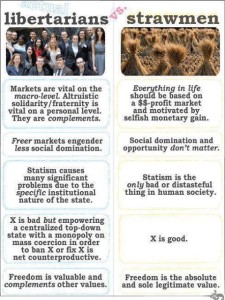
In a previous post I recanted from my position of “I don’t care if the government knows who I call”. I had held that because it was a step closer to my ideal of Radical Transparency – under that ideal everyone who be able to see who you called, but in return you’d also be able to see who’s looking, and see everyone that the looker has called. It was pointed out to me that advancing one half of that equation (the watchers can watch everyone) without advancing the other half (everyone can watch right back) leads away from what I want, as the watchers gain more power and have less reason to return transparency. The only winning move is to hold on tightly to secrecy and only trade it in fair exchange. Simply giving it away may look like its closer to Radical Transparency on the surface, while actually moving to Totalitarianism (the polar opposite of Transparency) in reality.

While I support many Libertarian ideals (not all… some I think are downright dangerous), it seems to me that Libertarians are doing the same thing all the time. They want to end government welfare, which currently supports both the ultra-rich in the form of corporate welfare and the poor in the form of plain old regular welfare. They will often vote with parties and interests who strip welfare from the low income population to move towards this ideal. But those parties and interests never move to strip welfare from the rich, and in effect the libertarians end up supporting a system which strengthens an unproductive ruling class that siphons off wealth. Deregulation often follows a similar track, wherein the only regulations that are repealed are those that protect the weak at the expense of the powerful, and never the other way around.

I know enough libertarians to know this is not what they want. The goal is an equal playing field, which the government may referee but never give preferential support to any one entity over another. They are being promised their ideal, with the politicians they vote for promising to level the whole field, starting at this side and moving across over time. One has to start somewhere, after all. But by “leveling” only one half of the field they are giving even MORE preferential support to the side who isn’t being focused on. It’s not a coincidence that the side left unmolested is the rich and powerful, the oligarchs and mega-corps. Allowing them to accrue all this excess power during the leveling process will make it much harder to reign them in when the time comes. And, call me cynical, but I doubt that there was ever any intention to level the other side anyway. I think the libertarians are being manipulated just as much as I was being manipulated.

The only way to advance without being exploited into strengthening your enemies is to demand both fronts are pushed at the same time. For everyone increase in our transparency to the government, we must demand an equal increase in government transparency to us. For every reduction in populace welfare, there must be a proportionate reduction in corporate welfare. Anything else is a losing move.

Aug 012013
 

enders-gameThere’s been a lot of talk about the merits of separating the Art from the Artist due to the Ender’s Game movie coming out this year. It’s one of the classics of SF, but Orson Scott Card is a raging homophobe. I’ve always been fond of the Death of the Author, and I don’t want an author’s opinions and personal life affecting my judgment of their art, so I generally try to know as little about an author as possible. After all, the separation might be an ideal, but ideals are notoriously tough in practice.

On the other hand, it is fair to judge an author by his book, and interpret other statements of his in light of that judgment. When I read Ender’s Game I loved it. Bear in mind that I also loved Atlas Shrugged when I first read it – I’m a sucker for good revenge narratives. When I read Ender’s Game I was its perfect target audience – a nerdy teenage boy who felt like an outcast. I wanted vengeance on those who had wronged me, I wanted the power to crush all those before me, I wanted to express this power with extreme violence, and I wanted to be held as a righteous and blameless paragon of virtue for doing all this. Ender’s Game delivered that in spades, with a protagonist who was exactly like me (I felt) in very similar situations. There is nothing about this book I didn’t love.

Much like what happened with Atlas Shrugged, as I grew older and started thinking about it more, I grew more and more troubled by what was being supported by the narrative. In the case of Ender’s Game, it is the claim that the only way to be safe is to completely exterminate anything you feel threatened by. Up to and including genocide over what was clearly a mistake. The perpetrator of such extreme reactive violence is absolutely innocent and righteous in his actions because he felt under threat. This is a philosophy of fear, clung to by the terrified… and they will never feel safe no matter how many people they kill.

It is also absolutely unworkable in any sort of society. Pre-emptive or retaliatory violence must be moderated with the understanding that afterwards we all still have to live together. Extremely disproportionate response leads to scenarios like we saw in the recent Zimmerman-Martin exchange, that allowed a man to walk free after killing a kid because he was losing a fistfight. If this is enshrined as a legitimate reaction it leads to the conclusion that Card eventually brought us to – genocide is the only final solution to any perceived threat. Ender’s Game should be a chilling warning of that, rather than a ringing endorsement of it.

(I’m not unique in this insight of course. There’s been many great articles written about this theme in Ender’s Game, one of my favorite ones being Creating The Innocent Killer)

This portrait of Card’s mentality given his work is worrisome on its face. But even further than that, he’s a strong supporter of an organization that considers homosexuals to be a threat to America and Everything Decent In The World. If I was part of a minority (or cared for someone in a minority) that was being attacked by a group that considers themselves unimpeachably pure-of-heart, considers that minority a threat, and a well-known figure in that group has publicly shown that he considers genocide against those he sees as threatening to be acceptable if he himself is “good”… well shit, I think I’d be making a hell of a big deal about this too.


(As an aside, I fortunately don’t feel torn on the issue of this movie, because I never had any intention of watching it in the first place. I’m just not interested in seeing Hollywood screw up another SF novel. I find it interesting that everyone I know who’s said they are boycotting the movie has already read the book. The Quirrell part of me wants to say it’s not that much of a sacrifice if the book’s already been read…)